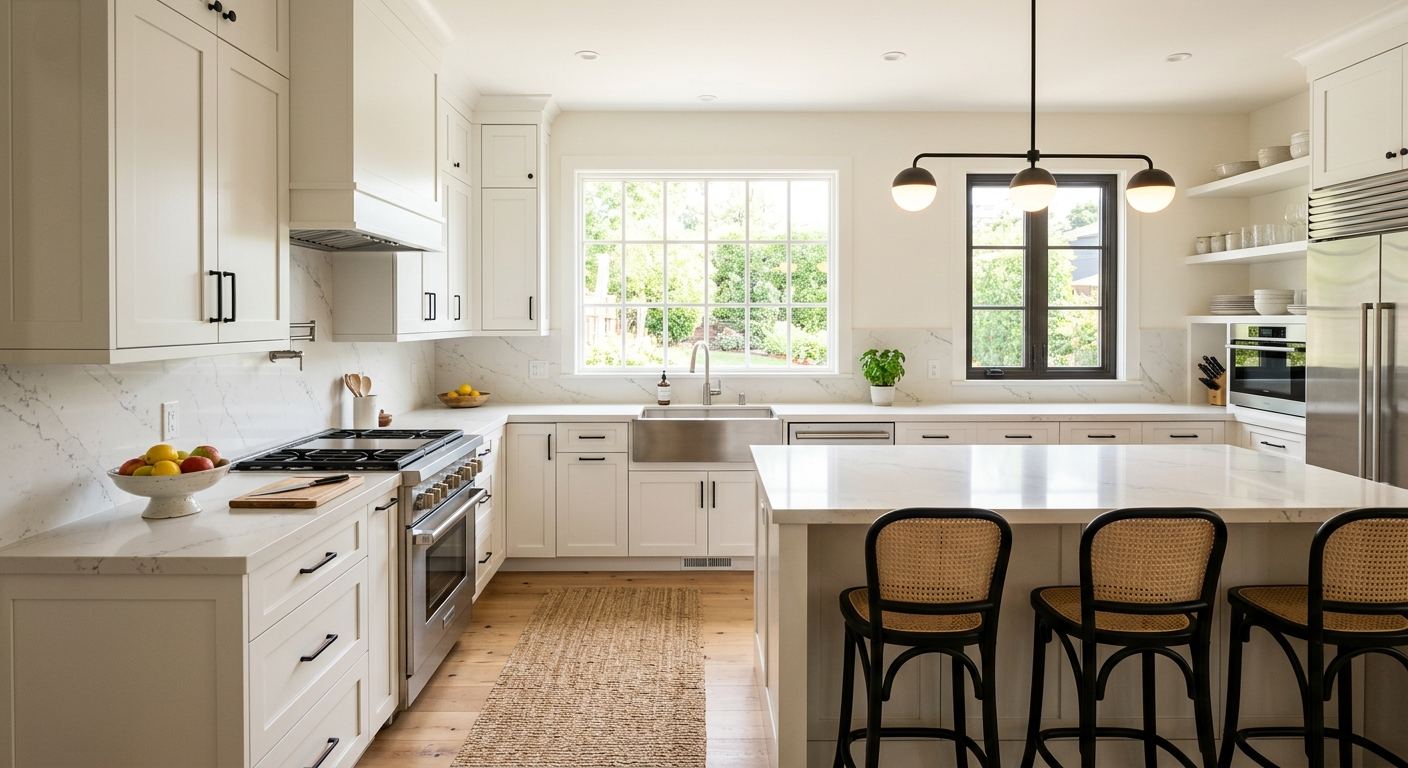
Kitchen renovation options and costs in Black Creek
Kitchen renovations in Black Creek, Ontario typically start with one key decision: whether you’re doing a quick facelift or a full rebuild. With a population of 21,737 (Statistics Canada, 2021 Census), Black Creek is small enough that many homeowners book contractors through a tight GTA network, so availability can swing with the spring/summer rush. In the broader Toronto economic region, higher-value housing patterns also tend to push homeowners toward better materials; in practice, finish expectations often rise because many owners want the same “move-in-ready” look buyers expect in the GTA.
Ontario’s cost drivers don’t behave like “weather-based” problems for kitchens; cabinetry and countertops pricing follow the market, and labour pricing is relatively uniform across the GTA. What the local climate does affect is installation logistics: winter scheduling can mean slower drying times for coatings and more indoor humidity management, especially when renovations include tile and flooring that need stable conditions. In addition, older homes around Black Creek may have out-of-level walls or dated rough-in plumbing, which can add labour even when the finish tier is modest. A good example of high demand is the older residential pockets near the Black Creek community core, where many homes are suited to updates that keep cabinetry layout changes limited while modernizing surfaces.
Below is a practical breakdown of common renovation tiers and what they typically include, so you can compare quotes apples-to-apples before you talk scope with a contractor.
| Renovation Tier |
What's Included |
Typical Duration |
Price Range |
| Cosmetic refresh (paint, hardware, new appliances only) |
Cabinet paint or touch-ups, new hardware/pulls, new appliances (no plumbing/gas changes), updated lighting where wires already exist |
1–3 weeks |
$6,000–$18,000 |
| Mid-range full renovation (new cabinets, counters, sink, tile) |
New semi-custom or stock cabinets, new countertops, sink + faucet (minor plumbing updates), backsplash tile, new floor finishes (as selected), standard electrical for lighting |
4–8 weeks |
$25,000–$55,000 |
| High-end full renovation (custom cabinets, stone counters, island) |
Custom cabinetry, premium stone/quartz counters, island build, upgraded appliance package, full-height or premium backsplash, higher-end lighting/electrical upgrades, more detailed trim/finishing |
8–16 weeks |
$70,000–$90,000 |
| Cabinet refacing only (new doors + drawer fronts, same boxes) |
Reface doors/drawer fronts, new hardware, optional interior refinishing, limited rework to existing cabinet boxes |
2–5 weeks |
$8,000–$35,000 |
| Countertop swap only (laminate to quartz or stone) |
Removal of old counters, install new quartz/stone or laminate replacement, reseal where required, sink cut-out and basic plumbing adjustments (if applicable) |
1–2 weeks |
$3,000–$15,000 |
| Backsplash tile installation only |
Tile supply/installation, surface prep, grout/seal, edge trim where needed (excludes full cabinet or counter replacement) |
3–7 days |
$2,000–$10,000 |
Prices are estimates only and vary by project scope, site access and material selection.
What affects the price of kitchen renovation in Black Creek
In Toronto and across Ontario, you’ll often see quotes for the “same kitchen” vary by 30–50% because each bid reflects different assumptions about labour risk, material lead times, and how much the contractor expects to uncover once walls come open. The reason is straightforward: kitchen renovations are part finish work (predictable) and part construction (less predictable). Local housing value and typical household income shape the finish tier far more than climate does. In higher-value pockets of the Toronto market, homeowners more commonly choose quartz or natural stone counters and semi-custom cabinetry because the cost is easier to justify on resale. In more price-sensitive areas of outer GTA, laminate and stock cabinets still dominate, with selective upgrades to keep ROI practical.
In Black Creek, a few local conditions commonly push costs up or down. First, older home construction can mean uneven floors and out-of-square walls; correcting them may be a “hidden” add-on even if the scope looks simple. Second, if the kitchen has dated rough-in plumbing, relocating a sink or reworking traps and supply lines usually lands in the higher bands quickly—often pushing a refresh that “could be” mid-range (around $25,000–$55,000) toward the upper mid-range when walls open. Third, when homeowners add an island, the electrical and ventilation planning is what surprises people most; adding circuits for outlets and under-cabinet lighting can add labour regardless of whether you choose stock or custom cabinets.
Finish selection still matters: a cabinet refacing-only scope can stay in the $8,000–$35,000 range, while full custom millwork and stone can move the project into the $70,000–$90,000 tier. The “best value” comes from matching the finish tier to your intended layout changes—and being realistic about what’s fixed once demolition starts.
| Price Factor |
Why It Matters |
Cost Impact |
| Cabinet tier — stock vs. semi-custom vs. fully custom millwork |
Higher tiers use different materials, build tolerances, and finishing; custom also adds time for shop drawings and fabrication |
$10,000–$45,000 |
| Countertop material — laminate vs. quartz vs. granite vs. stone |
Material cost and install complexity drive the spread; heavier stone often needs more careful templating and handling |
$3,000–$15,000 |
| Layout change — wall removal, island add, plumbing/gas move |
Structural and MEP work increases labour unpredictability and can require permits and inspections |
$5,000–$25,000 |
| Appliance package tier — builder vs. mid-range vs. pro-grade |
Pro-grade models can require different dimensions, ventilation considerations, and sometimes electrical upgrades |
$2,500–$12,000 |
| Flooring — refinish existing vs. full replacement |
Once cabinets are removed, floor transitions, subfloor prep and matching can add time and material |
$1,500–$10,000 |
| Backsplash — ceramic tile vs. marble vs. full-height slab |
More premium surfaces demand better prep, handling and finishing; full-height increases coverage and labour |
$2,000–$10,000 |
| Electrical — new circuits for island, under-cabinet lighting |
New circuits can trigger additional rough-in labour and code-compliant panel/box work |
$800–$6,500 |
| Permit fees and licensed trade requirements |
When plumbing, gas, structural changes or electrical upgrades are involved, permits and inspections add cost and scheduling steps |
$300–$4,500 |
Permits & regulations in Ontario
In Ontario, a straightforward cabinet-and-countertop swap usually doesn’t require a building permit. If you’re simply replacing cabinets in the same footprint, swapping countertops, updating finishes, adding hardware, and installing appliances without changing the existing plumbing or gas connection points, most homeowners can move forward without permitting. That said, kitchen renovations commonly cross the line into work that does require permits and licensed trades.
Typically, permits and inspections are required when you move plumbing supply or drain lines, relocate or add a gas connection (for a stove or range hood with gas), remove a load-bearing wall or perform structural changes, or add new electrical circuits (for example, outlets around an island or major under-cabinet lighting upgrades that require new wiring). Gas work must be completed by a licensed gas fitter, and electrical work must be performed by a licensed electrician—both require inspections where applicable. Always confirm who is pulling permits and paying associated fees before signing; the responsibility must be clearly stated in the written contract.
To verify a contractor in Black Creek, Ontario, ask for: (1) their Ontario licence details (as applicable to the trades they provide), (2) a certificate of liability insurance showing kitchen-renovation coverage, and (3) confirmation of WSIB/WCB coverage (or an appropriate exemption if legitimately applicable). Request documents before you pay deposits. Then, where possible, cross-check licence and trade status using the relevant provincial online registries and compare the names on the insurance certificates with the contracted company.
Cabinets, countertops and layout decisions in Black Creek
The three biggest decisions in a Black Creek kitchen renovation are: (1) cabinet tier, (2) countertop material, and (3) whether you change the layout. Cabinet tier drives both cost and how well the kitchen “fits” your daily workflow. Stock cabinets are typically the fastest and cheapest, semi-custom is the most common middle ground for GTA resale expectations, and custom millwork delivers the best fit for awkward rooms, unusual wall lengths and built-ins.
Countertops are the next major lever. Laminate is budget-friendly and offers good durability for everyday use, but it’s less resistant to heat and surface damage than modern quartz. Quartz is popular in the Toronto market because it balances stain resistance with low maintenance, while granite/natural stone adds a luxury look with more care. Butcher block can be a warm, livable choice, though it needs sealing and mindful handling around moisture—especially in older Ontario homes where humidity swings can be more noticeable in spring and fall.
Layout changes are where costs can jump unpredictably. Removing a wall, adding an island, or relocating plumbing/gas can be justified when the space gain improves circulation and seating; however, if the goal is mainly to refresh the look, keeping the core footprint can protect your budget. For example, if you’re debating laminate versus quartz while keeping layout fixed, upgrading counters can be the smartest “visible” spend: a full renovation might land in the $25,000–$55,000 range with laminate, while choosing quartz often nudges the same footprint closer to the upper end of that band (without triggering the higher $70,000–$90,000 territory that usually comes with custom cabinetry or major structural work).
| Option |
Durability |
Maintenance |
Best For |
Price Range |
| Stock cabinets (big-box) |
Solid for everyday use; limited sizes can make fit adjustments necessary |
Low—standard cleaning and hardware tightening |
Fast turnarounds and cost control |
$8,000–$20,000 |
| Semi-custom cabinets (local dealer) |
Good build quality with more size/finishing options |
Low—regular wipe-downs; check hinges and drawer slides periodically |
Most “Toronto resale-friendly” refreshes |
$18,000–$35,000 |
| Custom cabinets (local millwork shop) |
Highest fit and finish; best for irregular spaces and built-ins |
Low to moderate—depends on finish; follow manufacturer care |
Unique layouts, premium finishes, and maximum longevity |
$30,000–$55,000 |
| Laminate countertop |
Good for general use; can chip if impacted and may scorch with direct heat |
Low—avoid hot pans and sharp impacts; use gentle cleaners |
Budget renovations keeping footprint unchanged |
$3,000–$7,000 |
| Quartz engineered countertop |
Very durable surface with strong stain resistance; withstands normal kitchen wear well |
Low—routine cleaning only; no yearly sealing |
Busy households and buyers who want “premium but easy” |
$7,000–$14,000 |
| Granite / natural stone countertop |
High durability; unique look and good resistance to scratching, varies by stone |
Moderate—may require periodic sealing depending on stone type |
Homeowners seeking natural variation and upscale appearance |
$9,000–$16,000 |
| Butcher block countertop |
Durable but susceptible to knife gouges and water exposure if neglected |
Moderate—regular oiling/sealing; dry thoroughly |
Warm, traditional kitchens and households that like maintenance |
$5,000–$12,000 |
| Marble countertop |
Beautiful but more porous; can etch/stain if used heavily |
Higher—needs careful cleaning and sealing routines |
Low-to-moderate daily cooking and a “statement” look |
$10,000–$18,000 |
How to choose a kitchen renovation contractor in Black Creek
Choosing the right contractor in Black Creek, Ontario starts with proof—not promises. Verify Ontario licensing for the trades involved (especially gas fitters and electricians), and request liability insurance certificates that match the company doing the work. For safety and unpaid-work risk, confirm WSIB/WCB coverage for the crew that will be on-site. Ask the contractor to provide the current clearance/coverage documentation and confirm that your project will not be treated as subcontractor work with uncertain coverage.
Next, get 2–3 itemised written quotes, not one lump sum. The best estimates break down labour and materials (demolition, cabinet supply/installation, countertop templating/installation, tile prep, electrical/plumbing allowances, disposal, and any permit line-items). Read exclusions carefully: Are permits included or charged separately? Is waste disposal included? Are drywall patching and paint included, or only cabinet install?
Warranty matters. Confirm the workmanship warranty length (how long they stand behind installation), plus product/manufacturer warranties for cabinets, countertops and tile. If a warranty is transferable to future owners, ask for that in writing—this can matter for resale in the GTA.
For payment schedule, never pay more than 10–15% upfront. Hold back a portion until completion and final walkthrough. Finally, lock the timeline: request a start date and a completion estimate in writing, and ask how long material lead times can extend the schedule.
- Ask for insurance certificate naming the correct company and project address.
- Confirm gas and electrical work is handled by properly licensed trades.
- Require WSIB/WCB clearance documentation for workers on-site.
- Get a written scope with line-by-line labour and material allowances.
- Confirm who pulls permits (and who pays) before signing.
- Clarify demolition, hauling and disposal responsibilities.
- Verify countertop templating process and who attends templating.
- Confirm tile prep (backer board, waterproofing approach, layout planning).
- Ask whether they protect floors and counters daily during work.
- Make sure plumbing/gas shutoffs and shutdown schedules are planned.
- Require a workmanship warranty with start/end dates and coverage terms.
- Use a payment schedule tied to milestones, not open-ended progress.
Concrete red flags I see in Black Creek and the surrounding GTA include: contractors refusing to itemise quotes, no proof of WSIB/WCB or insurance, vague scope wording like “everything included” without listing disposal/permits, change orders signed without explanations or prices, and a timeline that ignores cabinet/counter lead times.
Frequently asked questions — kitchen renovation in Black Creek
What's the most cost-effective kitchen upgrade?
If you’re trying to stretch your budget in Black Creek, the most cost-effective upgrade is usually the one that gives the biggest visual change with minimal hidden construction. In practice, that’s often a cabinet refacing or a countertop swap—both can modernize the whole kitchen without tearing out plumbing or rerouting gas. Cabinet refacing typically falls in the $8,000–$35,000 range, while a countertop-only swap is commonly $3,000–$15,000. If your layout is functional and your rough-in is solid, these options tend to avoid the unpredictable labour that comes with opening walls. If you cook often, pair quartz with simple updates; if you’re mostly refreshing the look for resale, refacing plus new hardware and a backsplash can deliver a strong “new kitchen” feel.
Custom vs stock cabinets — is custom worth it?
Custom cabinets are worth it when your kitchen has irregular dimensions, awkward corners, or you want built-ins that stock systems simply can’t match. In Black Creek, many older homes have small inconsistencies—slightly out-of-square walls or non-standard openings—that become more noticeable once you remove existing cabinetry. Stock cabinets can be the most budget-friendly way to get a fresh look quickly, but the trade-off is fitting constraints. Semi-custom is often the sweet spot in the Toronto market for buyers who want quality and variety without the highest custom pricing. If your project is a mid-range full renovation (often around $25,000–$55,000), semi-custom cabinets usually deliver the best value. If you’re going into high-end territory like $70,000–$90,000, custom often makes sense—especially if you’re also adding an island and premium finishes.
How do I choose a kitchen contractor in Black Creek?
Start by verifying the contractor’s Ontario licensing for the trades they rely on, and require a certificate of liability insurance before work begins. For worker protection and site safety, confirm WSIB/WCB coverage (request the appropriate clearance documentation) and ensure the crew listed on the policy matches who will be on-site. Then get 2–3 itemised quotes where labour and materials are separated—this makes apples-to-apples comparisons possible and reduces “surprise” change orders. Review scope details: is permit pulling included if you’re moving plumbing or adding electrical circuits? Is waste disposal included? Finally, confirm the warranty terms for workmanship and whether product warranties carry forward on resale. A good contractor in Black Creek will welcome these questions and provide documents without delay.
What order do kitchen renovation steps happen in?
A typical GTA-appropriate sequence is: (1) measurement and final ordering—especially for cabinets and countertops; (2) demolition and rough-in checks—confirm plumbing/electrical locations before enclosure; (3) framing/repairs and subfloor or wall prep; (4) cabinet install after site conditions are stable; (5) countertop templating and fabrication coordination; (6) countertop installation; (7) tile backsplash and any flooring finishes (timing can vary based on your design); (8) appliance hookups and final electrical fit-off; (9) caulking, trim, painting touch-ups, and final walkthrough. The key is countertop templating should happen when cabinets are fully installed and level. If you’re making layout changes that involve plumbing/gas or electrical permits, those inspections must occur before closing walls. In Ontario, scheduling can also be impacted by indoor drying times for coatings and adhesives, so timelines should reflect that.
Can I live at home during a kitchen renovation in Black Creek?
Often yes, but it depends on scope and how your contractor sequences work. For cosmetic refreshes or cabinet refacing, you can usually stay in the home with a smaller disruption—typically $6,000–$18,000 jobs run in shorter windows and may keep cooking options manageable. For mid-range full renovations, typically $25,000–$55,000, you may need a temporary setup (microwave, kettle, fridge access) and a clear plan for water use if plumbing is touched. If the project includes new circuits, plumbing moves, or gas-related work, expect short shutdown periods and more protective containment dust controls. In high-end builds that include major layout changes and islands (often $70,000–$90,000), many homeowners plan partial relocation or at least create a “no-go zone” in the renovation path. Discuss daily access, cleaning, and dust protection early—your comfort depends on the plan.
Should I renovate my kitchen before selling in Black Creek?
Usually, it’s best when the renovation improves what buyers notice immediately—cabinets, countertops, and overall layout flow. In the Toronto market context, homeowners commonly recover more value when finishes look current without overbuilding. If your kitchen is dated but the footprint is workable, a cabinet refacing plus quartz counters and a clean backsplash can keep you in an achievable budget while improving buyer perception. If you’re doing a mid-range full renovation around $25,000–$55,000, focus spend on durable finishes and layout practicality rather than unnecessary structural changes. Renovating before selling is less attractive when the home already has functional, modern surfaces or when major plumbing/gas relocation is required—those projects tend to escalate into the higher tiers like $70,000–$90,000 where buyers may not fully reimburse the premium. In Black Creek, have your agent and contractor align on “buyer expectations” finishes to target the right tier.