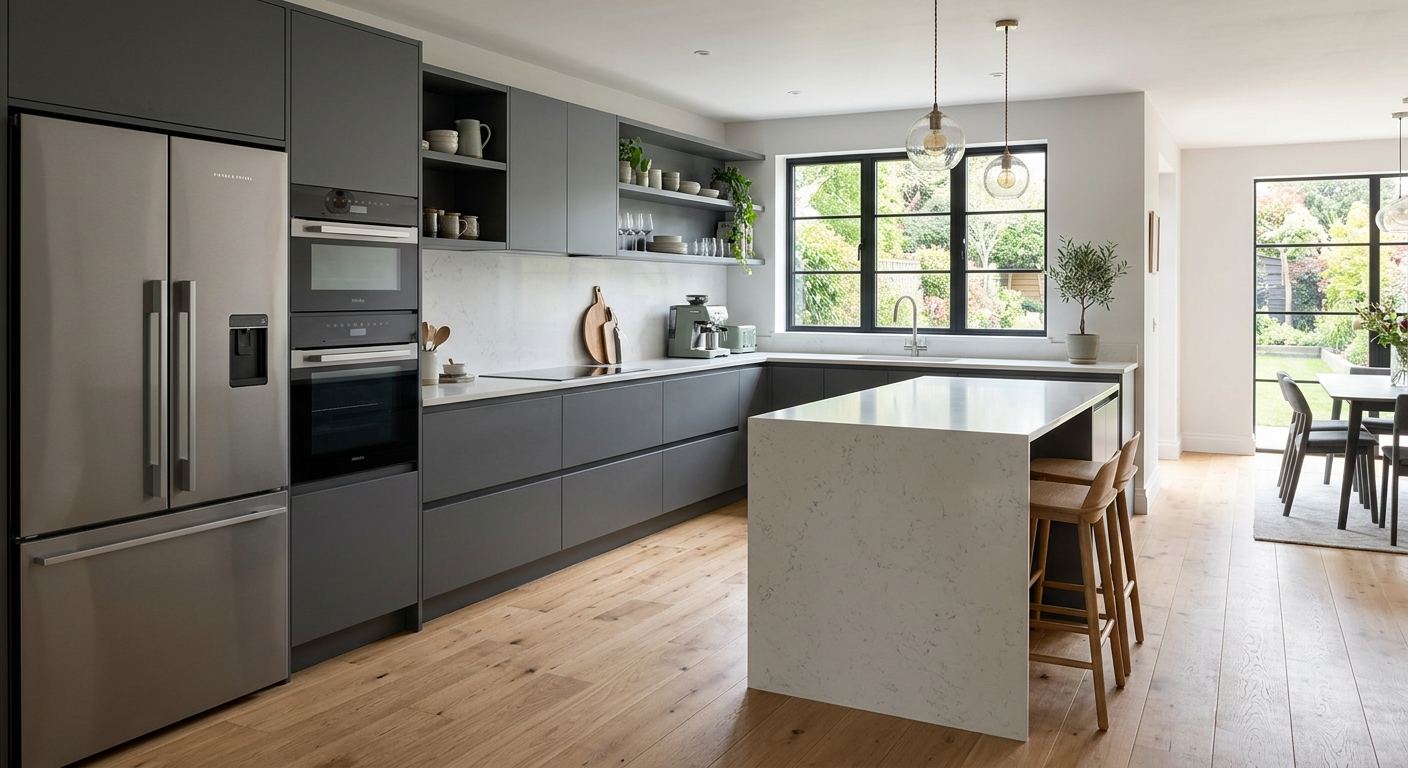
Kitchen renovation options and costs in Schreiber
Kitchen renovation in Schreiber is all about getting the right finish level for local buyers while still controlling labour and trade costs. With a small population of 1,039 and about 400 homeowner households (81.6% owning), most renovations here are done to improve day-to-day function and long-term resale value rather than for speculative “quick flips.” Median household income in 2020 was $75,500 (Statistics Canada, 2021 Census), which typically keeps homeowners clustered around practical mid-range choices—semi-custom cabinetry and quartz or laminate countertops—unless the home is a higher-end build or waterfront property. Schreiber’s housing stock is also older: 78.6% of homes were built before 1981 (Statistics Canada, 2021 Census). That matters because older framing and electrical/plumbing conditions can add discovery time and small change-orders even when the visible kitchen looks “fine.”
Across Northwestern Ontario, cabinetry remains the biggest driver of cost. In Schreiber, availability of installers is steady but scheduling can tighten during peak renovation season, which nudges labour totals upward if the project must fit short timelines. The climate itself doesn’t usually “damage” kitchen finishes, but it can affect site conditions (temperature swings affecting adhesives/caulking, and slower curing) and readiness of subtrades to work continuously. Demand is especially strong in the commercial-residential core around Water Street and the broader town-serviced areas, where families often renovate between school and fishing/holiday seasons. Below is a straightforward comparison of common project tiers to help you benchmark the quotes you’ll receive—then we’ll break down what most often causes variance.
| Renovation Tier |
What's Included |
Typical Duration |
Price Range |
| Cosmetic refresh (paint, hardware, new appliances only) |
Cabinet paint or finish refresh, new hardware/pulls, faucet swap if desired, appliance package, backsplash “touch-up” only if existing tile is staying |
1–3 weeks |
$5,000–$15,000 |
| Mid-range full renovation (new cabinets, counters, sink, tile) |
Semi-custom or stock cabinets (new boxes/doors), new countertop, sink and faucet, backsplash tile, basic electrical updates, labour for removal/installation |
4–8 weeks |
$30,000–$65,000 |
| High-end full renovation (custom cabinets, stone counters, island) |
Custom cabinetry, premium countertop (quartz/stone), island with upgraded lighting, more extensive tile (often larger-format), enhanced electrical/lighting plan |
7–14 weeks |
$65,000–$90,000+ |
| Cabinet refacing only (new doors + drawer fronts, same boxes) |
New door/drawer fronts, new trim/hinges, updated hardware, minor repairs to existing boxes, backsplash may be limited to what’s required around doors |
2–5 weeks |
$6,000–$22,000 |
| Countertop swap only (laminate to quartz or stone) |
Remove old surface, prep/leveling, install new countertop, cut-outs for sink and cooktop, basic sealant work |
3–10 days |
$2,500–$12,000 |
| Backsplash tile installation only |
Tile removal where needed, waterproofing prep (as required), tile install, grout/seal, trim and caulking, allowance for outlet covers/finishing |
4–10 days |
$1,500–$8,000 |
Prices are estimates only and vary by project scope, site access and material selection.
What affects the price of kitchen renovation in Schreiber
Even when homeowners ask for “the same kitchen,” quotes in Northwestern Ontario can swing by 30–50% because scope gets interpreted differently and because cabinetry and countertop systems have very different tiers. Local income and buyer expectations matter more than climate. In higher-value areas across the region, buyers tend to default to quartz or natural stone counters and semi-custom cabinetry because the renovation cost is easier to recover on resale; in more modestly priced homes, stock or semi-custom cabinets with laminate or entry-level quartz dominate because the project ROI stays reasonable. Schreiber sits within that same Northwest pattern: most kitchens are renovated to modernize function, but finish upgrades still follow what local households can comfortably absorb.
Layout changes are the most unpredictable cost regardless of finish level. Removing a wall to open up the kitchen, adding an island, or moving a gas line/plumbing line can trigger hidden labour: framing reinforcement, subfloor checks, electrical reroutes, and permit time. As a result, a basic renovation that should land in a mid-range band (for example, $30,000–$65,000) can drift upward if plumbing/gas locations don’t line up with the new design. Conversely, keeping the footprint and swapping to quartz can bring you closer to the $2,500–$12,000 countertop band rather than a full rebuild.
In Schreiber specifically, older homes built before 1981 (78.6% of stock) often have wiring that’s near capacity or older supply/drain runs that need assessment before a sink or dishwasher move. Cold-season scheduling can also affect work sequencing—tile and countertop installation may need more stable indoor conditions, and that can add labour coordination time. The practical takeaway: controls like cabinet tier and layout decisions usually outweigh “small” climate concerns.
| Price Factor |
Why It Matters |
Cost Impact |
| Cabinet tier — stock vs. semi-custom vs. fully custom millwork |
Pricing changes with build quality, customization (heights, internal options), and lead times |
Can move the total project by roughly $8,000–$30,000+ |
| Countertop material — laminate vs. quartz vs. granite vs. stone |
Material cost and fabrication/edge complexity vary widely |
Often adds $2,000–$10,000+ depending on choice |
| Layout change — wall removal, island add, plumbing/gas move |
Changes drive trade coordination, framing, and possible permit requirements |
Typically $5,000–$25,000+ |
| Appliance package tier — builder vs. mid-range vs. pro-grade |
Premium brands raise product and sometimes electrical/venting requirements |
Usually $1,500–$8,000+ |
| Flooring — refinish existing vs. full replacement |
Kitchen demo often damages adjacent flooring; replacement can expand scope |
Often $1,000–$6,000+ |
| Backsplash — ceramic tile vs. marble vs. full-height slab |
Labour hours and material weight/precision increase with premium surfaces |
Roughly $1,500–$8,000+ |
| Electrical — new circuits for island, under-cabinet lighting |
More fixtures and dedicated circuits require licensed electrical work |
Typically $500–$5,000+ |
| Permit fees and licensed trade requirements |
Any regulated work adds administration, inspections, and coordination time |
Can add $300–$2,500+ |
Permits & regulations in Ontario
In Ontario, many “swap” projects do not trigger permits, but several common kitchen changes do. Cabinet and countertop swaps—meaning you’re replacing existing cabinets or the counter surface without moving plumbing or rerouting venting/gas—typically don’t require a permit. However, you do need permits and licensed trades when you: move plumbing supply or drain lines, relocate a gas stove or make changes involving gas-fired equipment, remove a load-bearing wall, or add new electrical circuits (for example, for island outlets or specialty under-cabinet lighting circuits). Gas work must be carried out by a licensed gas fitter, and electrical work must be performed by a licensed electrician, with inspections where required.
Step-by-step, a homeowner in Schreiber should verify a contractor’s Ontario licensing and coverage before work starts:
- Ask for the contractor’s business/company legal name and check the licensing/registration information available online through Ontario’s public resources.
- Request a certificate of insurance (liability) showing coverage in effect for the project period.
- Confirm WSIB/WCB coverage details (or the applicable coverage documentation) and that subcontractors are covered.
- For gas or electrical scope, ask for proof that licensed trades are assigned to those specific tasks.
- Confirm who pulls permits in writing—permit responsibility should be explicit in your contract.
- Keep a paper trail: email confirmation of trade assignments, inspection scheduling, and change-order approvals.
Don’t assume: even if the contractor says “no permit needed,” verify it against the exact work scope you’re paying for. That clarity protects you when a foundation, wall, vent, or wiring detail is discovered during demo.
Cabinets, countertops and layout decisions in Schreiber
In a Schreiber kitchen renovation, three decisions shape both cost and resale appeal: (1) cabinet tier, (2) countertop material, and (3) layout changes. Start with cabinet tier. Stock cabinets are typically the fastest and cheapest, semi-custom is the most popular mid-range option, and custom cabinets provide the tightest fit for ceilings, angles and storage needs—but they come at a premium. Next, choose countertop material based on durability and maintenance. Laminate is budget-friendly and can look modern, but it’s more prone to damage at seams and can stain if not cared for. Quartz offers a strong balance of stain resistance and durability; natural stone and granite are also durable but can require more periodic maintenance depending on finish and sealing. Finally, layout changes are where you either unlock real value or spend money without visible payoff: open-concept wall removal and island additions can be justified when they improve traffic flow and family use, especially in older homes where kitchens can feel closed-in.
Northwestern Ontario buyers often want clean, bright surfaces and practical storage, so at mid-range budgets (commonly $30,000–$65,000) many homeowners choose semi-custom cabinets with quartz and a functional backsplash. At higher tiers ($65,000–$90,000+), custom cabinetry and stone counters become more common, especially when an island adds seating and upgraded lighting. Here’s a practical dollar example: if your plan is purely cosmetic—new quartz and fresh hardware—you may stay closer to the countertop band ($2,500–$12,000). But if you add an island and relocate plumbing/gas to support it, you’re funding framing, electrical coordination, and possible permit work, which can push the project into a full-renovation budget even if the cabinet footprint doesn’t change much.
Even though Schreiber’s winter climate isn’t a “counters destroyer,” cold swings can affect curing times for adhesives and caulking, so we plan sequencing carefully—especially before tile and countertop installation. That’s another reason good scope decisions early prevent cost drift.
| Option |
Durability |
Maintenance |
Best For |
Price Range |
| Stock cabinets (big-box) |
Good basic strength; limited custom sizing |
Low; keep hinges adjusted as needed |
Fast upgrades where you’re keeping the layout mostly unchanged |
$6,000–$18,000 |
| Semi-custom cabinets (local dealer) |
Very solid; more options for interiors and dimensions |
Low; hardware and soft-close components are easy to service |
Most Schreiber homeowners aiming for strong resale appeal |
$18,000–$35,000 |
| Custom cabinets (local millwork shop) |
Highest fit and build quality; ideal for awkward spaces |
Low to moderate; depends on wood species/finishes |
Unique layouts, ceiling height changes, premium storage systems |
$35,000–$60,000+ |
| Laminate countertop |
Moderate; seams can be a weak point |
Easy daily care; avoid prolonged heat/water at seams |
Budget-conscious renovations that still want a modern look |
$2,500–$6,000 |
| Quartz engineered countertop |
High; very resistant to stains and everyday wear |
Low; wipe clean, use non-abrasive cleaners |
Busy kitchens and buyers who want low-maintenance durability |
$6,000–$12,000 |
| Granite / natural stone countertop |
High; durable but varies by stone and finish |
Moderate; sealing and care depend on the specific stone |
Premium look when you want natural variation |
$8,000–$16,000+ |
| Butcher block countertop |
Moderate to high; can scratch and dent |
Moderate; regular oiling and protection from water sits |
Homes where you’ll treat the counter like a working surface |
$4,000–$10,000 |
| Marble countertop |
Moderate; softer and more sensitive than quartz/granite |
Higher maintenance; stains can etch over time |
Premium, design-forward kitchens where maintenance is acceptable |
$10,000–$20,000+ |
How to choose a kitchen renovation contractor in Schreiber
Choosing the right contractor in Schreiber comes down to proof, paperwork, and how clearly they price your scope. In Ontario, you want to verify licensing and coverage before you sign: request confirmation of the contractor’s insurance (liability), and ask how they handle WSIB/WCB coverage so both you and their trades are protected. For the regulated parts of a kitchen (gas work and electrical), insist on subcontractor proof as well—your quotes should name which licensed trade will handle gas fitting and electrical work. Never rely on verbal assurances.
Next, get 2–3 itemised written quotes, not just a single lump sum. You should see a breakdown that separates labour and materials: demo/removal, cabinet supply, countertop fabrication and install, electrical/plumbing line items (if included), tile work, and disposal. A clear scope should state what’s excluded (for example, moving structural walls, repairing damaged subflooring, or replacing flooring) and whether permits are included or billed as a separate allowance. Ask about disposal—some contractors include bin/haul-away, others treat it as an add-on.
Check warranty terms: workmanship warranty length (and what it covers), plus manufacturer warranties for cabinets and countertops. Confirm whether warranties are transferable to future owners—this matters for resale. For payments, avoid large upfront deposits; many reputable contractors structure payments so you’re never paying more than 10–15% at the start, with the remainder after milestones. Finally, insist on a start date and completion estimate in writing, along with what triggers delays.
- Ask for their Ontario business details and confirm insurance and WSIB/WCB documentation in writing.
- Get quotes itemised by trade and material (not one “kitchen package” line).
- Confirm who pulls permits and who pays permit fees (where applicable).
- Ensure the quote lists demo and disposal (bin/haul-away) explicitly.
- Check cabinet lead times and countertop template/measure dates.
- Review exclusions: what happens if old plumbing needs replacement or wiring upgrades are required.
- Require a colour/finish schedule and product specifications (handles, soft-close, cabinet doors/hinges).
- Confirm electrical scope: outlets for island, under-cabinet lighting, and circuit requirements.
- For tile, confirm waterproofing approach and grout/edge details.
- Ask about protection of floors and doorways during demo and installation.
- Verify the workmanship warranty and what constitutes a claim.
- Use milestone payments with a holdback until the job is complete and punch-list items are addressed.
Red flags to watch for in Schreiber: (1) quotes with no itemisation or missing line items for disposal and electrical/plumbing changes; (2) promises of “no permits needed” without addressing your exact scope; (3) no written warranty terms or vague “manufacturer will handle it” language; (4) large upfront payments (well beyond 10–15%); and (5) skipping site measurement/template dates for countertops and cabinets, which leads to rework and schedule slips.
Frequently asked questions — kitchen renovation in Schreiber
Should I renovate my kitchen before selling in Schreiber?
If you’re selling in Schreiber or the surrounding Northwest area, a kitchen refresh can help, but it should match the buyer tier you’re targeting. With homeowner households at 81.6% owning (Statistics Canada, 2021 Census) and many homes built before 1981 (78.6%), buyers often look for functional upgrades—clean cabinetry lines, brighter lighting, and reliable counter surfaces—more than dramatic structural changes. If your layout is sound, a mid-range renovation (commonly $30,000–$65,000) that focuses on semi-custom cabinets and quartz typically offers the most “visible value.” If budget is tighter, a countertop swap only or cabinet refacing can deliver noticeable improvement without opening up everything. The key is ROI: avoid costly island/plumbing moves unless the layout genuinely fixes a flow problem.
What's the most popular kitchen style in Schreiber right now?
Right now, the most common look we see in Schreiber is modern transitional: simple shaker-style or clean-lined cabinets, matte or satin hardware finishes, and brighter neutral tones (white, warm off-white, and light greys) paired with quartz countertops. Homeowners in this part of Ontario often want low-maintenance surfaces because kitchens get daily use through winter and shoulder seasons. That’s why quartz keeps showing up in mid-range budgets (for example, the $30,000–$65,000 band) where people want durability without constant sealing or special care. Islands are popular, but we typically recommend them only when the room size supports clear walkways—otherwise you get a “pretty but tight” kitchen that buyers notice immediately.
How do I know if I need to update my kitchen plumbing in Schreiber?
You usually don’t need to replace plumbing unless inspections reveal issues, but older homes (78.6% built before 1981) are more likely to have outdated supply or drainage runs. A few signs that plumbing may need attention: slow drains, recurring odours, water pressure drops near the sink/dishwasher, visible corrosion at supply lines, and signs of previous leaks under cabinets. If you’re moving the sink, dishwasher, or adding an island, plumbing updates are more likely because drain and supply locations must align with the new layout. For quotes, ask your contractor to include an allowance for investigation and confirm whether line replacement is included or handled as a change order. In Ontario, relocating plumbing also increases the chance of permit/inspection requirements.
What is the difference between a galley and open-concept kitchen?
A galley kitchen is typically a straight-through layout with counters on both sides and a corridor-like flow—efficient in smaller spaces, but it can feel closed off. An open-concept kitchen combines the kitchen with living/dining space so there’s a visual connection and more room to move, especially for entertaining. In Schreiber kitchens, galley layouts are common in older homes, and the “best ROI” renovations often focus on storage upgrades, better lighting, and countertop/cabinet improvements rather than structural changes. Open-concept renovations can be great, but they’re the higher-variability projects: wall removal may involve permits, electrical rerouting, and sometimes plumbing/gas adjustments. That uncertainty is one reason costs can drift well beyond an initial “refresh” estimate.
How do I get accurate kitchen renovation quotes in Schreiber?
Accurate quotes come from a detailed scope and firm selections. Start by getting itemised quotes with labour + materials breakdown: cabinets, countertops, tile, electrical/plumbing allowances (if needed), disposal, and any permit handling. Bring a clear plan and measurements, and choose your countertop and cabinet finish before signing so the contractor can template and order correctly. Ask what’s excluded—especially if you’re in a pre-1981 home where hidden issues can appear during demo (older wiring, subfloor conditions, or imperfect wall alignment). It also helps to benchmark against local tiers: for example, a full mid-range renovation often lands around $30,000–$65,000, while a countertop swap only typically sits in the $2,500–$12,000 range. If your quote doesn’t line up with your chosen scope, ask for clarification.
What's the best countertop material for a busy Schreiber kitchen?
For most busy households in Schreiber, quartz is the best balance of durability and daily maintenance. It resists stains and holds up well to everyday cooking, which matters through long Northwest winters when kitchens see heavy indoor use. In practical terms, quartz commonly fits well inside the countertop band ($6,000–$12,000), and it pairs nicely with semi-custom cabinets in the mid-range full-renovation tier. Laminate can work if you’re trying to stay lean, but it’s generally less forgiving with heat and can show wear at seams over time. Granite/natural stone can look premium and is durable, but it may require sealing and more careful maintenance. If you’re set on a “natural” look, we’ll help you pick the stone and finish that match your lifestyle and cleaning habits.