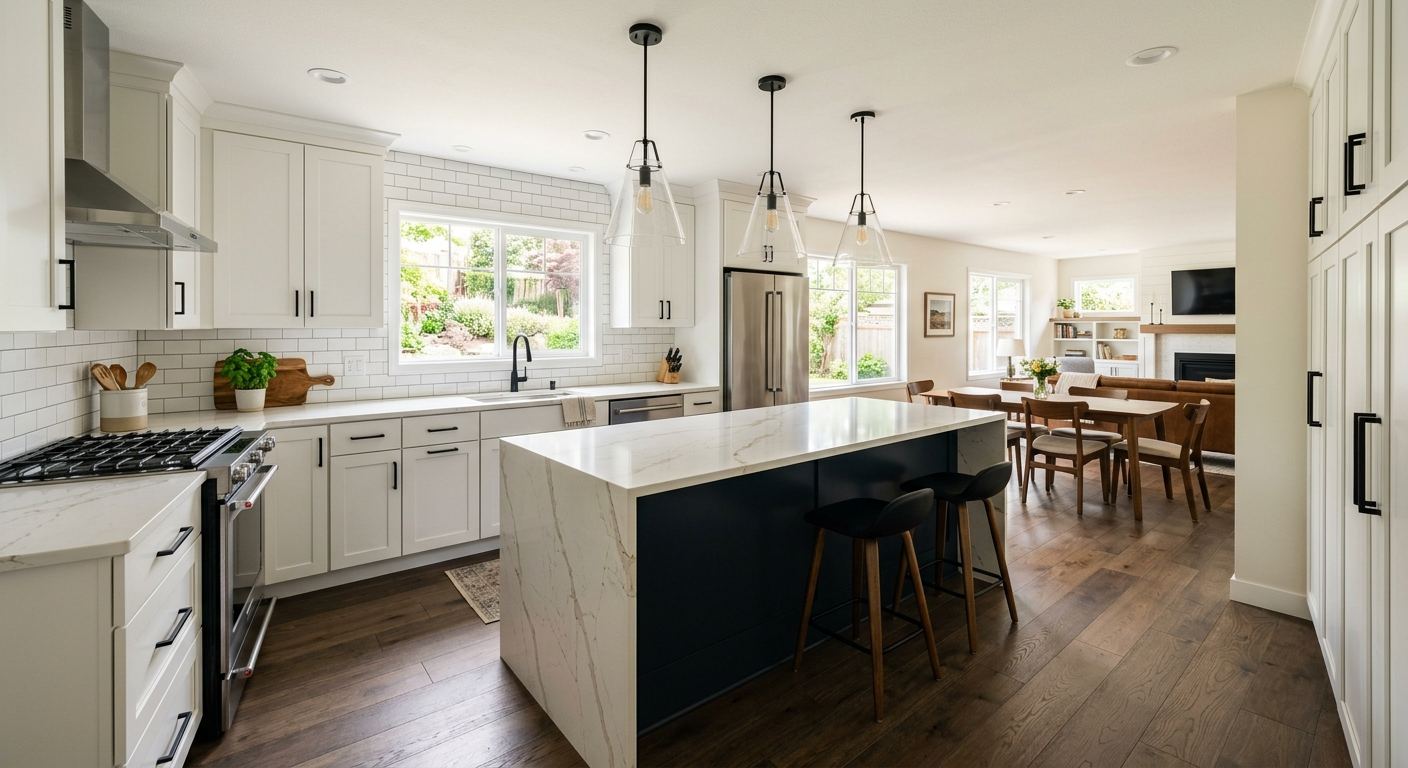
Kitchen renovation options and costs in Paisley
Paisley homeowners often start planning a kitchen renovation by looking at cost bands, then quickly learn the real budget range depends on how much of the kitchen you’re changing. With a small community population of 1,045 (Statistics Canada, 2021 Census), contractor availability can be tighter than in bigger GTA centres, so scheduling lead times may be longer—especially for custom cabinet installs and stone fabrication slots. At the same time, kitchen budgets in the Toronto economic region track more closely to home values and buyer expectations than to weather, so finishing choices tend to mirror what’s selling in nearby higher-value pockets. In many Toronto-area scenarios, homeowners aim to invest roughly 8–15% of home value into updated kitchens, which is why quotes can drift upward when you move from stock cabinetry to semi-custom or custom millwork and upgrade from laminate to quartz or natural stone. (Statistics Canada, 2021 Census) isn’t a place to anchor renovation math by itself, but it helps explain how demand concentrates: when fewer homes are available, homeowners tend to focus on resale-friendly updates that reduce “future buyer friction.”
Local trades in Paisley commonly work from GTA supply chains, so materials pricing is relatively consistent across the region. Labour, permits, and product lead times are the main drivers of variation. Warmer, humid summer conditions can also affect installation and curing timelines for finishes and adhesives (notably tile and some countertop fabrication/installation sequences), which can add a few days between trades. Once you decide whether you’re doing a cosmetic refresh, a full mid-range renovation, or a high-end rebuild with an island, you can compare options side-by-side below.
| Renovation Tier |
What's Included |
Typical Duration |
Price Range |
| Cosmetic refresh (paint, hardware, new appliances only) |
Paint (walls/trim), cabinet hardware changes, appliance swap (no duct/gas relocation), minor caulking/adjustments |
1–2 weeks |
$25,000–$35,000 |
| Mid-range full renovation (new cabinets, counters, sink, tile) |
Semi-custom or good stock cabinets, quartz or laminate counters, new sink + faucet, backsplash tile, basic plumbing hookup, improved lighting plan |
3–5 weeks |
$45,000–$65,000 |
| High-end full renovation (custom cabinets, stone counters, island) |
Custom cabinetry, premium quartz/natural stone, island (including electrical considerations), upgraded tile/backsplash, new sink location or plumbing updates if needed |
6–10 weeks |
$70,000–$90,000 |
| Cabinet refacing only (new doors + drawer fronts, same boxes) |
New door and drawer fronts, veneer/re-surfacing of existing boxes (where feasible), hardware, repaint/finish updates, basic install alignment |
2–4 weeks |
$20,000–$35,000 |
| Countertop swap only (laminate to quartz or stone) |
Removal and install of new countertop, sink cut-outs (if same footprint), sealing where required, disposal/transport |
3–7 days (plus template/fabrication time) |
$8,000–$15,000 |
| Backsplash tile installation only |
Ceramic or porcelain backsplash tile, surface prep, waterproofing membrane as needed, grout/seal, edge trims |
3–7 days |
$2,000–$10,000 |
Prices are estimates only and vary by project scope, site access and material selection.
What affects the price of kitchen renovation in Paisley
In Paisley and across the broader Toronto economic region, it’s common to see 30–50% quote differences for what looks like the “same” kitchen—because the biggest costs (layout, cabinets tier, and long-lead materials) aren’t always obvious in a quick walkthrough. Even when your finishes target the $25,000–$90,000 full-kitchen bands, the exact mix of stock versus semi-custom cabinets, laminate versus quartz or stone, and whether you’re moving plumbing or electrical can swing the total dramatically. Local home values and median income expectations typically drive finish tier: in higher-value pockets, homeowners more often choose quartz or natural stone and semi-custom cabinetry because the upgrade is easier to recover on resale. In more price-sensitive areas, laminate and stock cabinet options stay popular because they deliver a cleaner look without pushing budgets into the upper end.
Climate isn’t usually the “main” cost driver here—Toronto-area renovation costs are more influenced by market demand than harsh weather swings—but moisture and seasonal humidity can slow tile and finish curing. That means contractors sometimes schedule tile and grout work to avoid peak damp stretches, adding buffer days between trades. Two practical Paisley examples: (1) if your kitchen has older subfloors, you may need extra labour for flatness before new tile—often a hidden cost compared with a like-for-like swap; (2) if you’re adding an island and need new under-cabinet lighting plus electrical rough-in, you’ll feel the labour impact regardless of whether you choose laminate or quartz. Layout changes are where budgets become least predictable: removing a wall, adding an island, or moving a gas line can add significant engineering and licensed-trade time even when finish materials stay mid-range.
| Price Factor |
Why It Matters |
Cost Impact |
| Cabinet tier — stock vs. semi-custom vs. fully custom millwork |
Determines material quality, door styles, interior storage, and how well the kitchen fits awkward walls |
Can shift a full renovation by roughly 15–40% depending on linear feet and options |
| Countertop material — laminate vs. quartz vs. granite vs. stone |
Material price, fabrication complexity, and seam count affect both labour and materials |
Countertops can move from low–mid range into premium pricing quickly, often adding thousands |
| Layout change — wall removal, island add, plumbing/gas move |
Requires demolition, potential structural assessment, and licensed-trade rough-ins |
Frequently the biggest unpredictable driver; can increase labour and scheduling by weeks |
| Appliance package tier — builder vs. mid-range vs. pro-grade |
Higher-tier units can require different electrical/venting clearances and premium installation fittings |
Usually impacts total by a few thousand, but can escalate if venting/fit issues arise |
| Flooring — refinish existing vs. full replacement |
Whether you can protect and re-use flooring affects demolition scope and waste |
Replacements add both materials and labour; refinishing is typically cheaper but depends on damage |
| Backsplash — ceramic tile vs. marble vs. full-height slab |
Tile type drives prep, cutting complexity, and sealing; slabs add handling and accuracy demands |
Slabs and premium stones often add major labour and material cost versus standard ceramic |
| Electrical — new circuits for island, under-cabinet lighting |
Upgrading lighting and adding outlets is code-sensitive and requires a licensed electrician |
Can add noticeable cost and schedule time even if cabinet/tile finishes stay mid-range |
| Permit fees and licensed trade requirements |
Some work requires permits and inspections; others don’t |
Typically modest, but delays happen if paperwork isn’t planned at quote stage |
Permits & regulations in Ontario
In Ontario, not all kitchen work needs permits. Cabinet and countertop swaps usually do not require permits when you’re keeping plumbing, electrical, and gas locations the same and no structural work is involved. However, permits and licensed trades are typically required if you move plumbing supply or drain lines, relocate a gas stove (including changes that affect gas line routing), remove or modify a load-bearing wall, or add new electrical circuits (for example, dedicated outlets for an island or new lighting circuits). Gas work must be performed by a licensed gas fitter, and electrical work must be completed by a licensed electrician, with required inspections.
For a homeowner in Paisley, verification is part of protecting your investment. Step-by-step, ask your contractor for: (1) the trade contractor licence numbers (gas and electrical, if applicable) and confirmation they’ll pull permits where required; (2) a current certificate of insurance (liability) showing the renovation contractor and subcontractors are insured for the scope; and (3) proof of coverage for worker protection—commonly WSIB coverage or the applicable clearance/registration documentation where required by the contractor’s obligations. Where to look: check Ontario online licensing registries for the contractor/trade (especially for gas fitter and electrician), request a fresh COI (certificate of insurance) before work begins, and keep copies in your project folder. Most disputes happen when permit responsibility isn’t clearly stated, so confirm who pulls permits and who pays permit fees in writing before you sign.
Cabinets, countertops and layout decisions in Paisley
In Paisley, the three most consequential decisions in a kitchen renovation are cabinet tier, countertop material, and layout changes. First, cabinet tier sets the tone for storage, fit and longevity. Stock cabinets are usually the fastest and cheapest, while semi-custom cabinets are the most popular mid-range option because they balance cost with better internal organization. Custom cabinetry is the highest cost, but it can be worth it when you have difficult wall angles, special storage needs, or you want an island that “treats” the entire kitchen as one integrated design.
Second, countertops should be chosen for daily use, not just appearance. Laminate is budget-friendly and can look modern with the right edge profile, but it’s less forgiving with heat and sharp impacts. Quartz offers strong durability with easier maintenance and is a common resale-friendly choice in the Toronto market. Granite and other natural stones provide a premium look and heat resistance, though they can require more care and sealing depending on the stone. Butcher block can be great for homeowners who like a warmer, lived-in look, but it needs regular oiling and careful moisture management.
Third, layout changes are where you justify spend. If you’re adding an island or improving workflow, the cost can be justified when it creates real usability—more landing space, improved traffic flow, or better access to the sink and fridge. But if you’re changing plumbing/gas locations, that cost lands regardless of whether you pick laminate or quartz. For example, moving a sink within the existing footprint is often manageable; moving it to a far wall and relocating supply/drain can push you from a mid-range kitchen toward the upper band. In Toronto-area resale expectations, kitchens that read as “new” typically perform best—so a well-planned mid-range renovation with semi-custom cabinets and quartz can be a smarter value than spending heavily on an unnecessary layout shift.
| Option |
Durability |
Maintenance |
Best For |
Price Range |
| Stock cabinets (big-box) |
Good for day-to-day use; limited flexibility for awkward spaces |
Low—basic cleaning and hardware upkeep |
Fast upgrades and budget-focused renovations |
$8,000–$20,000 |
| Semi-custom cabinets (local dealer) |
Very solid; better interior options and fitting options |
Low—wipe clean, re-tighten hardware as needed |
Most Paisley renovations aiming for strong resale value |
$18,000–$35,000 |
| Custom cabinets (local millwork shop) |
Highest build quality and best fit for unique layouts |
Low, but requires proper cleaning products for finishes |
Islands, storage planning, and a “finished” designer look |
$35,000–$60,000 |
| Laminate countertop |
Moderate; can chip at seams and is sensitive to heat |
Easy daily cleaning; protect from hot pans and sharp impacts |
Refreshing the look without premium stone pricing |
$3,000–$7,000 |
| Quartz engineered countertop |
High resistance to stains and normal wear |
Low—typical cleaner only; minimal sealing |
Busy households and resale-friendly upgrades |
$6,000–$12,000 |
| Granite / natural stone countertop |
High durability; heat resistant depending on finish |
Moderate—may require periodic sealing and careful cleaning |
Premium look with natural variation |
$7,000–$15,000 |
| Butcher block countertop |
Good but can scratch; sensitive to prolonged moisture |
Higher—regular oiling and gentle cleaning |
Home chefs who want warmth and can maintain the surface |
$5,000–$10,000 |
| Marble countertop |
Very premium but more prone to etching/staining |
Higher—requires careful use and specific cleaners |
Low-traffic kitchens or homeowners who love the look |
$8,000–$18,000 |
How to choose a kitchen renovation contractor in Paisley
Choosing the right contractor in Paisley starts with verifying Ontario compliance and coverage, then locking down the details in an itemised scope. For licensing, confirm each required trade is properly licensed for the work (particularly gas fitter for any gas changes and an electrician for electrical circuit changes). Request proof of liability insurance for the renovation contractor (and subcontractors if they’re separate) and check the dates and scope on the certificate of insurance. For worker protection, ask for proof of WSIB/WCB coverage or the applicable clearance documentation where required. A reputable contractor won’t hesitate—what you’re looking for is current paperwork and clarity that their insurance covers the types of tasks on your kitchen scope.
Next, get 2–3 itemised written quotes. You want a breakdown that separates labour vs. materials, line items for demolition/disposal, cabinet install, countertop install, electrical/plumbing allowances, and any permit or inspection costs. Read exclusions carefully: are permits included, who handles disposal, and what happens if cabinet delivery is delayed? Verify warranties: workmanship warranty length, product/manufacturer warranty terms, and whether warranties are transferable if you sell your home. For payment schedule, never pay more than 10–15% upfront; use holdback and tie payments to milestones (like cabinet set, countertop install, final tile and punch list completion). Finally, insist on a start date and completion estimate in writing with key milestones, not just “as soon as possible.”
- Ask for a detailed scope: demo, drywall repairs, subfloor prep, and finish reinstalls are clearly listed.
- Confirm who pulls permits, schedules inspections, and pays any permit fees if required.
- Request licence proof for gas/electrical work where you’re changing supply lines or adding circuits.
- Get a current certificate of liability insurance and verify coverage limits.
- Ask for WSIB/WCB clearance or coverage documentation and confirm it matches the contractor entity on the quote.
- Ensure the quote includes disposal and whether it includes dump fees.
- Check that countertop templating and fabrication lead times are accounted for in the schedule.
- Look for allowances: appliances, lighting fixtures, plumbing fixtures, and flooring should not be vague.
- Confirm demolition dust control and protection for flooring/adjacent rooms.
- Ask how they handle site conditions (uneven walls, older cabinets, or out-of-square floors).
- Use a milestone payment plan with a holdback for punch-list completion.
- Require a workmanship warranty and get product warranty details in writing.
Red flags to watch for in Paisley: (1) a quote that’s “lump sum” with no line items for cabinets, countertop install, and electrical/plumbing allowances; (2) no written start/completion timeline or no milestone plan; (3) refusing to provide insurance/WSIB/WCB documentation before signing; (4) vague answers about permits (“we’ll handle it later”) when layout/plumbing/electrical changes are on the scope; and (5) asking for large upfront deposits beyond 10–15% without a signed schedule or milestone deliverables.
Frequently asked questions — kitchen renovation in Paisley
Custom vs stock cabinets — is custom worth it?
In Ontario and in Paisley specifically, custom cabinets are only “worth it” when they solve a real problem—like awkward corners, an island that needs precise proportions, or storage features you can’t get in stock lines. If your goal is a strong refresh, stock or semi-custom typically gets you the cleanest value. A practical way to decide is to compare what you’re paying for fit versus finish: semi-custom cabinets are often the best middle ground for kitchens aimed at the mid-range full-renovation budget (commonly in the $45,000–$65,000 range), while custom is more common when you’re targeting higher-end outcomes (often up into the $70,000–$90,000 band) where buyers expect a more bespoke look and better integration. If your walls are out of square, custom can save headaches, but it’s still smartest when the design is well planned before ordering.
How do I choose a kitchen contractor in Paisley?
Choose a contractor by verifying the paperwork, then comparing itemised quotes. First, ask for Ontario licence details where required (especially for electrical and gas work if you’re relocating appliances or changing circuits). Request an up-to-date certificate of liability insurance and confirm WSIB/WCB coverage or clearance documentation. Second, require 2–3 written quotes with labour and materials breakdowns (cabinet install, countertop templating/installation, tile, electrical/plumbing allowances, and disposal). Third, check the scope: make sure permits, inspections, and any exclusions (like subfloor repairs) are spelled out. If you’re comparing budgets that sit around $25,000–$90,000 for a full kitchen, the “cheap” bid often has the most exclusions. A good contractor will clearly show what’s included—and what isn’t—so you can make a fair decision for your Paisley home.
What order do kitchen renovation steps happen in?
For most kitchen renovations in Paisley, the order is designed to protect your schedule and avoid rework. Typically, the process starts with site prep and demolition, followed by rough-ins (electrical, plumbing, and any gas changes) and inspections where permits are required. Then drywall repairs and base preparation happen before cabinets go in. After cabinets are installed and levelled, countertops are templated and fabricated, and the countertop install follows. Tile and backsplash work usually comes after cabinets are set, with careful prep and waterproofing where needed. Flooring reinstalls typically happen after the main demo and before trim/finishing, depending on the product. Finally, appliances are installed, caulking/trim completed, and a punch-list walkthrough closes out the job. This sequencing matters because countertop lead times and licensed-trade inspections can shift the finish schedule if they’re not planned upfront.
Can I live at home during a kitchen renovation in Paisley?
Often, yes—but it depends on scope and how your home is laid out. For a cosmetic refresh (paint/hardware/new appliances only), many Paisley homeowners stay in place because the work is quicker and doesn’t require gutting. For a mid-range full renovation (new cabinets and counters), living at home is possible if the contractor can maintain safe access to at least one functional cooking and water area, and if there’s a clear dust-control plan. With high-end full renovations involving an island, tile, and multiple trades, it’s more disruptive and many families choose temporary accommodation or a limited “renovation kitchen” setup. Also consider that humidity and seasonal conditions can affect curing timelines for tile grouts and sealants, which may extend the time your kitchen is partially out of service. Discuss your exact start date, daily access expectations, and cleanup practices before signing.
Should I renovate my kitchen before selling in Paisley?
If you’re planning to sell, renovate based on what buyers will recognize and what the house needs—not just what you want. In the Toronto economic region, updated kitchens strongly influence buyer confidence, especially when finishes look current and durable. If your kitchen is outdated but structurally sound, a mid-range renovation using semi-custom cabinetry and quartz within the $45,000–$65,000 band often targets resale-friendly improvements without overspending. If you’re considering a high-end approach, it should match the home’s value and the expectations of local buyers; otherwise, you risk spending into the $70,000–$90,000 range without capturing proportional returns. Cosmetic refreshes can help as a staging tool, but if the layout is inefficient or cabinet boxes are worn, buyers may still discount the home. A local contractor can help you assess what’s “cosmetic” versus “functional,” so your renovation supports your sale timeline.
What's the most popular kitchen style in Paisley right now?
In Paisley and across the Toronto economic region, the most common “safe bet” style right now is a clean, modern transitional look: simple shaker or slab-inspired fronts, warm neutral colours, and a mix of matte hardware with brighter lighting. Finishes that read well in daylight (and in the evenings) tend to be popular—often paired with quartz countertops for consistent colour and low maintenance. Many homeowners also choose a backsplash that’s textured enough to add depth without overpowering the space, because it photographs well for listings. In budget planning terms, the look people want often pulls them from cosmetic-only changes into at least a mid-range full renovation, and that’s typically where the $45,000–$65,000 band becomes realistic. The goal is to deliver “move-in ready” durability while keeping the kitchen bright, functional, and easy for buyers to imagine using.