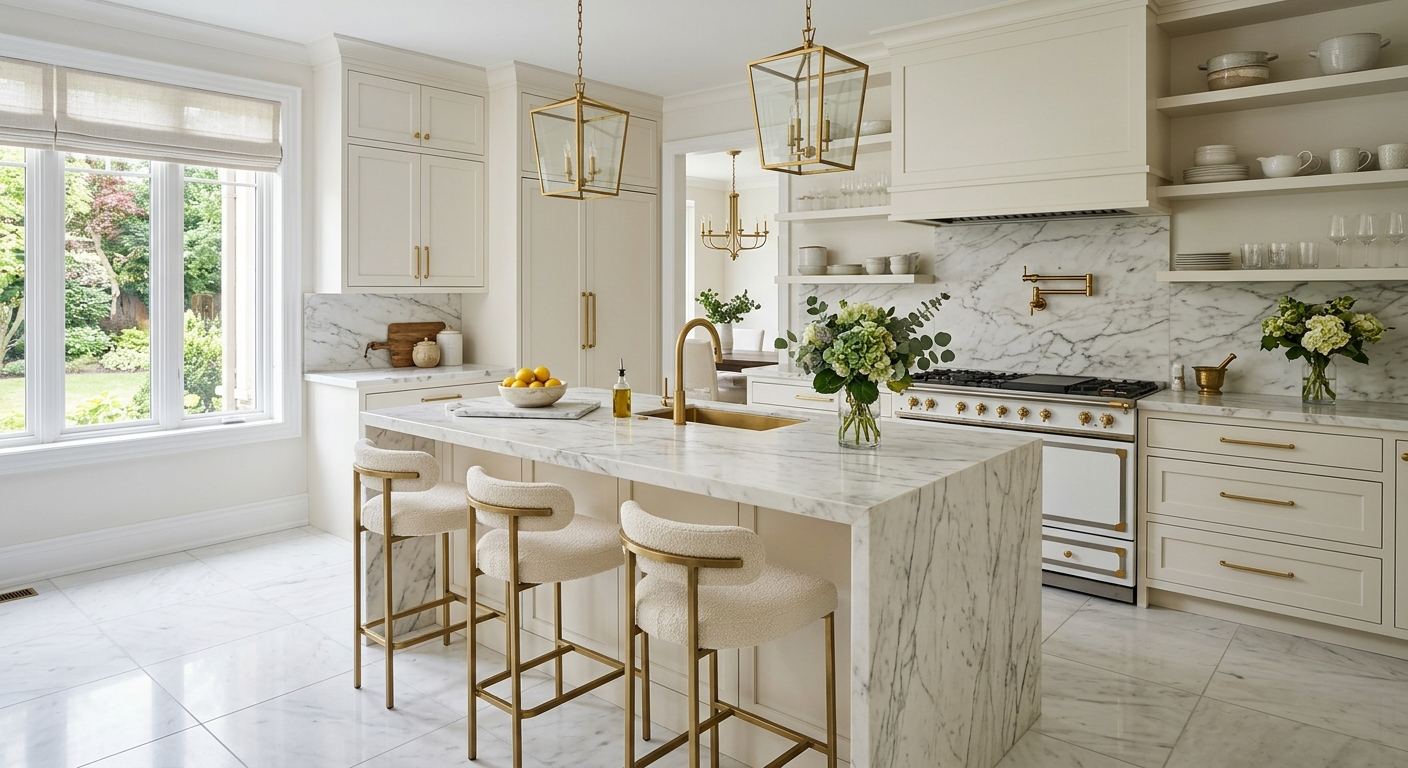
Kitchen renovation options and costs in Guelph
Kitchen renovation in Guelph ranges from a simple refresh to a full rebuild, and the right scope starts with your goals and your budget. In Guelph, many homeowners are planning renovations as their household finances stay steady—median household income is reported at $93,000 (Statistics Canada, 2021 Census)—and that matters because it influences whether you’ll choose stock cabinetry or move toward semi-custom and quartz-like finishes that buyers recognize right away. Homeownership is also the norm, with 65.7% of households owning their homes (Statistics Canada, 2021 Census), so most projects are designed to last and to recoup value on resale.
In the Kitchener–Waterloo–Barrie market, pricing is driven far more by home values and expected finish tier than by weather alone. That’s why the same “mid-range” plan can land higher in neighbourhood pockets of Guelph where homeowners tend to prioritize custom or semi-custom cabinetry and premium stone. Contractor availability and scheduling also tighten in peak renovation seasons, especially for carpentry and countertop templating, which can widen price gaps between “quick install” and “bespoke” timelines.
Renovations are particularly in demand in and around Stone Road Mall area and the West Guelph neighbourhoods, where many homes built before 1981 (43.7% of dwellings) are due for updates that bring layouts, lighting and finishes up to modern standards. Once you’re deciding between scope levels, it’s helpful to compare what each renovation tier typically includes and what you can expect to budget—see the table below.
| Renovation Tier |
What's Included |
Typical Duration |
Price Range |
| Cosmetic refresh (paint, hardware, new appliances only) |
Paint and caulking, new cabinet hardware/pulls, appliance swap (no major plumbing/electrical changes), basic cleaning/prep |
3–7 days |
$5,000–$15,000 |
| Mid-range full renovation (new cabinets, counters, sink, tile) |
New stock or semi-custom cabinets, quartz or entry-level stone counters, undermount sink and faucet, backsplash/tile, updated lighting, standard plumbing/electrical connections |
3–6 weeks |
$30,000–$60,000 |
| High-end full renovation (custom cabinets, stone counters, island) |
Fully custom cabinetry, premium stone/quartz, island with upgraded lighting, enhanced backsplash (including slab or premium tile), more complex electrical (under-cabinet + island circuits), layout tweaks |
6–12 weeks |
$60,000–$90,000 |
| Cabinet refacing only (new doors + drawer fronts, same boxes) |
Remove and replace doors/drawer fronts, new handles, refinish cabinet exterior, re-seal/repair where needed; counters kept unless worn |
1–3 weeks |
$6,000–$22,000 |
| Countertop swap only (laminate to quartz or stone) |
Remove old surface, install new quartz/stone (or premium laminate), reseal as required, cutouts for sink/cooktop, standard backsplash touch-up |
5–12 days |
$4,500–$12,500 |
| Backsplash tile installation only |
Demo as needed, install new tile/ceramic, grout/seal, caulk at changes of plane |
3–7 days |
$1,500–$8,000 |
Prices are estimates only and vary by project scope, site access and material selection.
What affects the price of kitchen renovation in Guelph
In Guelph and the wider Kitchener–Waterloo–Barrie economic region, two quotes for a “similar” kitchen can differ by 30–50% because the pricing drivers aren’t evenly distributed: cabinet build quality, countertop selection, and how much labour shifts from straightforward swaps to coordination-heavy work. Ontario-wide, labour availability and trade scheduling (carpentry, electrical, plumbing) can add cost even when the visible finishes look the same.
Home values and median income shape the typical finish tier far more than climate. In higher-value neighbourhoods around Kitchener, Waterloo, and Guelph, homeowners often standardize on quartz or premium stone and semi-custom cabinetry because buyers tend to view these as durable, modern upgrades—so the spend is easier to justify at resale. By contrast, in more modest pockets, ROI-minded owners usually choose stock cabinets, selective refacing, and laminate or entry-level quartz to keep the total project in the more accessible range. One consequence: a “mid-range” full renovation can commonly land around $30,000–$60,000, while a high-end scope with an island and custom millwork more often approaches $60,000–$90,000.
Concrete Guelph examples that raise cost: (1) older homes—especially those built before 1981—often have out-of-date electrical, so adding an island or relocating outlets triggers extra labour; (2) venting changes for range hoods can require more ducting coordination than homeowners expect; (3) if your kitchen floors or subfloor are uneven, subfloor repair before cabinetry can add days. Weather doesn’t directly “damage kitchens” year-round, but seasonal temperature and humidity swings can affect curing timelines for adhesives, caulking and some flooring transitions—so steady scheduling matters in spring and summer.
Regardless of materials, layout changes remain the most unpredictable cost: removing a wall, adding an island, or moving a gas line (or even just re-venting) can transform a cosmetic job into a structural and mechanical one.
| Price Factor |
Why It Matters |
Cost Impact |
| Cabinet tier — stock vs. semi-custom vs. fully custom millwork |
Cabinet build complexity drives material and labour time; hardware upgrades and better tolerances cost more but fit cleaner |
Often the largest swing, roughly 30–35% of total budget |
| Countertop material — laminate vs. quartz vs. granite vs. stone |
Material price, edge profiles, seam layout and templating complexity change install time and labour |
Can move countertop installation by thousands (e.g., quartz/stone higher) |
| Layout change — wall removal, island add, plumbing/gas move |
Mechanical reroutes, structural considerations and new openings increase coordination and permit scope |
Highest variability; commonly adds the most unexpected cost |
| Appliance package tier — builder vs. mid-range vs. pro-grade |
Electrical requirements, ventilation, and fitting clearances increase labour for higher-end models |
Can shift total budget meaningfully even if finishes stay similar |
| Flooring — refinish existing vs. full replacement |
Cabinet base setting, underlayment, and level transitions affect both prep and long-term performance |
Full replacement typically adds labour + material; refinish is lower cost |
| Backsplash — ceramic tile vs. marble vs. full-height slab |
Material density, cutting pattern and installation method affect labour duration and waste |
Full-height and premium stone are higher, tile is more budget-friendly |
| Electrical — new circuits for island, under-cabinet lighting |
Adding circuits requires licensed work and inspection; wiring runs can be hidden behind walls |
Often a significant add-on once you exceed standard plug-and-light upgrades |
| Permit fees and licensed trade requirements |
Scope requiring permits/inspections adds administrative steps and professional coordination |
Usually modest fees but large schedule/labour impacts |
Permits & regulations in Ontario
In Ontario, simple cabinet and countertop swaps usually don’t require permits. That includes replacing existing cabinets with new ones that use the same layout and not altering plumbing or electrical, and countertop installation when the sink/cooktop cutouts are simply re-used. However, permits and licensed trades are typically required when you’re changing the “systems” in the kitchen.
Work that commonly does require a permit includes: moving plumbing supply or drain lines (sink relocation, dishwasher drain changes), relocating gas lines or making changes for a gas stove, and modifying range hood venting when it changes the existing system. Removing a load-bearing wall also triggers permit requirements because it affects structure. If your renovation includes adding electrical circuits (for a new island receptacle layout, under-cabinet lighting circuits that require new wiring, or moving/adding breakers), that also typically requires permits and a licensed electrician’s work.
For a homeowner in Guelph, verify before you sign:
- Licensing: ask for the trade licence numbers for electricians and gas fitters (where applicable), and confirm through Ontario’s online licensing/verification tools.
- Liability insurance: request a current Certificate of Insurance naming you (or confirming they carry coverage appropriate to your job).
- WSIB/WCB coverage: confirm they have coverage for workers (or demonstrate compliance through their clearance letter/status).
- Contract language: confirm who pulls permits and who pays permit-related costs—put it in writing.
Always confirm permit responsibility with the contractor before signing; it’s part of protecting your project timeline and your liability.
Cabinets, countertops and layout decisions in Guelph
In a Guelph kitchen renovation, your three biggest decisions usually determine 80% of the result: (1) cabinet tier (stock, semi-custom, or custom), (2) countertop material (laminate, quartz, granite, butcher block, or marble), and (3) whether you’re changing the layout (open-concept wall removal, island addition, or plumbing/gas relocation). Because Kitchener–Waterloo–Barrie resale buyers often look for clean lines, modern storage and durable surfaces, these choices are less about “what looks nice today” and more about what holds up through everyday use and viewings.
For cabinets, stock is fastest and cheapest, while semi-custom is the most popular mid-range option because you get better depth/door options and more built-in solutions without custom shop pricing. Custom cabinets shine when you need unusual dimensions or want a perfect fit for older Guelph home layouts. Countertops follow a similar pattern: laminate is budget-friendly but least resilient to deep scratches and long-term wear; quartz is a durable, low-maintenance upgrade that often threads the needle for mid-range budgets; granite/natural stone offers premium aesthetics with sealing/maintenance considerations; butcher block is warm and practical but needs regular oiling to prevent drying and staining; marble is beautiful but softer and more maintenance-heavy.
Layout changes are where cost can jump quickly. Adding an island is justified when it improves circulation and storage—especially if your current work triangle is tight. But if you’re moving plumbing or gas to create that island sink or relocate the cooktop, the work becomes coordination-heavy and often pushes the project toward full renovation budgets rather than a refresh.
Here’s a realistic dollar example: if you’re debating quartz versus laminate, the upgrade may fit within a mid-range renovation where you’re targeting around $30,000–$60,000. If your cabinets are still dated or your layout needs a major reroute, spending extra on higher-end counters won’t solve the real usability issue—those cases are better planned as a full scope closer to $60,000–$90,000, where the kitchen changes are bundled with the mechanical and electrical upgrades required.
| Option |
Durability |
Maintenance |
Best For |
Price Range |
| Stock cabinets (big-box) |
Good for standard sizes; less flexibility for odd layouts |
Low day-to-day upkeep; hinges/finishes vary by line |
Faster installs and budget control |
$6,000–$18,000 |
| Semi-custom cabinets (local dealer) |
Very good—better fit options and storage configurations |
Low; choose quality hardware for long life |
Most popular mid-range renovations in Guelph |
$14,000–$30,000 |
| Custom cabinets (local millwork shop) |
Excellent—built to your dimensions and preferred door/style details |
Low with proper care; higher-grade components usually |
Challenging spaces and high-end finishes |
$25,000–$60,000 |
| Laminate countertop |
Moderate; can scratch or chip at edges over time |
Easy daily cleaning; avoid sustained heat and aggressive cleaners |
Cost-sensitive upgrades |
$1,500–$4,000 |
| Quartz engineered countertop |
High—very resistant to staining and daily wear |
Low; wipe clean and avoid impact at seams |
Best balance for resale-friendly durability |
$3,500–$8,500 |
| Granite / natural stone countertop |
High—durable but varies by stone; edges and seams matter |
Moderate; periodic sealing and care around acidic substances |
Premium look with natural variation |
$5,000–$12,000 |
| Butcher block countertop |
Good—can dent/scratch but can be sanded/refinished |
Higher maintenance; oiling and routine care needed |
Warm, lived-in style kitchens |
$3,000–$7,000 |
| Marble countertop |
Moderate—beautiful but more susceptible to etching and staining |
High; frequent sealing and careful cleaning habits |
Low-traffic showpiece style or careful homeowners |
$6,000–$14,000 |
How to choose a kitchen renovation contractor in Guelph
Choosing the right contractor in Guelph comes down to proof, process, and clarity—not just the lowest number. First, verify Ontario licensing where it applies: gas work must be done by a licensed gas fitter, and electrical by a licensed electrician. Ask for their licence numbers and confirm them through Ontario’s online licensing/verification tools. Next, request proof of liability insurance (a Certificate of Insurance that’s current and appropriate for your project) and confirm WSIB/WCB coverage for the workers involved. A clearance letter/status is often provided, and it matters because it protects you if an incident happens on site.
Then get 2–3 itemised written quotes. Look for a labour and materials breakdown rather than a single lump sum. The scope needs to spell out what’s included: cabinet install, countertop template/schedule, subfloor work, disposal, and whether permits are included or billed separately. Confirm whether demolition includes hauling away debris to a disposal facility, and whether there are any exclusions (e.g., hidden damage, asbestos testing, or making good drywall after mechanical rough-ins).
For warranty, insist on two parts: workmanship warranty length (often tied to their processes) and product/manufacturer warranties for cabinets, countertops and appliances. Ask if the warranty is transferable to you as the homeowner.
Finally, use smart payment scheduling. Never pay more than 10–15% upfront. Request a holdback until key milestones are complete, like countertop installation and final trim/caulking.
- License/coverage confirmation in writing (electrician/gas fitter where needed)
- Certificate of Insurance and WSIB/WCB clearance/status before work starts
- 2–3 itemised quotes with labour + materials, not lump sums
- Explicit demo, disposal, and protection scope (floors, stairs, cabinets not in scope)
- Permit responsibility stated in the contract
- Schedule: written start date and estimated completion date
- Change order process: written approvals with pricing method
- Countertop templating dates and who pays if templating is delayed
- Appliance cutout and electrical outlet location verification before fabrication
- Warranty terms stated (workmanship and manufacturer coverage)
- Payment milestones tied to measurable completion (rough-in, install, final)
- Site readiness expectations (parking/access, hoisting, dust control)
Red flags I see too often in Guelph: contractors who won’t provide WSIB/WCB proof, quotes that omit disposal or permit responsibility, vague scopes with lots of “allowances” but no quantities, payment requests above 10–15% upfront without milestones, and teams that cannot explain their countertop templating/lead-time plan. If you don’t get clear answers early, you’ll feel it later in delays and change orders.
Frequently asked questions — kitchen renovation in Guelph
What's the most cost-effective kitchen upgrade?
In Guelph and across Ontario, the most cost-effective upgrades are usually the ones that deliver a “new kitchen” look without major mechanical work. Typically, upgrading cabinet hardware and refinishing/painting visible cabinet faces, paired with a good lighting refresh (under-cabinet LEDs and updated switches) can make a big visual difference for relatively low disruption. If you want a bigger impact but still keep costs controlled, consider re-facing cabinets and swapping to quartz countertops—many homeowners land in the mid-range of $30,000–$60,000 when they’re doing a full upgrade, but smaller scope options like refacing can start around $6,000–$22,000. The best ROI usually comes from minimizing layout changes; moving plumbing or adding electrical circuits is where budgets jump.
Custom vs stock cabinets — is custom worth it?
Custom cabinets can be worth it in Guelph when your kitchen has unusual dimensions, older framing quirks, or you want specific storage solutions (pantries, appliance garages, built-in charging, deep drawers) that stock systems can’t match. For many homeowners, semi-custom hits the “sweet spot” because it improves fit and style without the full cost of made-to-order. If your goal is resale and you’re staying within a mid-range budget, stock or semi-custom often looks premium enough—especially when paired with quartz countertops. Custom becomes easiest to justify when you’re already approaching a full renovation budget like $60,000–$90,000, because the project’s overall scope supports higher cabinet line items and you can leverage the extra carpentry time.
How do I choose a kitchen contractor in Guelph?
Start by confirming the right coverage and licensing. For kitchen work that involves gas or electrical changes, you need licensed professionals; ask your contractor for licence details and confirm them through Ontario’s online verification tools. Also request liability insurance paperwork and verify WSIB/WCB coverage via clearance/status documentation. Next, compare apples-to-apples: ask for 2–3 itemised quotes with labour and materials breakdown, and confirm whether permits and disposal are included. Make sure their scope lists what’s excluded (common exclusions include hidden damage and subfloor repairs). Finally, watch the payment terms—never pay more than 10–15% upfront, and keep a holdback until key work is completed. Clear contracts prevent most Guelph renovation disputes.
What order do kitchen renovation steps happen in?
A typical order in Guelph is: (1) site measurements and final design sign-off, (2) demo and removal of old finishes, (3) rough-in work for plumbing/electrical (and gas work if applicable) and any required permit inspections, (4) drywall and surface prep, (5) flooring prep/installation if it’s part of the scope, (6) cabinet installation (leveling, fixing to studs, base alignment), (7) countertop templating (after cabinets are set), (8) countertop fabrication and installation, (9) backsplash installation, (10) final trim/caulking, paint touch-ups, and appliance hook-ups. This sequencing matters because cabinet installation must be finished before templating. If someone wants to template too early, you risk misaligned countertops and extra cost.
Can I live at home during a kitchen renovation in Guelph?
Many homeowners in Guelph do stay at home during parts of the renovation, especially for cosmetic refreshes or countertop/backplash-only projects. For mid-range full renovations and high-end scopes, it’s still possible, but you’ll need a workable plan for a temporary cooking area and protected pathways. If your project involves moving plumbing or significant electrical, you may be without a functional sink for a stretch of time, and demolition dust needs containment. A mid-range full renovation typically runs about 3–6 weeks, so most families set up a microwave/portable induction station and a simple “one-room kitchen” for daily meals. If the job pushes toward a complete rebuild closer to $60,000–$90,000, consider living arrangements carefully—schedule clarity reduces stress.
Should I renovate my kitchen before selling in Guelph?
It depends on your kitchen’s current condition and how much value you can realistically add. In Guelph, buyers often respond strongly to updated cabinets, clean countertops, modern lighting and a functional layout—even when they don’t change everything. If your kitchen is dated but structurally sound, a targeted renovation (like new counters and updated cabinet fronts/hardware) can improve buyer perception without overspending. If your layout is cramped or your electrical/plumbing is outdated, you may get better results by addressing the mechanical issues as part of a full renovation rather than patching. As a budget anchor, many homeowners plan mid-range projects around $30,000–$60,000 and use durability-driven choices (like quartz) to appeal to a broad buyer pool. If you’re unsure, ask for a scoped quote tied to your selling timeline—timelines and material lead times matter just as much as price.