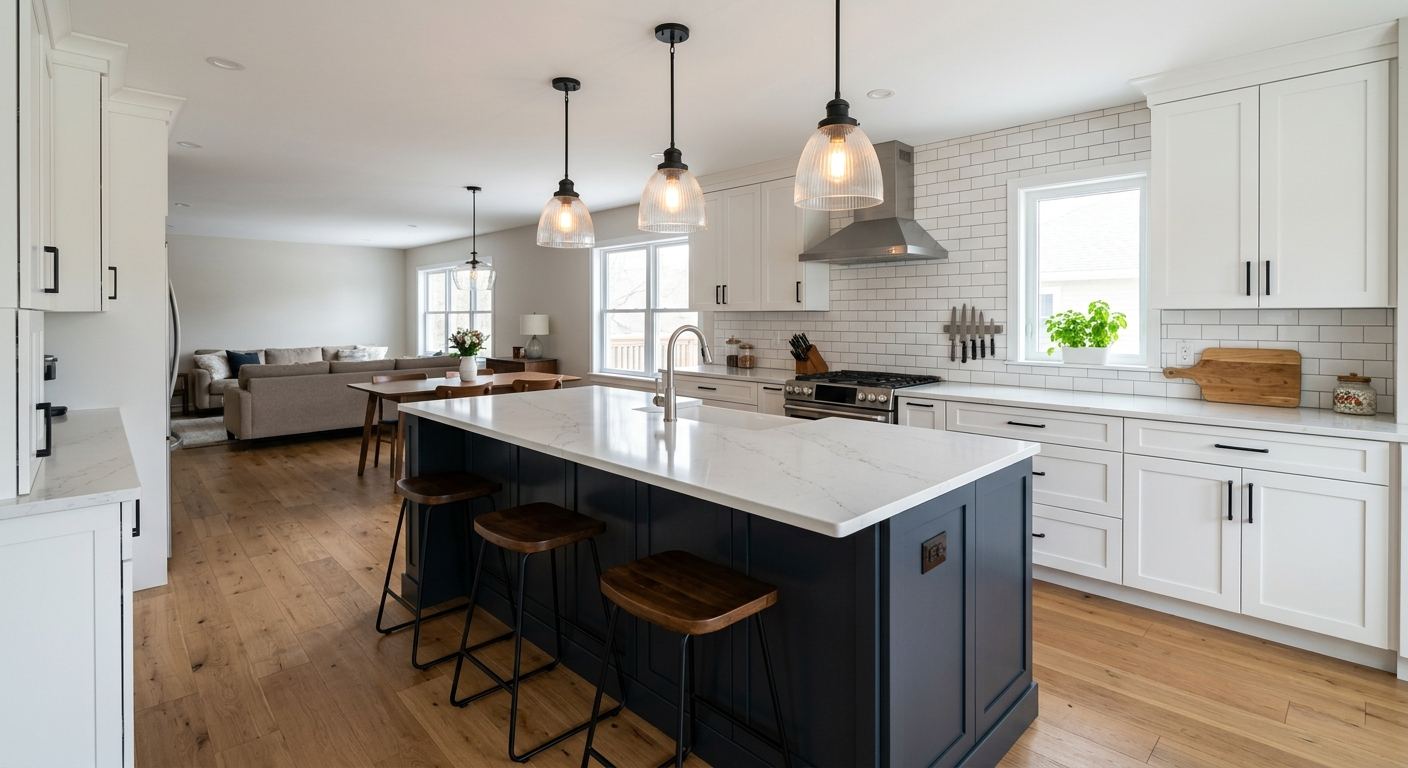
Kitchen renovation options and costs in Preston Centre
Preston Centre, Ontario sits in the Toronto economic region, and kitchen renovation choices there usually mirror what homeowners can recover at resale. With a local population of 10,441 (Statistics Canada, 2021 Census), the market is busy enough that contractors get steady work—but pricing still moves with Ontario’s broader affordability pressures. In higher-value pockets of the GTA, homeowners often invest a meaningful share of their home value into the kitchen (commonly around 8–15% in stronger resale areas), which is why you’ll see more quartz or natural stone and more custom millwork decisions. In more price-sensitive communities, the same layouts get done with semi-custom cabinetry, durable laminate tops, and selective upgrades to hit a better cost-to-value balance.
Unlike some regions where winter weather drives extra installation labour, Toronto-area renovation costs are shaped more by market expectations than climate. Availability and scheduling matter: popular finish tiers (semi-custom and premium stone) can add lead time for cabinet manufacturing and countertop templating. Labour pricing across the GTA is relatively consistent, so finish tier remains the main driver—moving from low–mid range refreshes into $80k+ territory when you add structural work, an island, or custom cabinetry. For many Preston Centre homes—often older detached and semi-detached stock—customers request layout updates that better use space, which helps explain why “mid-range full renovation” options are the most common starting point before owners decide whether to go higher-end.
Here’s a practical comparison of the most common renovation paths homeowners take in Preston Centre, and what budgets typically look like as you move up the tiers. If you’re in the West Preston / surrounding Preston Centre blocks, these options tend to be booked fastest due to strong demand for functional upgrades and modern finishes.
| Renovation Tier |
What's Included |
Typical Duration |
Price Range |
| Cosmetic refresh (paint, hardware, new appliances only) |
Cabinet paint (no box changes), new hinges/handles, new appliance package (no structural changes), basic lighting upgrades where existing wiring allows |
3–7 days |
$25,000–$35,000 |
| Mid-range full renovation (new cabinets, counters, sink, tile) |
New semi-custom or upgraded stock cabinets, quartz or good laminate countertops, undermount sink, tap, backsplash tile, flooring touch-ups/partial replacement, standard plumbing reconnect, ventilation connection where ducting already exists |
3–5 weeks |
$45,000–$70,000 |
| High-end full renovation (custom cabinets, stone counters, island) |
Fully custom cabinetry, premium quartz or natural stone counters, island construction (electrical/plumbing allowances if needed), full-height or feature backsplash, upgraded appliance package, higher-end fixtures and lighting design |
6–10 weeks |
$75,000–$90,000 |
| Cabinet refacing only (new doors + drawer fronts, same boxes) |
Door/drawer replacement, new end panels and trim, hardware, refinishing or patching around existing boxes, optional under-cabinet lighting if wiring is already present |
1–2.5 weeks |
$8,000–$35,000 |
| Countertop swap only (laminate to quartz or stone) |
Remove existing top, template and install quartz/stone (or upgrade laminate), re-set sink and tap plumbing connections as required, basic backsplash edge finish coordination |
1–2 weeks |
$3,000–$15,000 |
| Backsplash tile installation only |
Surface prep, tile installation, grout sealing, caulking at edges, optional niche or outlet trim updates if minor |
2–5 days |
$2,000–$10,000 |
Prices are estimates only and vary by project scope, site access and material selection.
What affects the price of kitchen renovation in Preston Centre
In Toronto and across Ontario, two homeowners can get quotes that differ by 30–50% for the same “new kitchen” concept because each contractor prices risk differently—especially around layout changes, hidden damage, and the finish tier chosen. Local home values and the income profile in the Toronto economic region shape expectations: in higher-value neighbourhoods, buyers are more likely to default to quartz or natural stone counters and semi-custom cabinetry because owners expect the renovation spend to show up in resale. In more price-sensitive pockets, laminate and stock cabinets are common, with the budget redirected to what buyers notice most (clean lines, good lighting, and a durable countertop).
Climate is rarely the driver in Preston Centre the way it is for exterior work. The Toronto area’s seasonality mainly affects scheduling and countertop lead times, not the fundamental installation labour. What matters more is the age of many homes and how often we find surprises behind older drywall: dated plumbing runs, irregular cabinet openings, or subfloor/underlayment that needs patching before new cabinets sit flat. When renovations go from “mid-range full renovation” at roughly $45,000–$70,000 into higher-end territory (often $75,000–$90,000), it’s usually due to custom millwork, stone selection, and island or electrical/plumbing scope—not winter conditions.
Concrete examples from Preston Centre jobs: (1) moving a gas cooktop or changing venting expectations can add significant trades time, even when the layout seems “simple”; (2) if your kitchen has older plaster walls, straightening and patching before cabinet install can add days and materials; (3) upgrading to full-height backsplash or premium tile patterns increases labour for fine alignment around outlets. Those factors can push costs beyond the base price bands even when the cabinet and countertop choices look similar on paper.
| Price Factor |
Why It Matters |
Cost Impact |
| Cabinet tier — stock vs. semi-custom vs. fully custom millwork |
Higher tiers offer better fit, more options (heights, internal organization), and typically longer lead times |
Can swing a full renovation by roughly $15,000–$30,000+ |
| Countertop material — laminate vs. quartz vs. granite vs. stone |
Material price and fabrication/templating difficulty vary widely, especially around islands and waterfall edges |
Typically $3,000–$15,000 for swaps, and higher for premium stone or complex installs |
| Layout change — wall removal, island add, plumbing/gas move |
Structural work and relocating services drive labour and permit scope; unpredictability is highest here |
Often adds $10,000–$25,000 depending on services and framing needs |
| Appliance package tier — builder vs. mid-range vs. pro-grade |
Upgraded appliances can require different electrical/venting requirements and premium trim/fit |
Can add $2,000–$12,000+ |
| Flooring — refinish existing vs. full replacement |
Protecting or matching existing flooring is cheaper than removing and replacing; subfloor condition affects outcome |
Often $1,500–$8,000+ depending on demolition scope |
| Backsplash — ceramic tile vs. marble vs. full-height slab |
Premium materials and full-height coverage increase layout time, cutting, and finishing |
Typically $2,000–$10,000+ |
| Electrical — new circuits for island, under-cabinet lighting |
Additional lighting and receptacles can require new circuit runs and inspections |
Often $800–$4,000+ for common upgrades; higher for major rework |
| Permit fees and licensed trade requirements |
Permits add administrative steps; licensed trades can price differently for complexity and scheduling |
Can add $500–$3,000+ depending on the permit scope |
Permits & regulations in Ontario
In Ontario, a simple cabinet or countertop swap typically does not require a building permit, because you’re finishing surfaces rather than changing structural elements or major systems. However, the moment you touch plumbing supply/drain lines, relocate a gas stove or adjust venting tied to a gas appliance, remove a load-bearing wall, or add electrical circuits, permits and licensed trade work usually come into play. For homeowners in Preston Centre, the most common cost surprises come from underestimating how far “small changes” can go—especially when drawings show cabinet work that quietly implies plumbing rework behind the scenes.
Here’s a straightforward way to think about it. Usually does not need a permit: painting cabinets, swapping doors/drawer fronts (refacing), replacing countertops, installing a backsplash, and replacing like-for-like fixtures without moving supply/drain locations. Usually does require permits and inspections: adding an island with new circuits and receptacles, moving a sink location, changing a dishwasher connection route, relocating a gas cooktop or range hood tied to gas venting, upgrading service panels for kitchen loads, or removing walls that affect structural support.
Step-by-step verification you can do before signing: (1) ask for the contractor’s Ontario licence details and confirm they’re registered for the trades involved; (2) request a current certificate of liability insurance and verify the coverage limits match the job size; (3) obtain proof of WSIB/WCB clearance where applicable for the trades doing installation and demolition; and (4) ask for inspection and permit responsibility in writing—who pulls permits, who schedules inspections, and when. If a contractor won’t provide documents or contract clarity, that’s a red flag in any Ontario kitchen project, including Preston Centre.
Cabinets, countertops and layout decisions in Preston Centre
Three decisions drive how successful your Preston Centre kitchen renovation feels: (1) cabinet tier, (2) countertop material, and (3) whether you change the layout (and how much). Cabinet tier controls the fit and finish you’ll live with every day. Stock cabinets are fastest and typically cheapest, but the openings can look “standard” in older homes where walls aren’t perfectly square. Semi-custom cabinets are the most popular mid-range choice in the Toronto market because they balance lead time and cost while improving storage, door styles, and the ability to correct imperfect rough openings. Fully custom cabinets cost the most, but they’re the best path for tight spaces, unusual ceiling heights, and high-end organizing features.
Countertop material is the biggest durability and maintenance lever. Laminate is budget-friendly and looks good with the right edge and pattern, but it’s more vulnerable to scorching and deep gouges. Quartz is the common “safe upgrade” because it resists staining and holds up well to everyday use. Natural stone (granite/stone) can be beautiful and durable, but it may require more careful sealing routines, depending on the specific stone. In Preston Centre homes, layout changes are often justified by space gain: an island can improve flow and storage, but it’s where electrical and plumbing scope can push costs sharply. When you move services, you also trigger the permit/licensed trade steps discussed earlier.
Budget-wise, a clear example: upgrading to quartz from laminate commonly moves a kitchen toward the mid-range band, while adding an island and custom cabinetry is what typically brings the total into high-end territory (around $75,000–$90,000 for larger builds). In the Toronto resale market, buyers often expect a modern countertop surface and clean cabinetry lines; the “smart spend” is investing in the countertop and cabinet feel, then keeping structural work limited unless the space truly needs it.
| Option |
Durability |
Maintenance |
Best For |
Price Range |
| Stock cabinets (big-box) |
Good for everyday use; fit can be less precise in older openings |
Low—keep hinges adjusted and wipe clean; touch-ups if walls are uneven |
Fast timelines and budget-conscious refreshes |
$8,000–$25,000 |
| Semi-custom cabinets (local dealer) |
Very solid; better sizing options and more door/style choices |
Low to moderate—maintain hardware and seal finishes as directed |
Most Preston Centre homeowners aiming for strong resale value |
$25,000–$50,000 |
| Custom cabinets (local millwork shop) |
Excellent; tailored fit and higher-end hardware/organization possibilities |
Low to moderate—finish care depends on door material and stain |
Odd layouts, ceiling-height matching, and premium organization |
$50,000–$90,000 |
| Laminate countertop |
Decent for family kitchens; sensitive to heat and deep impact |
Easy—wipe clean; avoid prolonged hot pans directly on the surface |
Keeping costs in the low–mid range with good visual results |
$3,000–$7,000 |
| Quartz engineered countertop |
High durability; resistant to staining and everyday wear |
Low—typical household cleaners; avoid abrasive pads |
Balance of beauty, durability, and resale-friendly appeal |
$7,000–$12,000 |
| Granite / natural stone countertop |
Very durable; performance varies by specific stone and finish |
Moderate—may require periodic sealing and careful cleaning |
Homeowners who want natural character and premium look |
$10,000–$15,000 |
| Butcher block countertop |
Good impact resistance; can scratch and swell if poorly maintained |
Moderate—oiling routine and immediate drying after spills |
Casual kitchens where warmth matters more than “no-fuss” care |
$6,000–$10,000 |
| Marble countertop |
Beautiful but more susceptible to etching and staining vs quartz |
Higher care—sealed maintenance and careful cleaning products |
High-end showpiece kitchens with a careful owner |
$12,000–$18,000 |
How to choose a kitchen renovation contractor in Preston Centre
Choosing the right contractor is less about flashy photos and more about proof: Ontario licensing/qualifications for the trades involved, liability insurance, and WSIB/WCB coverage. Start by asking for (1) proof of current general/commercial liability insurance (certificate of insurance); (2) evidence that the installation trades carry WSIB/WCB coverage where required; and (3) the specific trade documentation for gas/electrical work so you know the right people are doing the regulated tasks. If they can’t provide these documents quickly or they only “promise” coverage, don’t assume it’s fine.
Next, insist on 2–3 itemised written quotes. You want labour + materials broken out so you can compare apples-to-apples—especially for cabinets, countertops, tile, demolition/disposal, and electrical/plumbing allowances. A lump-sum number hides the differences that cause budget blowouts, like whether permits are included, whether drywall patching is included after cabinet install, and whether disposal is included in the price. Read the scope line by line: what’s excluded, what’s “allowance,” and what triggers extra charges.
Also confirm warranty terms. A workmanship warranty should be clear (length and what it covers), and manufacturer warranties should be provided for cabinets/countertops. Ask if the warranty is transferable if you sell your home—this matters for resale in Preston Centre. Finally, payment schedule matters: never pay more than 10–15% upfront. Use holdback tied to completion of punch-list items. Get a written start date and completion estimate, plus what happens if lead times delay cabinets or stone templating.
- Provide insurance certificate and confirm coverage amounts before signing.
- Show WSIB/WCB clearance documentation for trades doing interior work.
- List which permits are included (or excluded) and who pulls them.
- Confirm licensed trades for gas and electrical if your plan includes any relocation.
- Use an itemised quote: labour, materials, demolition, disposal, and allowances separated.
- Verify countertop fabrication includes templating and edge/undermount sink details.
- Confirm tile scope includes prep, waterproofing where required, and caulking details.
- Ask about cabinet installation plan for out-of-square walls (shim/patch method).
- Get a schedule that includes cabinet and countertop lead times.
- Require a written warranty: workmanship coverage length and exclusions.
- Keep deposits low (10–15% max) and use a holdback until punch list completion.
- Confirm the contractor will protect floors/doorways and manage site dust control.
In Preston Centre, common red flags include: a quote that’s only a single lump sum without allowances, refusal to provide insurance/WSIB documentation, vague wording like “permits if needed” with no responsibility assigned, missing start/end dates in writing, and warranty terms that are shorter than typical workmanship coverage or don’t clearly define what’s included.
Frequently asked questions — kitchen renovation in Preston Centre
Can I live at home during a kitchen renovation in Preston Centre?
Yes, many Preston Centre homeowners live at home during a renovation, especially for cosmetic updates, countertop swaps, refacing, and mid-range full renos that keep demolition contained. For major layout changes (new island, relocating plumbing, or electrical additions), you can still often remain at home, but expect a temporary “work zone” in the kitchen and limited access to sinks/cooking for portions of the schedule. Contractors typically set up a safe staging area, protect adjacent floors, and coordinate work to minimize dust. The practical question is whether you can manage temporary cooking (microwave/hot plate) and whether the job duration fits your routine. If you’re staying put, it’s also wise to plan for parking access and consider lead times for cabinets and countertops so the disruption stays concentrated rather than stretching out.
Should I renovate my kitchen before selling in Preston Centre?
Often, yes—but it depends on what buyers nearby will pay for and how dated the kitchen is. In the Toronto economic region, kitchens tend to influence buyer decisions because they signal overall finish level and day-to-day usability. If your cabinets are solid but outdated, refacing plus a countertop upgrade can be a smart move: cabinet refacing alone commonly falls in the $8,000–$35,000 band, and a countertop swap can be a smaller, targeted step. If your kitchen needs a full refresh (new cabinets, counters, sink, tile) budgets commonly land in the $45,000–$70,000 range for mid-range renovations. Avoid over-customizing unless you’re confident it matches common buyer expectations. For any Ontario sale plan, ask your Realtor what finishes are trending and whether your layout issues (traffic flow, lack of storage) are worth solving before listing.
What's the most popular kitchen style in Preston Centre right now?
In Preston Centre and the surrounding GTA, the most common “buyable” style is a clean, modern-transitional look: simple shaker-style or flat-panel cabinetry, warm neutral colours, and bright, durable surfaces. Quartz countertops remain the most requested upgrade because they give a consistent appearance with low maintenance, and many homeowners choose a neutral or veined pattern that photographs well for listing photos. Layouts that balance openness with defined zones—like a functional peninsula or an island that supports seating—are also popular because they work for everyday living and show well in open concept homes. The exact style varies by budget tier: mid-range renos often use semi-custom cabinetry and quartz, while high-end projects tend to go custom with stone counters and more detailed lighting and organization.
How do I know if I need to update my kitchen plumbing in Preston Centre?
Look for symptoms and planning triggers. If you’re moving the sink location, upgrading from a recirculating hood, or changing a dishwasher connection route, you’ll likely need plumbing work to match the new layout—this is where permits/licensed trades may be required. Even if you’re not moving fixtures, you may still need updates when there are signs of leaks under the sink, slow drains, corroded shut-off valves, or outdated supply lines. In older Preston Centre homes, it’s common to find that shut-offs are inaccessible or that drain lines don’t align perfectly with new cabinet bases, which can require additional coordination during installation. The best way to confirm is to have your contractor review your existing rough-in during demolition (or with a pre-renovation inspection) and include a realistic plumbing scope allowance in the quote.
What is the difference between a galley and open-concept kitchen?
A galley kitchen is a narrow, straight-through layout with counters on two opposing sides, often with a single path for movement. It can be efficient for cooking, but storage and workflow can feel tight if there isn’t enough counter space or lighting. An open-concept kitchen integrates with the adjacent living/dining areas, typically through removed wall sections or reconfigured openings, which creates a wider “social” space and often better sight lines. In Ontario, whether you can open up a wall depends on whether it’s load-bearing and on the structure—removing a load-bearing wall generally requires permits and careful planning. In the Toronto market, open-concept layouts can add value when done correctly, but they also increase scope unpredictability if electrical/plumbing needs to shift.
How do I get accurate kitchen renovation quotes in Preston Centre?
To get accurate quotes in Preston Centre, provide a clear scope and require itemised pricing. Start by getting 2–3 written quotes that break down labour and materials rather than a single lump sum. Include details on cabinet tier (stock vs semi-custom vs custom), countertop material, backsplash coverage, and whether you’re changing layout or relocating plumbing/gas. Make sure the quote specifies what’s included for demolition and disposal, whether permits are included and who pulls them, and how electrical/plumbing allowances are handled. Ask for a realistic timeline based on lead times for cabinets and countertop templating. Finally, confirm warranty terms and the payment schedule (keep upfront deposits within 10–15%). If you’re working within bands like $25,000–$90,000 for full renovations, detailed scope is what determines where you land—otherwise two contractors can both say “kitchen renovation” while pricing totally different projects.