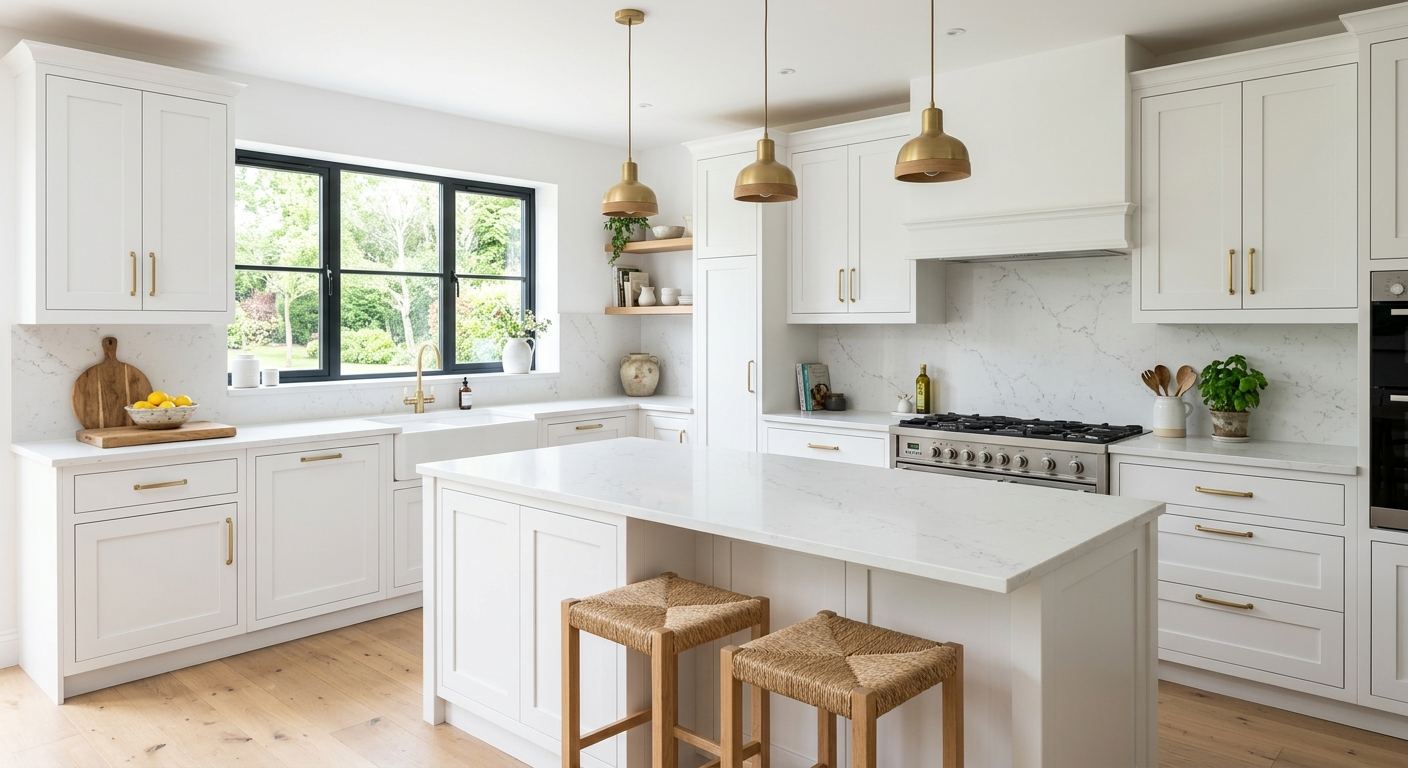
Kitchen renovation options and costs in Bluewater
Bluewater homeowners usually start their search by asking what a kitchen renovation will cost, and the answer depends on how far you want to go. With a median household income of $85,000 (Statistics Canada, 2021 Census) and a homeowner-heavy housing profile (83.5% of households own), many projects in Bluewater land on mid-range finishes that balance day-to-day use with resale value. In the Stratford–Bruce Peninsula region, kitchen budgets often track local home values more than “extreme climate” factors, so clients expecting a longer ownership window commonly choose semi-custom cabinetry and durable countertop surfaces. Weather still matters: Ontario winters mean dry-but-cold indoor heating cycles and seasonal moisture swings, so we pay attention to cabinet installation tolerances, caulking details around sinks, and how tile is bedded near exterior-facing walls—small workmanship choices that help prevent call-backs.
Renovations are especially in demand around the Port Albert area, where older housing stock and ongoing year-round use push homeowners to refresh lighting, storage, and workflow. Because many homes in the broader region were built before 1981 (60.5%), demolition can uncover out-of-date electrical runs and plumbing offsets, pushing labour higher even when finish selections stay “mid-range.” For planning purposes, most Bluewater budgets fall within the region’s backbone bands: full renovations typically start around the $35,000 mark and can reach $70,000+ when you move plumbing, add an island, or upgrade to quartz/stone surfaces.
Use the table below to compare common options before you request an itemised quote.
| Renovation Tier |
What's Included |
Typical Duration |
Price Range |
| Cosmetic refresh (paint, hardware, new appliances only) |
Cabinet paint or update, new hardware, appliance swap (same layout), minor caulking, and basic cleanup |
3–7 days |
$8,000–$18,000 |
| Mid-range full renovation (new cabinets, counters, sink, tile) |
New stock or semi-custom cabinets, new countertop, sink + faucet, backsplash tile, floor prep, and electrical refresh where needed |
3–5 weeks |
$35,000–$55,000 |
| High-end full renovation (custom cabinets, stone counters, island) |
Fully custom millwork, stone countertops, island build-out, upgraded backsplash (often to ceiling height), and deeper electrical/plumbing work |
5–8 weeks |
$55,000–$70,000 |
| Cabinet refacing only (new doors + drawer fronts, same boxes) |
New door/drawer fronts, new end panels where needed, refinish or replacement of exposed surfaces, and optional hardware upgrade |
1–2 weeks |
$8,000–$25,000 |
| Countertop swap only (laminate to quartz or stone) |
Removal and replacement of existing countertop, sink cut-out adjustments, new edge detail, and basic sealing/finishing |
4–8 days |
$3,000–$12,000 |
| Backsplash tile installation only |
Tile supply or install-only (varies by contractor), surface prep, waterproofing where appropriate, and grouting/sealing |
3–7 days |
$1,500–$7,000 |
Prices are estimates only and vary by project scope, site access and material selection.
What affects the price of kitchen renovation in Bluewater
Even when two homeowners request the “same” kitchen renovation across the Stratford–Bruce Peninsula region and broader Ontario, quotes can vary by 30–50%. The big reason is that finish tiers and the hidden work uncovered during demolition don’t scale evenly: one kitchen needs subfloor repairs and electrical rework, while another stays mostly cosmetic behind the walls. Local home values and household income shape the typical finish tier far more than climate. In higher-value pockets of the region, homeowners often choose quartz or natural stone counters and semi-custom cabinetry because they can better recover that spend on resale. In more modestly valued markets and for buyers focused on value, laminate and stock cabinets are common because they deliver a noticeable refresh without doubling the cabinetry and surface budget.
In Bluewater, there are a few concrete cost swings we see regularly. First, many homes in the area were built before 1981, so older wiring paths and plumbing rough-ins may force additional labour even if cabinet layout looks straightforward. Second, exterior-facing walls can bring more prep: cold-season cycling can loosen older tile beds or make caulk lines fail sooner, so we sometimes price extra waterproofing and membrane work. Third, accessibility affects labour—tight corridors and carry distance can add time for countertop and cabinet installs, especially when you’re moving stone slabs.
It’s also worth noting that layout changes are typically the most unpredictable cost regardless of finish. Removing a wall, adding an island, or moving a gas line can push you toward the higher end of the full renovation band ($35,000–$70,000), even if your cabinets stay “mid-range.”
| Price Factor |
Why It Matters |
Cost Impact |
| Cabinet tier — stock vs. semi-custom vs. fully custom millwork |
Door quality, interior storage, and how accurately boxes fit your walls affect both material cost and install labour |
Can swing the cabinetry budget by several thousands; custom often pushes projects toward the upper range of full renovations |
| Countertop material — laminate vs. quartz vs. granite vs. stone |
Material price, slab fabrication complexity, seam layout, and edge profiles drive cost |
Upgrades can materially increase countertop + installation; moving to quartz/stone commonly lifts the overall project level |
| Layout change — wall removal, island add, plumbing/gas move |
More demolition, blocking, framing, venting/electrical/plumbing rework, and sometimes structural work |
Often the biggest variable; can move you from mid-range into high-end labour pricing even with similar finishes |
| Appliance package tier — builder vs. mid-range vs. pro-grade |
Ventilation requirements, electrical specs, install tolerances, and finish/trim complexity differ by tier |
Modest to substantial; pro-grade packages frequently add both material and labour time |
| Flooring — refinish existing vs. full replacement |
Matching height transitions, underlayment, and damage during demolition affect cost |
Full replacement is a common add-on; refinish can reduce demo waste and labour |
| Backsplash — ceramic tile vs. marble vs. full-height slab |
Material weight and cutting complexity, plus surface prep and waterproofing |
Full-height or natural stone typically costs more than a standard tile run (often within the backsplash band) |
| Electrical — new circuits for island, under-cabinet lighting |
Code-compliant receptacle placement and lighting runs can require additional rough-in labour |
Costs vary widely depending on how many circuits are added and how far they must travel |
| Permit fees and licensed trade requirements |
Permits/inspections and the need for licensed trades can add administrative and labour overhead |
Usually incremental, but can increase total time and cost when major plumbing/gas/electrical changes are included |
Permits & regulations in Ontario
In Ontario, cabinet and countertop swaps generally do not require a permit. If you’re simply replacing doors, drawer fronts, or changing a countertop while keeping plumbing and gas locations the same, you’re typically in the “no permit” zone. Where permits do come in is when you change services: moving plumbing supply or drain lines, relocating a gas stove or range hood (or making any gas connection changes), removing a load-bearing wall, or adding new electrical circuits for an island, upgraded lighting, or additional receptacles.
In practice for Bluewater homeowners: (1) the contractor should tell you exactly which scopes trigger permits; (2) the permit holder is responsible for the submission and inspection process; and (3) you should confirm permit responsibility in writing before signing. Gas work must be completed by a licensed gas fitter, and electrical work must be performed by a licensed electrician, with inspections as required.
To verify a contractor in Ontario, do three things before work starts. First, confirm licensing: check the contractor’s trade credentials as applicable and ask for the relevant licensed trade details for gas and electrical. Second, request a certificate of insurance (liability) showing coverage for the renovation period. Third, ask for proof of WSIB/WCB coverage (or clearance where applicable for the contractor’s situation) and keep copies. If a contractor can’t provide documentation quickly, that’s usually a sign you’ll have trouble later when schedules slip or an inspection is missed.
Cabinets, countertops and layout decisions in Bluewater
In a Bluewater kitchen renovation, three decisions drive most of your satisfaction (and most of your cost): cabinet tier, countertop material, and layout changes. Cabinet tier affects how long the kitchen looks “new” as hinges loosen and doors absorb daily use. Stock cabinets are the fastest and cheapest option, semi-custom is the popular mid-range path because it offers better fit and storage options, and custom cabinets cost the most but shine when you have irregular wall lines or want a specific island/bench style. Countertops matter because Ontario’s seasonal indoor conditions—dry heating in winter and humidity swings—make correct sealing around sink cut-outs and well-installed backing critical. Finally, layout changes (open-concept wall removal, island addition, plumbing/gas relocation) are where you often gain real function, but you should only justify them when the space gain solves an actual daily problem like traffic flow, work triangle limits, or storage shortage.
From a Stratford–Bruce Peninsula resale perspective, buyers generally expect quartz or other durable surfaces at the mid-to-high tiers, while entry-level refreshed kitchens often use laminate to stay within a tighter budget. For a concrete example: a countertop swap band can land around $3,000–$12,000, but moving from laminate to quartz might be worth it if you’re staying put for years or if your home’s value tier supports modern finishes. If your plan is resale-focused and the cabinets are structurally sound, refacing (often $8,000–$25,000) can deliver the look change without the full rebuild cost.
| Option |
Durability |
Maintenance |
Best For |
Price Range |
| Stock cabinets (big-box) |
Good for day-to-day use; tolerances can be tighter in older homes |
Standard cleaning; hinges/hardware depend on brand tier |
Cost control and quick timelines |
$35,000–$55,000 |
| Semi-custom cabinets (local dealer) |
Solid build with more storage options and better fit for imperfect walls |
Low to moderate; keep seals and adjust hardware as needed |
Most Bluewater homeowners targeting a mid-range full renovation |
$35,000–$60,000 |
| Custom cabinets (local millwork shop) |
Highest fit and finish; ideal for unique layouts and island detailing |
Low; built for longevity when installed properly |
High-end projects and challenging dimensions |
$55,000–$70,000 |
| Laminate countertop |
Resistant to staining but can be less forgiving with heat/impact |
Simple cleaning; avoid prolonged heat exposure at seams |
Budget-friendly refresh and resale-friendly “update” |
$3,000–$6,500 |
| Quartz engineered countertop |
Very durable for daily cooking; consistent performance and fewer maintenance issues |
Low maintenance; clean normally and keep seams sealed |
Most mid-range buyers who want a modern look and durability |
$6,000–$12,000 |
| Granite / natural stone countertop |
Natural beauty and durability; varies by slab and finishing |
Typically requires attention to sealing depending on the stone |
High-end finishes and distinctive veining |
$7,000–$14,000 |
| Butcher block countertop |
Great resilience; can scratch and needs proper care near sinks |
Periodic oiling/sanding; protect from standing water |
Warm, traditional style and homeowners who like upkeep |
$4,500–$10,000 |
| Marble countertop |
Beautiful but softer; more sensitive to etching and staining |
Higher care; needs sealing and quick spill wipe-up |
Statement kitchens where lifestyle matches maintenance |
$10,000–$18,000 |
How to choose a kitchen renovation contractor in Bluewater
Choosing the right contractor in Bluewater starts with documentation. For Ontario licensing, ask for proof of the contractor’s credentials where applicable and, for the trades that need licences, request the licensed electrician and licensed gas fitter details in writing when gas or new circuits are part of your scope. Next, verify liability insurance: ask for a certificate of insurance showing coverage amounts and that it includes renovation work. Finally, confirm WSIB/WCB coverage—request evidence of coverage or clearance, and keep a copy with your contract package. Don’t rely on a verbal “we’re insured”; documentation is what protects you if something goes wrong on-site.
Then get 2–3 itemised written quotes instead of one lump sum. Itemised quotes should clearly separate labour and materials (cabinets, countertops, tile, plumbing/electrical labour, disposal, and any allowances). Read the scope carefully: what is excluded (flooring match, drywall repair, appliance costs, disposal)? Is permit pulling included, or is it an extra? Ask who is responsible for inspections and whether scheduling accounts for permit timelines. Warranty is another must: confirm workmanship warranty length, manufacturer warranty coverage for cabinets/countertops, and whether warranties transfer to a new owner if you sell.
On payment schedule, avoid paying more than 10–15% upfront. Use holdback until key milestones are complete, like countertop templating/installation and final tile/grout cure. Also, insist on a start date and a completion estimate in writing, with weather-sensitive allowances for demolition and slab/cabinet lead times.
- Verify insurance certificate and request the renewal date window.
- Confirm WSIB/WCB coverage or applicable clearance documentation.
- Ask for licensed trade details for gas and electrical work.
- Require itemised quotes (labour vs materials) with allowances listed.
- Check who pulls permits and who pays permit fees/inspection costs.
- Clarify disposal and demolition haul-away included or not.
- Confirm whether drywall repair/painting prep is included.
- Ask about cabinet delivery lead times and who handles claims.
- Review warranty: workmanship length and manufacturer warranty terms.
- Set milestones for payment (demo complete, rough-in complete, install complete).
- Get a written schedule that includes inspection days if needed.
- Ensure jobsite protection (plastic, dust control, floor protection) is in the contract.
In Bluewater, red flags I watch for include: skipping insurance/WSIB paperwork, quoting without itemised allowances (especially for cabinets/counters), promising countertop install dates before measurements/templating, saying permits are “never needed” even when plumbing/gas/electrical changes are discussed, and requesting large upfront payments beyond 10–15% without a formal milestone plan.
Frequently asked questions — kitchen renovation in Bluewater
How do I add an island to my Bluewater kitchen?
Adding an island is usually less about the island base and more about services. In Ontario, if the island requires new electrical (extra receptacles, under-cabinet lighting, or a cooktop/hood fan that changes your wiring), you’ll likely need a licensed electrician and an inspection plan. If you’re moving or adding gas (for a gas cooktop or relocating a range hood with gas), that must be done by a licensed gas fitter. On the cost side, island builds often push you toward the higher end of full renovations because layout changes can drive demolition and rough-in work. A realistic expectation is that a mid-range kitchen can move from the $35,000–$55,000 band into the upper range when you’re moving plumbing/gas and adding new circuits.
How much does a kitchen renovation cost in Bluewater?
In Bluewater, kitchen renovation costs typically follow the region’s mid-range bands rather than metro pricing. A full renovation is commonly budgeted at about $35,000–$70,000 depending on cabinet tier, countertop choice, and whether you change the layout. If you’re aiming for a quicker, lower-disruption approach, a cosmetic refresh is often far less, while cabinet refacing and countertop swaps can target smaller budgets (refacing often falls around $8,000–$25,000, while countertop installation is commonly $3,000–$12,000). Remember that homes built before 1981 (60.5% in the broader local profile) can bring extra labour during demo when wiring/plumbing don’t line up cleanly with new cabinet runs. That’s why two “similar” quotes can differ, even when materials look comparable.
How long does a kitchen renovation take in Bluewater?
Timelines depend on lead times and how much work changes your services. A cosmetic refresh can often be done in 3–7 days. A mid-range full renovation commonly takes 3–5 weeks, assuming cabinet and countertop lead times stay on schedule. Projects with an island, stone counters, and layout/rough-in changes generally take longer—around 5–8 weeks—because scheduling trades, inspections, and countertop templating/fabrication adds time. Ontario’s winter conditions can also affect sequencing, mainly when repairs involve drying times after demolition (drywall/plaster) and when exterior-facing walls need extra attention to moisture control. In Bluewater, we plan for these realities by scheduling rough-ins early and locking cabinet/countertop measurements as soon as the demolition reveals the final dimensions.
Quartz vs granite countertops — which is better?
Quartz is often the better “set-and-forget” choice for most homeowners in Ontario kitchens because it’s engineered for consistent performance and typically requires less maintenance than many natural stones. Granite is naturally beautiful and can be extremely durable, but it can vary by slab and may need sealing depending on the stone and finish. If your goal is day-to-day durability with minimal hassle, quartz is usually the safer bet—especially if you’re trying to land in the mid-to-upper mid-range budget where modern buyers expect a clean look. That said, both quartz and granite fall within the broader countertop installation band of about $3,000–$12,000 in many projects, while premium stone selections and added edges can push higher. The “better” option is the one that matches your maintenance comfort and lifestyle.
Should I reface or replace my cabinets?
Refacing is usually the smart move when your cabinet boxes are solid and your layout is staying the same. It replaces doors and drawer fronts and can refresh the look without the full demolition cost. In Bluewater, where many homes are older (60.5% built before 1981), refacing can avoid some hidden surprises if the existing framing is still true and the boxes aren’t sagging. Replacement is the better choice when boxes are damaged by water, heavily warped, or when you want a new layout with different storage planning, corner solutions, or an island integration. If you’re trying to stay efficient on budget, refacing often comes in around $8,000–$25,000, while a full renovation with new cabinetry and countertops typically lands in the $35,000–$70,000 range.
Do I need a permit for a kitchen renovation in Ontario?
Usually, cabinet and countertop swaps in Ontario do not require a permit. However, permits and inspections typically become part of the job when you change services—moving plumbing supply or drain lines, relocating gas lines or modifying gas appliances/hood connections, removing a load-bearing wall, or adding new electrical circuits (common with island receptacles and new under-cabinet lighting). Gas work must be performed by a licensed gas fitter, and electrical work by a licensed electrician, with inspection steps as required. For a Bluewater homeowner, the practical check is simple: confirm in your written contract who will apply for permits, who will schedule inspections, and what work is included in that process. Don’t sign until that responsibility is clearly stated.