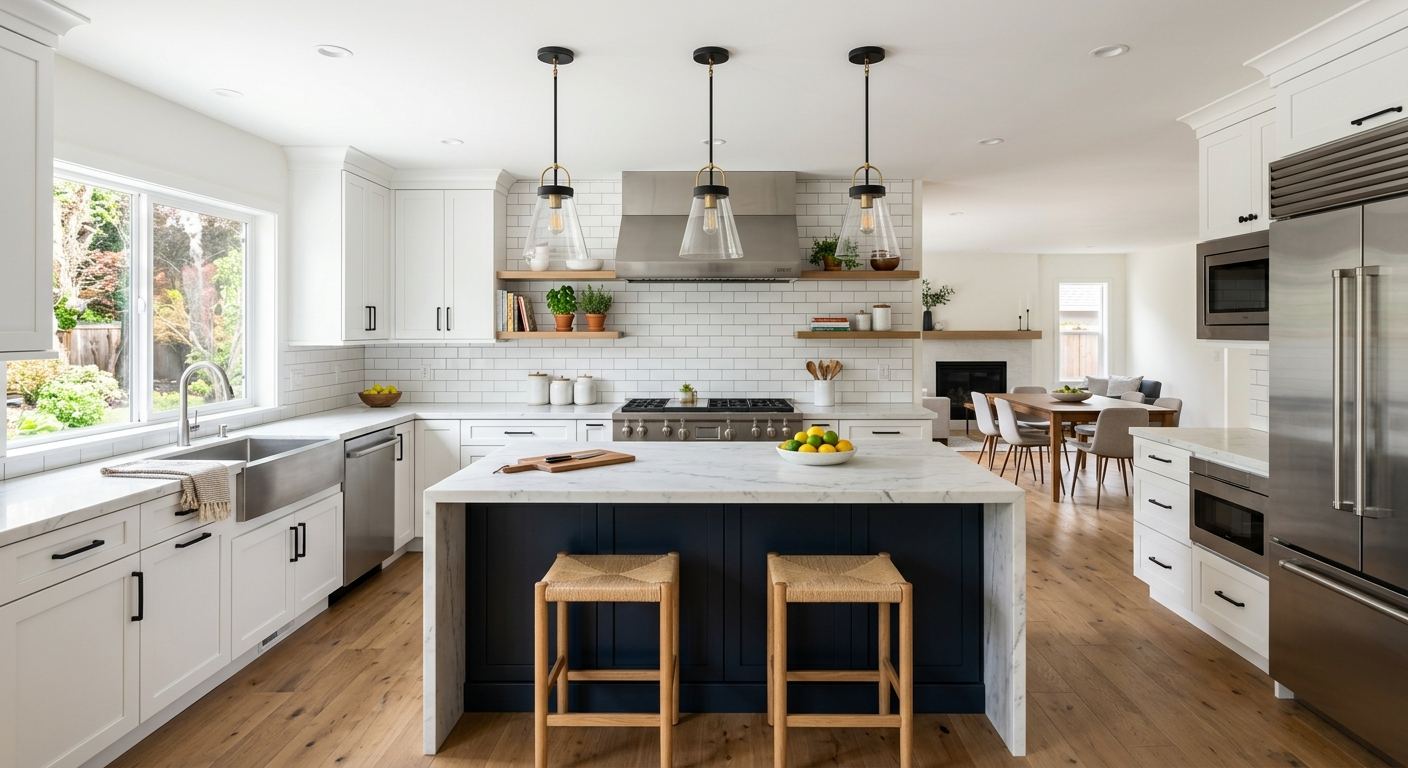
Kitchen renovation options and costs in Dorchester
Kitchen renovation in Dorchester, Ontario usually starts with budget and lifestyle—then quickly becomes a finish-tier decision. With Dorchester’s population of 9,329 (Statistics Canada, 2021 Census), you’ll find the local trades network is smaller than in the GTA core, so scheduling can be tighter when multiple renovations stack up. At the same time, the Toronto economic region’s housing market means homeowners often expect a kitchen that supports resale, especially in higher-value pockets where renovation spend can meaningfully influence perceived value. In practice, contractors tend to anchor their recommendations to typical project outcomes in the Toronto market rather than to seasonal weather.
Across southern Ontario, kitchen work costs don’t swing much with climate like flooring or exterior envelope projects do; the biggest “weather-like” cost driver is shipping and lead times for cabinetry and slab materials. The Toronto region also has consistent labour and material pricing, so the main cost lever is the finish tier. That’s why a modest refresh can land in the mid range, while a larger full renovation with custom cabinetry and stone counters pushes into the higher end of the band. In Dorchester, trade demand is especially strong in the broader Tillsonburg–Nodding/Tilsonburg-adjacent commuter corridor where homeowners often renovate to modernize older housing stock.
Below is a realistic comparison of common options and what they typically include, so you can align quotes to scope before comparing contractors.
| Renovation Tier |
What's Included |
Typical Duration |
Price Range |
| Cosmetic refresh (paint, hardware, new appliances only) |
Cabinet paint or refinishing where applicable, new hardware, wall paint/trim touch-ups, appliance replacement (no plumbing/gas moves), basic cleaning/caulking, reinstalling existing fixtures |
1–3 days on-site (plus appliance delivery/coordination) |
$5,000–$15,000 |
| Mid-range full renovation (new cabinets, counters, sink, tile) |
Semi-custom or quality stock cabinetry, countertop installation, sink swap, standard backsplash/tile, new or refreshed faucet/disposal hookups (no major layout), flooring patching to match, labour coordination and trim/finishing |
2–4 weeks |
$25,000–$55,000 |
| High-end full renovation (custom cabinets, stone counters, island) |
Fully custom cabinetry and millwork, quartz/natural stone, island build (cabinet + countertop), upgraded hardware/soft-close, enhanced lighting (where included in scope), full backsplash upgrade, sink and appliance integration with possible gas/plumbing relocation |
4–8 weeks |
$60,000–$90,000 |
| Cabinet refacing only (new doors + drawer fronts, same boxes) |
Door/drawer/front replacement, new veneer faces (where existing boxes are serviceable), hardware upgrade, scribe work, dust protection and removal/reinstall, typically keeps countertop and plumbing as-is |
1–2 weeks |
$8,000–$35,000 |
| Countertop swap only (laminate to quartz or stone) |
Remove existing laminate, prepare substrate, install new countertop and sink cut-out where applicable, reseal edges, basic backsplash trim transition (if included), disposal/reconnect only if required for sink changes |
3–7 days (longer if custom templates/edges) |
$3,000–$15,000 |
| Backsplash tile installation only |
Surface prep, layout and tile installation, grout/seal where required, caulking at edges, finishing transitions to existing countertops and walls |
3–7 days |
$2,000–$10,000 |
Prices are estimates only and vary by project scope, site access and material selection.
What affects the price of kitchen renovation in Dorchester
In Dorchester and across Ontario, two contractors can quote the “same” kitchen renovation and still land 30–50% apart because the scope is rarely identical—especially around layout, trade sequencing, and finish selections. Even in the Toronto economic region where material pricing and labour rates are relatively uniform, homeowners in higher-value areas typically choose quartz or natural stone and semi-custom cabinetry more often, while more price-sensitive homes may prioritize laminate and stock options to keep ROI strong. That finish tier difference alone can move you from the low–mid full renovation range to the $80k+ end when islands, stone, and custom millwork are part of the plan.
Local home values and household income patterns are the bigger driver than climate. Toronto-market expectations influence resale: many buyers equate higher-end counters and cabinetry with a “ready to move in” home, which supports renovation cost recovery. Layout changes are the most unpredictable regardless of finish tier: removing a wall, adding an island, or moving a gas line or plumbing run can add days of demolition and rough-in work, plus inspection/permit steps.
Here are a few concrete Dorchester realities that commonly raise or lower cost. If your kitchen is in an older home with dated subfloors, you may need localized floor prep before cabinets sit level—often adding a few days of work (and sometimes additional leveling materials). If you’re adding under-cabinet lighting and an island circuit, electrical labour can rise even when cabinets stay stock. Conversely, if you keep the existing sink location and only swap a countertop, you can often stay near the countertop-only band of $3,000–$15,000 rather than triggering a full rework. For kitchens that move into full renovation territory, the band $25,000–$90,000 reflects how quickly custom cabinetry and stone elevate material and labour time.
| Price Factor |
Why It Matters |
Cost Impact |
| Cabinet tier — stock vs. semi-custom vs. fully custom millwork |
Quality of box construction, door styles, internal organizers, tolerances, and lead times vary widely by tier |
Can shift a mid-range kitchen into the high-end range by tens of thousands depending on wall length and island complexity |
| Countertop material — laminate vs. quartz vs. granite vs. stone |
Material cost, fabrication time, edge profiles, and install labour change with thickness, seams, and heaviness |
Laminate is typically the lowest-cost per sq. ft.; quartz/stone commonly push budgets toward the upper half of the full-reno band |
| Layout change — wall removal, island add, plumbing/gas move |
Triggers demolition, rough-in work, possible permits/inspections, patching, and schedule impacts |
Often the biggest unpredictable swing; can add several days and materially increase labour and compliance costs |
| Appliance package tier — builder vs. mid-range vs. pro-grade |
Pro-grade models cost more and may require specific electrical, ventilation, or fit clearances |
Can raise project totals even when cabinetry and counters stay mid-range |
| Flooring — refinish existing vs. full replacement |
Cabinet removal and uneven subfloors may require underlayment, leveling, or full replacement for a seamless look |
Refinishing saves labour, while replacement expands material and install time |
| Backsplash — ceramic tile vs. marble vs. full-height slab |
Tile is labour-intensive but predictable; marble/slab adds material weight, cutting difficulty, and seam planning |
Backsplash-only projects can range widely; premium materials quickly reach the top of the backsplash band |
| Electrical — new circuits for island, under-cabinet lighting |
New circuits require licensed work and inspection; fixture count and wire routing affect labour time |
Usually increases cost more than homeowners expect when adding an island or upgrading lighting plans |
| Permit fees and licensed trade requirements |
Some work requires permits and inspections; licensed trades cost more but reduce risk |
Can add direct fees and schedule lead time even when materials are the same |
Permits & regulations in Ontario
In Ontario, many “swap” projects for a kitchen are straightforward from a permit standpoint. Cabinet and countertop swaps generally don’t need permits because you’re keeping the existing plumbing/electrical positions and structure intact. However, if your Dorchester renovation involves moving plumbing supply or drain lines, relocating a gas stove, or changing where a range hood vents (especially if gas is involved), you’ll typically need permits and licensed trade involvement.
Work that typically requires permits (and must be performed/verified by the right licensed professionals) includes: moving sink plumbing (supply/drain changes), moving or adding gas appliances or relocating gas piping, removing a load-bearing wall or making structural changes, and adding new electrical circuits (for example, circuits for an island, additional receptacles, or significant lighting upgrades). Electrical must be done by a licensed electrician, and gas work must be done by a licensed gas fitter; both usually require inspection sign-off for safety.
Step-by-step, here’s how a homeowner verifies a contractor in Ontario before signing: (1) Ask for the contractor’s certificate of insurance (general liability) and confirm the policy is current; (2) Request WSIB/WCB clearance letter or proof of coverage for the workers who will be on-site; (3) For licensed trades (gas/electrical), verify their individual licence details through the Ontario registry listings and ensure the contractor provides the licence/permit numbers connected to your job; and (4) Confirm in writing who is pulling permits, who pays the permit fees, and what inspections are required. Responsibility belongs in the contract—never in a handshake.
Cabinets, countertops and layout decisions in Dorchester
The three most consequential decisions in a Dorchester kitchen renovation are cabinet tier, countertop material, and whether you change the layout. Together, they determine not only the look but also the resale fit in the Toronto market and the total project complexity. Buyers across the region typically expect modern hardware and smooth, durable surfaces; as price increases, they also expect tighter cabinet finishing and countertop consistency with fewer visual seams and better edge detailing.
Start with cabinet tier. Stock cabinets are fastest and usually cheapest because manufacturing is standardized and lead times are shorter. Semi-custom cabinets are the most popular mid-range choice because they strike a balance: better height options, better finishes, and flexible interior organization while still controlling cost. Custom cabinetry gives the best fit for awkward Dorchester room angles, unusual ceiling heights, or built-ins—but it’s the highest cost and often the longest lead time.
Next, choose countertops with real maintenance in mind. Laminate is budget-friendly and fine for many homeowners, but it’s less resistant to heat and long-term wear. Quartz is a strong “set it and forget it” option: it’s non-porous, easier to clean, and commonly aligns with mid-range refreshes. Granite or natural stone delivers premium character but can require more thoughtful sealing/maintenance depending on the stone. If you want warmth, butcher block looks great, but it needs oiling and careful handling around water and heat.
Finally, layout changes are where costs can jump quickly. Keeping plumbing in the same area keeps you closer to the simpler bands—while moving sink or gas lines moves you toward full renovation pricing. For example, upgrading from laminate to quartz alone can follow the countertop-only band around $3,000–$15,000, but adding an island and relocating rough-ins often requires electrical/plumbing work that can push the total toward $25,000–$90,000 depending on cabinet tier and stone. In Ontario’s winter heating cycles and humidity swings, stable cabinet surfaces and well-fitted countertops also matter because expansion gaps and poor sealing become more noticeable over time.
| Option |
Durability |
Maintenance |
Best For |
Price Range |
| Stock cabinets (big-box) |
Good daily durability; limited sizing flexibility |
Low—wipe clean, check hinges/shelves as needed |
Fast timelines and budget-first renovations with straightforward room dimensions |
$8,000–$20,000 |
| Semi-custom cabinets (local dealer) |
Very good durability; better build quality and organization options |
Low to moderate—standard cleaning and hardware upkeep |
Most Dorchester homeowners targeting a mid-range full renovation with upgraded look |
$15,000–$35,000 |
| Custom cabinets (local millwork shop) |
Excellent durability; best for precise fit and premium hardware systems |
Low—typical cabinet care; quality hinges/finishes hold up |
Complex layouts, built-ins, ceiling-to-floor runs, and premium resale presentation |
$30,000–$60,000+ |
| Laminate countertop |
Moderate durability; can chip or blister if exposed to heat/water at seams |
Low—regular cleaning; avoid heat and prolonged standing water |
Budget-conscious refreshes where you want a clean look for resale |
$3,000–$7,000 |
| Quartz engineered countertop |
High durability and consistent appearance; resistant to everyday staining |
Low—wipe clean; no sealing required for most quartz products |
Mid-range to high-end kitchens aiming for “looks like stone” performance |
$7,000–$15,000 |
| Granite / natural stone countertop |
High durability; heat tolerant compared to laminate; natural variation |
Moderate—sealing may be recommended depending on stone |
Premium kitchens that want natural character and elevated resale appeal |
$10,000–$18,000 |
| Butcher block countertop |
Good durability with proper care; susceptible to cuts and dents like wood |
Moderate—oil/condition regularly; protect from heat and prolonged wet spots |
Casual, warm designs and homeowners who cook often and enjoy wood maintenance |
$5,000–$12,000 |
| Marble countertop |
Premium feel; more sensitive to etching/staining than quartz (depending on finish) |
Higher—needs careful cleaning and periodic sealing |
High-end aesthetic kitchens where the homeowner understands maintenance expectations |
$12,000–$22,000 |
How to choose a kitchen renovation contractor in Dorchester
Choosing the right contractor for a kitchen renovation in Dorchester comes down to proof: licensing/coverage, clarity of scope, and a payment/timeline plan that protects you. In Ontario, verify the contractor’s liability insurance by asking for a current certificate of insurance and checking the coverage limits and effective dates. Next, confirm WSIB/WCB coverage—request a clearance letter or proof of active coverage for workers who will be on-site. For licensed trades, ask who will complete gas and electrical work and verify their credentials independently through Ontario licensing resources; you want the right trade under the right permit.
When you request quotes, insist on 2–3 itemised written estimates that separate labour and materials (not just a single lump sum). Make sure the quote lists cabinet supply, countertop fabrication/installs, tile/backsplash materials, plumbing/electrical scope, and waste disposal. Read exclusions line-by-line: ask whether permits are included, whether demolition/disposal is included, and what happens if your home requires unexpected repairs (like subfloor leveling or drywall patching). For warranty, separate product/manufacturer warranty from workmanship warranty; confirm how long each lasts, and whether warranty is transferable if you sell the home. Finally, payment scheduling matters—never pay more than 10–15% upfront. A holdback until completion (and punch-list sign-off) keeps quality accountable. Ask for a start date and a completion estimate in writing, including a practical lead-time plan for cabinets and slabs.
- Ask for WSIB/WCB clearance letter or proof of active coverage before work starts
- Request certificate of insurance (general liability) and confirm it’s current
- Confirm who pulls permits and who pays permit/inspection fees
- Get licences for gas fitting and electrical in writing (and verify they match your scope)
- Use 2–3 itemised quotes with labour vs. materials clearly separated
- Check what’s excluded: disposal, drywall repair, underlayment/levelling, patching/painting
- Confirm cabinet lead times and countertop template dates in the schedule
- Require a written warranty for workmanship and a separate product warranty document
- Clarify warranty punch-list timelines after substantial completion
- Plan payment milestones: keep upfront to 10–15%, hold back until final walkthrough
- Ask how dust control is handled during cabinet removal and tile work
- Get a written timeline with start date, key milestones, and change-order process
Common red flags in Dorchester include: (1) quotes that don’t specify permits/inspection responsibility; (2) “lowest price” bids that lump labour and materials without line items; (3) contractors asking for large upfront payments beyond 10–15%; (4) no written warranty or unclear workmanship coverage; and (5) vague timelines that ignore cabinet/countertop lead times and template dates.
Frequently asked questions — kitchen renovation in Dorchester
What's the ROI on a kitchen renovation?
In Dorchester (and the broader Toronto economic region), kitchen ROI is strongest when you upgrade what buyers see immediately: clean cabinet styling, durable countertops, good lighting, and a layout that improves usability. Because the Toronto market has higher expectations in many neighbourhood pockets, homeowners often choose quartz or natural stone and semi-custom cabinetry more readily, which tends to support resale presentation. That said, ROI varies with your starting condition and how much you change the layout. If you keep plumbing largely in place and focus on a mid-range full renovation (often $25,000–$55,000), ROI tends to be steadier than projects with major gas/plumbing relocations. If you go high-end with custom millwork and stone (up toward $60,000–$90,000), you’re investing for buyer appeal, but the return depends on whether your market segment will pay for that level of finish. (Statistics Canada, 2021 Census) confirms Dorchester’s smaller population base, so quality workmanship and resale-ready finishes matter even more for local buyer confidence.
How do I budget for a kitchen renovation?
Budgeting is easiest when you separate “must-haves” from “nice-to-haves” and then map them to realistic bands. For example, if your goal is visual refresh plus appliance updates, start with the cosmetic tier and keep scope tight—those projects often run well below a full renovation. For a practical middle step, plan a mid-range full renovation (new cabinets/counters, sink, and tile) and expect totals in the $25,000–$55,000 area, depending on cabinet tier and countertop choice. If you’re swapping only the countertop or adding a backsplash, you can budget more precisely: countertop swaps commonly fit $3,000–$15,000, while backsplash tile installation is often $2,000–$10,000. Always include a contingency for layout-driven unknowns—moving plumbing supply/drain or relocating gas typically changes inspection and labour requirements. In Ontario, permits and licensed trades for those moves should be built into your budget from day one, not treated as surprises.
Can I move my kitchen sink or stove?
Yes, you can move a sink or stove, but the feasibility depends on what needs to change beneath the floor/walls and whether gas/electrical work is involved. A sink move often requires modifications to supply lines and drain routing; in Ontario, that work typically requires permits and licensed plumbing coordination. Moving a stove or range hood—especially if gas is involved—can require permits and gasfitter work; gas must be handled by a licensed gas fitter and inspected. If your kitchen is in older housing stock, existing plumbing runs may be difficult to reroute without added framing and drywall patching. Cost-wise, sink/stove moves often push you out of “swap-only” budgeting and toward full renovation pricing, because rough-in work adds time and complexity. A common strategy for Dorchester homeowners is to keep the main plumbing footprint and make upgrades around it, then use a mid-range renovation plan (often $25,000–$55,000) for cabinets, counters, and finish quality.
What's the most cost-effective kitchen upgrade?
The most cost-effective upgrade is usually one that delivers a “whole-kitchen” visual change without triggering expensive rework. For many Dorchester homeowners, that’s either resurfacing cabinets (refacing) or changing the countertop plus backsplash combination. Cabinet refacing can dramatically update the look for a fraction of full replacement, and many projects land in the $8,000–$35,000 range depending on door style and hardware. Another high-impact, often cost-controlled option is a countertop swap: replacing laminate with quartz or stone frequently fits $3,000–$15,000. Pairing that with a backsplash tile update (commonly $2,000–$10,000) can make the kitchen feel new without the unpredictability of moving plumbing or gas lines. The “best” upgrade also depends on your layout: if the room feels cramped, layout changes (like an island add) can be worth it, but they’re rarely the most cost-effective move because they tend to require electrical, plumbing/gas coordination, and permit steps.
Custom vs stock cabinets — is custom worth it?
Custom cabinets are worth it when you need an exact fit or want built-ins and layouts that stock sizes can’t accommodate—think odd angles, ceiling-to-floor runs, or a well-planned pantry wall. In Dorchester, where some homes have older room dimensions and non-standard widths, custom can make the kitchen look truly integrated. Stock cabinets (big-box) are typically the fastest and most budget-friendly route, and they can be great if your layout is straightforward. Semi-custom often sits in the middle as the most common “best of both” choice. Cost is the deciding factor: custom cabinetry budgets can climb quickly into the high-end range, and the overall kitchen total often follows the finish tier—so a custom-driven plan typically trends toward the $60,000–$90,000 side when combined with stone and islands. If your goal is resale-ready quality with controlled risk, semi-custom plus a quartz countertop is often a strong ROI path compared to going fully custom. In short: custom is “worth it” for fit and function; it’s “not worth it” when it’s chosen just to chase a look you can achieve with semi-custom.
How do I choose a kitchen contractor in Dorchester?
Start with verification and transparency. In Ontario, confirm the contractor has current liability insurance and WSIB/WCB coverage (ask for the clearance letter or proof). Then ensure the right licensed trades are assigned: gas work must be done by a licensed gas fitter, and electrical by a licensed electrician—both should be tied to your scope and any required permits/inspections. Next, ask for 2–3 itemised written quotes that break down labour and materials instead of lump sums, including whether permit pulling, disposal, and drywall/patching are included. Read the scope carefully: exclusions and “allowances” are where surprises happen. For warranty, confirm workmanship warranty length and how manufacturer warranties are handled for cabinets and countertops, including whether any coverage is transferable. Lastly, protect your cash flow: keep upfront payments to 10–15%, and hold back until the job is complete and punch-list items are addressed. If you’re budgeting around a mid-range renovation (often $25,000–$55,000), insisting on a detailed scope helps you avoid paying custom-level costs for a project that wasn’t fully custom.