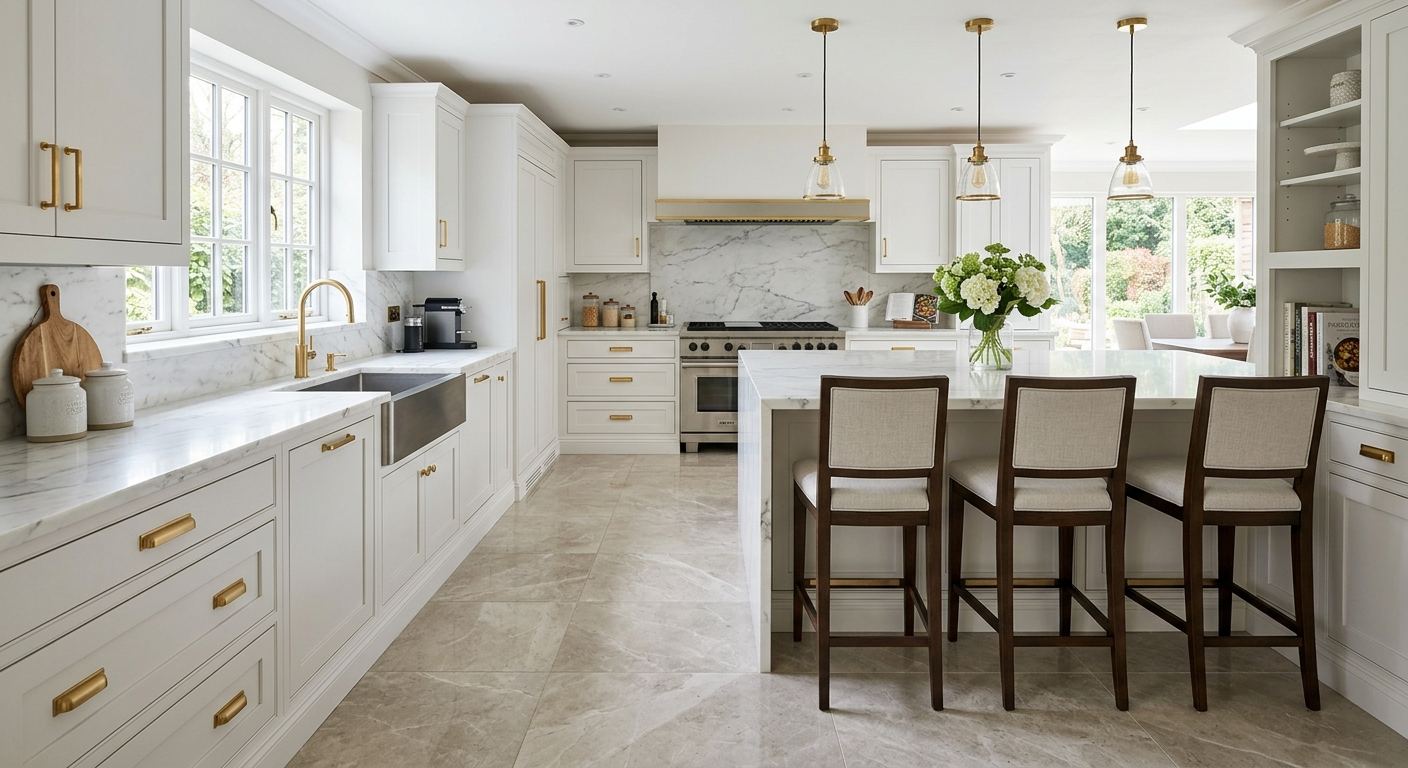
Kitchen renovation options and costs in Gloucester
Kitchen renovation in Gloucester, Ontario is shaped less by weather and more by what buyers expect to see when they tour homes in the Ottawa area. With a population of 150,012 (Statistics Canada, 2021 Census), Gloucester’s housing mix includes many families planning renovations to protect resale value and daily comfort. In Ottawa’s higher-value home pockets, homeowners often target a “mid-to-premium” look—custom-ready layouts, upgraded hardware, and modern surfaces—because finishes tend to matter at listing time. Contractors in the Ottawa economic region commonly price work based on finish tier, and the local market’s willingness to pay steers most quotes away from low-budget laminate-only makeovers.
Ottawa-area costs also reflect labour availability and material choice more than the local climate itself. While the region’s freeze–thaw cycles and winter humidity swings can stress grout and caulking at floor and backsplash edges, they generally don’t change the big-ticket pricing drivers as much as cabinet type and countertop selection. In neighbourhoods along the east end, where many homes were built in the 1980s–2000s and owners are refreshing aging kitchens, trade demand is especially steady—so you’ll often see tighter scheduling and more competitive pricing for mid-tier full renos. That said, a cosmetic refresh can be booked quickly, while full upgrades that include plumbing/electrical changes typically need more lead time and coordination.
To help you compare options before you call for quotes, use the table below to estimate typical scope and budgeting ranges for Gloucester projects.
| Renovation Tier |
What's Included |
Typical Duration |
Price Range |
| Cosmetic refresh (paint, hardware, new appliances only) |
Cabinet paint or refinish (no box changes), new hardware, painting/trim touch-ups, appliance swaps (same rough opening) |
3–7 days |
$6,000–$18,000 |
| Mid-range full renovation (new cabinets, counters, sink, tile) |
New semi-custom cabinets, quartz counters, sink and faucet, backsplash tile, minor flooring refresh, labour for installation |
3–6 weeks |
$60,000–$90,000 |
| High-end full renovation (custom cabinets, stone counters, island) |
Fully custom millwork, natural stone counters, island build-out, upgraded hardware, designer backsplash (often full-height), coordinated plumbing/electrical |
6–12 weeks |
$120,000–$150,000+ |
| Cabinet refacing only (new doors + drawer fronts, same boxes) |
Door and drawer front replacement, new hardware, new veneer surfaces, optional cabinet paint, basic prep and install |
1–3 weeks |
$12,000–$30,000 |
| Countertop swap only (laminate to quartz or stone) |
Removal and install of existing counters, new quartz/stone tops, sink cut-out adjustments, reseal/finish work |
3–10 days |
$8,000–$18,000 |
| Backsplash tile installation only |
Tile supply, thinset/wet-area prep, tile install up to typical full height behind counters, grout and caulk detailing |
3–7 days |
$2,500–$12,000 |
Prices are estimates only and vary by project scope, site access and material selection.
What affects the price of kitchen renovation in Gloucester
In the Ottawa region, you’ll often see quotes for what looks like the “same kitchen” swing by 30–50%. The difference usually comes down to local finish expectations and how much the contractor has to rebuild the foundation—cabinet boxes, support structure, subflooring, wall prep, and any hidden plumbing or electrical. In higher-value Ottawa-area markets, many homeowners default to quartz or natural stone counters and semi-custom or custom cabinetry because the perceived upgrade is easier to recoup on resale. In more modest, lower-finish expectations, laminate and stock cabinets dominate to keep the project closer to the lower end of budget tiers (Statistics Canada, 2021 Census).
Layout changes are the most unpredictable cost driver regardless of finish. Removing a wall, adding an island, or moving plumbing (sink) and gas (stove/range setup) requires coordination across trades and often adds subfloor/framing and electrical work. In Gloucester, older housing stock in established areas can also mean more time for discovery—unexpected shutoff valve locations, out-of-level walls, or worn subflooring near exterior walls that pick up moisture during Ottawa winters.
Concrete examples: (1) If you keep cabinets in the same footprint but move from laminate to quartz, your quote may land in the countertop tier (often around $8,000–$18,000 depending on size and edging) without touching rough plumbing. (2) If you expand the island with an additional run of electrical and update lighting, budgets can jump toward the mid-range full renovation band (commonly $60,000–$90,000) even if the cabinet tier stays semi-custom. (3) If a backsplash install becomes a full-height designer wall, it can shift from a small labour job into a materials-heavy scope that pushes closer to the upper backsplash tier.
Bottom line: Gloucester pricing follows your cabinet and countertop choices first, then your layout and utility changes.
| Price Factor |
Why It Matters |
Cost Impact |
| Cabinet tier — stock vs. semi-custom vs. fully custom millwork |
Higher tiers offer better fit/finish, more door styles, and options for corners, storage, and pull-outs |
Often drives the biggest step change in total kitchen cost (and can separate mid-range from high-end) |
| Countertop material — laminate vs. quartz vs. granite vs. stone |
Material cost, thickness, fabrication complexity, and edging/profile choices affect labour and waste |
Can move a countertop-only job from budget ($4,000–$10,000) into premium (upper end of $4,000–$18,000) |
| Layout change — wall removal, island add, plumbing/gas move |
Triggers extra framing, drywall, tile-floor prep, inspections, and coordination across trades |
Frequently the largest “surprise” after demolition; can add weeks and raise budgets 10–30%+ |
| Appliance package tier — builder vs. mid-range vs. pro-grade |
Ranges, ventilation, and built-in fridges differ in price and often require ventilation/clearance planning |
Mid-range appliances usually add cost but can protect longevity; pro-grade can push total project into luxury bands |
| Flooring — refinish existing vs. full replacement |
Kitchen remodels often reveal subfloor wear; matching under cabinets and transitions takes labour |
Full replacement adds demolition and install labour; refinishing can reduce scope |
| Backsplash — ceramic tile vs. marble vs. full-height slab |
Tile type, pattern complexity, and height increase materials and detailing time |
Can shift from a straightforward backsplash to a materials-heavy designer feature |
| Electrical — new circuits for island, under-cabinet lighting |
New loads require proper circuit planning, box placement, and inspection |
Often adds cost even when cabinet footprint stays the same |
| Permit fees and licensed trade requirements |
Work that touches electrical, gas, plumbing routes, or structural elements typically requires permits |
Minor for “swap-only” scopes; larger for combined wall/plumbing/electrical changes |
Permits & regulations in Ontario
For most Gloucester homeowners, “swap-only” kitchen updates don’t require a permit. In Ontario, cabinet and countertop replacements generally fall under routine renovation work—if you’re keeping existing cabinet locations and not altering plumbing or gas lines. However, permits are typically required when you change the systems behind the walls: moving plumbing supply or drain lines, relocating gas connections (for a stove/range and some ventilation setups), removing a load-bearing wall, or adding new electrical circuits and outlets (including island electrical and new lighting tied into house wiring).
Gas work must be completed by a licensed gas fitter, and electrical work must be completed by a licensed electrician—both require appropriate inspections before walls are closed. Because “who pulls the permit” varies by contractor, you should confirm responsibility in the written contract before signing.
How to verify a contractor in Gloucester, step-by-step: (1) Ask for their Ontario licensing details and check their business status through the appropriate online registry for the trade(s) doing the work (or ask your contractor to provide proof for each trade contractor). (2) Request a current certificate of insurance (liability) and confirm it covers renovations at your address; keep a copy. (3) Ask for WSIB/WCB clearance (coverage) for their workers; a clearance letter or proof-of-coverage document should be provided on request. (4) For any subcontractors, insist the same insurance and coverage proof is supplied for each participating licensed trade.
Cabinets, countertops and layout decisions in Gloucester
The three decisions that most affect your Gloucester kitchen renovation outcome are cabinet tier, countertop material, and layout changes. First, choose cabinet tier: stock cabinets are the fastest and generally cheapest, semi-custom is the most popular middle ground, and custom millwork is the highest cost but offers the best fit for unusual spaces, high-end storage, and a truly tailored look. Second, pick your countertop: laminate is budget-friendly and forgiving to replace, quartz offers a strong balance of durability and maintenance, while granite/stone and marble deliver standout aesthetics that can elevate a kitchen into the luxury band. Third, decide whether to change layout—open-concept wall removal, island additions, or moving plumbing/gas. Layout upgrades are usually justified when they improve traffic flow, create seating/work zones, or solve a functional pain point (like poor drawer access or cramped circulation).
In the Ottawa resale market, buyers frequently expect cleaner lines, modern hardware, and countertops that read “premium.” That tends to steer renovations above the bare minimum. For example, if you stay in the same footprint and upgrade laminate to quartz, you may spend within the countertop installation tier (often roughly $4,000–$18,000 depending on size and edge details) without the cost risk of moving utilities. But if you add an island that requires new electrical and plumbing coordination, you’re more likely to land toward the mid-range full renovation band—commonly $60,000–$90,000 for a typical semi-custom kitchen—because labour, materials, and inspection coordination expand the scope.
Ottawa’s seasonal humidity and freeze–thaw cycles don’t usually dictate product selection, but they do matter for durability at seams, backsplash edges, and caulking. Proper subflooring prep and sealing around penetrations are what keep new surfaces looking good through years of winters.
| Option |
Durability |
Maintenance |
Best For |
Price Range |
| Stock cabinets (big-box) |
Good for standard sizes; hinges and alignment depend on install quality |
Low day-to-day care; touch-up paint may be needed on doors over time |
Fast timelines, tight budgets, straightforward layouts |
$12,000–$25,000 |
| Semi-custom cabinets (local dealer) |
Strong build with better options for storage and corner solutions |
Low maintenance; easier to match finishes and hardware across runs |
Most Gloucester homeowners aiming for mid-tier resale appeal |
$25,000–$55,000 |
| Custom cabinets (local millwork shop) |
Highest fit and finish; best for irregular walls and premium storage layouts |
Low routine maintenance; best results with durable coatings |
Luxury renovations and homes where the kitchen is a key feature |
$55,000–$95,000+ |
| Laminate countertop |
Budget durability; can chip at edges if struck and needs good seam detailing |
Wipe clean; avoid prolonged water at seams |
Cost-controlled renovations and quick refreshes |
$4,000–$10,000 |
| Quartz engineered countertop |
Very durable and consistent; resists staining better than many natural options |
Minimal maintenance; wipe clean and keep joints sealed |
Best balance of look, durability, and practical upkeep for Ottawa winters |
$8,000–$18,000 |
| Granite / natural stone countertop |
Extremely durable; unique visual character and heat resistance |
Occasional sealing (depending on stone) and careful seam/grout detailing |
Premium aesthetics and “statement” kitchens |
$12,000–$20,000+ |
| Butcher block countertop |
Can dent or scratch; performs well with proper care |
Oiling/conditioning required to prevent drying or water damage |
Warm, family-oriented kitchens where you’ll maintain the surface |
$7,000–$16,000 |
| Marble countertop |
Elegant but softer; more sensitive to etching from acids |
Requires careful cleaning and sealing practices |
Designer look where maintenance habits match homeowner lifestyle |
$15,000–$25,000+ |
How to choose a kitchen renovation contractor in Gloucester
Choosing the right kitchen contractor in Gloucester starts with proof—Ontario licensing where required, liability insurance, and workers’ coverage. Here’s the practical approach: first, ask which licensed trades are involved for your scope (gas fitter for any gas changes; electrician for new circuits/outlets/lighting tied into wiring; and plumbing trades where relevant). Then verify their credentials and business status through the appropriate online registry links for their trade. Next, request a certificate of liability insurance naming the job site address (or showing coverage for renovations) and make sure it’s current. Finally, confirm WSIB/WCB coverage by asking for a clearance letter or proof-of-coverage document; it should cover the contractor’s workers who will work in your home.
Get 2–3 itemised written quotes, not lump sums. You want line items that separate labour, cabinet supply, countertop fabrication/installation, tile/backsplash scope, electrical/plumbing allowances, demolition and disposal, and any permit costs. Read exclusions carefully: confirm whether permit pulling is included, whether old materials/disposal are included, and who handles patching, sanding, and painting touch-ups. Warranty matters too—ask for the workmanship warranty length, what manufacturer warranties cover, and whether warranties are transferable if you sell your home.
For payments, never agree to heavy upfront costs. A safer schedule is roughly 10–15% deposit, then progressive payments tied to milestones. Hold back payment until the job is complete and deficiencies are corrected, including final caulking and hardware alignment. Timeline should be in writing with a start date, lead-time assumptions, and a completion estimate.
- Confirm which permit(s) apply to your exact changes and who pulls them.
- Ask for an itemised labour/materials breakdown with allowances clearly stated.
- Verify the contractor’s liability insurance certificate is current and job-site relevant.
- Request WSIB/WCB clearance/proof of coverage before work begins.
- Ensure the quote states disposal/dump fees and who manages recycling/landfill.
- Check whether patching, drywall finishing, and paint touch-ups are included.
- Confirm cabinet measurements and cut-sheet approvals before fabrication.
- Ask how they handle subfloor leveling and wall out-of-plumb conditions.
- Verify countertop template scheduling and lead times (fabrication delays happen).
- Clarify warranty terms: workmanship start date, scope, and response time.
- Ensure electrical/gas changes specify licensed trades and inspection responsibility.
- Use a written payment schedule tied to defined milestones, with holdback.
Common red flags I see in Gloucester kitchen renos: (1) quotes that only use “allowance” language without numbers or realistic ranges; (2) no proof of WSIB/WCB coverage or missing insurance documentation; (3) a lump-sum price with no scope breakdown for demolition/disposal and patch/paint; (4) avoidance of discussing permits for plumbing/gas/electrical changes; and (5) warranties stated verbally but not included in the contract.
Frequently asked questions — kitchen renovation in Gloucester
Do I need a permit for a kitchen renovation in Ontario?
In Gloucester and across Ontario, swap-and-refresh work usually doesn’t need a permit—cabinet replacements and countertop installs typically fall into “no permit” territory when you’re not altering plumbing, gas, or structural elements. Where permits come in is when you move supply/drain lines, relocate gas connections (including changes related to stove/range setups), remove a load-bearing wall, or add new electrical circuits/outlets (common with islands and under-cabinet lighting). The key is to match permit responsibility to your exact scope, and to confirm it in writing with your contractor before you sign. If your contractor is vague about permits, pause and ask what work triggers permits and which licensed trades will be involved.
What's the ROI on a kitchen renovation?
ROI varies by how much you change and how well the finish tier matches your neighbourhood expectations. In higher-value Ottawa-area homes, buyers tend to pay more attention to modern cabinets, durable countertops, and clean tile detailing—so mid-tier to high-tier renovations can protect resale value better than a basic refresh. A common planning approach is that many homeowners target roughly 5% to 15% of their home value for a remodel, and then choose finishes accordingly. If you upgrade from laminate to quartz during a mid-range project, you usually get stronger perceived value than appliances-only updates. As a budgeting reference, many Ottawa-area full renovations land around $60,000–$90,000 for mid-tier work or higher for custom looks, such as $120,000–$150,000+ luxury kitchens.
How do I budget for a kitchen renovation?
Budgeting starts with your “tier,” because cabinets and counters set the ceiling for most Gloucester projects. A practical path is to decide whether you’re aiming for a cosmetic refresh, a mid-range full renovation, or a higher-end custom kitchen, then build outward from there. For example, a cabinet refacing-only approach often sits around $12,000–$30,000, while countertop swaps commonly fall near $4,000–$18,000 depending on material and size. If you’re doing a full mid-range reno with new cabinets, quartz, tile, and installation, many budgets sit in the $60,000–$90,000 band. Also add a separate line for layout/utilities uncertainty—moving plumbing, adding an island, or upgrading electrical can change costs quickly.
Can I move my kitchen sink or stove?
Yes, you can move a sink or stove in many Gloucester homes, but it’s where costs and permitting move sharply. Moving a sink involves relocating plumbing supply and drains, which typically requires permits and licensed trade work and then careful sealing to protect against moisture along seams and edges. Moving a stove/range is more complex when gas is involved—gas-related changes must be done by a licensed gas fitter and inspected. If you’re switching to an island setup, you should also plan for new electrical circuits for lighting and outlets. If you want better cost control, the most affordable option is usually keeping the sink/stove near existing rough-ins and upgrading finishes instead.
What's the most cost-effective kitchen upgrade?
The most cost-effective upgrade is often one that delivers “big visual change” without triggering the highest-risk scopes: layout, plumbing/gas moves, or structural work. In many Gloucester kitchens, a quartz countertop upgrade can be a standout improvement relative to cost—especially if you keep the cabinet boxes and footprint. Countertop-only swaps are commonly priced within the $4,000–$18,000 band depending on size and stone edge details. Another strong value move is a backsplash tile installation that is planned carefully (good prep, correct grout/caulking for Ottawa winter use, and matching transitions). For a lower spend, hardware upgrades and paint can refresh the look quickly, but they won’t correct dated cabinet storage or countertop wear.
Custom vs stock cabinets — is custom worth it?
Custom can be worth it when your kitchen layout is challenging or when you want a high level of fit and storage—like built-ins for pantry zones, specialized corner solutions, or a true furniture-style look. If your goal is speed and a cleaner upgrade at the best price point, stock cabinets are usually the most cost-effective path, and semi-custom is often the best value for most Gloucester homeowners. In practical budgeting terms, stock/fast options often sit lower than semi-custom, while fully custom millwork is typically what pushes you toward the upper renovation bands (for many projects that means work well above $60,000–$90,000, and sometimes into $120,000–$150,000+). The “worth it” decision comes down to how much you’ll benefit from the extra storage/fit versus how long you plan to stay in the home and your resale expectations.