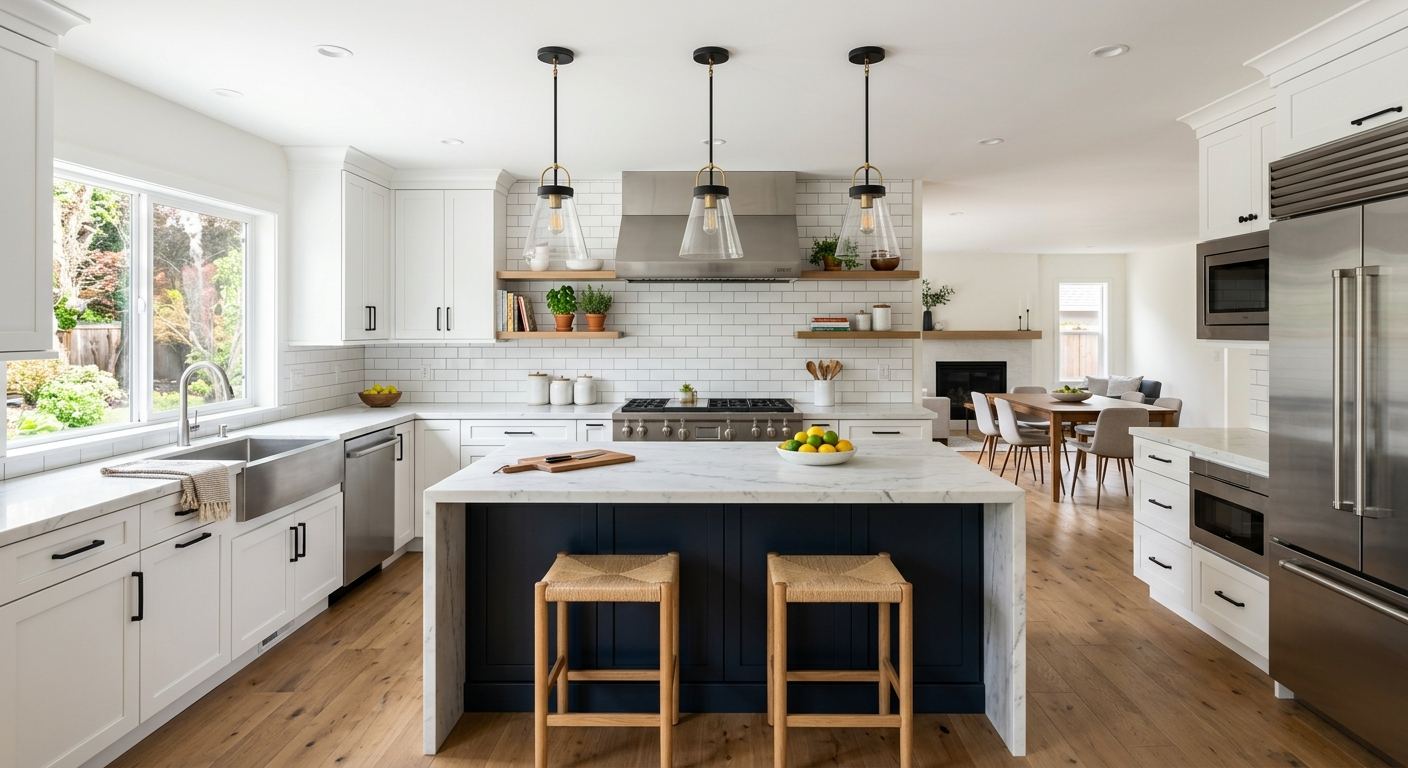
Kitchen renovation options and costs in Sapperton
Sapperton homeowners usually start their kitchen plan with one question: “What will this cost in our neighbourhood?” With Sapperton’s population at 6,327 (Statistics Canada, 2021 Census), the local market is active but not as stretched as Vancouver cores, so you’ll often find solid availability for cabinet installs and flooring crews—especially for straightforward scopes. That said, Lower Mainland–Southwest pricing is still driven more by what buyers expect to pay when they resell than by winter or summer conditions. In higher-value Metro Vancouver buying pockets, owners more commonly choose semi-custom or custom cabinetry and quartz/stone counters, because the renovation cost tends to be recovered on resale. The broader affordability picture also matters: even in smaller communities in the region, kitchen upgrades often land in the mid-range when households can sustain the finish uplift rather than staying with basic laminate and stock cabinetry.
In Sapperton specifically, the practical cost spread comes from market finish expectations and how busy trade schedules are. The climate doesn’t usually “break” kitchens here like extreme freeze-thaw can, but moisture control still matters—especially around sinks, dishwashers, and tile backsplashes. Neighbourhood demand tends to be strongest in the older, owner-occupied housing stock where homeowners are updating layouts for today’s cooking and entertaining. Once you’re clear on your target finish level, it becomes much easier to compare options side-by-side—so the table below can guide your first set of quotes.
| Renovation Tier |
What's Included |
Typical Duration |
Price Range |
| Cosmetic refresh (paint, hardware, new appliances only) |
Paint, new hardware, new cabinet pulls/knobs, appliance swap (like-for-like), minor patching |
5–10 business days |
$8,000 – $25,000 |
| Mid-range full renovation (new cabinets, counters, sink, tile) |
New stock or semi-custom cabinets, new countertop, sink/faucet, backsplash tile, flooring patching, plumbing reconnect |
3–5 weeks |
$40,000 – $80,000 |
| High-end full renovation (custom cabinets, stone counters, island) |
Custom cabinets, premium stone (quartz/stone), island build, upgraded hardware, extended backsplash, more complex layout detailing |
6–10 weeks |
$85,000 – $120,000 |
| Cabinet refacing only (new doors + drawer fronts, same boxes) |
Door/drawer replacement (reface), refinished/trim upgrades, new hardware, backsplash and countertop typically not included |
1–3 weeks |
$8,000 – $35,000 |
| Countertop swap only (laminate to quartz or stone) |
Remove old counters, install new quartz/stone, basic sink set-in replacement (if like-for-like), sealant/finishing |
2–7 business days |
$3,000 – $12,000 |
| Backsplash tile installation only |
Surface prep, tile install, grout/seal, caulking at sink and corners (matching existing finishes) |
3–7 business days |
$1,500 – $6,000 |
Prices are estimates only and vary by project scope, site access and material selection.
What affects the price of kitchen renovation in Sapperton
In Sapperton and across the Lower Mainland–Southwest, you can see the same kitchen end up 30–50% apart depending on the finish tier, contractor approach, and how much work is hidden behind walls. The biggest driver isn’t climate—it’s the market’s willingness to pay for premium materials and labour-heavy cabinetry packages. In higher-value parts of the region, owners often default to quartz or stone counters and semi-custom cabinetry because resale expectations support those finishes. In more modest scopes, laminate and stock cabinets dominate because the ROI is stronger and the job is simpler. That’s why a project that looks similar on paper can land anywhere from a constrained “refresh-to-mid” spend to a full rebuild with stone and made-to-fit millwork.
Layout changes create the most unpredictable cost, regardless of finish. Removing a wall, adding an island, or moving plumbing or a gas line can add labour, permit steps, and coordination time. Here are a few Sapperton-specific examples contractors commonly run into: older kitchens often have dated plumbing rough-ins that don’t align neatly with new cabinet rails, requiring rework before countertop fabrication; narrow stair/driveway access can slow material delivery, which increases on-site labour hours; and when homeowners choose upgraded tile backsplashes with full-height or more complicated patterns, the extra prep and waterproofing details add time even if the tile “footprint” isn’t large.
For budgeting, it helps to think in bands: a mid-range full renovation is often targeted around $40,000 – $80,000, while stone-and-island builds more commonly move toward $85,000 – $120,000. Even if you stay mid-range, any plumbing/gas shift tends to push you toward the upper end more than changing cabinet colour does.
| Price Factor |
Why It Matters |
Cost Impact |
| Cabinet tier — stock vs. semi-custom vs. fully custom millwork |
Custom sizing, specialty doors, and internal upgrades change both materials and install time |
Small jobs can shift by roughly 10–30%+ |
| Countertop material — laminate vs. quartz vs. granite vs. stone |
Stone slabs and fabrication/templating add cost and require careful install coordination |
Commonly adds several thousand dollars |
| Layout change — wall removal, island add, plumbing/gas move |
More trades, coordination, and potential demolition/patching |
Often the single biggest swing factor |
| Appliance package tier — builder vs. mid-range vs. pro-grade |
Electrical requirements, venting details, and install complexity vary by model |
Can move budgets by thousands |
| Flooring — refinish existing vs. full replacement |
Removing cabinets may require flooring repairs or full replacement depending on the base condition |
Moderate to large depending on subfloor condition |
| Backsplash — ceramic tile vs. marble vs. full-height slab |
Material weight, cutting complexity, and sealing/WP requirements |
Typically increases costs with complexity and coverage height |
| Electrical — new circuits for island, under-cabinet lighting |
Licensed work, panel changes, and added labour for wiring and fixture install |
Can noticeably increase mid-range totals |
| Permit fees and licensed trade requirements |
Any regulated work changes the schedule and adds administrative and inspection steps |
Generally adds a measurable overhead |
Permits & regulations in British Columbia
In British Columbia, simple cabinet and countertop swaps typically do not require permits because you’re replacing finishes without altering regulated systems. That means cabinet installation/refacing and countertop replacement (including quartz or natural stone) are usually treated as renovation work with no major “system change.” However, permits and licensed trades are commonly required when you move plumbing supply or drains, relocate gas for the stove/range area (and certain hood setups), remove a load-bearing wall, or add/modify electrical circuits—especially for islands, new outlets, or under-cabinet lighting layouts tied to added wiring.
For a Sapperton homeowner, the practical way to verify a contractor’s compliance starts before work begins. First, ask the contractor for their BC licence details (where applicable to the trades involved), and request a certificate of insurance showing current liability coverage. Second, confirm clearance and coverage documentation for workers—typically through proof that the contractor’s staff are covered under the appropriate Canadian workers’ compensation system (coverage details should be provided on request). Third, review who is responsible for permits: you want it spelled out in the contract as “permit pulls by contractor” or “permit pulls by homeowner with contractor coordination,” including inspection scheduling.
Step-by-step: (1) request proof of licence/registration for the relevant trades, (2) ask for insurance certificate(s), (3) verify workers’ compensation coverage documentation, (4) confirm which scope items trigger permits (plumbing/drain relocation, gas relocation, electrical circuit additions, load-bearing wall changes), and (5) ensure permits/inspections responsibilities are in writing before you sign.
Cabinets, countertops and layout decisions in Sapperton
Your three biggest cost-and-impact decisions in a Sapperton kitchen are cabinet tier, countertop material, and whether you change the layout. In the Lower Mainland–Southwest, buyers generally expect kitchens to feel “finished” and current—so cabinet choice sets the foundation for resale. Stock cabinets are the fastest and usually lowest cost because they’re designed to standard sizing. Semi-custom cabinets are the most common mid-range option in this region because they offer better fit and interior upgrades without the long lead times of fully custom millwork. Custom cabinets cost more, but they’re the best route when you’re dealing with awkward corners, unusual ceiling heights, or a layout that needs made-to-fit rails and panel alignments.
Countertops drive day-to-day satisfaction. Laminate is budget-friendly but can stain or chip at edges over time depending on use; quartz is the practical “busy kitchen” choice because it’s durable and relatively low-maintenance. Granite and other natural stones are beautiful and long-lasting, but they’re more dependent on sealing and edge care. Butcher block can work well in family homes but needs ongoing maintenance to avoid moisture swelling at seams.
For layout, think resale. Adding an island can be justified when it improves flow and function—especially in open-plan living spaces common in renovation-ready homes. But moving plumbing or a gas line is where budgets can jump quickly because it triggers extra coordination and regulated trade work. As a concrete example, upgrading from laminate to quartz counters might move you into the $3,000 – $12,000 countertop-swap band; adding an island with plumbing/gas relocation can push the project upward far beyond a simple material upgrade.
| Option |
Durability |
Maintenance |
Best For |
Price Range |
| Stock cabinets (big-box) |
Good for standard use; limited sizing flexibility |
Low—basic cleaning, watch for hinge wear over time |
Budget refreshes and faster timelines |
$8,000 – $25,000 |
| Semi-custom cabinets (local dealer) |
Very solid; better options for storage and fit |
Low—typical cabinet care and hardware tightening |
Most Sapperton mid-range renovations |
$25,000 – $60,000 |
| Custom cabinets (local millwork shop) |
Excellent; tailored construction and alignment |
Low—quality materials usually age well |
Complex layouts and high-finish resale goals |
$60,000 – $95,000 |
| Laminate countertop |
Decent but more sensitive to burns and edge impact |
Low daily care; avoid prolonged standing water at seams |
Cost-conscious upgrades |
$3,000 – $6,000 |
| Quartz engineered countertop |
Very durable; resistant to staining |
Low—wipe clean; minimal sealing compared with natural stone |
Busy kitchens and families |
$6,000 – $10,000 |
| Granite / natural stone countertop |
Excellent; strong and heat-tolerant |
Moderate—periodic sealing and careful edge protection |
Premium look with long-term care commitment |
$8,000 – $12,000 |
| Butcher block countertop |
Good when maintained; can scratch and dent |
Higher—oil/condition regularly and protect seams |
Warm, lived-in style kitchens |
$5,000 – $9,000 |
| Marble countertop |
Beautiful but more vulnerable to staining/etching |
Higher—requires careful cleaning and protection |
Design-led kitchens with lighter day-to-day use |
$10,000 – $18,000 |
How to choose a kitchen renovation contractor in Sapperton
Choosing the right kitchen renovation contractor in Sapperton comes down to verification, clarity, and risk control. In British Columbia, make sure the contractor can provide proof of required trade licensing for the work they perform or subcontract, plus liability insurance showing current coverage. For workers’ compensation coverage, ask for documentation that confirms appropriate workers’ compensation protection for their crew (and any subcontractors they control). Don’t accept “we’re covered” verbally—request the certificate details and keep copies for your records.
Next, get 2–3 itemised written quotes—not lump sums. You want the labour and materials broken out so you can compare like-for-like (cabinet supply, install, countertop fabrication/setting, tile materials, electrical/plumbing provisions, demolition, and disposal). Carefully read the scope exclusions: does the quote include permit pulls if required, who pays inspection fees, and whether old material disposal is included? A quality quote also names the warranty: workmanship warranty length, product/manufacturer warranty terms, and whether coverage transfers if you sell your home.
For payment, protect yourself: never pay more than 10–15% upfront, and use progress payments tied to completed milestones. Hold a portion back until the job is complete and clean-up is done to spec. Finally, require a timeline in writing with a start date and completion estimate, including a realistic lead time window for cabinets and stone fabrication. In a kitchen renovation, schedule delays often happen at delivery and fabrication points, not during demolition.
- Confirm BC licensing for trades involved and request proof before work starts.
- Ask for current liability insurance certificate and coverage limits.
- Request workers’ compensation coverage documentation for the contractor and key subcontractors.
- Insist on itemised quotes (labour + materials) rather than lump sums.
- Check whether permits are included and who is responsible for permit pulls and inspections.
- Verify disposal/haul-away is included (old cabinets, packaging, construction debris).
- Confirm demolition scope and what happens to the subfloor/walls before new finishes.
- Require a plumbing/electrical plan for island outlets, under-cabinet lighting, and any moving of services.
- Get countertop details confirmed in writing: template date, fabrication responsibility, and sink/cooktop cut-outs.
- Ask about tile waterproofing approach around wet zones and the grout/seal system.
- Review warranty terms: workmanship, manufacturer coverage, exclusions, and transferability.
- Use a payment schedule with 10–15% max upfront and a final holdback until acceptance.
Red flags in Sapperton: (1) quotes that are missing itemised allowances for cabinets, stone fabrication, and tile prep; (2) no clear answer on who pulls permits when plumbing/gas/electrical is changed; (3) requesting large upfront payments beyond 10–15%; (4) refusing to provide insurance/coverage documents; and (5) vague timelines that don’t account for cabinet lead times and stone templating.
Frequently asked questions — kitchen renovation in Sapperton
What's the best countertop material for a busy Sapperton kitchen?
For most busy Sapperton households, quartz is the most balanced choice: it’s durable for everyday chopping, resists staining better than many natural options, and typically needs only routine cleaning. If you’re comparing budgets, a countertop swap band often lands around $3,000 – $12,000 depending on thickness, edge profile, and whether you’re doing multiple pieces or an island. Marble is beautiful but can etch or stain more easily, so it’s better for lower-traffic homes or for homeowners who want to baby the surface. Laminate can work for strict budgets, but edge chips and wear around seams show up sooner with heavy use. In Sapperton’s Lower Mainland–Southwest climate, the bigger real-world issue is moisture control at sinks and dishwashers—good caulking/sealing and proper installation matter as much as the countertop material.
How do I add an island to my Sapperton kitchen?
Adding an island is usually more than “dropping in a cabinet base,” because it changes flow, storage, and sometimes electrical or plumbing needs. In many Sapperton homes, the island is easiest to justify when the room layout already supports clear walkways to the fridge and sink—then you can add seating and extra prep space. If you want an island sink, dishwasher paneling, or a cooktop, expect additional labour and likely regulated trade work for moved plumbing/gas and added electrical circuits. From a budget perspective, an island can quickly push the project beyond a simple refresh, especially if you’re targeting a full renovation tier like $40,000 – $80,000 or higher. The contractor should map services before demolition, confirm utility locations, and provide a written plan for outlets, lighting, and any ventilation requirements.
How much does a kitchen renovation cost in Sapperton?
Kitchen renovation pricing in Sapperton typically depends on finish tier and whether you’re changing layout or services. A cosmetic refresh (paint, hardware, and appliance swaps) is often the most restrained path, while full renovations move quickly once cabinets, counters, and tile are included. As local planning benchmarks, many homeowners target mid-range full renovations around $40,000 – $80,000 and high-end scopes around $85,000 – $120,000, especially when stone counters and island builds are involved. Cabinet refacing only can be far less than replacing everything, and countertop swap projects often sit in a tighter range like $3,000 – $12,000. The most common reason quotes differ by 30–50% in Lower Mainland–Southwest is not climate—it’s cabinetry quality, stone/fabrication choices, and the unpredictability of demolition behind older walls (plumbing rough-in alignment and subfloor condition).
How long does a kitchen renovation take in Sapperton?
Timelines in Sapperton are usually driven by trade scheduling and material lead times, not just demolition. Cosmetic refreshes can be fast—often about 5–10 business days—because you’re not removing cabinetry or waiting on stone fabrication. Mid-range full renovations commonly take around 3–5 weeks, while high-end projects with custom cabinetry and stone counters often run 6–10 weeks. Countertop-only projects can be completed in a few days once templating and fabrication are done, and backsplash tile installs are often 3–7 business days. The main “hold-up” patterns are: cabinet delivery windows, stone templating schedules, and any permit/inspection steps if you’re moving plumbing, gas, or electrical circuits. To avoid surprises, ask your contractor for a written start date and completion estimate and confirm who is responsible for lead-time tracking.
Quartz vs granite countertops — which is better?
“Better” depends on your priorities. Quartz is usually the best fit for busy kitchens because it’s engineered for consistent performance, tends to resist staining well, and typically doesn’t require the same sealing routine as many natural stones. Granite is also very durable and often handles heat well, but it’s natural variation by slab and generally needs periodic sealing to keep it protected. In a Sapperton kitchen, the real-life difference you’ll feel is maintenance habits: quartz is more forgiving day-to-day, while granite rewards homeowners who are comfortable with care routines. Budget-wise, both sit in the countertop band—often around $6,000 – $12,000 for typical kitchen sizes depending on thickness, edges, and how many pieces are required. If you’re unsure, ask your contractor to show you sample slabs and to explain sealing/edge care based on the exact granite you select.
Should I reface or replace my cabinets?
Refacing is worth considering when your cabinet boxes (the frames) are still sound—doors, drawer fronts, and finishes can be updated without the full demolition of a replacement. That can be a lower-cost way to modernize, and it’s usually faster than a full cabinet replacement. Replacement is better when boxes are damaged, the layout doesn’t work (wrong storage depth, awkward corner plan), or you want significant structural changes like new rail heights or a different cabinet configuration to support an island or appliance moves. For budgeting, refacing commonly sits in the cabinet installation/refacing band—often around $8,000 – $50,000 depending on coverage and hardware—while a full cabinet-and-counter renovation is more in the $40,000 – $80,000 (mid-range) or higher scope. In Sapperton and the Lower Mainland–Southwest, resale expectations often favour fully updated cabinetry plus counters when layouts are changed, but refacing can still deliver strong results when the underlying structure is solid. Always have a contractor inspect the boxes first.