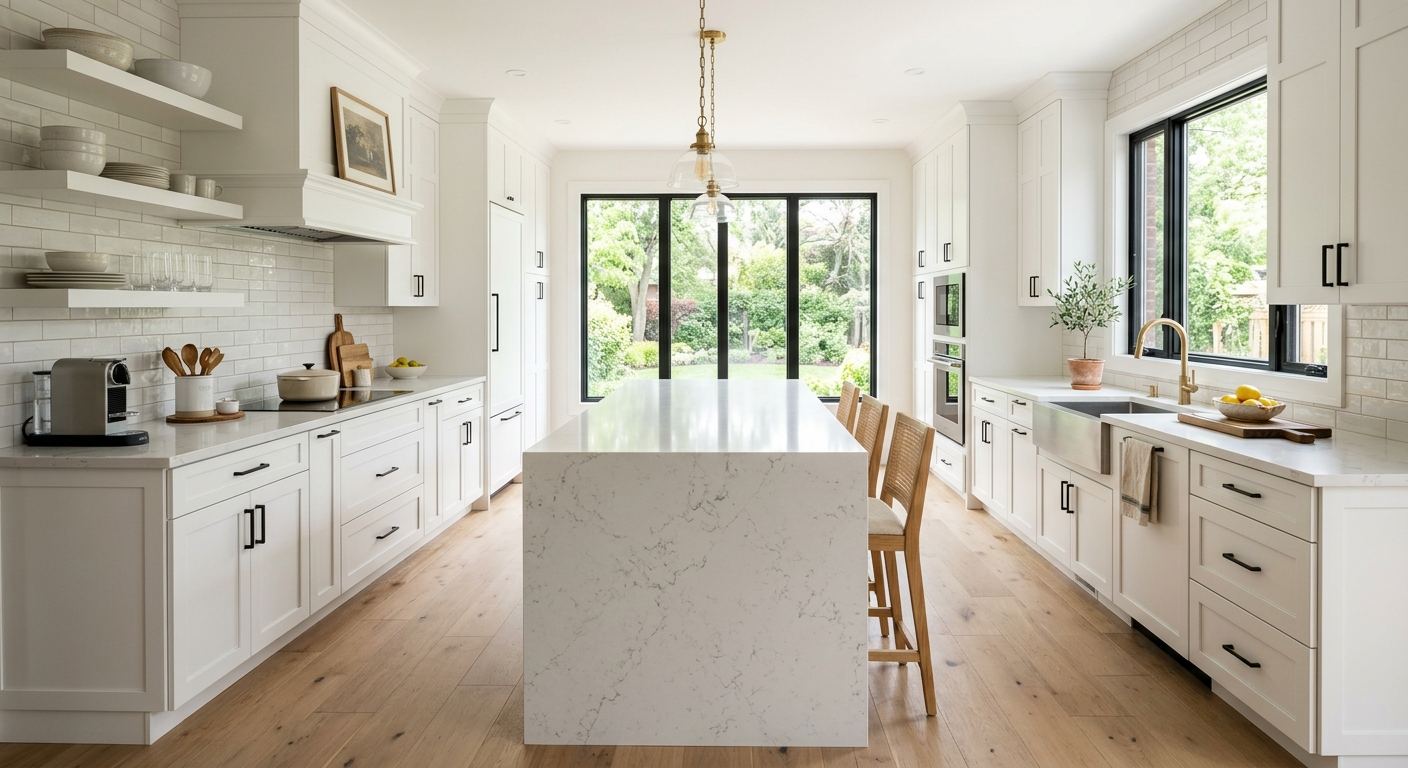
Kitchen renovation options and costs in Royal Oak
Kitchen renovations in Royal Oak usually start with the same question: “What can I change without blowing the budget?” With a population of 8,855 in the city (Statistics Canada, 2021 Census), Royal Oak homeowners tend to favour practical, resale-friendly upgrades that look modern but don’t require extreme structural work. In the Lower Mainland–Southwest, where home values are generally higher than many other parts of B.C., many owners also plan for a finish level that buyers will recognize on short notice.
That local market pressure is why the renovation path matters as much as the kitchen size. In higher-value pockets of the Lower Mainland–Southwest, homeowners more often choose semi-custom or custom cabinetry and quartz/stone counters, because the finish upgrade can be recovered more easily at resale. The flip side is that if you’re targeting a “refresh” look, contractors can keep costs controlled by focusing on paint, hardware, and selected appliance swaps.
Climate plays a smaller role in pricing than the market in this region, but it still affects how you should spec materials. British Columbia’s coastal conditions mean higher humidity swings—so drawer hardware, cabinet sealing details, and ventilation choices matter for long-term performance, especially in older homes with tighter ventilation. Contractor availability is strongest where trades can stage multiple jobs efficiently, which is why kitchen work is especially in demand around nearby activity hubs like Surrey and the Burnaby corridor, where renovation volumes keep cabinet installers and countertop fabricators booked. With that context, the table below compares the most common renovation tiers you’ll see in Royal Oak quotes.
| Renovation Tier |
What's Included |
Typical Duration |
Price Range |
| Cosmetic refresh (paint, hardware, new appliances only) |
Cabinet paint or new doors only where possible, new pulls/handles, replace like-for-like appliances, patch/prime/paint walls, basic caulking and touch-ups |
1–3 weeks |
$8,000–$20,000 |
| Mid-range full renovation (new cabinets, counters, sink, tile) |
New cabinet installation (often semi-custom), new countertops, sink/faucet replacement, backsplash tile, sink plumbing reconnection, new flooring under kitchen scope, appliance set-up |
4–8 weeks |
$40,000–$85,000 |
| High-end full renovation (custom cabinets, stone counters, island) |
Custom millwork, stone counters (quartz/stone), island design with tailored cabinetry, expanded backsplash (often up to full-height), upgraded hardware and lighting, appliance package integration |
8–14 weeks |
$85,000–$120,000 |
| Cabinet refacing only (new doors + drawer fronts, same boxes) |
Remove and replace doors/drawer fronts, hardware swap, new panels/trim where needed, clean and re-seal work surfaces, optional paint touch-ups, limited backsplash refresh |
2–5 weeks |
$8,000–$35,000 |
| Countertop swap only (laminate to quartz or stone) |
Remove existing tops, install new quartz/stone, seam/cut adjustments, undermount sink set if required, basic splash/edge matching and sealing |
1–3 weeks |
$6,000–$12,000 |
| Backsplash tile installation only |
Tile supply and install, remove existing backsplash where needed, prep and waterproofing where required, grout and seal, countertop/small trim finishing |
1–2 weeks |
$1,500–$6,000 |
Prices are estimates only and vary by project scope, site access and material selection.
What affects the price of kitchen renovation in Royal Oak
In the Lower Mainland–Southwest, two quotes for the “same” kitchen can easily differ by 30–50% because buyers and contractors are responding to local demand—home values, household income expectations, and the finish level that appraisers and future buyers will recognize. In British Columbia, it’s less about outdoor climate damage and more about how owners decide to spend when resale matters. That’s why the typical finish tier is driven more by market economics than weather.
In higher-value Lower Mainland–Southwest areas, homeowners frequently default to quartz or stone counters and semi-custom cabinetry because the cost is easier to justify on resale. In more modest neighbourhood pockets, laminate and stock cabinets often dominate since ROI is better when you keep the scope lean. The biggest unpredictable cost driver in Royal Oak is layout work—removing a wall, adding an island, or moving a gas line. Those tasks pull in extra trades, inspections, and coordination time, so labour and permit-related overhead can rise quickly regardless of whether you’re using laminate or stone.
Concrete Royal Oak examples: (1) Older homes often have dated plumbing runs and limited access, so reconnecting a sink plus changing drain slope can add hours even if cabinets stay put. (2) If your current backsplash hides an uneven wall, tile prep can expand from a “quick skim coat” to full wall rebuild. (3) Homes with tight kitchen footprints can make island installation more labour-intensive—cutting, aligning, and finishing toe-kicks and drawer fronts often takes longer than homeowners expect. As a reference point, a mid-range full renovation commonly lands in the $40,000–$85,000 band, while moving into a high-end scope with custom millwork and stone can push you toward $85,000–$120,000.
| Price Factor |
Why It Matters |
Cost Impact |
| Cabinet tier — stock vs. semi-custom vs. fully custom millwork |
Custom increases design time, fabrication steps, and fit/finish labour on site |
$10,000–$45,000 |
| Countertop material — laminate vs. quartz vs. granite vs. stone |
Material pricing, thickness/edge profiles, and fabrication complexity drive cost |
$2,500–$12,000 |
| Layout change — wall removal, island add, plumbing/gas move |
Triggers extra trades, coordination, and inspections; can require structural work |
$5,000–$30,000 |
| Appliance package tier — builder vs. mid-range vs. pro-grade |
Premium appliances can raise material cost and integration complexity |
$1,500–$12,000 |
| Flooring — refinish existing vs. full replacement |
Removal and reinstallation add labour, plus matching transitions and underlay work |
$1,000–$7,000 |
| Backsplash — ceramic tile vs. marble vs. full-height slab |
Premium stone and full-height builds increase cutting, sealing, and set time |
$500–$6,000 |
| Electrical — new circuits for island, under-cabinet lighting |
More circuits and lighting options require licensed electrical work and inspections |
$800–$6,500 |
| Permit fees and licensed trade requirements |
Required permits and inspections add administrative cost and scheduling lead time |
$500–$4,500 |
Permits & regulations in British Columbia
In British Columbia, many “like-for-like” kitchen updates don’t require permits, but work that changes services or structural elements usually does. Cabinet and countertop swaps typically do not require a permit when you’re keeping plumbing, gas connections, and electrical locations the same. The moment you move plumbing supply/drain lines, relocate gas components (including a stove/range hood that uses gas), remove a load-bearing wall, or add electrical circuits, you’re in permit-and-inspection territory.
Here’s how homeowners in Royal Oak can verify before signing: first, ask your contractor which permit(s) they will pull versus which trades will pull. Then confirm the contractor’s licensing and insurance. For licensed work, cabinet installers may not be the same as the trades that do electrical or gas, so verify each trade’s licence coverage for the specific scope.
Next, check contractor liability insurance by requesting a current certificate of insurance and confirming the work is covered for renovation scope. For coverage related to workers and jobsite protection, confirm WCB/WSIB coverage documentation—most responsible firms can produce clearance/coverage evidence on request.
Finally, confirm licences using the appropriate online registry listings and ensure the names match the company on your contract and invoices. Make sure the contract clearly states permit responsibility, inspection scheduling, and who handles follow-up corrections if an inspector calls something back.
Cabinets, countertops and layout decisions in Royal Oak
When you’re planning a kitchen renovation in Royal Oak, there are three decisions that consistently determine both your budget and your end result: (1) cabinet tier, (2) countertop material, and (3) whether you change the layout. Cabinet tier usually sets the pace and the fit quality. Stock cabinets are the fastest and cheapest, but semi-custom is often the best balance for most Lower Mainland–Southwest resale expectations—more options for door styles, interior storage, and appliance-fit. Custom cabinets cost more, yet they’re often worth it when you have awkward corners, ceiling heights that don’t match standard sizing, or you want a truly built-in island.
Countertops are where the price gap becomes easy to feel. Laminate can look great with the right edge profile and colour, but it won’t carry the same “premium” expectation as quartz or natural stone. Quartz engineered countertops are a common upgrade because they’re durable, relatively low-maintenance, and they perform well in our coastal humidity swings when sealed and installed properly. Granite/natural stone adds prestige but can require more careful selection and ongoing sealing.
Layout changes are the “just because you can” budget item. Removing a wall or adding an island can be justified when it improves circulation, adds seating, or makes the kitchen functional for daily use—not only when it improves aesthetics. As a real budgeting example: if you’re deciding between mid-range cabinets with quartz versus fully custom cabinets and stone, the move from a mid-range full renovation ($40,000–$85,000) to a high-end scope ($85,000–$120,000) is often justified by the added millwork complexity plus stone fabrication and island build-out, not by the countertop upgrade alone.
| Option |
Durability |
Maintenance |
Best For |
Price Range |
| Stock cabinets (big-box) |
Good for everyday use; durability depends on door material and finish |
Low; tighten hinges periodically and avoid soaking |
Fast timelines and budget-conscious refreshes |
$8,000–$25,000 |
| Semi-custom cabinets (local dealer) |
Very good; better storage options and more consistent fit |
Low; routine cleaning and careful humidity control |
Most Royal Oak homeowners targeting strong resale appearance |
$20,000–$55,000 |
| Custom cabinets (local millwork shop) |
Excellent; tailored joinery and optimized layout details |
Low to moderate; hinges and hardware still require basic upkeep |
Unusual spaces, full island builds, and design-led kitchens |
$45,000–$90,000 |
| Laminate countertop |
Moderate; can chip and is less resistant to heavy heat impact |
Low; use cutting boards and manage moisture at seams |
Cost control with a fresh look |
$3,000–$6,000 |
| Quartz engineered countertop |
High; very resistant to staining and daily wear |
Low; wipe clean, avoid abrasive pads |
Premium look with practical maintenance in coastal climates |
$6,000–$12,000 |
| Granite / natural stone countertop |
High; strong surface with natural variation |
Moderate; requires periodic sealing and careful stain management |
Natural aesthetic and statement colour |
$7,000–$14,000 |
| Butcher block countertop |
Good when maintained; can scratch and dent but can be sanded/refinished |
Moderate; frequent oiling and immediate moisture control |
Warm, farmhouse-style kitchens |
$4,500–$9,000 |
| Marble countertop |
Moderate; beautiful but softer and more prone to etching |
Higher; sealing and gentle cleaners required |
Showpiece kitchens where owners maintain surfaces carefully |
$9,000–$18,000 |
How to choose a kitchen renovation contractor in Royal Oak
Choosing the right contractor in Royal Oak is about confirming three things upfront: licensing/coverage, a properly scoped written quote, and a realistic schedule. In British Columbia, your job may require multiple trades—especially if you’re adding circuits or moving plumbing/gas. Verify each trade’s licence as it applies, but start by asking the general contractor (or lead contractor) for their documentation.
For licensing, look for public online registry listings for the contractor and the trades involved in electrical and gas scopes. For liability insurance, request a current certificate of insurance and ensure the company name matches the one on the contract and invoices. For workers’ coverage evidence, ask for WCB/clearance documentation so you’re not stuck with jobsite risk. A contractor who won’t provide these quickly is usually trying to avoid accountability, and that’s a problem in kitchen builds.
Then get 2–3 itemised written quotes. You want a line-by-line breakdown for labour and materials, not a single lump sum. Ask what’s excluded: disposal? protection of floors and stairs? permit pulling? allowances for appliances? Finally, confirm warranty terms—workmanship warranty length, manufacturer warranties for cabinets/counters, and whether warranties are transferable if you sell your home.
For payment, never pay more than 10–15% upfront. Use progress payments and hold back a portion until punch list completion. Ask for a start date and completion estimate in writing; countertop fabrication and cabinet lead times can affect your schedule more than demolition does.
- Ask for licence and insurance proof before signing.
- Require an itemised quote (labour + materials) with clear allowances.
- Confirm who pulls permits and schedules inspections (if required).
- Verify disposal/haul-away is included (and where tipping occurs).
- Ensure floor and doorway protection is listed in the scope.
- Get a written demolition and start-to-finish timeline with lead-time assumptions.
- Confirm countertop templating dates and who pays if changes are requested late.
- Ask how they handle cabinet-to-wall irregularities (shims, fillers, or custom scribing).
- Confirm electrical scope includes under-cabinet lighting or island circuits only if quoted.
- Review warranty coverage for workmanship and products separately.
- Use a payment schedule with a holdback until final clean and sign-off.
- Make sure the contract includes scope-change pricing (rate card for extras).
Red flags to watch for in Royal Oak: (1) only a lump-sum number with no allowances or line items, (2) no clear permit responsibility when plumbing/gas/electrical is moving, (3) vague timelines without accounting for cabinet/counter lead time, (4) reluctance to provide insurance/licence documentation, and (5) pushing for higher upfront deposits than 10–15%.
Frequently asked questions — kitchen renovation in Royal Oak
What's the most cost-effective kitchen upgrade?
The most cost-effective upgrade in Royal Oak is usually a cosmetic refresh paired with targeted “high-impact” swaps—new hardware, a cabinet paint/finish update, and replacing worn appliances. If your layout is functional, you can often avoid layout-related permit work and keep labour disruption low. Many homeowners start with a cosmetic refresh tier in the $8,000–$20,000 range, which typically delivers a noticeable visual change without the complexity of cabinet replacement. If you want to step up for better longevity, the next best value is often a countertop swap: moving into quartz can be a practical middle ground while staying within the countertop installation band of about $6,000–$12,000. In B.C.’s coastal humidity, ventilation and sealing details around sinks and seams also matter for lasting results.
Custom vs stock cabinets — is custom worth it?
Custom cabinets are worth it when your kitchen has sizing challenges—odd corners, ceiling heights, or a need to optimize storage and workflow with an island. In the Lower Mainland–Southwest, many Royal Oak homeowners choose semi-custom first because it offers a strong “fit and finish” upgrade without the full lead time and cost jump of fully custom millwork. As a rough planning benchmark, stock cabinet packages often sit lower (and can align with renovation budgets closer to the lower end of the range), while custom cabinets can push your total project into the high-end band if you’re also upgrading stone counters and expanding the backsplash. If your goal is resale appeal and a clean modern look, semi-custom plus quartz commonly lands in the mid-range full renovation band around $40,000–$85,000. For a fully custom build with an island and stone, totals often trend toward $85,000–$120,000.
How do I choose a kitchen contractor in Royal Oak?
Start with proof: ask for British Columbia licence details where applicable, current liability insurance, and WCB coverage documentation. Then request 2–3 itemised written quotes with a labour and material breakdown (not just a lump sum). Confirm what’s included—permit pulling responsibility, disposal/haul-away, and protection of floors/entryways. Kitchen jobs often stall when homeowners discover late exclusions, like missing caulking/sealing, incomplete backsplash prep, or countertop templating assumptions. Also check warranty terms for workmanship and manufacturer products, and confirm whether warranties carry over if you sell. For payment, keep deposits to about 10–15% and use progress payments. Finally, ask for a written timeline that accounts for cabinet and countertop lead times, not just demolition and install.
What order do kitchen renovation steps happen in?
Typical sequence in Royal Oak is: measurements and layout confirmation first, then demolition/protection, followed by any structural or service changes that require permits and licensed trades. After rough work (electrical outlets/circuits, plumbing/gas tie-ins if moving), installers complete base cabinets and wall framing adjustments, then countertops templating and fabrication. Once counters are installed, you finish backsplash work, then final hardware, lighting trim, caulking, and appliance hookup. Flooring changes (if included) usually go in after demolition but before most countertop/finishing steps, depending on your design details. The key timing point is countertop templating and fabrication lead time—if you rush cabinetry install or change dimensions late, you can create delays. A properly planned mid-range renovation often finishes within the 4–8 week window, while high-end custom work can extend due to custom cabinet and stone lead times.
Can I live at home during a kitchen renovation in Royal Oak?
Many homeowners can live at home during a kitchen renovation in Royal Oak, especially for cosmetic refreshes and refacing, but it depends on scope and whether you’re moving services. If you’re keeping plumbing and gas locations the same and only replacing cabinets/counters, you may be able to maintain a basic kitchen setup (like a temporary cook area) while keeping dust and debris controlled. For mid-range full renovations, living onsite is possible but usually involves a staged kitchen workflow—often a temporary sink area and protected dining space. For high-end full renovations with wall changes, island plumbing, or significant electrical work, many families choose to temporarily relocate because the disruption is higher and access through hallways and doorways can be limited. For budgeting, “living at home” should be planned as part of the scope because additional protection and cleanup labour can affect totals.
Should I renovate my kitchen before selling in Royal Oak?
In most Royal Oak cases, a kitchen refresh makes sense before selling if your goal is to remove “dated” visuals and present a modern, functional layout to buyers. The decision depends on what buyers in your area expect and how much wear your current kitchen shows. If your cabinets are structurally fine, a refresh with new hardware and paint can be a cost-effective way to improve perceived value, often in the $8,000–$20,000 band. If you need more than cosmetic work—warped fronts, worn counters, or an outdated layout—aim for a mid-range full renovation that typically sits around $40,000–$85,000. In the Lower Mainland–Southwest, higher finish tiers (quartz/stone and semi-custom or custom cabinetry) are more common when homeowners are targeting faster resale or higher asking prices. Timing matters: ensure countertop templating and cabinet lead times are scheduled so the home is sale-ready without long delays.