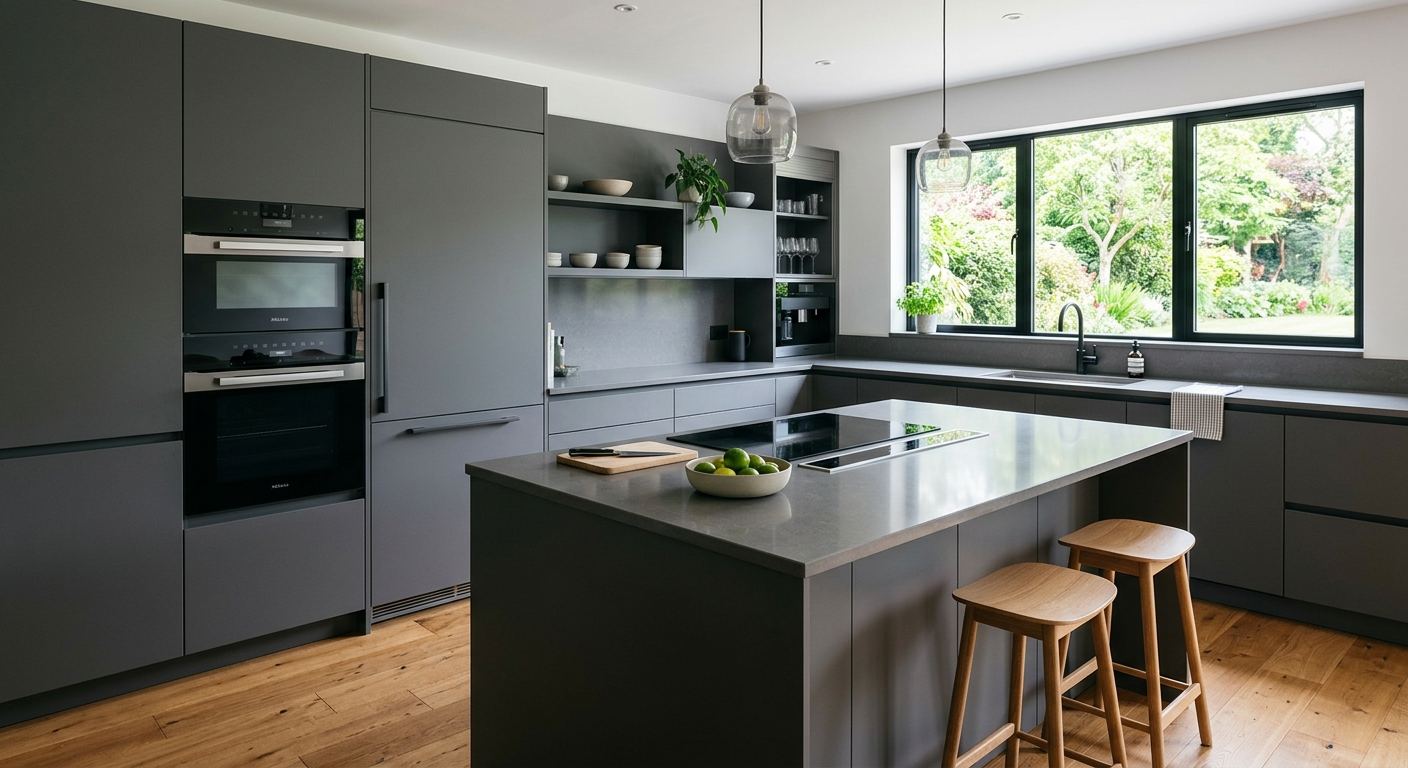
Kitchen renovation options and costs in Huntingdon
Kitchen renovations in Huntingdon are often decided by the kind of buyer experience you want to create—not just by materials. Huntingdon sits in a lower-profile pocket of the Lower Mainland–Southwest, and with a small population (1,224 people per the Statistics Canada, 2021 Census), there can be fewer trades competing directly for every job date. That matters because contractor availability and scheduling can move costs, especially for full rebuilds that stack cabinet install, countertop templating, flooring, and electrical work in the same week.
In the Lower Mainland–Southwest, pricing is driven more by local home value expectations and the finish tier homeowners want than by climate. Homeowners in higher-value parts of the region are more likely to choose quartz or stone counters and semi-custom cabinetry because the spend is easier to justify on resale. Where finish expectations are more modest, laminate surfaces and stock cabinets dominate as a practical way to control budget while still refreshing the look. (Statistics Canada, 2021 Census)
Climate still plays a supporting role: British Columbia’s wet seasons and freeze-thaw cycles around winter fronts can stress grout lines and caulking if the prep isn’t done correctly. That’s why good moisture-tolerant underlayment, proper flashing around exterior doors, and ventilation planning can influence durability and how often homeowners redo tile or backsplash. In Huntingdon—especially around the local commercial corridor and older residential clusters where renovations are concentrated—tile work and cabinetry installs are especially in demand.
Below is a practical way to compare common scopes before you request a detailed quote.
| Renovation Tier |
What's Included |
Typical Duration |
Price Range |
| Cosmetic refresh (paint, hardware, new appliances only) |
Cabinet paint or repaint, new pulls/knobs, appliance swap (like-for-like), touch-up caulking, basic countertop clean/seal where applicable |
3–7 days |
$8,000–$18,000 |
| Mid-range full renovation (new cabinets, counters, sink, tile) |
New semi-custom or upgraded stock cabinets, new countertops (quartz or laminate), sink + faucet, backsplash tile, sink plumbing reconnect, tile floor (partial or full), updated lighting as needed |
3–5 weeks |
$40,000–$85,000 |
| High-end full renovation (custom cabinets, stone counters, island) |
Fully custom millwork, stone counters (granite/stone/quartz slabs), large island design, upgraded hardware, full-height or feature backsplash, premium lighting plan, expanded electrical for island and under-cabinet lighting |
5–10 weeks |
$85,000–$120,000 |
| Cabinet refacing only (new doors + drawer fronts, same boxes) |
New door and drawer fronts, veneer/overlay to visible surfaces, hinges/soft-close hardware, alignment adjustments, optional new crown moulding and rail details |
1–2.5 weeks |
$8,000–$30,000 |
| Countertop swap only (laminate to quartz or stone) |
Remove existing tops, install new quartz/stone, sink cut + reconnect (if minimal changes), new seam detailing, sealants as required |
2–5 days |
$18,000–$45,000 |
| Backsplash tile installation only |
Tile layout, waterproofing prep where required, tile installation, grout + caulking, final cleaning |
3–7 days |
$1,500–$6,000 |
Prices are estimates only and vary by project scope, site access and material selection.
What affects the price of kitchen renovation in Huntingdon
For the same kitchen “look,” quotes in the Lower Mainland–Southwest can swing by 30–50% across projects and even within the broader British Columbia market. The reason is straightforward: homeowners tend to choose a finish tier based on expected resale returns, and that pushes labour-heavy items—like cabinetry installation complexity, countertop fabrication, and layout changes—into different cost categories. In higher-value Lower Mainland–Southwest neighbourhoods, it’s common to default to quartz or stone counters and semi-custom cabinetry, while more budget-conscious refreshes lean on laminate and stock cabinets for a better return.
Layout changes create the biggest cost uncertainty regardless of finish tier. Removing a wall, adding an island, or relocating a gas line (where applicable) or plumbing can force rework of subflooring, rough-in work, ventilation adjustments, and electrical rerouting. Those items don’t scale neatly, and that’s why two kitchens that both end up at “mid-range” can land in very different totals.
In Huntingdon specifically, a couple of local conditions often drive price up. First, if the existing cabinets are older and out of square (common in homes built or renovated decades ago), the installer may need more shimming, rebuilds, or selective flooring adjustments before countertops can template. Second, heavier wet-season humidity can reveal or worsen poorly sealed backsplash edges—so we often budget for correct waterproofing prep and re-caulk details around the sink and along exterior-wall runs. If you’re aiming for a full renovation in the $40,000–$85,000 zone, these “prep” realities are usually manageable; if you’re stepping into $85,000–$120,000 high-end territory, the schedule and material allowances typically expand because custom details need tighter tolerances.
Next, here are the specific price factors contractors weigh when building your estimate.
| Price Factor |
Why It Matters |
Cost Impact |
| Cabinet tier — stock vs. semi-custom vs. fully custom millwork |
Different lead times, fitting complexity, and material/finish quality change both labour hours and total spend |
Can shift overall project cost by ~10%–35% |
| Countertop material — laminate vs. quartz vs. granite vs. stone |
Fabrication method, edge profiles, seam planning, and weight/installation requirements vary by material |
Often adds ~5%–25% depending on slab complexity |
| Layout change — wall removal, island add, plumbing/gas move |
Rough-in trades, structural coordination, and rerouting utilities introduce unpredictable quantities |
Typically the largest variable; can add ~15%–50% |
| Appliance package tier — builder vs. mid-range vs. pro-grade |
Power/venting specs and installation tolerances differ; pro-grade units may require more electrical/vent work |
Commonly ~2%–20% of total depending on selection |
| Flooring — refinish existing vs. full replacement |
Existing floors may be damaged during demo; subfloor prep affects tile/luxury vinyl performance |
Can move cost by ~5%–20% |
| Backsplash — ceramic tile vs. marble vs. full-height slab |
Higher-end materials demand more precise layout, cutting, and sealing; full-height adds square footage |
Typically ~3%–15% depending on coverage and material |
| Electrical — new circuits for island, under-cabinet lighting |
Electrical scope determines licensed labour time and material; additional lighting increases cabling and controls |
Often adds ~1%–12% depending on how much changes |
| Permit fees and licensed trade requirements |
Where permits/inspections are triggered, timelines and administrative effort increase |
Can add ~1%–8% and also impact schedule |
Permits & regulations in British Columbia
In British Columbia, a straightforward cabinet or countertop swap usually doesn’t require a permit. Replacing existing cabinets with new ones (keeping the same footprint and utility hookups) and swapping countertops while reconnecting the sink as-is are typically permit-free. However, permits and licensed trades are commonly required when the work changes the “systems” in the home. Moving plumbing supply or drain lines, relocating a gas stove connection or range hood that vents with gas, removing a load-bearing wall, and adding new electrical circuits (for an island, under-cabinet lighting, or new receptacles) are the work types that typically trigger permits and inspections.
Step-by-step, here’s how a homeowner in Huntingdon can verify a contractor in British Columbia before work starts. First, request the contractor’s licence information and confirm it through the appropriate online government registry for the trades involved (electrical and gas work must be performed by licensed trades). Second, ask for a certificate of insurance—current liability coverage—and make sure the policy dates align with your project dates. Third, verify that they carry workers’ coverage as required for employees/subcontractors (commonly referenced as WCB/WSIB coverage). Fourth, ask for proof documents such as clearance letters if the contractor uses subcontract labour. Finally, ensure the contract clearly states who pulls permits, who schedules inspections, and how costs are handled if the scope expands.
Cabinets, countertops and layout decisions in Huntingdon
The three most consequential decisions in a Huntingdon kitchen renovation are cabinet tier, countertop material, and whether you’re changing the layout. Start with cabinet tier: stock cabinets are fastest and typically lowest cost, semi-custom is the most popular mid-range choice in the Lower Mainland–Southwest, and fully custom millwork gives the best fit and design flexibility but increases both pricing and lead time. Next, choose countertop material—laminate, quartz, granite/stone, butcher block, or marble—because maintenance and real-life durability differ. Quartz is the “set it and forget it” option for many homeowners, while granite/stone offers natural variation and strength with a need for periodic sealing. Butcher block can be warm and repairable, but it requires regular oiling and careful water protection around sinks. Marble is high-end and beautiful, but it needs diligent care to prevent etching.
Finally, decide on layout changes. Open-concept wall removal and island additions can justify the cost when they create usable circulation, better lighting sightlines, and a family-friendly workflow—especially for buyers who expect practical space. But if your goal is a refresh, relocating plumbing or gas lines and moving structural elements can push your budget quickly beyond the $40,000–$85,000 band. For example, in a common mid-range scenario, upgrading from laminate to quartz might increase your countertop budget by roughly $3,000–$12,000 within typical ranges, while moving a sink location can effectively require additional rough-in labour, materials, and inspection coordination—often more than the countertop upgrade itself.
In Huntingdon’s real-world housing stock, many kitchens are in homes with older framing and slightly uneven walls. That makes careful cabinet installation and seam planning more important than chasing the cheapest material. If you want the cleanest result without paying for overcompensation, it’s often smarter to allocate to semi-custom cabinetry and good prep rather than jumping straight to full custom for every element.
| Option |
Durability |
Maintenance |
Best For |
Price Range |
| Stock cabinets (big-box) |
Good for normal household wear; depends on build quality and door finish |
Low; keep hinges adjusted, protect against prolonged moisture near sink |
Quick updates and budget-focused renovations |
$8,000–$25,000 |
| Semi-custom cabinets (local dealer) |
Very solid; better options for interior storage and tighter fitting |
Low; soft-close hardware reduces wear |
Most Huntingdon homeowners aiming for a practical, resale-friendly upgrade |
$25,000–$55,000 |
| Custom cabinets (local millwork shop) |
Excellent; best tolerances for odd spaces and custom storage |
Low to moderate; depends on finish type, but built to last |
Design-led layouts and kitchens with challenging dimensions |
$55,000–$90,000 |
| Laminate countertop |
Moderate; can chip or scratch and seams require good detailing |
Low; avoid standing water at seams and edges |
Refresh projects where you want a new look with controlled cost |
$3,000–$7,000 |
| Quartz engineered countertop |
High; resistant to stains and everyday impacts |
Low; wipe-clean routine is usually enough |
Busy households and homeowners targeting broad buyer appeal |
$7,000–$12,000 |
| Granite / natural stone countertop |
Very high; durable with natural toughness |
Moderate; periodic sealing may be required |
Premium look with strong performance |
$9,000–$15,000 |
| Butcher block countertop |
Moderate to high; can be sanded/repaired if cared for |
Higher; oiling and careful water management needed near sinks |
Warm, rustic style kitchens and families that maintain surfaces |
$5,000–$10,000 |
| Marble countertop |
High but softer than quartz/stone; can etch under acidic spills |
Moderate to high; sealing and careful cleaning |
High-end aesthetics where homeowners commit to care |
$10,000–$18,000 |
How to choose a kitchen renovation contractor in Huntingdon
Choosing the right contractor in Huntingdon starts with verifying the credentials for the trades you actually need. For British Columbia, confirm that electrical and any gas-related work are performed by licensed professionals (ask for their licence details and insurance). Request proof of liability insurance and ensure coverage dates overlap with your project. If the contractor uses crews or subcontractors, ask about workers’ coverage documentation commonly referenced as WCB/WSIB coverage, and get a clearance letter if available. Don’t accept “we’re covered” without documents—ask for the certificate and keep a copy with your contract.
Next, collect 2–3 itemised, written quotes that break labour and materials down rather than one lump sum. The best quotes show demo/disposal, cabinet supply and install, countertop fabrication and install, tile/backer board and waterproofing details, electrical scope, and any plumbing reconnect work. Read the scope carefully for exclusions: is permit pulling included or billed separately, is debris hauling/disposal included, and are appliances installed and hauled away?
Warranty matters for both the workmanship and the products. Ask for the workmanship warranty length in writing, whether manufacturer warranties apply to cabinets/counters, and whether they’re transferable if you sell the home. Payment schedule should be conservative: never pay more than 10%–15% upfront, and use a holdback until the job is substantially complete and punch-list items are finished. Finally, get the start date and completion estimate in writing so you’re not relying on verbal timelines.
- Ask for licence proof for the trades involved (especially electrical and any gas work).
- Request liability insurance certificate and confirm project dates.
- Verify WCB/WSIB/clearance documentation for workers or subcontractors.
- Get 2–3 itemised quotes (labour + materials), not just one total.
- Confirm disposal/removal is included in the scope.
- Clarify permit pulling responsibility and who pays permit fees.
- Ensure countertop templating and fabrication lead times are listed.
- Ask how they handle out-of-square walls and uneven floors.
- Confirm warranty terms for workmanship and manufacturer products.
- Request a written start date and a realistic completion window.
- Review the change-order process in the contract before signing.
- Confirm what’s included for plumbing/electrical “reconnects.”
Concrete red flags I commonly see with kitchen contractors in Huntingdon include: vague scopes that don’t list disposal or permit responsibility, refusing to provide proof of insurance/licensing, requiring large deposits beyond 10–15% without milestones, giving only verbal timelines without lead-time assumptions, and offering “too-good-to-be-true” pricing that doesn’t include electrical, tile prep, or countertop templating.
Frequently asked questions — kitchen renovation in Huntingdon
What order do kitchen renovation steps happen in?
In a typical Huntingdon, British Columbia kitchen renovation, the order is designed to keep rough work protected and avoid redoing finished surfaces. First is planning and measurements (including cabinet sizing and countertop templating timing). Then comes demolition, including removing cabinets, disconnecting appliances, and prepping walls/floors. Rough-in work (plumbing supply/drain changes, electrical for new circuits or island outlets, and venting changes if needed) follows. After that, you install cabinets, then tile/backer board and waterproofing where applicable, and finally countertops (usually after cabinets are secured and aligned). Flooring is often staged before or after cabinets depending on the product and base height. Last comes trim, hardware, appliance installation, caulking/finishing, and a cleanup plus punch-list.
Can I live at home during a kitchen renovation in Huntingdon?
Many homeowners in Huntingdon do stay in their homes during renovation, especially for a cosmetic refresh or a limited scope. For example, appliance-only updates or a backsplash tile-only job is often done fast enough that you can keep using the rest of the kitchen with minimal disruption. For mid-range full renovations (commonly in the $40,000–$85,000 range), you may need a temporary cooking setup (microwave, induction hot plate, and access to a sink) for parts of the schedule while cabinets and countertops are installed. During high-end builds with layout changes and stone counters (often $85,000–$120,000), it’s more disruptive because multiple trades work across the same area. The decision depends on how much plumbing/electrical is moving and how many days the main kitchen is “out of service.”
Should I renovate my kitchen before selling in Huntingdon?
In Huntingdon and the surrounding Lower Mainland–Southwest market, a kitchen refresh is often worth it when the current layout is functional and the renovation aligns with what buyers expect at that finish tier. If your kitchen cabinets are dated but the structure is sound, a targeted upgrade (new hardware, repaint, a backsplash, and possibly countertops) can improve visual value without overbuilding. If you’re aiming to capture a broader buyer pool, quartz or similar modern surfaces usually feel current, and semi-custom cabinetry is a common mid-range sweet spot. That said, chasing premium custom millwork doesn’t always pay back if the rest of the home doesn’t support that level of finish. If you’re unsure, ask contractors for comparable pricing scenarios and think in “decision tiers”: a $8,000–$18,000 refresh versus a full mid-range rebuild in the $40,000–$85,000 band. Also factor the local pool of renovation-focused buyers, since timing and inventory can affect how quickly you need the project completed.
What's the most popular kitchen style in Huntingdon right now?
While style tastes vary by neighbourhood and household, the most requested look in Huntingdon right now tends to be clean, bright, and practical: shaker-style or simple slab-front cabinetry, neutral paint colours, and quartz countertops in softer tones (whites, warm greys, and light greige). Many homeowners also choose an island-focused layout when space allows, because it matches how people actually cook and socialize. Backsplashes are commonly a durable ceramic tile with modern grout lines, or a more premium look if the budget supports it. If you’re considering a refresh, staying in a mid-range finish profile often helps the kitchen feel “new” without triggering the higher costs of full custom cabinetry. A contractor can help you align your style choices with the typical buyer expectations for the Lower Mainland–Southwest market—where upgrades are valued, but overly niche designs can be harder to resell.
How do I know if I need to update my kitchen plumbing in Huntingdon?
You may need plumbing updates in Huntingdon if inspections reveal corrosion, slow drains, or water pressure issues, or if you’re changing the location of the sink, dishwasher, or gas line connection. Even without moving plumbing, it’s smart to check shutoff valves, supply lines, and whether existing drain connections are brittle—older connections can crack during disassembly. If you’re doing a countertop swap only, you’ll typically just reconnect the sink, so major plumbing replacement usually isn’t required unless problems exist. But for layout changes, quotes often include allowance for rough-in work and reconnection because moving the sink or dishwasher requires new supply/drain routing, labour time, and sometimes permit coordination. If you’re unsure, ask your contractor to include a “condition check” during demo, so you can separate cosmetic issues from real plumbing risks before costs escalate.
What is the difference between a galley and open-concept kitchen?
A galley kitchen is a long, corridor-style layout with counters along two opposing walls, typically with a clear walkway in between. This layout is efficient in smaller homes, but it can feel enclosed and limits seating space. An open-concept kitchen removes barriers to connect the kitchen with living/dining areas, often improving sightlines, natural light distribution, and social flow. In Huntingdon, the decision usually depends on the existing home structure and whether wall removal is feasible. Open-concept projects are more likely to involve layout changes, electrical additions, and potentially permit-driven work because you may relocate outlets, alter ventilation, or address structural elements. That’s also why open-concept kitchen renovations typically trend higher in cost than a cosmetic refresh—especially if plumbing or gas-related work changes.