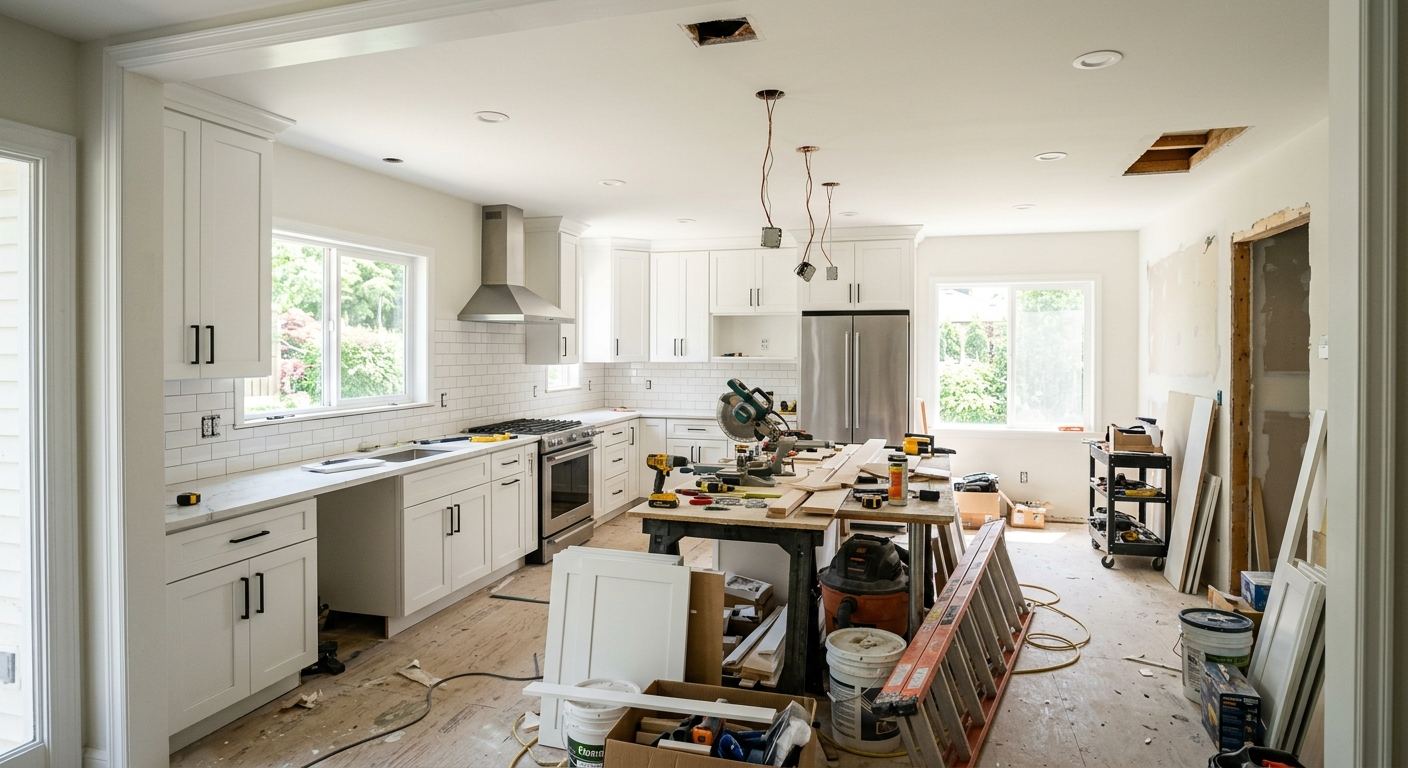
Kitchen renovation options and costs in Crofton
Crofton, British Columbia is a small community—population 1,446 (Statistics Canada, 2021 Census)—and that scale shows up in kitchen renovation planning, contractor scheduling, and material lead times. In the Lower Mainland–Southwest, pricing is driven more by home value and expected finish level than by day-to-day weather. Even though Crofton isn’t a high-density urban core, the projects we see here still tie into the same buying psychology as the broader Lower Mainland–Southwest: buyers often expect modern, easy-to-clean surfaces, updated lighting, and cabinets that look “built-in.” In higher-value parts of the region, homeowners are more likely to choose semi-custom or custom cabinetry and quartz or stone counters because the upgrade tends to hold value on resale; in more modest cases, laminate and stock options keep the renovation inside a tighter budget.
Lower Mainland–Southwest demand also affects availability. When homeowners request design-led layouts (like island additions) and premium material packages, trades get booked earlier, and timelines lengthen—especially when you’re coordinating plumbing, electrical, and countertop fabrication. Climate matters mainly in how you prep and seal areas around sinks, windows, and exterior-adjacent walls; the cost swing is usually less about freeze–thaw damage and more about material choices, complexity, and how many trades touch the room. In Crofton, this trade is especially in demand around the waterfront and older residential pockets near local shopping corridors where homeowners often want refreshed, brighter kitchens without a full structural rebuild. Below is a practical comparison to help you map your scope to a budget before you call for quotes.
| Renovation Tier |
What's Included |
Typical Duration |
Price Range |
| Cosmetic refresh (paint, hardware, new appliances only) |
Cabinet paint or re-stain (if applicable), new hardware, caulking and re-sealing at sink, appliance swap, minor touch-ups |
3–7 days |
$8,000–$18,000 |
| Mid-range full renovation (new cabinets, counters, sink, tile) |
New cabinets (stock/semi-custom), new countertops, sink + faucet, backsplash tile, under-cabinet lighting where included, plumbing updates as required, labour + install |
3–6 weeks |
$40,000–$80,000 |
| High-end full renovation (custom cabinets, stone counters, island) |
Custom millwork, quartz/stone counters, island build, upgraded hardware, extended backsplash, expanded electrical (island circuits), more complex layout coordination |
6–12 weeks |
$85,000–$120,000 |
| Cabinet refacing only (new doors + drawer fronts, same boxes) |
New door/drawer fronts, veneer/finish over existing boxes (if structurally sound), updated hardware, light cleaning and prep, optional new sink base if feasible |
2–4 weeks |
$8,000–$35,000 |
| Countertop swap only (laminate to quartz or stone) |
Demolition and removal of existing counters, new countertop fabrication and install, polishing/edge finishing, sink cut-out adjustments as needed |
1–3 weeks |
$12,000–$25,000 |
| Backsplash tile installation only |
Surface prep, tile supply (if quoted), layout, waterproofing/edge finishing at changes of plane, grout/seal where required |
3–7 days |
$1,500–$6,000 |
Prices are estimates only and vary by project scope, site access and material selection.
What affects the price of kitchen renovation in Crofton
In the Lower Mainland–Southwest (and across British Columbia generally), quotes for the same “size” kitchen can vary by 30–50% because the real cost drivers are finish tier, cabinetry complexity, and how many building systems you alter—not climate. Home values and typical household budgets push many owners toward quartz or stone counters and semi-custom cabinetry in higher-value pockets, while more budget-conscious renovations lean on laminate and stock cabinets. The result is that a 12–15 ft run kitchen can land in a mid-range full renovation band (for example, around $40,000–$80,000) or escalate into high-end territory once you add custom millwork, islands with upgraded electrical, and stone surfaces.
Layout changes are the most unpredictable cost regardless of finish level. Removing a wall, adding an island, or moving a gas line/plumbing for a relocated sink can trigger permit work, inspection schedules, and extra demolition and patching. In Crofton, older housing stock in established neighbourhoods can also mean more hidden surprises: out-of-square walls, older supply lines, or mismatched cabinet bases that force re-framing before countertops can be installed.
Two practical examples from Crofton-area jobs: (1) if you keep the existing sink location, you can often stay closer to a countertop swap-only scope (commonly $12,000–$25,000) because the cut-outs and plumbing hook-ups are straightforward; (2) if you move the sink to an island or exterior wall run, labour rises quickly because it’s not just cabinets—there’s drywall rebuild, potential drain slope work, and electrical for task lighting that buyers notice. Weather influences mainly prep and sealing details, but it usually doesn’t change labour rates the way material lead times and cabinetry build complexity do.
| Price Factor |
Why It Matters |
Cost Impact |
| Cabinet tier — stock vs. semi-custom vs. fully custom millwork |
Controls the amount of bespoke sizing, door styles, hardware quality, and installation detailing |
Can shift a project by roughly $12,000–$45,000 |
| Countertop material — laminate vs. quartz vs. granite vs. stone |
Material cost, fabrication complexity, and edge treatments affect both price and timeline |
Commonly $3,000–$12,000 for countertop installation alone, plus material variation |
| Layout change — wall removal, island add, plumbing/gas move |
Alters carpentry, demolition, and building-system work; often drives permits and trade coordination |
Typically adds $8,000–$35,000 depending on what moves |
| Appliance package tier — builder vs. mid-range vs. pro-grade |
Changes appliance purchase price, fit/finish, and venting requirements for ranges |
Can swing $2,000–$20,000 within the same layout |
| Flooring — refinish existing vs. full replacement |
Subfloor condition, height transitions, and match to new cabinet toe-kicks |
Often $1,500–$8,000 depending on scope |
| Backsplash — ceramic tile vs. marble vs. full-height slab |
Finishes increase material, cutting precision, and waterproofing detail work |
Typically $1,500–$6,000, with higher-end exceptions |
| Electrical — new circuits for island, under-cabinet lighting |
Lighting and island circuits may require additional work and inspection |
Often $1,000–$6,000 |
| Permit fees and licensed trade requirements |
Some work requires permits and licensed trades, which adds administrative and inspection time |
Can add $500–$3,500 plus scheduling impacts |
Permits & regulations in British Columbia
In British Columbia, not all kitchen changes require permits, and that’s where homeowners sometimes get caught by surprises. A straightforward cabinet or countertop swap typically does not need a permit because you’re replacing like-for-like with no changes to plumbing, gas, structural elements, or electrical circuits. However, permits generally become part of the project when you move plumbing supply/drain lines (like relocating a sink), relocate gas equipment (including ranges and any gas-connected components), remove a load-bearing wall, or add new electrical circuits—especially for island outlets and under-cabinet lighting upgrades that require new wiring paths. Gas work must be performed by a licensed gas fitter, and electrical work must be performed by a licensed electrician, with required inspections.
Here’s how a homeowner in Crofton can verify a contractor before work starts:
- Request the contractor’s licence details for relevant trades (gas/electrical) and confirm the specific trade is licensed for the work being done.
- Ask for a certificate of insurance (liability) and confirm coverage aligns with the project scope and dates.
- Confirm coverage for work safety through the contractor’s workers’ coverage documentation (commonly referred to as WSIB/WCB coverage in B.C. processes).
- Verify licences using the appropriate online registry listings for the trade type and company name.
- Have the contractor specify in writing who pulls permits and who pays fees—permit responsibility should be in the contract.
If the contractor can’t clearly explain what needs a permit and who handles it, that’s a major planning red flag for a renovation timeline in Crofton.
Cabinets, countertops and layout decisions in Crofton
When you renovate a Crofton kitchen, the three biggest decisions that control your final cost are: (1) cabinet tier (stock for speed and cost, semi-custom for the best balance, custom for exact fit), (2) countertop material (laminate, quartz, granite, butcher block, or marble), and (3) layout changes (open-concept wall removal, island addition, or plumbing/gas relocation). In the Lower Mainland–Southwest resale market, buyers typically notice how the kitchen “reads” at a glance—clean lines, consistent cabinet reveals, durable countertops, and practical lighting—more than they notice minor behind-the-wall construction. That’s why semi-custom cabinets and quartz are so common in mid-range full renovations, while custom millwork and stone counters push totals upward quickly.
Durability and maintenance matter in a Coast climate: even without harsh freezes, kitchens see moisture and humidity from cooking and cleaning. If you choose materials that don’t tolerate heat stains or that require careful sealing, you’ll pay more long-term in maintenance or repairs. For example, marble can be stunning, but it’s more prone to etching than quartz and may require more diligent care. But if you keep the sink and main plumbing locations steady, you can justify upgrades by focusing spending where it’s visible and functional.
A simple dollar example: moving from laminate to quartz in a countertop swap-only approach often lands around the $12,000–$25,000 band for install and fabrication. If you instead change the layout—add an island and move a sink or add a new gas/vent path—the project can jump toward a full renovation range like $40,000–$80,000 or beyond, even if you keep the cabinet style similar. In other words: upgrade the surfaces if you can; change the plumbing/gas only when the space gain truly makes sense.
| Option |
Durability |
Maintenance |
Best For |
Price Range |
| Stock cabinets (big-box) |
Good durability with standard finishes; limited size flexibility |
Low; keep hardware tight and clean with non-abrasives |
Budget-friendly updates and faster timelines |
$8,000–$20,000 |
| Semi-custom cabinets (local dealer) |
Better fit and more door/style options; improved build consistency |
Low; typical wipe-down, occasional hardware tightening |
Most popular mid-range Crofton renovations |
$20,000–$45,000 |
| Custom cabinets (local millwork shop) |
Highest durability and best layout fit; handles awkward spaces |
Low to moderate; quality hardware and finish care |
Design-led kitchens and difficult layouts |
$45,000–$75,000 |
| Laminate countertop |
Reasonable for everyday use; can chip at edges if impact-heavy |
Low; avoid prolonged hot items directly on surface |
Value-focused refreshes |
$3,000–$7,000 |
| Quartz engineered countertop |
High durability and good resistance to staining |
Low; wipe clean; avoid cutting on surface without protection |
High-performing, resale-friendly kitchens |
$7,000–$12,000 |
| Granite / natural stone countertop |
Very durable; natural variation; good heat tolerance |
Moderate; periodic sealing depends on stone type |
Owners wanting classic natural character |
$8,000–$13,000 |
| Butcher block countertop |
Durable with proper care; sensitive to standing water and heat |
Moderate to high; regular oiling and careful moisture management |
Warm, heritage or modern farmhouse looks |
$6,000–$10,000 |
| Marble countertop |
Beautiful but softer; can etch and stain without careful use |
Higher care level; sealing and careful cleaning required |
Design-forward kitchens used gently |
$10,000–$18,000 |
How to choose a kitchen renovation contractor in Crofton
For a kitchen renovation in Crofton, start by verifying that the right trades are actually licensed for the work your plan includes. Ask for proof of liability insurance (certificate of insurance) and request their workers’ coverage documentation commonly referred to as WSIB/WCB coverage in B.C. Then, check licensing through the appropriate online registry entries for the trade type—especially for gas and electrical scope—so you can confirm the person/company performing the work is authorized. If a contractor can only talk generally about “we handle permits,” but can’t show trade credentials for the specific tasks, you’ll feel that risk later in inspections and rework.
Next, get 2–3 itemised written quotes, not lump sums. Look for a labour-and-materials breakdown that clearly separates cabinetry supply, install labour, countertop fabrication and installation, plumbing/electrical allowances, disposal/recycling, and any permit pulling fees. Read the scope line-by-line: confirm what’s excluded (for example, drywall repairs beyond a defined allowance, floor patching, or any upgrades to electrical routing). Ask whether disposal is included and whether old materials are taken away or left on site.
Warranty matters too. Confirm the workmanship warranty length (and what it covers), the manufacturer warranty on cabinets/counters, and whether the warranty is transferable if you sell the home in the next few years. For payments, never agree to more than 10–15% upfront; use a holdback until completion and final walkthrough. Finally, require a start date and a realistic completion estimate in writing so scheduling aligns with countertop fabrication and inspection timing.
- Proof of B.C. licensing for gas/electrical work where applicable
- Certificate of liability insurance with project dates
- Confirmation of workers’ coverage documentation (WSIB/WCB coverage)
- 2–3 itemised quotes with labour and materials separated
- Written scope including inclusions/exclusions (permits, disposal, patching)
- Countertop fabrication timeline stated in writing
- Cabinet spec sheet included (brand, door style, finish, warranty)
- Workmanship warranty length and process for service calls
- Manufacturer warranty details and whether it transfers
- Payment schedule capped at 10–15% upfront, with a holdback
- Site protection plan (dust control, door protection, cleanup)
- Clear start date, milestones, and completion estimate
Common red flags I see in Crofton: (1) quotes that only list a “total” without showing labour/material allowances, (2) refusal to provide insurance or trade licence proof, (3) vague wording like “permits by client” even when plumbing/electrical work is included, (4) no written schedule for countertop fabrication and install, and (5) payment demands beyond 10–15% before any materials are ordered or site prep begins.
Frequently asked questions — kitchen renovation in Crofton
What order do kitchen renovation steps happen in?
In Crofton, the safest order is demolition last-minute only after you’ve confirmed the cabinet specs and countertop measurements. Typically: (1) final measurements and shop drawings, (2) permit/booking if plumbing/electrical scope includes required approvals, (3) demo and disposal, (4) rough-in for plumbing/electrical (and gas if applicable), (5) drywall/patching and surface prep, (6) cabinet installation and level adjustments, (7) countertop fabrication and install, (8) backsplash tile, flooring touch-ups, painting/trim, and (9) final hardware and appliance connections. This sequencing matters because cabinets must be set perfectly for countertops, and backsplash lines often depend on counter heights. If your plan is a countertop swap only (often $12,000–$25,000 in install scope), most steps compress—but rough prep and sealing still need time.
Can I live at home during a kitchen renovation in Crofton?
Often yes, but it depends on how disruptive your scope is. A cosmetic refresh or a backsplash-only job usually allows you to live in the home with minimal disruption. If you’re doing a mid-range full renovation—new cabinets and counters, sink and tile—most homeowners choose to stay home and use a temporary setup (microwave, kettle, and a small fridge) while the main work happens. In Crofton, older homes can make it tougher because plumbing access and wall patching can take longer than expected. If your renovation includes moving plumbing, gas, or adding electrical circuits, expect a short “no kitchen” period around rough-in and inspection days. If you’re in the $40,000–$80,000 band, plan your living area protection and daily food routine ahead of time, and insist on dust control in the contract.
Should I renovate my kitchen before selling in Crofton?
Renovating before selling can be worth it when you choose the upgrades buyers expect: clean cabinet fronts, durable counters, updated hardware, and a layout that feels bright and functional. In the Lower Mainland–Southwest market, buyers often respond strongly to quartz or stone counters and a thoughtful cabinet package, which is why many kitchens land in the mid-range full renovation range (often $40,000–$80,000) when resale value is the priority. That said, if your home is older and you’re discovering plumbing or electrical issues, it can be smarter to address those earlier even if finish upgrades are simplified. Also consider timeline: countertop fabrication and permits can extend the schedule. If you’re unsure, aim for the highest-impact visible elements first (cabinets + counters + lighting) before taking on layout changes that require gas/plumbing moves.
What's the most popular kitchen style in Crofton right now?
Right now in Crofton and across the broader Lower Mainland–Southwest, the “safe bet” style is modern transitional: shaker-style doors, warm whites/creams or soft greys, and straightforward hardware finishes (like matte black or brushed nickel). Layout-wise, many homeowners keep the kitchen practical—working triangle stays similar—while improving storage (deeper drawers, better pantry solutions) and adding task lighting. Countertops are commonly quartz due to low maintenance and durability in everyday cooking. If you’re comparing budget tiers, stock cabinets typically suit a quicker refresh with simpler lines, while semi-custom cabinets are popular for that tailored, built-in look that still fits many resale budgets. For high-end looks, custom millwork and an island with upgraded electrical can push you toward the top band (for full renovations, commonly $85,000–$120,000).
How do I know if I need to update my kitchen plumbing in Crofton?
You don’t always need a full plumbing replacement, but you do need to assess condition and compatibility with your renovation scope. If you’re keeping the sink in the same location and only swapping counters or doing cabinet work, you may only need minor adjustments (new supply lines, faucet update, or re-sealing). You should plan for more plumbing involvement when you see leaks, low water pressure, corrosion around shutoffs, repeated clogs, or water damage under older cabinets. Plumbing updates become more likely if you’re moving the sink, adding a dishwasher, relocating to an island, or encountering blocked/undersized drain piping during demo. Because moving supply/drain lines can require permits and licensed work, confirm the plan early—your contractor should explain what’s “replace to meet code” versus “upgrade for longevity.”
What is the difference between a galley and open-concept kitchen?
A galley kitchen is a layout where cabinetry and appliances run along two parallel walls, typically with a narrow walkway between them. It’s efficient for cooking but can feel closed off, which is why many homeowners consider opening up or reconfiguring sightlines during renovation. An open-concept kitchen blends the kitchen with living/dining space, usually by removing or modifying walls and aligning cabinetry with the room’s main traffic flow. In British Columbia, the trade-off is planning complexity: open-concept changes may involve structural assessment and permits, plus electrical and venting coordination. In Crofton, many renovations start by improving functionality within the existing footprint (storage, counters, lighting) before attempting a wall removal. If you do need structural changes, it’s usually what drives budgets into the higher full renovation bands rather than a simple cosmetic refresh.