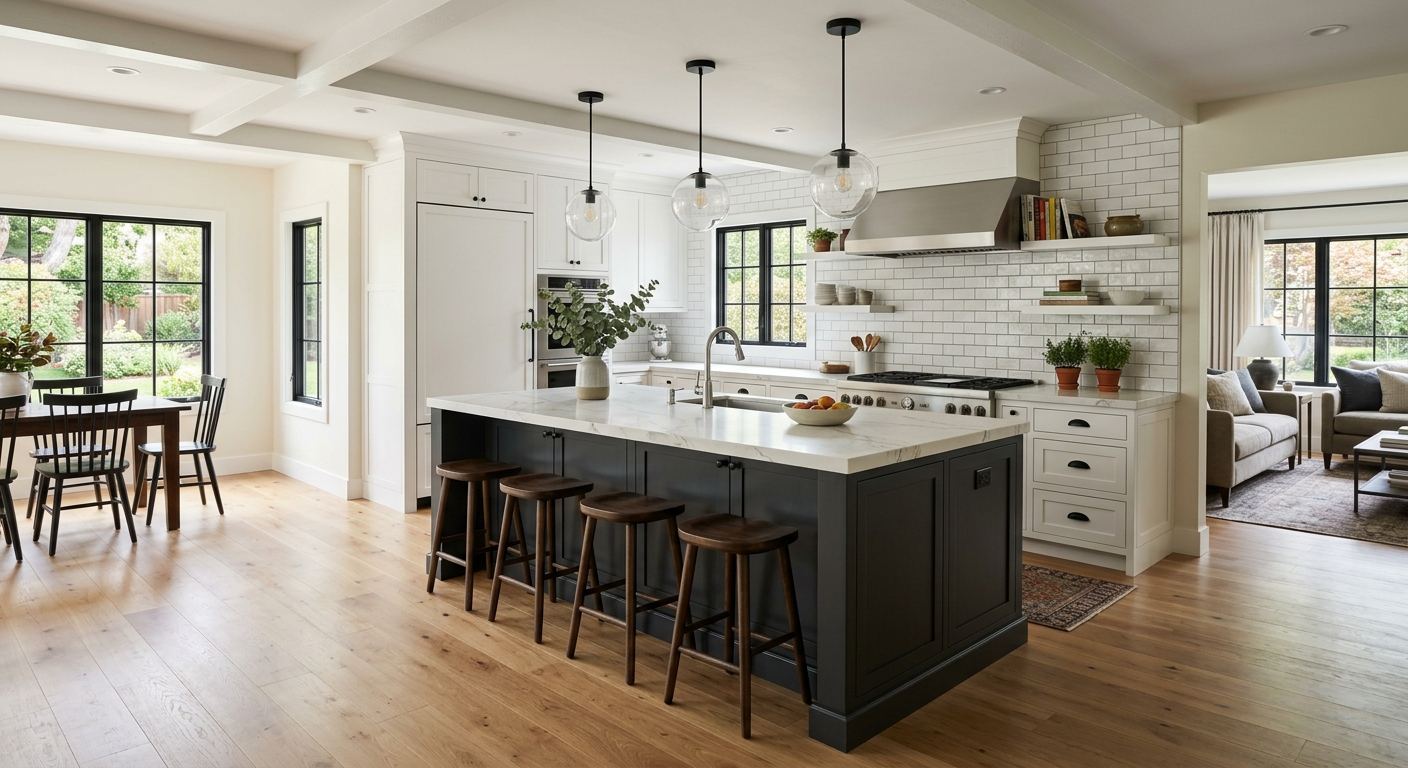
Kitchen renovation options and costs in Lillooet
Lillooet is a small community, but kitchen renovations there still follow British Columbia’s real-world pricing drivers: finish expectations, labour availability, and the resale logic homeowners use when planning a rebuild. With a median household income of $66,000 (Statistics Canada, 2021 Census), many local owners choose a practical “refresh-to-full-renovation” path rather than going straight to premium millwork. At the same time, homeowners are often balancing older housing stock—55.4% of homes were built before 1981 (Statistics Canada, 2021 Census)—which can mean dated layouts, uneven walls, and more subfloor or electrical catch-up work.
In the Lower Mainland–Southwest, kitchen costs tend to be shaped more by market expectations than climate. Contractors commonly see the biggest swings between a laminate-and-stock-cabinet refresh and a stone-counter, made-to-fit cabinetry package, because those are the finishes buyers associate with higher-value listings. Lillooet’s coastal-influenced weather (wet seasons, winter freeze–thaw, and humidity swings) also matters for materials selection: long runs of tile, good ventilation, and proper cabinet sealing protect against swelling and grout cracking, which can add labour even when materials look “mid-range.” In demand locally, you’ll often notice trades and showroom support clustered around the Hwy 99 corridor and the established residential areas near downtown—where renovation demand rises alongside home turnover and accessory upgrades.
Below is a realistic way to compare common renovation tiers, then you can decide which scope is worth the money for your kitchen size and timeline.
| Renovation Tier |
What's Included |
Typical Duration |
Price Range |
| Cosmetic refresh (paint, hardware, new appliances only) |
Cabinet paint/stain, new hardware/pulls, appliance swap, minor caulking, touch-up tile/trim as needed |
1–3 weeks |
$8,000–$25,000 |
| Mid-range full renovation (new cabinets, counters, sink, tile) |
Semi-custom or quality stock cabinets, new countertop, new sink/faucet, backsplash tile, floor/trim refresh, basic lighting updates |
4–8 weeks |
$40,000–$85,000 |
| High-end full renovation (custom cabinets, stone counters, island) |
Custom cabinetry/millwork, quartz or natural stone counters, island build, upgraded backsplash (including feature work), premium hardware, deeper lighting and electrical allowance |
7–14 weeks |
$85,000–$120,000 |
| Cabinet refacing only (new doors + drawer fronts, same boxes) |
New door/drawer fronts, veneer or replacement panels, hardware, align/level adjustments, countertop and backsplash typically not included |
2–5 weeks |
$8,000–$35,000 |
| Countertop swap only (laminate to quartz or stone) |
Remove laminate, fabricate/install quartz or stone, seam/edge finishing, sink cut-out allowance, basic sealant and cleanup |
3–7 days |
$3,000–$12,000 |
| Backsplash tile installation only |
Tile supply and install, surface prep, waterproofing membrane where needed, grout/seal, small trim work |
3–10 days |
$1,500–$6,000 |
Prices are estimates only and vary by project scope, site access and material selection.
What affects the price of kitchen renovation in Lillooet
Homeowners often see the same kitchen idea quoted 30–50% apart across the Lower Mainland–Southwest and other British Columbia regions—and it’s usually not because the contractor is “better” or “worse.” The spread comes from what the quote assumes about finish tier (stock vs semi-custom vs custom), the expected resale-ready level, and the complexity of the job site. In the Lower Mainland–Southwest, higher-value buyer expectations encourage quartz or stone counters and upgraded hardware more often than in lower-cost markets, which pushes typical full renovation totals upward. In Lillooet, the median household income of $66,000 (Statistics Canada, 2021 Census) means many owners choose upgrades that feel visible and durable, rather than changing everything at once.
Also, climate is a secondary driver compared with market finish logic. Lillooet’s wet season and freeze–thaw cycles mainly influence labour (proper ventilation, waterproofing details under tile, and moisture-aware cabinet installation) rather than material pricing. The unpredictable cost really comes from layout: removing a wall, adding an island, or moving a gas line can require additional framing, plumbing/gas work, and electrical runs—so your budget can swing even if you keep cabinetry mid-range.
Concrete examples I see locally: (1) older homes built before 1981 can hide out-of-square framing and old knob-and-tube or DIY wiring paths, which adds time before cabinets can sit flush; (2) if your backsplash goes to the ceiling or you upgrade to full-height tile, prep and waterproofing make tile & membrane labour rise quickly; (3) moving a sink to an island or to a perimeter run often costs more than swapping in a countertop upgrade, even when the countertop alone might be in the lower range of the $3,000–$12,000 band.
As you price options, keep the project tier in mind: a practical mid-range full renovation often lands in the $40,000–$85,000 territory, while island + stone + custom cabinetry can move you into the $85,000–$120,000 band fast.
| Price Factor |
Why It Matters |
Cost Impact |
| Cabinet tier — stock vs. semi-custom vs. fully custom millwork |
Material quality, hardware quality, fit/finish, and how well the layout adapts to older framing |
Can shift the kitchen total by roughly $10,000–$40,000 depending on the scope |
| Countertop material — laminate vs. quartz vs. granite vs. stone |
Cost per square foot, fabrication complexity (seams/edges), and longevity |
Typical countertop-only swaps can fall in $3,000–$12,000, with stone generally at the top end |
| Layout change — wall removal, island add, plumbing/gas move |
Framing, trades coordination, permits, and hidden damage risk |
Often adds the largest uncertainty; plan for $5,000–$25,000+ depending on what moves |
| Appliance package tier — builder vs. mid-range vs. pro-grade |
Electrical/gas requirements, ventilation needs, and installation tolerance |
Commonly $1,500–$8,000+ swing on appliances and venting allowances |
| Flooring — refinish existing vs. full replacement |
Removal/repair of subfloor, leveling, and transition details around toe-kicks |
May add $2,000–$10,000 depending on the existing condition |
| Backsplash — ceramic tile vs. marble vs. full-height slab |
Surface prep, waterproofing, and heavier material handling |
Can move within the $1,500–$6,000 band; full-height can exceed it |
| Electrical — new circuits for island, under-cabinet lighting |
Code-compliant wiring runs and lighting layout planning |
Frequently $1,000–$6,000+ depending on circuit needs and fixtures |
| Permit fees and licensed trade requirements |
Gas/electrical/plumbing work generally triggers permits, inspections, and scheduling |
May add a few hundred to several thousand dollars plus schedule time |
Permits & regulations in British Columbia
In British Columbia, a cabinet or countertop swap typically does not require a permit by itself. If you’re simply changing finishes—like replacing doors, refacing cabinets, or swapping laminate for quartz—most projects stay permit-light. Where permits and licensed trades are required is when you change the function or the service: moving plumbing supply or drain lines, relocating or adding gas components (such as your stove), removing a load-bearing wall, or adding electrical circuits for things like an island outlet cluster or under-cabinet lighting. In those cases, you’ll need the relevant permits and inspections, and the work must be done by licensed professionals.
Step-by-step for homeowners in Lillooet:
- Ask your contractor, in writing, to list exactly which scopes are permit-requiring and who pulls the permit.
- Request copies of the contractor’s certificate of insurance (liability) before work starts.
- For trades: confirm the gas fitter’s licence and the electrician’s licence (and that inspections are booked).
- Look for the clearance/authorization documentation your contractor provides after inspections (retain it for your records).
- Verify coverage details: if a project goes through WCB/WSIB-equivalent coverage, ask for proof of clearance/registration for the correct employer entities.
Before you sign, confirm who is responsible for permits in the contract—because even when materials swaps are straightforward, plumbing/gas/electrical changes add compliance steps that affect both cost and schedule.
Cabinets, countertops and layout decisions in Lillooet
When you’re planning a kitchen renovation in Lillooet, the three decisions that drive both satisfaction and resale appeal are: (1) cabinet tier, (2) countertop material, and (3) whether you change the layout (open a wall, add an island, or relocate plumbing/gas). In a market where buyers often expect a clean, modern look, stock cabinets are the fastest path to a refreshed appearance, but they’re less flexible if your home is out-of-square or the existing walls don’t line up well. Semi-custom cabinets are usually the “sweet spot” because they cost less than full custom while still letting the installer adapt to older framing and better conceal uneven runs.
Countertops follow the same logic. Laminate can be budget-friendly, but in Lillooet’s humidity and wet-season use, you’ll want durable edges, good installation, and careful sealing around the sink. Quartz is a popular mid-to-upgrade choice because it resists staining and holds up well to daily cooking. If you’re considering granite/natural stone, plan for higher material and fabrication rates, along with realistic seam placement around your island or long runs.
Layout changes are where budgets can justify themselves—or fail. If adding an island creates real workspace and traffic flow, the spend can be worth it. But if you’re moving a sink or gas connection for minimal gain, you’ll often get more value by upgrading visible surfaces instead. For example, moving to quartz might fit within the countertop-only $3,000–$12,000 band, while plumbing/gas relocation can push you beyond that quickly even before cabinetry and tile are accounted for.
For resale in the Lower Mainland–Southwest, buyers commonly expect cohesive finishes at the price points of a mid-range full renovation ($40,000–$85,000) and higher-end builds ($85,000–$120,000). Choose options that match your intended sale timeline and how “showpiece” you want the kitchen to feel.
| Option |
Durability |
Maintenance |
Best For |
Price Range |
| Stock cabinets (big-box) |
Good for standard layouts; hinges and particle core quality vary by brand |
Keep hardware tight; touch up minor chips; avoid prolonged moisture at edges |
Fast renovations, straightforward measurements |
$8,000–$25,000 |
| Semi-custom cabinets (local dealer) |
Better fit adjustments and more finish/hardware choices |
Routine wipe-down; verify caulk lines near sink and dishwasher |
Most homeowners aiming for a mid-range full renovation look |
$20,000–$55,000 |
| Custom cabinets (local millwork shop) |
Highest precision fit; ideal for irregular rooms and premium hardware packages |
Wipe spills promptly; protect against steam and wet-season moisture |
Signature kitchens, complicated layouts, built-ins and islands |
$45,000–$90,000 |
| Laminate countertop |
Resilient for daily use; seams and edges are the weak points if poorly sealed |
Wipe clean; avoid soaking at seams; replace if edges lift |
Budget refreshes and appliance-only upgrades |
$3,000–$6,000 |
| Quartz engineered countertop |
Very durable surface; handles staining and typical kitchen abrasion well |
Low maintenance; clean with mild soap; ensure proper sealing at sink |
Balanced value and longevity for family kitchens |
$6,000–$10,000 |
| Granite / natural stone countertop |
Hard and long-lasting; varies by stone pattern and finish |
Periodic sealing depending on stone; prevent prolonged moisture at cutouts |
Premium look with natural variation |
$8,000–$12,000 |
| Butcher block countertop |
Durable with care; sensitive to standing water and heat without protection |
Oil/maintain; dry thoroughly near sink and dishwasher |
Warm, traditional style and households that maintain finishes |
$5,000–$9,000 |
| Marble countertop |
Premium look; more susceptible to etching/staining than quartz in heavy use |
More careful cleaning; consider daily sealing/maintenance routine |
Showpiece kitchens with a lighter touch |
$10,000–$18,000 |
How to choose a kitchen renovation contractor in Lillooet
Choosing the right contractor in Lillooet starts with proof, not promises. In British Columbia, verify the contractor’s licensing where applicable (for plumbing/gas/electrical work, the individual trade must be licensed), and confirm liability insurance before any demolition. You should also ask for proof of WCB/coverage clearance (or the equivalent coverage documentation your contractor is required to carry). The easiest way to check: request the documents up front, then confirm details by matching the insured employer/company name on the certificate of insurance.
Next, get 2–3 itemised written quotes—not a lump sum. The best quotes break down labour and materials so you can see what’s included for cabinets, countertop fabrication, tile prep, demolition, disposal, electrical allowances, and whether permits are included. Read the scope line-by-line: look for exclusions like “subfloor repair not included,” “permit fees extra,” or “electrical by others.” Make sure demolition and disposal are included or clearly costed.
Warranty matters too: ask for the workmanship warranty length and whether it’s tied to a specific completion date. Also ask how manufacturer warranties work for cabinetry, hardware, and countertops, and whether they’re transferable if you sell the home.
For payments, never pay more than 10–15% upfront. Hold back part of the payment until the job is complete and defects are addressed. Finally, demand a written timeline with both a start date and an estimated completion date, since lead times for cabinets and stone in the Lower Mainland–Southwest can shift schedules.
- Request insurance certificate and verify it matches the contractor’s legal company name.
- Confirm licensed trades are used for gas and electrical scopes.
- Ask who pulls permits and whether permit fees are included or extra.
- Require an itemised quote (labour + materials), not a single total.
- Check inclusions for demolition, disposal, and site protection.
- Verify cabinet installation scope includes leveling/repair for uneven walls.
- Confirm countertop templating responsibility and what happens if measurements are off.
- Ask about tile waterproofing details behind the backsplash and around sink areas.
- Get a written warranty for workmanship (length and claim process).
- Clarify product warranties: who registers the product and how long coverage lasts.
- Use a payment schedule with a final holdback until punch-list completion.
- Get start/completion dates in writing, including lead-time assumptions.
Red flags I commonly see with kitchen renovation contractors in Lillooet: vague “we’ll handle permits” language without naming who is responsible; quotes that don’t itemise labour vs materials; refusal to provide insurance documents or trade licence details; payment terms that ask for large upfront deposits; and no written warranty terms for workmanship or defects resolution.
Frequently asked questions — kitchen renovation in Lillooet
Do I need a permit for a kitchen renovation in British Columbia?
In British Columbia, many kitchen renovations don’t need a permit when you’re doing like-for-like changes such as painting cabinets, replacing hardware, or swapping counters and cabinets without changing the plumbing or electrical layout. Where permits are typically required is when you move plumbing supply/drain lines, relocate gas connections (for example, moving a stove location or gas line), remove a load-bearing wall, or add new electrical circuits (common when adding island outlets or new lighting runs). For your Lillooet project, confirm the permit responsibility in your written contract—especially if trades need inspections. If you stick to a refresh-level scope, you may stay simpler and closer to the $8,000–$25,000 band.
What's the ROI on a kitchen renovation?
In most parts of British Columbia, a kitchen renovation tends to improve marketability and can help recoup value, but the ROI depends heavily on how closely your updates match buyer expectations for your neighbourhood and price tier. In the Lower Mainland–Southwest, buyers more often expect cohesive finishes—quartz/stone counters and upgraded cabinetry—so a “showpiece” kitchen can perform better for resale than a purely cosmetic job. That said, not every dollar spent returns equally: expensive layout changes or full custom millwork can overshoot the value for some listings. A practical mid-range full renovation (often in the $40,000–$85,000 range) usually balances durability and modern appearance without unnecessary risk. If your goal is ROI with less unpredictability, focus first on cabinets, counters, and a well-planned backsplash.
How do I budget for a kitchen renovation?
Start by choosing a renovation tier, then build your budget around scope—not just materials. For Lillooet homeowners, it’s common to begin with a roadmap: a cosmetic refresh (paint/hardware/appliances) can sit around $8,000–$25,000, while a mid-range full renovation with new cabinets, counters, sink, and tile often lands in $40,000–$85,000. If you’re planning an island and premium finishes, you can move toward the $85,000–$120,000 band quickly. Also include contingency: older homes built before 1981 can reveal uneven framing, wiring touch-ups, or flooring repairs once cabinets come out. Ask for itemised quotes so you can see what’s included (permits, disposal, electrical allowances) versus what’s excluded.
Can I move my kitchen sink or stove?
Yes, you can move a kitchen sink or stove in Lillooet, but it’s one of the highest-variability parts of pricing. Moving a sink usually means moving plumbing supply and/or drains, and that commonly triggers permits and licensed plumbing work. Moving a stove is even more sensitive because gas work must be performed by a licensed gas fitter, with proper inspections. Because these changes affect hidden walls and service runs, expect more demolition, more coordination between trades, and sometimes extra cabinet modifications. If you’re trying to control cost, consider keeping the sink/stove footprint and spending on visible upgrades—countertops and cabinetry. That approach can keep you closer to a countertop swap budget (often $3,000–$12,000) instead of adding service-move uncertainty.
What's the most cost-effective kitchen upgrade?
For many Lillooet kitchens, the most cost-effective upgrade is often the one that delivers a “new kitchen” look without major hidden-work risk. Common winners are: cabinet refinishing/refacing (new doors/drawer fronts) and countertop swaps, because they change the visual impact fast. If your layout is already functional and services are in the right places, a countertop swap only can be a strong value move—frequently within the $3,000–$12,000 band depending on material choice and edge/seam complexity. A backsplash tile upgrade is another cost-controlled option if you plan proper prep and waterproofing details. If you’re choosing between “all new” versus “targeted,” targeted upgrades tend to protect your budget when older framing or moisture-proofing details increase labour.
Custom vs stock cabinets — is custom worth it?
Custom cabinets can be worth it in Lillooet when your kitchen has an irregular layout, challenging measurements, or you want built-ins (like wall units or a true feature island) that stock systems can’t fit properly. But for many homeowners, the incremental cost of fully custom millwork can exceed what you need to meet modern buyer expectations—especially if your goal is a mid-range remodel. Semi-custom cabinets are often the “best value” compromise: they’re flexible enough to handle older home framing and still fit a more predictable budget. For context, stock cabinets are typically the lowest-cost route, while custom cabinetry is where totals climb toward the high-end renovation tier ($85,000–$120,000) once counters, tile, and additional labour are included. If you’re unsure, request a quote that shows all three tiers so you can compare cost against the specific fit benefits in your room.