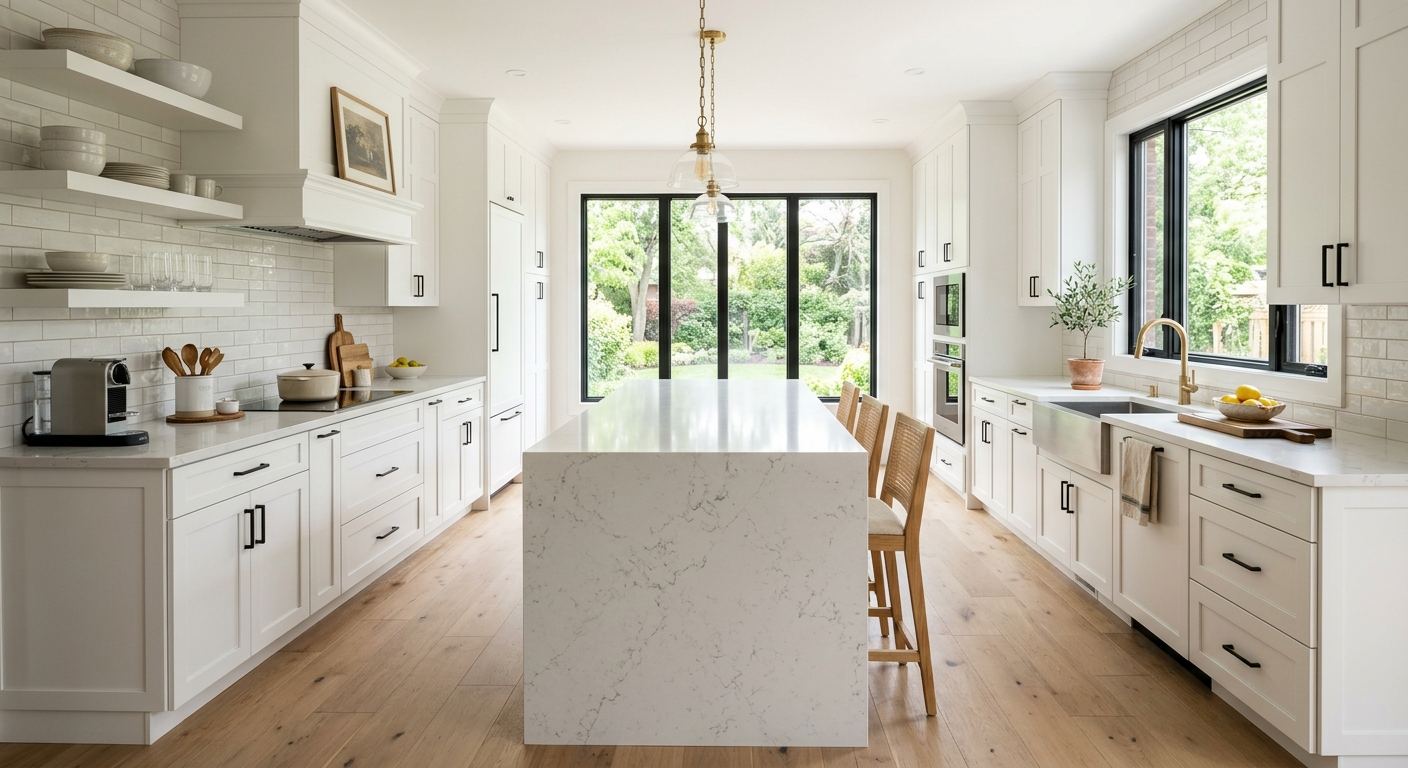
Kitchen renovation options and costs in Kitimat
Kitimat homeowners typically make kitchen choices based on value-for-money, not Vancouver pricing. With a median household income of $103,000 (Statistics Canada, 2021 Census) and a housing stock where 77.9% of homes were built before 1981 (Statistics Canada, 2021 Census), many renovations focus on functional upgrades—clean storage, better lighting, and easier-to-clean surfaces—rather than full structural reworks. In the North Coast economy, many families also choose mid-range finishes (stock or semi-custom cabinets, laminate or entry-level quartz counters, and practical tile) to keep budgets in line with what buyers expect when they tour. That’s especially common in older neighbourhood pockets such as Riverlodge area, where kitchens often need modernization but layouts may be kept mostly intact.
Cost also reflects how quickly trades are available and how remote logistics play out for materials. The marine climate matters too: we see moisture-driven wear in older floors and cabinetry edges, so homeowners sometimes budget a bit more for water-tolerant flooring prep and reliable caulking/grout sealing. Still, for most quotes, the biggest swing isn’t weather—it’s the scope (moving plumbing/electrical, wall changes, or adding an island) and the finish tier you pick.
To compare realistic options, use the tiers below as a budgeting backbone, then tighten your selection after a site visit and a detailed scope review.
| Renovation Tier |
What's Included |
Typical Duration |
Price Range |
| Cosmetic refresh (paint, hardware, new appliances only) |
Cabinet repaint or touch-up, new hardware, cabinet-safe paint/primer, appliance swap (no changes to gas/plumbing locations), minor caulking; excludes cabinet replacement |
1–3 weeks |
$6,000–$15,000 |
| Mid-range full renovation (new cabinets, counters, sink, tile) |
New stock or semi-custom cabinets, laminate or entry-level quartz counters, new sink + faucet, backsplash tile, new flooring (or refinished where possible), basic plumbing/electrical adjustments to match fixtures |
4–8 weeks |
$30,000–$60,000 |
| High-end full renovation (custom cabinets, stone counters, island) |
Fully custom cabinetry, premium quartz/stone counters, island build-out, upgraded backsplash (higher-end tile or slab look), more lighting options, likely layout changes, enhanced trim and detailing |
8–14 weeks |
$60,000–$75,000+ |
| Cabinet refacing only (new doors + drawer fronts, same boxes) |
New doors/drawer fronts/trim, updated hardware, interior reorganization (where offered), countertop carryover or limited swap planning, repaint/finish work; boxes must be sound |
2–5 weeks |
$6,000–$20,000 |
| Countertop swap only (laminate to quartz or stone) |
Remove existing counters, install quartz/stone with new sink cut-outs (as needed), seal/finish edges, basic backsplash changes if required for fit |
2–4 weeks |
$2,500–$9,000 |
| Backsplash tile installation only |
Tile removal (if replacing), install new backsplash tile, backer prep as needed, caulking/sealing for splash zones |
1–2 weeks |
$2,000–$8,000 |
Prices are estimates only and vary by project scope, site access and material selection.
What affects the price of kitchen renovation in Kitimat
Across North Coast BC (Prince Rupert, Terrace, Kitimat and surrounding Kitimat–Stikine communities), two homeowners can receive quotes that differ by 30–50% for what looks like the same kitchen on paper. The usual reason is that “the same job” often hides different finish tiers and different building work. Here, home value and household income tend to steer finish expectations more than climate does: when a market has higher buying power, homeowners more often go with quartz or stone counters and semi-custom cabinetry because the spend tends to carry through resale. In steadier, more modest scopes, laminate counters and stock cabinetry deliver better value—especially when layouts remain mostly unchanged.
In Kitimat, cabinet and countertop choices show up quickly in your budget, but the most unpredictable costs come from layout changes. If you remove a wall, add an island, or move plumbing/gas connections, you’re paying for extra labour, patching, subfloor/flooring repairs, and additional trades scheduling. That’s where remote logistics can create small delays and sometimes add handling costs for specific products.
Concrete examples from recent North Coast builds: (1) upgrading from laminate to quartz is often a straightforward install, frequently sitting within the $2,500–$9,000 countertop band, while moving a sink location can push the job into a full mid-range renovation pattern (more like $30,000–$60,000) because plumbing rough-ins and cabinet modifications are required. (2) Replacing tile only is usually contained in the $2,000–$8,000 band, but full flooring replacement after water-damaged subfloor prep after older-home moisture exposure can add significant labour. With 77.9% of homes built before 1981 (Statistics Canada, 2021 Census), we also see more out-of-level walls that increase shim/trim work during cabinet installs—small per cabinet run, big across a whole kitchen.
| Price Factor |
Why It Matters |
Cost Impact |
| Cabinet tier — stock vs. semi-custom vs. fully custom millwork |
Higher tiers add customization, better hardware options, more precise fit, and longer lead times |
Large swing; often the biggest single driver after scope |
| Countertop material — laminate vs. quartz vs. granite vs. stone |
Material cost, edge profiles, thickness, and fabrication complexity vary widely |
Medium to large; can move you several thousand dollars quickly |
| Layout change — wall removal, island add, plumbing/gas move |
Requires framing/structural review, new rough-ins, patching, and extra trade scheduling |
Often the most unpredictable; can add significant cost regardless of finishes |
| Appliance package tier — builder vs. mid-range vs. pro-grade |
Pro-grade models increase purchase price and may require electrical/gas configuration changes |
Medium; increases total project but can also affect rough-in work |
| Flooring — refinish existing vs. full replacement |
Moisture, wear, and subfloor condition in older homes can force replacement |
Medium; hidden damage can turn a “simple” plan into a bigger rebuild |
| Backsplash — ceramic tile vs. marble vs. full-height slab |
Prep requirements and installation complexity increase with stone or full-height walls |
Small to medium; still visible and can be labour-intensive |
| Electrical — new circuits for island, under-cabinet lighting |
Lighting upgrades and new outlets require licensed electrical work and sometimes panel/route changes |
Medium; ties to permit/inspection timing |
| Permit fees and licensed trade requirements |
Any regulated work adds admin, inspections, and scheduling of licensed specialists |
Small to medium directly, but can increase total timeline and labour coordination |
Permits & regulations in British Columbia
In British Columbia, a straightforward cabinet or countertop swap typically does not require a permit. If you’re replacing the countertops with the existing sink locations, and you’re swapping cabinet finishes without changing major systems, you can usually proceed with no permits beyond any standard trade requirements for electrical or plumbing work already in place. However, when the renovation touches the building systems, permits become common and licensed trades are mandatory.
Work that typically DOES require permits and licensed trades includes moving plumbing supply or drain lines, relocating a gas line or changing where the stove/range hood vent connects (especially for any gas appliance-related changes), removing a load-bearing wall, and adding or rerouting electrical circuits (for example, adding outlets for an island or installing new dedicated lighting circuits). In those cases, the licensed gas fitter and licensed electrician handle their portion, and inspections are part of the process.
For Kitimat homeowners, the best approach is to verify everything before signing: (1) ask for the contractor’s licence details and certificate of liability insurance, (2) confirm whether each licensed trade is scheduled under their own licence for gas or electrical work, and (3) request proof of workers’ compensation coverage documentation for the labour involved. Where applicable, you can confirm licences and standing via the relevant provincial online registries, then cross-check against the insurance certificate and any clearance/coverage letter your contractor provides for your project.
Always make sure permit responsibility (who pulls permits, who pays fees, who schedules inspections) is clearly written into the contract scope.
Cabinets, countertops and layout decisions in Kitimat
The three most consequential decisions in a Kitimat kitchen renovation are cabinet tier, countertop material, and layout. First, cabinet tier: stock cabinets are fastest and cheapest because boxes and components are standardized. Semi-custom is the most popular mid-range choice locally because it offers better sizing, upgraded drawer organization, and a more tailored look without the full premium of custom millwork. Custom cabinets are the highest cost, but they’re most justified when you have unusual dimensions, need full-height features, or want built-ins (pantries, appliance garages, appliance lift-outs) that match your lifestyle.
Second, countertop material: laminate can be a strong value option for busy households and typically lands in the mid-range renovation path when combined with upgraded cabinets. Quartz is a common North Coast “sweet spot” because it resists staining and wipes clean in everyday cooking, which matters when you’re dealing with the salt-air and moisture exposure that can affect grout, edges, and surrounding surfaces over time. Granite/natural stone looks premium and holds up well, but it can be more sensitive to maintenance preferences, and the install plan matters for seam placement. Butcher block adds warmth, though it requires more care to maintain the surface and edge integrity in a damp climate pattern.
Third, layout: an open-concept wall removal or island addition can be worth it only when it’s solving a real workflow problem. If you want more prep space and seating, an island is often justified; if your existing footprint already works, keeping the plumbing/gas locations can prevent the “hidden” cost balloon that comes with rough-ins. For a quick example: upgrading counters within the $2,500–$9,000 range can be a high-impact improvement, while moving plumbing to support a relocated sink can push you into the broader $30,000–$60,000 mid-range renovation zone because cabinets, drywall, and floor prep typically need more work.
| Option |
Durability |
Maintenance |
Best For |
Price Range |
| Stock cabinets (big-box) |
Good for most homes; durability depends on door finish and hinges |
Low; wipe clean and keep hardware tight |
Fast timelines and budget-focused refreshes |
$6,000–$25,000 |
| Semi-custom cabinets (local dealer) |
Very good; better internal options and more door/drawer configurations |
Low; protect finishes from moisture at seams/edges |
Most Kitimat renovations targeting resale-friendly upgrades |
$15,000–$40,000 |
| Custom cabinets (local millwork shop) |
Excellent; built to fit your exact space and detailing preferences |
Low to moderate; quality hardware maintenance |
Challenging layouts, full-height designs, built-ins |
$30,000–$60,000+ |
| Laminate countertop |
Good for everyday use; avoid impacts at edges |
Low; keep seams sealed and replace if water gets underneath |
Value projects and quick upgrades |
$2,500–$5,500 |
| Quartz engineered countertop |
Very good; resistant to stains and daily wear |
Low; wipe with mild cleaners and avoid abrasive pads |
Busy kitchens and buyers expecting an “easy care” surface |
$4,500–$9,000 |
| Granite / natural stone countertop |
Excellent; durable with proper sealing and seam planning |
Moderate; occasional sealing and spot maintenance |
Premium look with a timeless resale appeal |
$6,000–$12,000 |
| Butcher block countertop |
Good; can dent/scratch and is edge-sensitive |
Moderate; oiling/conditioning and careful drying after spills |
Warm, rustic style and homeowners willing to maintain |
$4,000–$8,500 |
| Marble countertop |
Beautiful but softer; more prone to etching and staining |
Higher; sealing and careful cleaning habits |
Showpiece kitchens where texture and stone drama matter |
$7,000–$16,000+ |
How to choose a kitchen renovation contractor in Kitimat
When you hire a contractor in Kitimat, confirm three things up front: British Columbia licensing, liability insurance, and workers’ compensation coverage. For licensed trades (gas fitting and electrical), make sure the contractor either provides the licensed trade’s details or guarantees the licensed trade will perform the regulated work. You can check contractor/labourer licensing via provincial online registries where available, then ask for a certificate of insurance showing liability coverage that matches your project scope. For workers’ compensation, request proof of coverage for the workers assigned to your job so you’re not exposed if an accident happens on site.
Next, get 2–3 itemised written quotes. “Kitchen renovation $45,000” is not enough—ask for a labour and materials breakdown by major scope items (cabinet supply/installs, countertop fabrication and install, tile and prep, plumbing/electrical allowance, demolition/disposal, and any drywall/painting). Read exclusions carefully: disposal included or extra? permit fees included or billed later? Who handles protecting flooring and cleaning? Warranty terms matter too: insist on a workmanship warranty length and ask whether product warranties (cabinet/countertop/appliances) are direct from manufacturers and whether they’re transferable to you.
On payments, a good rule is to keep early deposits to roughly 10–15% and hold back a portion until punch-list items are complete. Finally, require a start date and a completion estimate in writing, and ensure the schedule accounts for material lead times (especially countertops and custom cabinetry).
- Request BC licence and proof of insurance before signing; keep copies in your project file.
- Confirm licensed trades for gas/plumbing/electrical work and who pulls permits.
- Ask for an itemised quote (labour + materials), not just a lump sum.
- Check what’s included: demolition, disposal, floor protection, and site cleanup.
- Verify whether countertop fabrication is quoted as supply-only or includes templating and install.
- Confirm tile scope: wall prep, backer board (if needed), and sealing/grout type.
- Review electrical scope: new circuits/outlets/under-cabinet lighting allowances.
- Ask how they handle hidden damage in older homes (pre-1981 construction is common).
- Get cabinet specs in writing: box material, door style, drawer hardware, and finish warranty.
- Require a schedule with lead times, inspection steps, and buffer days.
- Holdbacks: plan for a final payment tied to completion and sign-off.
- Confirm workmanship warranty coverage and how to submit warranty claims.
Red flags to watch for in Kitimat include: refusing to put scope and exclusions in writing, vague allowances that change at the end of the job, missing proof of insurance or workers’ coverage, asking for large upfront payments (well beyond 10–15%), and providing no clear start/finish timeline—especially when countertop templating and cabinet lead times are involved.
Frequently asked questions — kitchen renovation in Kitimat
How do I know if I need to update my kitchen plumbing in Kitimat?
In Kitimat, plumbing upgrades are often driven by condition rather than style. If you’re noticing slow drains, leaks under the sink, corrosion at supply lines, or inconsistent hot-water temperature, it’s worth budgeting an inspection during demo. Also pay attention to older under-sink shutoffs and any evidence of moisture damage around toe-kicks and cabinet bases—77.9% of homes were built before 1981 (Statistics Canada, 2021 Census), so dated plumbing arrangements are common. If you plan to move the sink, dishwasher, or add an island, that’s when plumbing is more likely to need “rough-in” work and licensed trade involvement. A good contractor can run a targeted scope: pressure-test, check supply/drain connections, and propose the minimum changes needed for a reliable install.
What is the difference between a galley and open-concept kitchen?
A galley kitchen is typically a narrow, two-wall layout where prep and cooking work runs along parallel counters. It’s efficient for small footprints and often keeps plumbing and electrical runs simpler, which can help your budget stay closer to a refresh or mid-range plan (for many kitchens, that’s the $30,000–$60,000 band when you’re doing full replacement). An open-concept kitchen removes a wall to connect living and cooking space, which can improve sightlines and resale appeal, but it usually increases scope: structural review, drywall patching, flooring transitions, and sometimes new electrical circuits for added lighting/outlets. In Kitimat’s older housing stock, open-concept changes also require careful planning around existing framing and where services actually run.
How do I get accurate kitchen renovation quotes in Kitimat?
Accurate quotes come from a detailed scope and clear inclusions. In Kitimat, ask for an itemised quote that separates labour and materials, including cabinet install, countertop fabrication and install, tile prep, and electrical/plumbing allowances. Ensure the quote notes what’s included for demolition and disposal, and whether permits are pulled by the contractor or by you (and who pays fees). Provide photos and a simple floor plan sketch, then do a site visit so the contractor can confirm wall condition, subfloor levelness, and whether your existing cabinet boxes are salvageable. If you’re comparing tiers, anchor your expectations to local bands: a cabinet refacing project may be around the $6,000–$20,000 range, while a full mid-range renovation commonly lands in $30,000–$60,000. Quotes that don’t reference scope like this often surprise homeowners later.
What's the best countertop material for a busy Kitimat kitchen?
For most busy households in British Columbia coastal weather, quartz is the most practical “set it and forget it” option: it handles daily cooking wear well, resists staining better than many traditional surfaces, and is usually straightforward to maintain. Laminate can be a smart budget choice, especially if you’re keeping the layout stable and focusing money on cabinets and lighting; it typically fits within the $2,500–$5,500 countertop range depending on size and edge profiles. Natural stone like granite is durable and looks premium, but homeowners often spend more time on sealing and careful cleaning habits. Marble looks luxurious but is more prone to etching/staining, so it’s better for lower-abuse kitchens. Whatever you choose, make sure seams are installed cleanly and protected from moisture at edges, because damp air can reveal small workmanship gaps over time.
How do I add an island to my Kitimat kitchen?
Adding an island is doable, but in Kitimat it’s usually a scope decision more than a materials decision. First, confirm clear walking space and whether you can connect power and (if needed) plumbing for a sink or dishwasher. If you’re planning an island with a cooktop or sink, electrical and/or plumbing changes usually follow, which typically increases labour and may trigger permits and licensed trade work. If you’re staying with an island for prep and seating only (no plumbing/gas moved), cost is usually more predictable and may still fit within a mid-range renovation plan. If your island requires relocating a gas line or moving a gas appliance connection, that’s regulated work and should be done by the appropriate licensed professional. A contractor should also check cabinet toe-kick and floor flatness so the island sits level and doesn’t stress countertop seams.
How much does a kitchen renovation cost in Kitimat?
Kitchen renovation costs in Kitimat depend heavily on scope and finish tier. For a full refresh (paint/hardware and new appliances without moving plumbing or electrical), many projects fall around the $6,000–$15,000 range. For a mid-range full renovation with new cabinets, counters, a sink, and backsplash tile, a common local target is $30,000–$60,000. If you’re adding an island and upgrading to custom cabinetry or premium stone counters, budgets can push higher, often aligning with the upper BC band (sometimes $60,000–$75,000+). Weather matters less than people think—quotes are more affected by whether you’re moving plumbing/electrical, removing walls, or replacing flooring because hidden conditions in older homes can increase demo and repair time.