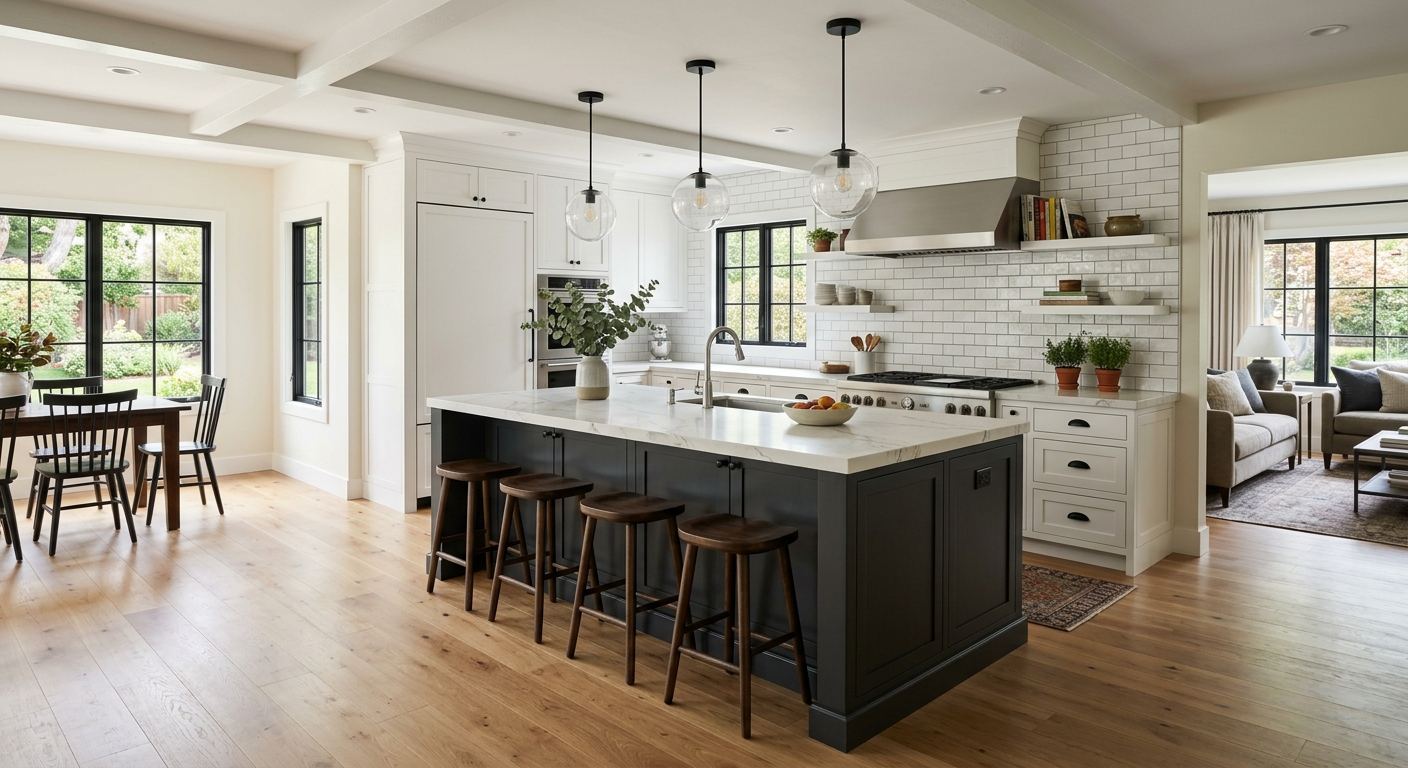
Kitchen renovation options and costs in Slave Lake
Slave Lake homeowners typically face the same big decision first: how much change you want—cosmetic refresh versus a full layout and millwork overhaul. With a median household income of $111,000 (Statistics Canada, 2021 Census), many families in town can target a mid-range finish tier that still feels “updated” without chasing the highest-end custom route. It also helps to remember that around 29.1% of local housing stock was built before 1981 (Statistics Canada, 2021 Census), and older homes often need extra labour for electrical corrections, uneven walls, and cabinet level-up, even when the design is modest.
In the Athabasca–Grande Prairie–Peace River region, renovation budgets track closely with home value expectations and resale economics—not just square footage. That’s why you’ll see common scopes priced around the mid-band for cabinets and counters, with durable, budget-conscious tile and laminate or entry-level quartz most frequently selected. At the same time, Slave Lake’s northern climate means garages, exterior doors and indoor humidity swings can be tougher on finishes: installers take extra care with ventilation, caulking, and sealing at countertop seams so moisture doesn’t creep where it can.
Contractor demand is especially strong around the Lakeside and downtown core areas where many renovations are within older residential pockets and timelines are tighter due to active neighbourhood housing. Next, compare the typical options and price ranges before you decide which level of work matches your budget.
| Renovation Tier |
What's Included |
Typical Duration |
Price Range |
| Cosmetic refresh (paint, hardware, new appliances only) |
Paint, new hardware/pulls, appliance replacement, simple fixture swaps (no cabinet rework) |
1–3 weeks |
$3,500–$12,000 |
| Mid-range full renovation (new cabinets, counters, sink, tile) |
New semi-custom or quality stock cabinets, new countertop, sink + basic plumbing connections, backsplash tile, flooring touch-ups or replacement allowance |
3–8 weeks |
$20,000–$55,000 |
| High-end full renovation (custom cabinets, stone counters, island) |
Custom cabinetry, premium quartz/granite/natural stone, island with upgraded storage, upgraded backsplash, higher-tier lighting and more extensive demo |
6–12 weeks |
$55,000–$80,000 |
| Cabinet refacing only (new doors + drawer fronts, same boxes) |
Refaced fronts/doors, new hardware, matching trim, countertop not included |
2–5 weeks |
$6,000–$25,000 |
| Countertop swap only (laminate to quartz or stone) |
Remove/replace existing countertop, new sink cut-out allowance, under-mount or top-mount setup, edge profiling |
3–10 days |
$3,500–$15,000 |
| Backsplash tile installation only |
Tile supply allowance, install, trim at edges and outlets, caulking and grout sealing |
3–7 days |
$2,000–$9,000 |
Prices are estimates only and vary by project scope, site access and material selection.
What affects the price of kitchen renovation in Slave Lake
In Slave Lake, you can get two quotes that look similar on paper but come in 30–50% apart because the “hidden” drivers—cabinet tier, layout changes, and electrical/plumbing scope—aren’t equal across proposals. Across the Athabasca–Grande Prairie–Peace River region, most jobs still land in the mid-range finish tier, and that’s largely because renovation spending is tied to what buyers will pay for an updated kitchen. With incomes supporting mid-range upgrades, homeowners often choose semi-custom cabinets and laminate or entry-level quartz, while higher-value pockets push to premium quartz, natural stone, and fuller millwork packages.
Climate affects cost less than many people expect, but it does influence details: in a northern climate, installers plan around temperature swings and moisture control. That means more time on sealing and leveling, especially in homes built before 1981 where wall surfaces and framing tolerances can be inconsistent—often adding labour even before materials are selected. The biggest cost volatility still comes from layout changes (wall removal, adding an island, moving a gas line, or rerouting plumbing), regardless of whether you’re choosing laminate or quartz.
Concrete Slave Lake examples: (1) a countertop swap from laminate to quartz typically lands in the $3,500–$15,000 range, but if the sink location changes, you pay for additional cut-outs, plumbing labour, and sometimes cabinet modifications; (2) adding an island may move you from a mid-range full renovation band into the upper half of the $20,000–$80,000 scope because electrical circuits, new lighting, and extra labour for custom toe-kicks and base construction add up quickly. The resale logic is simple: quartz or better millwork is easier to justify because buyers recognise it immediately, but unnecessary layout moves are the budget sink.
| Price Factor |
Why It Matters |
Cost Impact |
| Cabinet tier — stock vs. semi-custom vs. fully custom millwork |
Pricing is driven by materials, door styles, interior organization, and customization tolerance |
Often the largest single line item; can swing total by 25–45% |
| Countertop material — laminate vs. quartz vs. granite vs. stone |
Material, slab handling, edge profiles, and fabrication complexity |
Can add thousands; laminate to quartz is usually the “sweet spot” value-wise |
| Layout change — wall removal, island add, plumbing/gas move |
Creates demolition, structural review, trade reroutes, and patching time |
High variance; commonly the difference between a mid-range and upper-tier job |
| Appliance package tier — builder vs. mid-range vs. pro-grade |
Stoves, ventilation, and dishwashers change cut-outs, venting, and electrical demands |
Usually 5–15% of the project, but it can increase labour if upgrades require reroutes |
| Flooring — refinish existing vs. full replacement |
Some floors can be repaired; others need full replacement if cabinets are removed |
Can add several thousand depending on how much needs to be replaced |
| Backsplash — ceramic tile vs. marble vs. full-height slab |
Specialty stone increases fabrication, sealing, and installation time |
Minor scopes stay near the low end; slab/full-height pushes higher |
| Electrical — new circuits for island, under-cabinet lighting |
Licensed electrical time is usually priced separately from cabinetry install labour |
Frequent “surprise” cost when new outlets and island lighting are added |
| Permit fees and licensed trade requirements |
Work that touches plumbing, gas, structural elements, or electrical typically triggers permits and inspections |
Adds administrative cost and schedule time; also affects which contractor disciplines you hire |
Permits & regulations in Alberta
In Alberta, simple cabinet and countertop swaps typically do not require a permit—because you’re replacing finishes without changing plumbing, gas, electrical, or structural conditions. However, as soon as you move plumbing supply/drain lines, relocate a gas stove or range hood that involves gas venting, remove a load-bearing wall, or add new electrical circuits (like for an island or additional outlets), you’re generally in permit-and-inspection territory with licensed trades. Gas work must be performed by a licensed gas fitter, and electrical work must be done by a licensed electrician; both require inspections before you close up walls or proceed with finishing.
For a Slave Lake homeowner, the practical verification steps are straightforward. First, ask for the contractor’s Alberta licence details and confirm the trade is licensed for the specific work (gas vs electrical vs general renovation scope). Second, request a certificate of insurance (liability) and proof of workers’ compensation coverage (WSIB/WCB clearance letter or equivalent documentation, depending on coverage status). Third, check that the insurer lists the correct business entity name on the certificate. Finally, verify what the contractor is responsible for in writing: permit pull, inspection scheduling, disposal, and who pays for rework if an inspection fails.
Don’t rely on verbal assurances—have the permit responsibility spelled out in your contract before you start demo. That’s how you avoid delays when older homes reveal issues behind walls.
Cabinets, countertops and layout decisions in Slave Lake
The three most consequential decisions in a Slave Lake kitchen renovation are (1) cabinet tier, (2) countertop material, and (3) layout changes. Start with cabinets: stock cabinets are usually the fastest and cheapest because the box sizes are standardized and lead times are shorter. Semi-custom cabinets (the most common mid-range choice) balance cost with better fit—great when you have older framing tolerances or want upgraded internal storage. Custom cabinets are the highest cost, but they shine when you want non-standard dimensions, specialty pantry layouts, or a truly integrated island.
Countertops then set the “first impression.” Laminate is budget-friendly and easy to maintain, but seams and impact resistance vary with quality. Quartz offers a cleaner look, strong everyday durability, and typically fits the mid-range budget target in the $20,000–$55,000 full renovation band when paired with semi-custom cabinetry. Granite or other natural stone is premium—beautiful and long-lasting, but it’s higher in material and installation, and it may require sealing depending on the stone and finish. If you want warmth and a casual look, butcher block can work, but in a northern climate you’ll need disciplined cleaning and seasonal attention to avoid dryness or moisture-related movement.
Finally, layout changes are the cost multiplier. If you remove a wall to open the kitchen or add an island, the space gain can justify the spend—especially in resale-minded renovations where buyers expect an open, functional flow. But moving plumbing or gas lines is where budgets jump unpredictably. For example, a straightforward countertop swap from laminate to quartz may stay near $3,500–$15,000, while relocating a sink for an island can add electrical/plumbing labour and patching that pushes the project toward the upper end of the $20,000–$80,000 range.
| Option |
Durability |
Maintenance |
Best For |
Price Range |
| Stock cabinets (big-box) |
Solid and dependable if installed level and sealed properly |
Low; touch-ups as needed for hinges and edges |
Fast timelines and tight budgets |
$6,000–$20,000 |
| Semi-custom cabinets (local dealer) |
Good durability with better door/organizer options |
Low; periodic hardware tightening is usually enough |
Most Slave Lake renovations aiming for value and a better fit |
$15,000–$35,000 |
| Custom cabinets (local millwork shop) |
Highest fit and longevity; best for specialty storage |
Low, but requires careful protection at seams and edges |
Unique layouts, built-ins, and premium resale feel |
$30,000–$60,000 |
| Laminate countertop |
Decent for daily use; seam quality matters |
Wipe clean; avoid prolonged standing water at seams |
Budget-conscious upgrades |
$2,500–$7,000 |
| Quartz engineered countertop |
Highly durable for everyday cooking and impact resistance |
Low; no routine sealing typically required |
Strong value-per-dollar and a modern look |
$4,500–$12,000 |
| Granite / natural stone countertop |
Very durable; natural variation and good heat resistance |
Often needs periodic sealing depending on stone |
Premium appearance and “forever home” upgrades |
$6,000–$15,000 |
| Butcher block countertop |
Durable but can scratch and is sensitive to moisture |
Oil/condition as recommended; manage spills promptly |
Warm, casual style with regular upkeep |
$3,500–$10,000 |
| Marble countertop |
Beautiful but softer; can etch with acidic spills |
Higher care: prompt cleaning and protective sealing |
Low-heat, display-style kitchens and premium looks |
$7,000–$18,000 |
How to choose a kitchen renovation contractor in Slave Lake
Choosing a contractor in Slave Lake starts with checking that they can legally and safely do the work you’re planning. For Alberta projects, verify licensing for the trades involved (gas work by a licensed gas fitter; electrical by a licensed electrician). Ask for liability insurance and a WSIB/WCB clearance letter so you know you’re not taking on worker injury or coverage gaps. You should also be able to obtain the certificate of insurance showing the correct business name and coverage limits, and confirm it aligns with the scope (demolition, cabinet install, electrical, gas/venting, tile, etc.).
Next, get 2–3 itemised written quotes. Itemised means a line-by-line labour and materials breakdown—not just a single lump sum—so you can see what’s included for demo, disposal, cabinet installation, counter fabrication/installation, tile prep, electrical rough-in allowances, and backsplash details. Read the scope carefully: confirm whether permits are pulled by the contractor or by you, whether disposal/dump fees are included, and what’s excluded (for example, subfloor repairs, drywall patching depth, or bringing old wiring up to code). Warranty matters too: request the workmanship warranty length, the product/manufacturer warranty for cabinets/counters, and whether warranties are transferable to future owners.
Finally, protect your cash flow. Never pay more than 10–15% upfront; structure payments for milestones, and hold back a final completion amount until final cleanup and punch-list items are done. Your timeline should be in writing with a start date and estimated completion range, because Northern lead times and scheduling can shift.
- Confirm the contractor’s legal business name matches the insurance certificate.
- Verify trade licensing for gas and electrical, not just “general renovations.”
- Request liability insurance and a WSIB/WCB clearance letter (or equivalent proof).
- Get 2–3 itemised quotes with a labour vs materials breakdown.
- Ask who pulls permits and who pays permit fees; ensure it’s in the contract.
- Confirm disposal/dump fees and who hauls demo debris.
- Ensure drywall patching, floor leveling, and trim finishing are scoped.
- Ask about cabinet level-up for older homes built pre-1981.
- Confirm countertop templating timing and who pays for re-fabrication.
- Request a written tile plan: substrate prep, grout type, and edge detailing.
- Review warranty: workmanship length, manufacturer coverage, and transferability.
- Set payment milestones; keep 10–15% holdback until punch list is complete.
Red flags to watch for: (1) quotes that aren’t itemised and don’t specify what’s included for plumbing/electrical allowances; (2) refusal to provide insurance/WSIB/WCB proof; (3) “permit included” claims without specifying responsibilities; (4) requiring large upfront payments beyond 15%; and (5) vague timelines with no written start/completion estimate.
Frequently asked questions — kitchen renovation in Slave Lake
What's the ROI on a kitchen renovation?
In Slave Lake and across Alberta, kitchens tend to deliver strong buyer appeal, but the ROI depends on how “neutral” and functional the update is—not just the price tag. A mid-range kitchen often performs best: semi-custom cabinets, quartz counters, and durable tile surfaces are easier to value for resale than very niche layouts or ultra-premium materials that don’t match the rest of the home. In your decision-making, use the local reality that many homeowners target an updated finish tier rather than full luxury millwork. For budgeting, it’s common to stay within the full renovation bands (roughly $20,000–$80,000) and avoid costly layout changes unless they clearly improve flow. Also remember that in older housing stock—29.1% built before 1981—hidden prep and rework can reduce ROI if the scope isn’t planned.
How do I budget for a kitchen renovation?
Start by picking a renovation tier, then add realistic “project truth” costs. For example, if you’re doing a countertop-only upgrade, budgeting around $3,500–$15,000 is a common starting point, while a backsplash tile-only install is often in the $2,000–$9,000 range. If you’re doing a full mid-range renovation, plan around the $20,000–$55,000 band, and recognize that upgrades, electrical add-ons, and older-home prep can push you toward the upper end. Include a contingency for surprises like out-of-level walls or outdated wiring behind cabinetry. In Slave Lake, climate swings can also mean extra care at sealing seams and ensuring ventilation—small items that prevent future rework. Always ask for itemised quotes so you can confirm what’s included (demo, disposal, permit responsibility, and patching).
Can I move my kitchen sink or stove?
You can, but whether it’s practical and affordable depends on what must change behind the walls. Moving a sink typically involves rerouting plumbing supply and drain lines, which is the kind of work that often triggers permits and requires licensed plumbing and inspections. Moving a stove can be even more complex if it’s a gas range—gas relocation must be handled by a licensed gas fitter, and changes may affect venting and pressure. Electrical for new outlets, under-cabinet lighting, or hood controls may also require a licensed electrician and additional circuits. In a northern climate, rerouting and closing walls also means you want to ensure proper sealing and insulation to reduce moisture and temperature-related movement. If you’re trying to keep costs down, consider keeping the sink and stove where they are and spend budget on cabinet storage and countertops instead, which stays closer to predictable bands.
What's the most cost-effective kitchen upgrade?
For many Slave Lake homeowners, the best cost-effectiveness is usually either (a) cabinet refacing (new doors and drawer fronts while keeping the existing boxes) or (b) swapping countertops to a durable, modern surface. Refacing can be a strong option because it upgrades the visible “face” of the kitchen without full demolition; it often falls into the $6,000–$25,000 band depending on the cabinet quantity and detail. Countertop upgrades alone are another efficient lever, commonly around $3,500–$15,000, especially when you keep the same sink location and edge profiles. The key is matching materials to the way your kitchen is used: quartz for low-maintenance and daily wear, and good tile/caulking at countertop seams to handle moisture swings typical of northern winters. If you only choose one upgrade and you’re aiming for resale appeal, cabinets and countertops together are usually the most noticeable combination.
Custom vs stock cabinets — is custom worth it?
Custom cabinets are worth it when you have a specific layout challenge or want specialty storage that stock can’t match—like unusual wall dimensions, a tailored pantry, or an island configuration that must fit perfectly. In Slave Lake’s older housing stock (29.1% built before 1981), frames can be out of square, and custom work can help produce a tighter, higher-end finish. That said, most homeowners don’t need full custom to get a big improvement. Semi-custom is often the value sweet spot because it provides better fit and more interior options without the highest millwork costs. For budgeting, stock cabinets often land on the lower end (roughly within the $6,000–$20,000 range in typical scopes), while custom can push much higher (up to $30,000–$60,000 for cabinetry alone in many projects). If ROI and budget control are your priorities, start semi-custom first and only go custom for the parts that truly need it.
How do I choose a kitchen contractor in Slave Lake?
Choose a contractor by verifying credentials, then comparing itemised quotes and scope clarity. In Alberta, confirm the right licensing and documentation for the work: gas tasks must be done by a licensed gas fitter, electrical by a licensed electrician, and both should be inspected. Ask for liability insurance and proof of WSIB/WCB coverage (a clearance letter or equivalent). Next, request 2–3 itemised quotes with a labour + materials breakdown—if it’s only a lump sum, it’s harder to compare apples-to-apples. Make sure the scope states what’s included: demo and disposal, permit responsibility, patching and finishing depth, and whether countertop templating/re-fabrication is covered if errors occur. For money safety, don’t pay more than 10–15% upfront and hold back until the punch list is complete. In Slave Lake, watch for red flags like vague timelines, missing insurance, or no written warranty details.