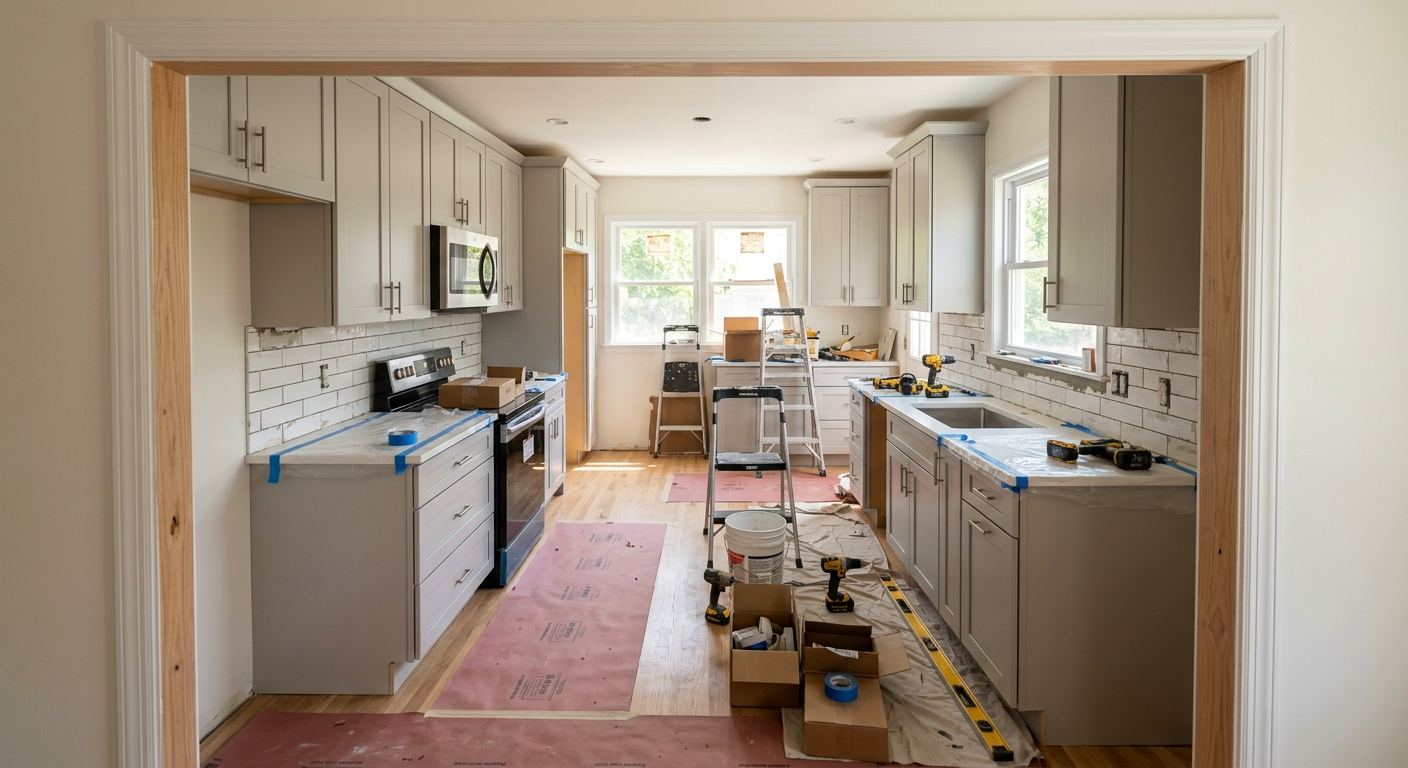
Kitchen renovation options and costs in Auburn Bay
Auburn Bay is a fast-growing community in the Calgary economic region, and kitchen upgrades here tend to reflect homeowners’ expectations for resale-ready finishes. With a 2021 population of 18,090 residents (Statistics Canada, 2021 Census), demand for quality trades stays steady—especially in South Calgary–adjacent neighbourhoods where families are updating functional layouts. In a market shaped by household purchasing power and housing values, many owners choose a finish tier that matches the rest of the home rather than chasing “lowest possible” pricing.
In the Calgary economic region, kitchen renovation budgets typically track local home values and household incomes, so the same job can land in different tiers depending on the level of cabinetry and stone homeowners expect. That’s why Auburn Bay kitchens often move toward quartz or natural stone counters and semi-custom cabinetry, even for “mid-range” refreshes. Skilled labour availability also matters: Calgary trade rates commonly run around 90–140 per hour, so design time, project management, and installation labour are a major share of total cost.
Climate isn’t the main driver of cost in Alberta for kitchens, but it does influence the building schedule—winter supply-chain delays, indoor humidity control for adhesives/finishes, and the care needed for flooring transitions between seasons. If you’re in demand for cabinetry and countertop scheduling, trades frequently target the busy pockets near McKenzie Lake and the Auburn Bay town-centre area where turnkey renovations are most common.
Below is a quick comparison of common renovation tiers in Auburn Bay, followed by what typically changes pricing when you move up or down.
| Renovation Tier |
What's Included |
Typical Duration |
Price Range |
| Cosmetic refresh (paint, hardware, new appliances only) |
Cabinet paint or repaint, new pulls/hinges, matching appliance package (no cabinet rework), basic caulking/trim updates |
3–7 business days |
$3,500–$12,000 |
| Mid-range full renovation (new cabinets, counters, sink, tile) |
New semi-custom cabinets, countertop (solid surface), sink and faucet, backsplash tile, new flooring/transition work as needed, plumbing hookup |
3–6 weeks |
$25,000–$65,000 |
| High-end full renovation (custom cabinets, stone counters, island) |
Custom cabinetry, quartz or natural stone counters, island with electrical, upgraded backsplash (tile or slab look), sink/faucet upgrades, coordinated appliance package |
6–12 weeks |
$70,000–$100,000 |
| Cabinet refacing only (new doors + drawer fronts, same boxes) |
Remove and replace doors/drawers/trim, reface panels where needed, refit hardware, light surface prep; counters usually reused if in good shape |
2–4 weeks |
$8,000–$35,000 |
| Countertop swap only (laminate to quartz or stone) |
Remove existing tops, install new quartz/stone, edge profile updates, reseal at sink/cooktop, basic backsplash caulk/patching |
2–5 business days |
$3,000–$12,000 |
| Backsplash tile installation only |
Tile removal/patching as required, mortar/grout install, standard back-wall coverage; includes trim and tidy-up |
3–7 business days |
$2,500–$8,000 |
Prices are estimates only and vary by project scope, site access and material selection.
What affects the price of kitchen renovation in Auburn Bay
In Auburn Bay (Calgary economic region), quotes for what looks like the “same” kitchen can swing by 30–50% because contractors price risk: finish-tier choices, how much demolition is required, and how often layouts trigger plumbing, gas, or electrical work. Even with a similar footprint, homeowners who select quartz and semi-custom cabinets often experience higher material and fabrication costs, plus more shop time for custom sizing—so the labour and scheduling effort rises too. In Alberta, the trade market is busy enough that scheduling complexity can also affect total project management costs.
Home values and income expectations generally shape the finish tier far more than weather. In higher-value Calgary-area pockets, homeowners commonly default to quartz or natural stone counters and semi-custom cabinetry because buyers notice those upgrades and may recover value on resale. In more modest markets, laminate and stock cabinets dominate because they keep total outlay closer to a budget refresh. That’s why you’ll see many projects cluster around the mid five-figures (for example, a mid-range full renovation near the $25,000–$65,000 band), while layout reworks and premium materials can push into the $70,000–$100,000 range.
Concrete Auburn Bay examples: (1) If your home has older, out-of-square cabinetry, adding new cabinets can require more labour for shimming, drywall patching, and countertop overhang adjustments—raising the cost even before you choose stone. (2) If you want an island tied to an existing ventilation plan, electrical rough-in and potentially a new circuit commonly add labour and inspection steps. (3) If the current counters are damaged from winter “drying out” or prior DIY maintenance, removal and substrate rebuild can add unexpected cost. (4) If you’re updating flooring at the same time, transition pieces around doorways and subfloor leveling can be a hidden driver.
Bottom line: layout changes—moving a sink line, adding an island, or relocating a gas line—are typically the least predictable part of the budget, often more than the choice between quartz and granite.
| Price Factor |
Why It Matters |
Cost Impact |
| Cabinet tier — stock vs. semi-custom vs. fully custom millwork |
Custom sizing, specialty finishes, and soft-close hardware increase shop time and material cost |
Typically shifts the project by several thousand dollars up or down; often a primary reason “mid-range” becomes “high-end” |
| Countertop material — laminate vs. quartz vs. granite vs. stone |
Material pricing and fabrication complexity affect install time and labour |
Laminate stays closer to the lower end of the $3,000–$12,000 countertop band; stone often pushes toward the top |
| Layout change — wall removal, island add, plumbing/gas move |
Demolition plus trade coordination adds risk, inspection steps, and schedule days |
One layout decision can move a project from the mid five-figures into the upper five-figures |
| Appliance package tier — builder vs. mid-range vs. pro-grade |
Premium models cost more and may require electrical/venting compatibility work |
Can add or reduce several thousand dollars depending on warranty tiers and installation requirements |
| Flooring — refinish existing vs. full replacement |
Kitchen demolition stresses subfloor; matching new flooring to existing varies by condition |
Refinish can save money, but full replacement is common in full renovations near the $25,000–$65,000 band |
| Backsplash — ceramic tile vs. marble vs. full-height slab |
Large-format tile and stone require more precise substrate prep and cutting |
Full-height or premium stone can bring backsplash work toward or beyond the $2,500–$8,000 band |
| Electrical — new circuits for island, under-cabinet lighting |
New circuits and lighting upgrades require licensed work and inspection coordination |
Often affects both labour and timeline, especially in projects aiming for higher-end integrated lighting |
| Permit fees and licensed trade requirements |
Permit administration and contractor availability can increase indirect costs |
Not always large fees, but they can shift total budget due to scheduling and inspection delays |
Permits & regulations in Alberta
In Alberta, not every kitchen update needs permits, but the work that touches plumbing, gas, major structure, or new electrical circuits usually does. Cabinet and countertop swaps themselves generally do not require permits: replacing cabinets in place or installing new tops over the existing base is typically considered a finishing trade scope. Likewise, a backsplash install is commonly treated as a finishing task when it doesn’t involve moving services.
Permits and licensed trades are typically required when you change the “service” infrastructure. That includes: moving plumbing supply or drain lines (sink, dishwasher drain, or relocating the sink), relocating a gas stove or range-related components (including a range hood tied to gas venting), removing or altering a load-bearing wall, and adding new electrical circuits such as powering an island receptacle or significant under-cabinet lighting changes.
How a homeowner in Auburn Bay verifies your contractor before signing: (1) Ask for the Alberta licence details for any electrician or gas fitter involved, then cross-check the contractor’s credentials using the relevant online registry for their trade. (2) Request a certificate of insurance (liability) with jobsite coverage and confirm it includes the work scope. (3) For workers, ask how WSIB/WCB coverage is handled—then request proof/clearance documentation from the contractor before the first day on site. (4) Confirm who pulls the permit in writing—responsibility belongs in the contract, not in verbal assurances.
Cabinets, countertops and layout decisions in Auburn Bay
In Auburn Bay, your three biggest decisions usually aren’t about paint colour—they’re about cabinet tier, countertop material, and whether you change the layout. First, choose cabinet tier: stock cabinets are the fastest and cheapest, semi-custom is the most popular mid-range option in this market, and custom cabinetry is the priciest but offers the best fit for odd corners, ceiling heights, and “maker-style” layouts that sell well to Calgary-area buyers. Second, pick a countertop material. Laminate is budget-friendly but can be more prone to wear at seams. Quartz is the common “best value” for many homeowners because it’s durable and low-maintenance. Granite and other natural stone look premium but require more care. Butcher block adds warmth and is great for certain lifestyles, though it needs routine sealing.
Third, decide on layout changes: opening up a wall for an open-concept feel, adding an island, or relocating plumbing/gas lines. These changes are often justified when they create functional gains—like better traffic flow, improved seating, or clearer sightlines into living areas that match how buyers tour homes in the Calgary resale market. However, if you can get most of the benefit by reconfiguring without moving major services, you’ll usually control the budget better.
Realistic dollar example: If you stay within a straightforward replacement—new semi-custom cabinets and quartz, without moving plumbing—you may land closer to the $25,000–$65,000 mid-range band. If you add an island with electrical, plus any sink relocation or gas line adjustments, the same overall “look” can push toward the $70,000–$100,000 high-end band because the trades, inspections, and installation time increase.
Alberta’s seasonal temperature swings don’t dictate countertop choice, but they do impact adhesives, curing schedules, and flooring transitions—so layout decisions that require more demolition tend to feel the timeline impact the most.
| Option |
Durability |
Maintenance |
Best For |
Price Range |
| Stock cabinets (big-box) |
Solid for daily use, but limited flexibility for unusual dimensions |
Minimal; keep hardware tightened and wipe clean |
Budget refreshes where the footprint stays the same |
$8,000–$20,000 |
| Semi-custom cabinets (local dealer) |
Better fit and hardware options; strong everyday durability |
Low; regular cleaning and occasional hinge/hardware checks |
Most Auburn Bay renos targeting resale-ready quality without fully custom pricing |
$15,000–$35,000 |
| Custom cabinets (local millwork shop) |
Highest fit and finish; tailored storage systems hold up well long-term |
Low; careful cleaning for specialty finishes |
Layouts with corners, ceiling-height complexity, or bespoke storage needs |
$30,000–$65,000 |
| Laminate countertop |
Good for light-to-moderate use; seam edges can be wear points |
Wipe and dry; avoid prolonged standing water at seams |
Keeping costs down on refreshes |
$3,000–$6,000 |
| Quartz engineered countertop |
Very durable surface; resists staining better than laminate |
Low; clean with mild soap, avoid harsh abrasives |
Auburn Bay homeowners who want “set it and forget it” maintenance |
$5,000–$12,000 |
| Granite / natural stone countertop |
Hard and heat-tolerant; varies by stone selection |
Periodic sealing recommended; wipe up spills promptly |
Premium look buyers who understand light ongoing care |
$7,000–$15,000 |
| Butcher block countertop |
Durable but can dent; protects well with proper upkeep |
Regular oiling/sanding touch-ups as needed |
Family kitchens with frequent food prep and a lived-in aesthetic |
$4,500–$11,000 |
| Marble countertop |
Beautiful but more susceptible to etching/staining |
Higher care; sealing and mindful cleaning |
Low-abuse households aiming for a luxury look |
$9,000–$18,000 |
How to choose a kitchen renovation contractor in Auburn Bay
Choosing the right contractor in Auburn Bay is mostly about proving competence up front—licensing, coverage, and clarity in the quote. In Alberta, verify that anyone performing electrical work is a licensed electrician and anyone doing gas work is a licensed gas fitter. Ask for proof of licence and trade registration details, then check them against the appropriate online registry for their trade. Also request a current certificate of liability insurance and confirm the coverage limits are appropriate for renovation work at your property. Finally, ask about WSIB/WCB coverage for workers and obtain proof/clearance documentation before work starts—this helps protect you if a worker is injured on site.
Next, get 2–3 itemised written quotes, not one lump-sum number. You want a labour-and-materials breakdown that clearly shows what’s included (demo, disposal, framing/drywall repairs, cabinet install, countertop templating and install, tile labour, electrical/gas trades). Read the scope for exclusions: Is permit pulling included? Is waste disposal included? Are you paying separately for floor protection, cabinet adjustments, or plywood/substrate repairs under countertops?
Warranty matters too: confirm workmanship warranty length (for install issues), product/manufacturer warranty (for defects), and whether warranties are transferable if you sell. For payment scheduling, never pay more than about 10–15% upfront; hold back a portion until completion and punch-list items are done. Finally, insist on a start date and a completion estimate in writing, with a realistic allowance for countertop fabrication lead times.
- Ask for written proof of trade licences for any electrical or gas work involved.
- Request certificate of liability insurance and confirm it covers renovation work at your address.
- Confirm WSIB/WCB coverage documentation and timing before the first day on site.
- Get 2–3 itemised quotes with line-by-line labour and material pricing.
- Clarify what demolition and disposal include (and whether recycling diversion is available).
- Confirm whether permits are included or separately billed.
- Check if substrate repairs (drywall/plywood under counters) are included if discovered during demo.
- Require cabinet install specs: shimming, anchoring method, leveling plan, and adjustment process.
- Confirm countertop templating and lead time; ask who pays for re-templating if errors occur.
- Ask about tile scope: backer board requirements, waterproofing behind wet areas, grout type.
- Get warranty terms in writing for both workmanship and products, and whether they transfer to future owners.
- Use a payment schedule that keeps 10–15% retained until a punch-list is completed and signed off.
Red flags in Auburn Bay: vague “we’ll figure it out later” scope language, quotes without disposal or substrate repair allowances, no written warranty terms, forcing a large upfront deposit, or refusing to provide licence/insurance/WSIB/WCB documentation before starting.
Frequently asked questions — kitchen renovation in Auburn Bay
How do I add an island to my Auburn Bay kitchen?
Add an island by planning it as a full services and layout project, not just a cabinet footprint. In Auburn Bay homes, many layouts need a new electrical plan for island receptacles and often under-cabinet lighting, which means licensed electrical work and inspection steps. If you also want a sink in the island, that can require plumbing supply and drain line changes—typically the highest unpredictability in cost and schedule. Start by confirming your existing breaker capacity, venting/hood plan (especially if you’re switching cooktop styles), and available clearance for traffic flow. If your current kitchen already has room, you can sometimes keep plumbing/gas in place and only add electrical, which helps control the budget. Islands commonly land closer to mid-range full renos in the $25,000–$65,000 band when plumbing doesn’t move, and can push toward $70,000–$100,000 when you relocate services.
How much does a kitchen renovation cost in Auburn Bay?
In Auburn Bay, full kitchen renovation costs usually cluster based on finish tier and whether services move. A cosmetic refresh (paint, hardware, new appliances only) can be a relatively modest project at roughly $3,500–$12,000. For a true mid-range full renovation—new cabinets, counters, sink, and backsplash/tile—many households land around the $25,000–$65,000 range, especially when plumbing stays where it is. If you’re aiming for custom or semi-custom cabinetry with stone counters and an island, budgets commonly rise into the $70,000–$100,000 range because of fabrication time and electrical/plumbing coordination. Labour rates in the Calgary economic region are often a significant cost share (commonly around 90–140 per hour), so itemised scope matters. Also, Auburn Bay’s active trade demand can affect scheduling, which is why a detailed plan and confirmed lead times help avoid expensive rush charges.
How long does a kitchen renovation take in Auburn Bay?
Typical timelines in Alberta depend on whether you’re swapping finishes or changing layout and services. A cosmetic refresh often finishes in about 3–7 business days. A backsplash-only tile job is frequently 3–7 business days. Mid-range full renovations (new cabinets/counters, sink, tile) typically take 3–6 weeks once demolition and rough-in are done and countertop templating/install is scheduled. High-end renovations with custom cabinetry and an island often run 6–12 weeks, mainly due to cabinet fabrication, countertop lead times, and the need to coordinate electrical, plumbing, and any permit inspections. In Auburn Bay, winter schedules can also add time for curing/finish windows and for flooring transitions. The best way to protect your schedule is to get a written timeline that includes templating dates and clearly states when trades arrive for rough-in versus final trim.
Quartz vs granite countertops — which is better?
Quartz is usually the “better fit” for most Auburn Bay households because it’s engineered for consistent colour and it’s low-maintenance compared with many natural stones. It resists staining well and typically requires only routine cleaning with mild products. Granite is very durable and offers a natural, high-end look, but it can require periodic sealing and more careful spill cleanup—especially with acidic substances. From a budgeting standpoint, both can sit in the higher end of the countertop range; in many renovations, quartz commonly aligns with the $5,000–$12,000 band, while granite often trends toward the upper portion depending on slab selection and edge profile. If you entertain often, have kids, or want the simplest care routine, quartz is usually the practical choice. If you prioritize natural veining and you’re comfortable with light ongoing care, granite can be a strong option.
Should I reface or replace my cabinets?
Refacing is often worth it when your existing cabinet boxes are solid, level, and structurally sound, and your goal is to update the look without relocating plumbing or rebuilding the entire system. Cabinet refacing typically falls around the $8,000–$35,000 range and can be a faster path if boxes don’t need major repair. Replacement is the better choice if boxes are damaged, doors are failing, the layout is cramped, or you want to add features like pull-outs, integrated charging stations, or major storage redesigns that require new internal configurations. In Auburn Bay renovations, many homeowners choose semi-custom replacement when they’re also changing counters and want alignment upgrades that look seamless from day one. If you’re dealing with visible water damage near sinks or poor installation over time, replacing is usually the safer long-term investment—even if refacing looks cheaper at first glance.
Do I need a permit for a kitchen renovation in Alberta?
Often, simple swaps don’t need permits in Alberta, but service changes usually do. Cabinet and countertop swaps alone typically don’t require a permit. You generally do need permits (and the corresponding licensed trades and inspections) when you move plumbing supply/drain lines, relocate gas components related to cooking, remove or alter a load-bearing wall, or add new electrical circuits such as for island receptacles and significant lighting upgrades. For Auburn Bay homeowners, the most common mistake is assuming that “finishing work” stays permit-free even when demolition reveals the need to change the underlying services. Always confirm who pulls permits in writing before signing—this should be in your contract, not just discussed verbally. A reputable Alberta contractor will outline required permits based on your exact scope and will coordinate inspections around scheduling and countertop/cabinet installation.