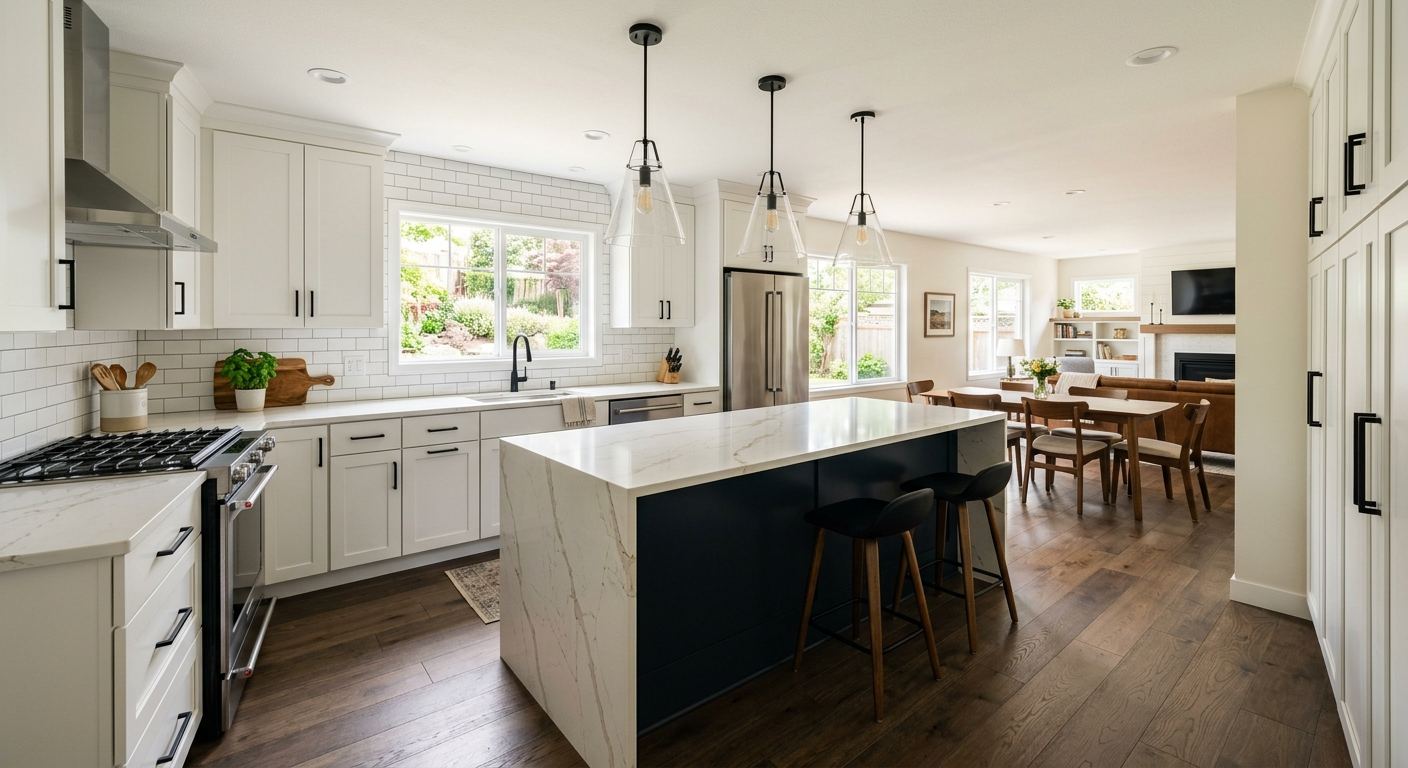
Kitchen renovation options and costs in Millrise
Kitchen renovation in Millrise, Alberta usually comes down to budget first, then finish choices. With a population of 6,655 in the area (Statistics Canada, 2021 Census), the local contractor pool is smaller than in the core city, so scheduling can matter as much as design. Calgary-area household decision-making is also closely tied to home value expectations, and that’s why many Millrise homeowners target a “sell-friendly” upgrade: durable cabinets, quartz or stone counters, and clean lines that appeal to buyers across the Calgary economic region. In higher-value pockets, homeowners often steer toward semi-custom millwork and stone counters because the cost tends to feel recoverable on resale (Statistics Canada, 2021 Census).
Climatically, Alberta doesn’t typically drive kitchen renovation cost the way it drives roof or siding, but it does affect trade scheduling. Winter road conditions and spring thaw can slow material deliveries and increase site protection time, especially for tile and flooring installs. Also, because skilled trades in Calgary often run about $90–$140 per hour, labour, design, and project management become a major share of your total—so two contractors quoting the same scope can still land far apart when scheduling, supervision, and inclusions differ. In Millrise specifically, cabinet and countertop demand is especially high in the newer residential pockets where homeowners upgrade for long-term use and eventual resale.
Below is a practical comparison of renovation tiers, so you can map your goals to realistic pricing and timelines.
| Renovation Tier |
What's Included |
Typical Duration |
Price Range |
| Cosmetic refresh (paint, hardware, new appliances only) |
Paint, cabinet hardware change, minor caulking/trim updates, appliance swap (like-for-like), optional basic lighting refresh |
1–3 weeks |
$6,000–$18,000 |
| Mid-range full renovation (new cabinets, counters, sink, tile) |
New semi-custom or quality stock cabinets, new countertops (often quartz), sink and faucet, backsplash tile, floor prep, updated plumbing connections |
3–7 weeks |
$25,000–$65,000 |
| High-end full renovation (custom cabinets, stone counters, island) |
Custom cabinetry, stone countertops with upgraded edges, island (often with electrical/plumbing provisions), full backsplash, integrated lighting, pro-grade finishes |
6–12 weeks |
$65,000–$120,000 |
| Cabinet refacing only (new doors + drawer fronts, same boxes) |
Replace doors/drawer fronts, reface cabinet faces, hardware swap, new crown/trim, labour for refinishing where needed |
2–4 weeks |
$8,000–$35,000 |
| Countertop swap only (laminate to quartz or stone) |
Remove old counters, template, install new quartz/stone, new sink cut-out as needed, basic sealing and finishing at seams |
1–2 weeks |
$3,000–$12,000 |
| Backplash tile installation only |
Remove old backsplash (if needed), tile installation, grout/seal, finishing trims and caulking around outlets |
1–2 weeks |
$2,500–$8,000 |
Prices are estimates only and vary by project scope, site access and material selection.
What affects the price of kitchen renovation in Millrise
In the Calgary economic region, quotes for what looks like the same kitchen can vary by 30–50% because contractors price risk and unknowns differently. Two kitchens might both have “new cabinets and counters,” but one scope includes electrical upgrades, site protection, disposal, and permit handling—while another leaves those as allowances. Labour availability also shifts seasonally; when trade calendars tighten, the hourly impact shows up fast in installation, supervision, and rework rates.
The biggest driver in Millrise is local housing value and median income expectations, not climate. In higher-value markets, many homeowners default to quartz or natural stone counters and semi-custom cabinetry because the renovation cost is easier to justify on resale. Where buyers expect a “finished” look, you’ll see more upgrades like under-cabinet lighting, better hardware, and full-height or well-detailed backsplashes. In more modest markets, laminate and stock cabinetry can still deliver strong ROI, keeping budgets closer to the lower end of the $25,000–$100,000 full-renovation band.
Layout changes are where costs get unpredictable regardless of finish tier. Removing a wall, adding an island, or moving a gas line or plumbing typically adds design time and licensed-trade coordination. For example, switching from a straightforward countertop swap (often $3,000–$12,000) to a remodel that includes relocating a sink can push you into the mid-band full renovation range due to rough-in work and inspection steps. Millrise homeowners with older housing stock sometimes uncover undersized subflooring at tile locations, which can add prep costs even when cabinet and counter choices stay the same.
Here are the main price factors that move your budget up or down in practical Millrise scenarios.
| Price Factor |
Why It Matters |
Cost Impact |
| Cabinet tier — stock vs. semi-custom vs. fully custom millwork |
Quality of construction, hardware grade, fit/finish, and lead times vary widely between tiers |
Often shifts cabinet budget by $10,000+ on mid projects |
| Countertop material — laminate vs. quartz vs. granite vs. stone |
Material cost, fabrication complexity, edge profiles, and installation labour change the total |
Can add $2,000–$10,000 depending on material and size |
| Layout change — wall removal, island add, plumbing/gas move |
Requires rough-in work, coordination with licensed trades, and more demo/dust control |
Most unpredictable; commonly adds $8,000–$30,000+ |
| Appliance package tier — builder vs. mid-range vs. pro-grade |
Electrical requirements, ventilation compatibility, and finish compatibility drive extra labour |
Often adds $1,500–$8,000+ over a basic appliance set |
| Flooring — refinish existing vs. full replacement |
Subfloor condition and removal/replace scope affect prep time and waste disposal |
Can add $2,000–$12,000+ depending on extent and flooring type |
| Backsplash — ceramic tile vs. marble vs. full-height slab |
Material density, pattern matching, and waterproofing/detailing requirements raise labour |
Can swing by $1,500–$6,000+ versus basic tile |
| Electrical — new circuits for island, under-cabinet lighting |
Extra circuits and fixtures increase electrician time and inspection needs |
Typically adds $800–$4,500+ |
| Permit fees and licensed trade requirements |
Inspection timing and documentation can affect schedules and contractor overhead |
May add $300–$3,000+ depending on scope |
Permits & regulations in Alberta
In Alberta, not every kitchen update triggers a permit. Generally, cabinet and countertop swaps typically do not require a permit when you’re keeping plumbing and gas lines where they are. That means changing boxes-to-doors, refacing, or installing new countertops over the existing layout is usually straightforward from a regulatory standpoint.
However, permits and licensed trades usually are required when you change the building systems—not just the finishes. In practice, you should expect a permit (and licensed trade involvement) when you:
- Move plumbing supply or drain lines (sink relocation, dishwasher relocation)
- Relocate or modify gas appliances, or alter the route supplying gas (including certain range hood setups)
- Remove a load-bearing wall or alter structural elements
- Add new electrical circuits (common with island outlets and under-cabinet lighting upgrades)
- Make electrical panel or major wiring modifications
For a homeowner in Millrise, the best approach is to verify before work starts. Step-by-step: (1) ask the contractor for their Alberta licence information and confirm it through the appropriate online registry, (2) request a current certificate of insurance (liability) and confirm the jobsite location is covered, and (3) confirm WSIB/WCB clearance for the contractor and key trades involved. Don’t accept “we’ll get it later”—clearance letters or coverage documentation should be provided before the first scheduled day. Finally, ensure the permit responsibility and any inspection scope are written clearly in the contract so you’re not surprised later.
Cabinets, countertops and layout decisions in Millrise
The three most consequential decisions in a Millrise kitchen renovation are (1) cabinet tier, (2) countertop material, and (3) layout changes. These choices steer both your day-to-day usability and your resale appeal in the Calgary market.
Cabinet tier: Stock cabinets are fastest and cheapest because the parts are readily available. Semi-custom cabinets (a very common mid-range choice in this region) balance cost with better storage planning and finishes. Custom cabinets cost the most, but they’re worth it when you need tight spacing, unusual wall angles, or a specific island layout. Calgary-area buyers often expect clean alignment and thoughtful storage, so a semi-custom approach frequently hits the sweet spot between budget and look.
Countertops: Laminate can be budget-friendly and durable for day-to-day, but it generally can’t match quartz or natural stone in heat resistance and consistent appearance. Quartz engineered counters are a frequent choice because they’re low maintenance and hold up well to Alberta’s indoor humidity swings. Granite/stone elevates the “luxury” feel and looks exceptional with custom cabinetry, but costs more for material and fabrication. Marble adds sophistication but requires more careful maintenance. In practice, moving from laminate to quartz typically nudges the job into a higher tier while keeping the overall structure similar—especially when you’re already budgeting for quality cabinets.
Layout changes: Removing a wall for open-concept flow or adding an island can be justified when it improves traffic patterns and makes the kitchen functional for how Millrise households live. But if you’re also relocating plumbing or gas, the rough-in work becomes the cost driver, not the finish.
Example: if you keep the sink in place, a countertop swap only might sit in the $3,000–$12,000 band. If you move the sink to support an island, you’re no longer in “swap-only” territory, and the budget can quickly shift toward a mid-range full renovation—often $25,000–$65,000—because of plumbing rough-in, tile and finishing changes, and coordination time.
| Option |
Durability |
Maintenance |
Best For |
Price Range |
| Stock cabinets (big-box) |
Solid for everyday use; limited sizing options can affect fit |
Low; protect from moisture at seams and sinks |
Fast turnarounds and tighter budgets |
$8,000–$22,000 |
| Semi-custom cabinets (local dealer) |
Better materials and hardware options; improved storage layouts |
Low; keep runners and hinges maintained |
Most Millrise remodels aiming for a resale-friendly finish |
$15,000–$45,000 |
| Custom cabinets (local millwork shop) |
Best fit and build quality; handles irregular spaces well |
Low to moderate; premium hardware may need occasional adjustments |
Complex layouts, premium aesthetics, and long-term stays |
$30,000–$70,000+ |
| Laminate countertop |
Durable surface for normal use; seams are the weak point long-term |
Low; avoid standing water at seams |
Budget-first renovations and rental-style upgrades |
$3,000–$6,500 |
| Quartz engineered countertop |
Very durable; consistent colour and generally better scratch resistance |
Low; wipe clean, avoid abrasive pads |
Most popular “smart value” choice in Calgary-area resale markets |
$5,500–$12,000 |
| Granite / natural stone countertop |
High durability with natural variation and heat tolerance |
Moderate; typically requires periodic sealing depending on stone |
Upmarket kitchens seeking a natural-luxury look |
$7,500–$16,000 |
| Butcher block countertop |
Strong but can dent; best with careful use and quality finish |
Moderate; regular oiling/conditioning |
Family-focused kitchens that like a warm, lived-in style |
$4,500–$10,500 |
| Marble countertop |
Elegant but more susceptible to etching/staining than quartz |
Higher; requires careful cleaning and sealing |
Design-forward renovations and low-impact kitchen habits |
$10,000–$22,000+ |
How to choose a kitchen renovation contractor in Millrise
Choosing the right contractor is about reducing surprises: permits, lead times, and finish installation quality. In Alberta, verify licensing and coverage before a single hole is drilled. Ask for their current Alberta licence details and confirm eligibility through the proper online registry. Request a certificate of liability insurance that lists the jobsite address. Also confirm WSIB/WCB clearance (or the applicable coverage documentation for the trades involved). If the contractor won’t provide proof or gives vague answers, that’s a major warning sign.
Get 2–3 itemised written quotes—labour and materials separated—rather than one lump sum. A solid quote will show cabinet supply costs, countertop fabrication/installation, electrical/plumbing inclusions (or allowances), tile scope, disposal, and finish carpentry. Read the scope line-by-line: what’s excluded (demo, patching, painting, subfloor repairs)? Is permit pulling included or billed separately? Is waste disposal part of the price or an extra charge at the end?
Warranty matters in Millrise because kitchens see heavy daily use. Confirm workmanship warranty length, what it covers, and whether it transfers if you sell the home. Separately, confirm the manufacturer warranty for cabinets/counters and how claims are handled. Payment schedule should be conservative: never pay more than about 10–15% upfront; hold back a portion until the work is complete and defect-free. Finally, insist on a written start date and completion estimate, including dependencies like cabinet lead times and countertop templating.
- Ask for licence/registration info and confirm it through Alberta’s online resources before signing.
- Request certificate of liability insurance and ensure it covers renovations at your Millrise address.
- Verify WSIB/WCB clearance for the contractor and key subcontractors.
- Get 2–3 itemised quotes with labour and material line items (no “allowance-only” scopes).
- Confirm who pulls permits and schedules inspections for plumbing, gas, electrical, or structural work.
- Check exclusions: demo, drywall patching, painting, flooring underlayment, disposal, and missed items.
- Make sure countertop templating and fabrication lead times are scheduled in the timeline.
- Confirm demolition dust control and site protection methods for existing flooring and stairs.
- Request a written warranty: workmanship duration, what it covers, and claim process.
- Clarify product warranties: cabinet door/drawer warranties, countertop warranty terms, and sealing responsibilities.
- Agree on payment milestones tied to inspections and completion (keep a holdback until wrap-up).
- Get a written start date, revised timeline rule (weather/material delays), and contact plan.
Concrete red flags I often see in Millrise projects: (1) quotes that omit disposal and patching/drywall finishing but still include “tile and install,” (2) no written warranty on workmanship, (3) vague permit responsibility (or claiming “no permits needed” when plumbing/gas/electrical is changing), (4) requiring large upfront payments beyond 10–15%, and (5) refusing to break down costs for cabinets, counters, and trade work.
Frequently asked questions — kitchen renovation in Millrise
Can I live at home during a kitchen renovation in Millrise?
Often, yes—many Millrise homeowners remain in the home, especially when the scope is limited to cosmetic refreshes, cabinet refacing, or countertop/backsplash work. If you’re doing a mid-range full renovation (commonly $25,000–$65,000), living on-site is usually workable but requires a plan for dust control, temporary cooking, and at least one functional sink location if plumbing is changing. Alberta winters can also mean more indoor dust management time, and that’s something good contractors schedule into their daily workflow. If your renovation includes moving plumbing or gas lines, the kitchen may be partially shut down for rough-in and inspections, typically lengthening the “no cooking” window. Ask your contractor for a phase plan (demo, rough-in, install, trim/finish) so you can stage meals and keep a safe work zone.
Should I renovate my kitchen before selling in Millrise?
It depends on your buyer audience and the condition of the existing kitchen. In Millrise and across the Calgary region, buyers often respond well to visible, easy-to-understand upgrades—clean cabinetry, modern countertops (quartz is common), and updated backsplash and hardware. If your kitchen is dated but structurally sound, a “smart upgrade” approach (for example, refacing plus a countertop swap) can be more cost-effective than a full layout change. If you’re considering a full renovation that moves you toward the mid five-figures, keep the scope aligned with what buyers in Calgary expect at that price point—functional storage and bright, durable surfaces usually win. If you need to move plumbing/gas or open walls, the costs rise sharply and can outweigh benefits unless the layout truly improves flow. A good contractor can help you set decisions based on budget bands like $25,000–$100,000 and the finishes that tend to sell well.
What's the most popular kitchen style in Millrise right now?
Millrise kitchens currently trend toward bright, functional modern styles: shaker-style or simple slab-front cabinetry in neutral tones, paired with quartz counters and a clean backsplash that ties into open-concept living areas. In the Calgary market, buyers generally like cohesive finishes—matte or satin hardware, consistent lighting, and natural-looking stone colours. Quartz (and in some upscale renos, natural stone) has become a frequent choice because it’s low maintenance and looks premium without as much upkeep as marble. If you’re planning an island, many homeowners choose a slightly higher-end countertop and under-cabinet lighting because it photographs well and improves everyday visibility. While “style” varies, the common thread in Alberta kitchens is practicality: storage, durable surfaces, and a layout that works with family traffic patterns.
How do I know if I need to update my kitchen plumbing in Millrise?
Look for signs like slow drains, water pressure changes, frequent leaks under the sink, or inconsistent hot water when multiple fixtures run. If you’re planning to move a sink, dishwasher, or taps, updating plumbing is often part of the scope because the contractor must rough-in supply and drain lines to the new location. Even when you’re not moving fixtures, a renovation is a good time to inspect shutoff valves and confirm hoses and connections are in good condition. In Alberta’s household plumbing environments, older kitchens can hide issues behind existing cabinets, and once floors or walls come out, it’s smarter to replace compromised sections than to patch them and hope. Your contractor should include an inspection step in the process and explain what is being replaced versus cleaned/retained. Any relocation of supply/drain typically falls under permit and licensed-trade coordination in Alberta.
What is the difference between a galley and open-concept kitchen?
A galley kitchen is a narrow layout with counters along two parallel walls, which can be very efficient for cooking but can feel tight if you want space for socializing. An open-concept kitchen connects to living/dining areas, usually by removing a wall or repositioning a boundary, which creates a more spacious feel and better sightlines. In Millrise, open-concept layouts are popular when homeowners want a more modern flow and easier traffic movement for families. The trade-off is cost and complexity: open-concept often involves additional design planning and, depending on the wall, may require structural assessment and permits. If you’re only re-facing cabinets or swapping counters, you’re typically not changing layout, so costs stay in the lower renovation bands. But if you’re changing how walls or pathways work, expect your budget to move toward the full renovation ranges such as $25,000–$100,000.
How do I get accurate kitchen renovation quotes in Millrise?
Accurate quotes start with clear scope and real measurements. Provide your contractor with photos, a floor plan if you have one, and your must-haves (cabinet tier, counter material, island yes/no, backsplash coverage). Then request 2–3 itemised written quotes that separate labour from materials—especially for cabinets, countertops, tile, electrical, plumbing, and disposal. Ask whether permits are included and who is responsible for pulling them if you’re moving plumbing, gas, electrical circuits, or removing load-bearing walls. Make sure the quote states whether the contractor includes demo, drywall patching, and painting allowances, and what happens if hidden conditions are found. For timelines, ask for lead-time assumptions for cabinet and countertop fabrication. Finally, confirm the payment schedule: keep upfront payments around 10–15%, and hold back until completion. If you compare quotes that land close to $8,000–$35,000 for refacing or $3,000–$12,000 for countertops, the differences usually come from inclusions, not just materials.