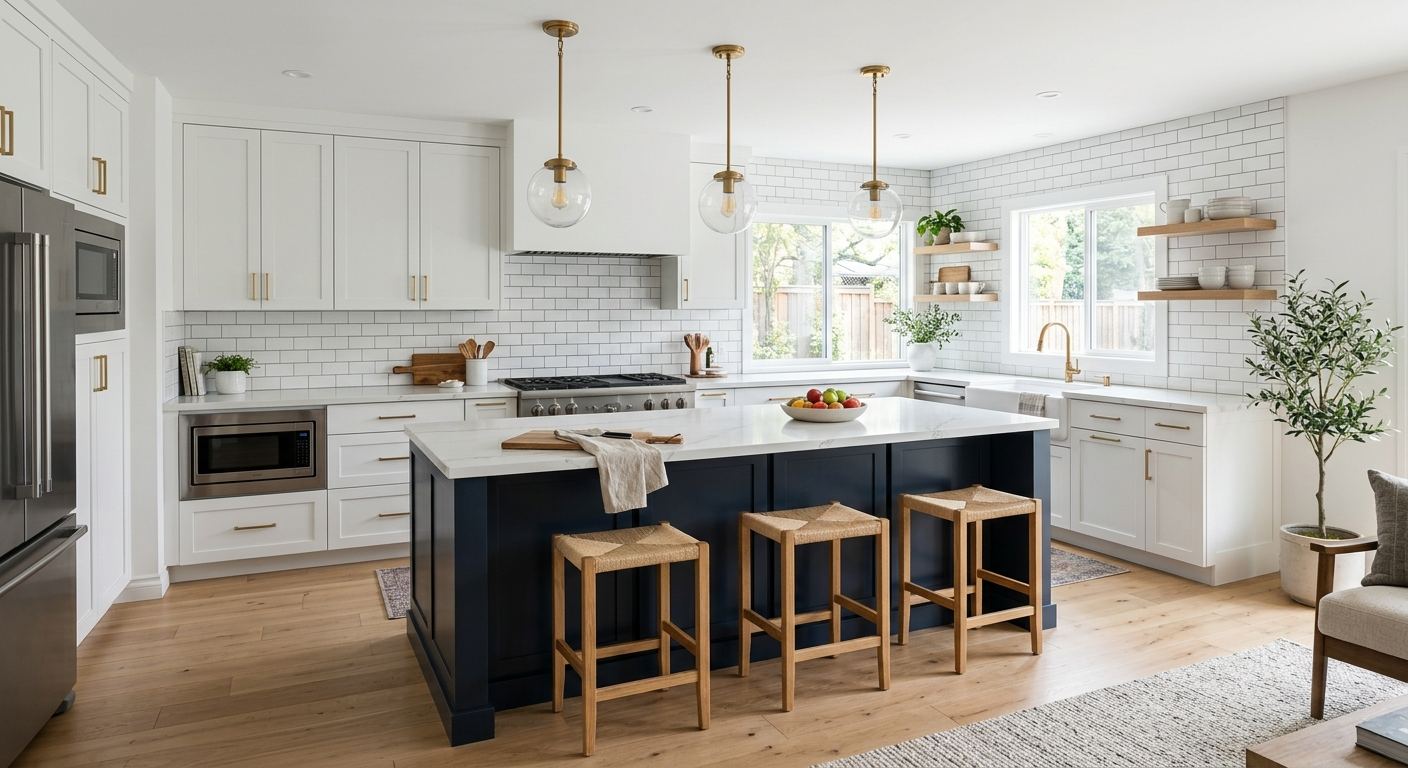
Kitchen renovation options and costs in Ritchie
Ritchie, Alberta is a tight-knit neighbourhood where kitchen upgrades are driven more by home value expectations than by weather alone. With a population of 4,194 (Statistics Canada, 2021 Census), local demand is concentrated: homeowners typically want clean, resale-friendly finishes without losing too much functionality. In the Calgary economic region, renovations often align with what buyers pay for updated kitchens—so it’s common for many projects to target the “mid” or “high” tier finishes instead of purely cosmetic changes. That shift matters because labour is a big line item in Alberta’s strong construction market, and skilled work in Calgary commonly lands around 90–140 per hour, raising the share of the budget spent on design, demolition, and installations.
Contractors in Ritchie also see a pattern with older housing stock: if your existing cabinets and flooring are still sound, you can keep costs closer to a refresh or mid-range renovation. Calgary’s climate mainly affects logistics—sealed spaces, winter site protection, and drying/curing times for coatings and adhesives—rather than the core cost drivers. Where costs jump is when budgets include layout changes like moving plumbing, adding an island, or installing integrated lighting. In practical terms, projects in the South Rundle / Ritchie crossroads area typically book faster because this is where crews can combine multiple jobs and reduce travel time.
Below are realistic renovation tiers you can use to compare quotes before you start pricing materials and layouts.
| Renovation Tier |
What's Included |
Typical Duration |
Price Range |
| Cosmetic refresh (paint, hardware, new appliances only) |
Paint, new cabinet hardware, minor carpentry touch-ups, swapping appliances (no cabinet or counter changes), re-seal/small caulk work |
3–7 business days |
$7,000–$18,000 |
| Mid-range full renovation (new cabinets, counters, sink, tile) |
New semi-custom cabinets, new countertops, sink and faucet, backsplash tile, disposal hook-up refresh, typically basic lighting refresh |
3–6 weeks |
$25,000–$60,000 |
| High-end full renovation (custom cabinets, stone counters, island) |
Custom cabinets (or high-end semi-custom), stone counters, island (often with added electrical/plumbing), full backsplash or slab feature, premium lighting and appliance integration |
6–12 weeks |
$70,000–$100,000 |
| Cabinet refacing only (new doors + drawer fronts, same boxes) |
Door and drawer front replacement, new hardware, reface wrap for visible areas, repaint/finish match, optional new crown/trim |
1–3 weeks |
$8,000–$28,000 |
| Countertop swap only (laminate to quartz or stone) |
Demolition of existing surface, template, new quartz or natural stone install, cut-outs for sink/cooktop, seam/edge finishing, new caulking and sealing |
1–2 weeks |
$3,000–$12,000 |
| Backsplash tile installation only |
Tile removal (if needed), surface prep, backer/primer where required, tile installation, grout, sealing, caulking around outlets |
4–10 business days |
$2,500–$8,000 |
Prices are estimates only and vary by project scope, site access and material selection.
What affects the price of kitchen renovation in Ritchie
Even when homeowners in Ritchie ask for the “same” kitchen, quotes across Calgary and Alberta can swing by roughly 30–50%. The reason is simple: most budget variance comes from finish expectations, scope complexity (especially layout), and how quickly trades can mobilize for your specific timeline—not from climate itself. In higher-value Calgary-area neighbourhoods, homeowners typically invest 10–15% of home value for a refresh and up to 20–25% for a redesign, which pushes projects toward quartz or natural stone counters and semi-custom or custom cabinetry. Those decisions are easier to justify on resale because updated kitchens hold market appeal; in more modest finishes tiers, laminate and stock cabinets dominate and keep the ROI closer to the “safe” range.
In Ritchie specifically, two local conditions commonly move pricing up or down: (1) whether your existing cabinet boxes are level and structurally sound (older installs can require extra labour for shimming, re-squaring and wall repair), and (2) how much your kitchen’s plumbing stack and venting route need to be adjusted. For example, adding an island can look like a $5,000 change on paper, but once you include electrical and possibly plumbing relocation, it can push you into the mid or high full-renovation bands—closer to $25,000–$60,000 when you’re staying reasonable, or $70,000–$100,000 if the layout requires a larger wall change and premium stone. Another common cost lever is installation timing: when winter sealing/curing conditions extend drying time for mudding, paint and adhesives, crews may schedule longer site days, especially on tile and countertop projects.
Concrete examples you can use during quoting in Ritchie: replacing laminate with quartz is often a straightforward install when your base remains unchanged, but if you’re also updating sink cut-outs and edging, the scope becomes more labour-heavy. Likewise, full-height backsplash tile is usually priced higher because it requires more substrate prep and careful outlet finishing, even before you choose higher-end materials.
| Price Factor |
Why It Matters |
Cost Impact |
| Cabinet tier — stock vs. semi-custom vs. fully custom millwork |
Custom fit, internal layouts (pull-outs, pantries), material thickness and finish durability change both pricing and installation time |
Can shift the job by many thousands, often determining whether you land in the mid band or high-end band |
| Countertop material — laminate vs. quartz vs. granite vs. stone |
Material cost, fabrication complexity, and seam/edge detailing affect the final countertop and install price |
Laminate is typically far lower; natural stone and premium quartz can materially increase your total |
| Layout change — wall removal, island add, plumbing/gas move |
Relocating services drives licensed work, permits, additional labour and sometimes structural work |
Often the biggest swing factor; can add significant cost regardless of finishes |
| Appliance package tier — builder vs. mid-range vs. pro-grade |
Premium appliances require better alignment, ventilation planning, and sometimes cabinetry modifications |
Higher-end packages increase material cost and can extend install time |
| Flooring — refinish existing vs. full replacement |
Matching transitions and protecting floors during demolition can reduce or increase labour |
Full replacement adds demo, underlayment/subfloor checks, and reinstall labour |
| Backsplash — ceramic tile vs. marble vs. full-height slab |
Surface prep, cutting around outlets, and heavier materials raise labour and risk |
Full-height and marble/stone typically cost several thousand more than ceramic tile |
| Electrical — new circuits for island, under-cabinet lighting |
Adding circuits and updating lighting affects both permit scope and electrical labour time |
Can add meaningful cost even with “simple” lighting upgrades |
| Permit fees and licensed trade requirements |
Permits and inspections apply when moving plumbing/gas or adding electrical circuits, changing scheduling and paperwork |
Costs vary by scope but can noticeably impact total project price |
Permits & regulations in Alberta
In Alberta, many “surface-level” kitchen changes do not require permits, but anything involving structural changes or relocating services usually does. As a homeowner in Ritchie, it helps to think in categories. Cabinet and countertop swaps (replacing surfaces in the same footprint) are typically not a permit trigger: you’re not moving plumbing, gas or structural elements, and you’re usually maintaining the existing layout.
Where permits and licensed trades come in is when your renovation crosses into service movement. You’ll generally need permits for moving plumbing supply or drain lines, relocating a gas line (including for the stove and sometimes venting tied to gas), removing a load-bearing wall, and adding electrical circuits—such as new outlets for an island, or under-cabinet lighting that requires circuit additions. Gas work must be done by a licensed gas fitter, and electrical work must be performed by a licensed electrician; both require inspections before you can close up the work.
A practical step-by-step verification process is this: (1) Ask the contractor for their Alberta licence details and company info; (2) confirm their liability insurance certificate and ensure it lists kitchen renovation scope; (3) request evidence of WSIB/WCB coverage for workers (the proof should be current); and (4) ask for a clearance letter or coverage confirmation document. Then, compare your contract—who is pulling permits, and who pays—because permit responsibility and timelines should be written into the agreement before any demolition starts.
Cabinets, countertops and layout decisions in Ritchie
In a Ritchie kitchen renovation, the biggest value decisions usually fall into three buckets: cabinet tier, countertop material, and layout change. First, cabinet tier determines your storage feel and fit. Stock cabinets are typically the fastest and cheapest option, while semi-custom (a common mid-range choice in Calgary-area resale markets) gives better internal organization and improved door/drawer sizes. Custom cabinets bring the best fit and specialty storage, but they raise both material cost and lead time.
Second is the countertop material. Laminate can be a budget-friendly choice and works well if you want visual impact without major spend, but it’s less resilient than engineered stone in terms of heat and deep scratch resistance. Quartz is a strong “resale-safe” middle ground: it’s durable, low-maintenance, and readily matches the look buyers expect in updated Calgary kitchens. Granite or other natural stone is beautiful but can require more attention and careful sealing schedules. Butcher block adds warmth and can work in family kitchens, but it needs routine maintenance to keep edges and seams looking crisp.
Third, layout changes are where cost becomes unpredictable. Removing an opening wall, adding an island, or relocating plumbing/gas can push permits and licensed work into the scope. A wall removal can be justified when it meaningfully improves circulation or creates a usable island footprint for real daily use. But if your layout already works, it’s often not justified—especially when resale buyers will still reward strong cabinetry and countertop choices.
Here’s a concrete example: if your goal is to upgrade from laminate to quartz without moving plumbing, you can often stay in the $3,000–$12,000 countertop swap band plus minimal accessory work. If you pair that with moving a sink and adding an island, your budget can quickly transition into the mid full-renovation band $25,000–$60,000 because plumbing routing, electrical updates, and extra demolition stages add labour and schedule risk.
Alberta’s seasonal swing matters mainly for installation logistics—drying and curing windows for mud, paint and mortar—so plan lead times early. That way, your kitchen lands in the right finish season without rushing critical trades.
| Option |
Durability |
Maintenance |
Best For |
Price Range |
| Stock cabinets (big-box) |
Solid for light-to-moderate use; limited custom storage options |
Regular hardware tightening and gentle cleaning; finish touch-ups if needed |
Fast timelines, budget-focused refreshes, basic storage |
$8,000–$20,000 |
| Semi-custom cabinets (local dealer) |
Better fit and sturdier options; improved drawer/pantry configurations |
Low day-to-day upkeep; maintain hinges and adjust soft-close components |
Most Ritchie homeowners aiming for resale-friendly storage |
$15,000–$35,000 |
| Custom cabinets (local millwork shop) |
Highest build quality and perfect fit around awkward corners |
Low routine upkeep; specialty finishes may need specific care |
Complex layouts, unique storage needs, premium kitchen designs |
$30,000–$60,000 |
| Laminate countertop |
Good day-to-day performance; sensitive to heat and deep gouges |
Wipe clean; avoid prolonged heat exposure and sharp cutting directly on surface |
Budget upgrades that keep your footprint the same |
$3,000–$7,000 |
| Quartz engineered countertop |
Very durable surface; resistant to stains and everyday impacts |
Low maintenance; use gentle cleaners and protect from extreme heat |
Resale-friendly look with dependable performance |
$6,000–$12,000 |
| Granite / natural stone countertop |
Highly durable; unique patterns and edges |
May require periodic sealing depending on stone choice |
Premium visual impact and timeless material |
$7,000–$14,000 |
| Butcher block countertop |
Strong, but susceptible to nicks and moisture around seams if not cared for |
Oiling/conditioning and careful drying after wet tasks |
Family kitchens that want warmth and a lived-in feel |
$5,000–$11,000 |
| Marble countertop |
Elegant but softer and more prone to etching and staining |
Higher upkeep; quick wipe-downs and careful daily care |
Showpiece kitchens where maintenance is part of the plan |
$9,000–$18,000 |
How to choose a kitchen renovation contractor in Ritchie
Choosing the right contractor in Ritchie is less about flashy photos and more about proof of coverage and clarity in the scope. Start with Alberta licensing and insurance: confirm the business is properly licensed where applicable, then request a current certificate of liability insurance and proof of WSIB/WCB coverage for their workers. You can verify WSIB/WCB coverage directly through the insurer or coverage documentation they provide, and for trades work in your scope, ask how they’ll coordinate licensed installers (gas fitter for gas changes; electrician for electrical additions). A good contractor will welcome these checks—because it protects both of you.
Next, request 2–3 itemised written quotes, not one-page estimates. The breakdown should separate labour vs materials, show allowance items (like tile, fixtures, demolition, disposal, and electrical/plumbing components), and state whether permits are included. Read your scope for exclusions: for example, is material haul-away included? Is countertop templating scheduled and covered? Will they handle drywall repairs and painting or is that your responsibility?
Warranty and payment schedule matter too. Look for a workmanship warranty (length and what’s covered) and confirm what warranty you receive for the products from the manufacturer or supplier. Ask if any warranty is transferable to the next owner. For payment, keep it conservative: never pay more than 10–15% upfront; use staged payments tied to measurable milestones. Finally, timeline: insist on a start date and an estimated completion date in writing, including cabinet/counter lead time so you’re not stuck mid-renovation.
- Ask for the exact permit plan: what will be permitted, who pulls permits, and what inspections are expected.
- Confirm licensed trade coordination for any gas or electrical work, and request names or sub-trade details in advance.
- Get itemised quotes with allowances broken out (tile pattern, grout type, cabinet finish, lighting fixtures).
- Check that disposal/haul-away is included for demolition materials (cardboard, drywall, old cabinets).
- Require a detailed scope of drywall repair, sanding, and painting responsibility.
- Ask who protects floors/entries during demolition and installs (dust control and tarping matter).
- Verify countertop templating scheduling and whether it’s included in the labour scope.
- Confirm who orders appliances and whether installation includes electrical/plumbing hook-ups.
- Request a workmanship warranty statement in writing before you sign.
- Confirm payment milestones align with completed stages (demo complete, cabinetry set, counters templated, final caulking done).
- Check communication cadence: who provides progress updates and how changes are approved in writing.
- Ensure the quote includes basic site access considerations (parking, protection, and staging rules).
Concrete red flags I see too often in Ritchie: (1) quotes that are only lump sums with no allowance breakdown, (2) contractors who won’t show a current liability insurance certificate or WSIB/WCB coverage documentation, (3) vague timelines with no cabinet/counter lead-time plan, (4) promises to “handle everything” without clarifying who is pulling permits and who is doing licensed gas/electrical work, and (5) payment requests that exceed 10–15% upfront with no signed milestones.
Frequently asked questions — kitchen renovation in Ritchie
What's the most cost-effective kitchen upgrade?
For many Ritchie homeowners, the best cost-to-impact upgrade is upgrading the look of the kitchen without changing the footprint. Typically, cabinet hardware, a paint refresh, and a backsplash can deliver a big visual shift at a relatively modest cost. If you want a more noticeable “new kitchen” feel, pair refacing or a countertop swap with one strong material: for example, moving to quartz often lands around the $3,000–$12,000 countertop swap band when the layout stays the same. Avoid starting with a layout change unless you truly need it—moving plumbing or adding electrical for an island is where budgets can climb quickly and scheduling becomes more complex. In Alberta, the weather mostly affects how long coatings and tile mortar need to cure, but the core value comes from finishes that match Calgary resale expectations.
Custom vs stock cabinets — is custom worth it?
Custom cabinets can be worth it when your kitchen has challenging dimensions, awkward corners, or you want specialty storage (pantries, appliance garages, or fully tailored drawer layouts). However, if your goal is to update a fairly standard Ritchie layout, stock cabinets are often the most economical and can still look polished with the right finish and hardware. The trade-off is fit and internal organization: custom millwork tends to reduce gaps and improves functionality, which can matter if you plan to live with the kitchen for many years. In resale terms, semi-custom is commonly the “sweet spot” for Alberta buyers. If you’re aiming for a mid-range full renovation budget of roughly $25,000–$60,000, semi-custom frequently gives the look and storage buyers expect without the cost jump that pushes projects toward the higher-end band.
How do I choose a kitchen contractor in Ritchie?
Start by confirming coverage and accountability. In Alberta, ask for proof of liability insurance and WSIB/WCB coverage before any work begins, and make sure any licensed trade involved (electrical or gas) is coordinated properly. Next, request 2–3 itemised written quotes with labour and materials breakdown, plus allowances (tile, fixtures, and any disposal/haul-away). Read the scope carefully: check what’s excluded, whether permit pull is included, and whether drywall repair and painting are part of the contractor’s responsibilities. For warranties, ask for workmanship warranty length and whether product warranties are transferable. Finally, keep the payment schedule conservative—never pay more than 10–15% upfront—and require a start date and completion estimate in writing. If a contractor can’t provide these basics, you’ll often feel it later in change orders and delays.
What order do kitchen renovation steps happen in?
A typical kitchen sequence in Ritchie starts with verification and measurements, then demolition. Once you’ve confirmed the layout and finishes, contractors template for countertops and order cabinets, because those lead times drive the schedule. In most projects, demolition happens first, followed by rough-ins (electrical, plumbing, and any gas changes requiring licensed trades and inspections), then framing/drywall repairs. After that, cabinetry goes in, then countertops are templated (or installed if already templated), then backsplashes and flooring transitions are completed. Finally, you finish with trim, caulking, painting touch-ups, appliance installation, and close-out cleaning. Alberta’s winter conditions can add schedule time for curing paint/mud and for keeping workspaces protected, so the contractor should plan drying windows and protect the site. If you’re in the mid full renovation tier (often $25,000–$60,000), the rough-in stage is where most schedule dependencies show up.
Can I live at home during a kitchen renovation in Ritchie?
Often yes, but it depends on how invasive the scope is. With a cosmetic refresh or a countertop swap only, many homeowners stay in the home with minimal disruption. For a full renovation—especially when cabinets, floors, and electrical/plumbing are being changed—living onsite can still be possible if the contractor sets up a safe work zone and maintains dust control, but you’ll likely lose access to the kitchen for a period. In Alberta winters, dust containment and ventilation are important because you’ll be keeping windows closed for heating, which can make air quality management more challenging. Your contractor should provide a clear plan for temporary cooking and water access, plus daily cleanup standards. If your project is closer to a high-end redesign budget (often $70,000–$100,000), the timeline is longer, and that usually makes full-time living harder unless you can set up a temporary cooking area elsewhere in the home.
Should I renovate my kitchen before selling in Ritchie?
If you’re planning to sell in the near term, the safest strategy is to renovate only what increases buyer confidence and reduces perceived risk. In many Calgary-area resale situations, updated countertops and cabinetry—especially quartz counters and well-finished cabinet interiors—help buyers see the home as move-in ready. You don’t necessarily need a full redesign to get that effect; a countertop swap plus a modern backsplash can be a practical approach, often fitting within $3,000–$12,000 for counters plus additional tile costs. If your kitchen layout is already functional and services are staying put, you reduce permit-driven complexity and schedule uncertainty. On the other hand, major layout changes (moving plumbing/gas or adding an island) can be risky before a sale if budgets creep or inspections delay close-up work. As always, align your selections with what buyers in your local market expect for the price point—because in Ritchie, strong finishes are what sell the story.