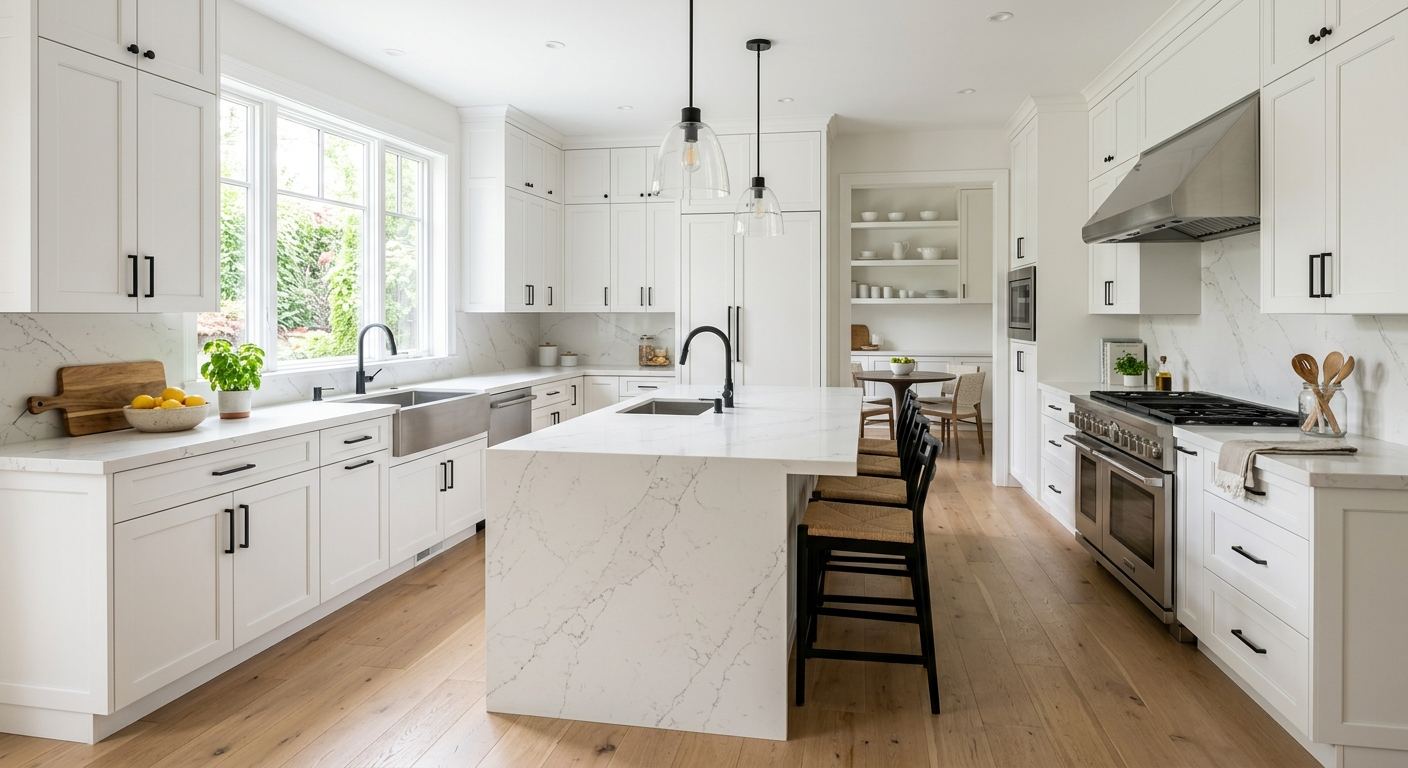
Kitchen renovation options and costs in Canmore
Kitchen renovations in Canmore tend to start with the same question—“What will this cost?”—but the answer usually changes quickly once you pick finishes. With a median household income of about $106,000 (Statistics Canada, 2021 Census), many homeowners aim for a mid-to-premium look rather than the entry-level option, and that shows up in cabinet style and counter choice. Canmore’s housing profile also matters: about 66.2% of households are homeowners (Statistics Canada, 2021 Census), so projects are often planned as long-term upgrades for how people actually live, not just resale staging.
In the Banff–Jasper–Rocky Mountain House economic region, pricing is driven more by household incomes and buyer expectations than by a “climate surcharge.” In practice, Alberta’s cold snaps and indoor heating cycles can be tough on adhesives and poorly prepared surfaces, so proper prep is non-negotiable—especially on older homes. The trade-off is that contractors are generally available enough to keep scheduling realistic; the big swings in quotes are usually design and material tier, not winter weather.
Demand is especially noticeable around Canmore’s downtown core and the Bow Valley corridor where condos and townhomes are frequently reconfigured for more storage and better sightlines. If you’re comparing options, use the tiers below as a practical starting point before you request itemised quotes.
| Renovation Tier |
What's Included |
Typical Duration |
Price Range |
| Cosmetic refresh (paint, hardware, new appliances only) |
Patch/prime and paint, hardware swaps, faucet where applicable, appliance-only replacements, basic install and haul-away |
1–3 weeks |
$10,000–$25,000 |
| Mid-range full renovation (new cabinets, counters, sink, tile) |
New semi-custom or quality stock cabinets, laminate/quartz counters, new sink/faucet, backsplash tile, flooring refinishing or partial replacement, standard electrical updates as needed |
4–8 weeks |
$40,000–$75,000 |
| High-end full renovation (custom cabinets, stone counters, island) |
Fully custom cabinetry, granite/stone or premium quartz, island with detailed millwork, extended backsplash or feature wall, upgraded lighting, plumbing/gas coordination, higher-end finish packages |
8–14 weeks |
$75,000–$90,000+ |
| Cabinet refacing only (new doors + drawer fronts, same boxes) |
Replace doors/drawer fronts and hardware, new fascia where required, refinish or adjust openings, disconnect/reconnect sink/faucet as needed, optional new backsplash |
2–5 weeks |
$6,000–$22,000 |
| Countertop swap only (laminate to quartz or stone) |
Remove old counters, template/measure, install quartz/granite/stone, cut-outs, seam and edge finishing, reseal/treat as product requires |
1–2 weeks |
$3,000–$15,000 |
| Backsplash tile installation only |
Demo of existing backsplash (if needed), surface prep, tile layout/install, grouting/sealing, caulking at countertop/wall transitions |
3–10 days |
$1,500–$8,000 |
Prices are estimates only and vary by project scope, site access and material selection.
What affects the price of kitchen renovation in Canmore
Across the Banff–Jasper–Rocky Mountain House economic region and the wider Alberta market, the same kitchen job can land 30–50% apart because quotes are driven by finish tiers, labour complexity, and how much the layout changes—not by a single “weather premium.” In higher-value communities like Canmore, homeowners often choose quartz or stone counters and semi-custom cabinets because these materials hold up well for everyday use and are easier to market to buyers on resale. That matters when median incomes are around $106,000 (Statistics Canada, 2021 Census); people are more likely to treat upgrades as durable improvements rather than temporary fixes. In lower-value areas, laminate and stock cabinets are more common, keeping totals closer to the lower end of Alberta’s typical ranges (for example, a countertop-only swap versus a full renovation).
Climate plays a supporting role. Canmore’s winter conditions can cause movement in older framing and walls—especially in homes built before 1981, which make up about 11.6% of dwellings in the town (Statistics Canada, 2021 Census). If a contractor doesn’t address out-of-square cabinets, poor substrate prep, or moisture-related surface issues up front, you may pay later for callbacks. You’ll often see that reflected in labour for shimming, correcting drywall or waterproofing behind tile, and ensuring proper ventilation.
Two practical examples that commonly shift cost in Canmore: upgrading from a mid-range full renovation budget of about $40,000 to $75,000 into the high-end band of $75,000 to $90,000+ often comes down to cabinetry tier and island complexity, not just the counter price. Similarly, adding under-cabinet lighting and rerouting a few circuits can be a minor line item, but moving plumbing for a sink or relocating a gas line can add the kind of coordination that pushes labour and inspection time into the upper range.
| Price Factor |
Why It Matters |
Cost Impact |
| Cabinet tier — stock vs. semi-custom vs. fully custom millwork |
Construction quality, fit/finish, storage features, and lead times |
Commonly drives the largest swing within the same floor plan |
| Countertop material — laminate vs. quartz vs. granite vs. stone |
Material cost per square foot, templating complexity, and fabrication/edge finishing |
Can move you from a mid-range countertop swap into a premium full-reno tier |
| Layout change — wall removal, island add, plumbing/gas move |
Structural risk, ventilation demands, and trades coordination |
Often the biggest unpredictable cost regardless of finish |
| Appliance package tier — builder vs. mid-range vs. pro-grade |
Higher-end units cost more and may require refined electrical/venting |
Can add thousands quickly even when “appliances only” is assumed |
| Flooring — refinish existing vs. full replacement |
Access limitations during cabinet install and whether subfloor prep is required |
Full replacement typically adds significant labour and material |
| Backsplash — ceramic tile vs. marble vs. full-height slab |
Material density, cutting complexity, and sealing/maintenance requirements |
Feature walls can push beyond basic backsplash pricing |
| Electrical — new circuits for island, under-cabinet lighting |
Additional breakers, fixture wiring, and GFCI considerations |
Ranges from modest upgrades to a larger rework package |
| Permit fees and licensed trade requirements |
Administrative costs and inspection scheduling |
Usually unavoidable if plumbing/gas/electrical work expands |
Permits & regulations in Alberta
In Alberta, a straightforward cabinet or countertop replacement often does not require a building permit. Swapping cabinets in the same footprint and replacing counters with similar cut-outs typically stays in the “no permit” zone because you are not changing the building services. However, permits and licensed trades usually come into play when you touch plumbing supply/drain lines, relocate a gas stove or range hood where gas is involved, remove a load-bearing wall, or add new electrical circuits—particularly for islands with new outlets and upgraded lighting.
Gas work must be performed by a licensed gas fitter, and electrical work must be performed by a licensed electrician. Both trades require inspections after the work is complete to ensure safety and code compliance. If you’re doing a full kitchen in Canmore and considering a new island, that often triggers additional electrical and sometimes plumbing/gas coordination depending on where the sink and/or cooktop are moving.
Before signing, verify the contractor’s Alberta licensing and coverage in writing: (1) request their licence numbers and check the online registry for the applicable trades; (2) ask for a current certificate of insurance showing liability coverage and review the stated job site address; (3) confirm WSIB/WCB coverage so you’re not exposed if a worker is injured on-site. A good contractor will also clearly outline which trade pulls which permits, and it should be stated in the contract—don’t rely on “we’ll handle it” without specifics.
Cabinets, countertops and layout decisions in Canmore
If you want the biggest impact on both day-to-day function and resale appeal in Canmore, focus on three decisions: cabinet tier, countertop material, and whether you’re changing the layout. First, cabinet tier controls storage, finish tightness, and how well doors and drawers stay aligned over the long term in a temperature-variable mountain climate. Stock cabinets are the fastest and usually the cheapest, semi-custom is the most common “sweet spot,” and fully custom millwork costs more but delivers the best fit—especially for older walls that need shimming or specific measurements.
Second, countertop material affects durability and maintenance. Laminate is a good entry point, but it can be more prone to damage at seams if heavy objects get dropped or if the substrate wasn’t level. Quartz is a strong all-around choice for busy kitchens because it’s durable and generally low maintenance. Granite/natural stone adds visual character and heat resistance, but it may require periodic sealing depending on the stone. Butcher block can be warm and practical for food prep, but it needs ongoing care to protect against moisture and staining.
Third, layout changes are the value driver only when the space gain is real. In Canmore, buyers often want kitchens that feel open and functional. If you remove a wall for an open-concept flow or add an island for seating and workflow, the cost can be justified—especially if you’re investing in a mid-range renovation around $40,000 to $75,000. But moving a plumbing/gas line can increase complexity enough that staying within the $40,000–$90,000+ full renovation bands requires careful planning.
Concrete example: if you upgrade from laminate to quartz as part of a mid-range renovation, that difference is often worth it because it upgrades both appearance and maintenance without forcing a full redesign. On the other hand, choosing fully custom cabinets purely for aesthetics, while keeping the layout and countertop basic, can be an expensive mismatch unless your current measurements and storage goals truly demand custom fit.
| Option |
Durability |
Maintenance |
Best For |
Price Range |
| Stock cabinets (big-box) |
Good for standard openings; less flexible for out-of-square walls |
Low routine maintenance; hinges/hardware upkeep if used heavily |
Speed and budget-focused upgrades with minimal layout changes |
$6,000–$15,000 |
| Semi-custom cabinets (local dealer) |
Better variety of sizes and finishes; strong daily-use performance |
Low maintenance; hardware and door alignment stay dependable |
Most Canmore renovations balancing cost, fit, and finish |
$15,000–$30,000 |
| Custom cabinets (local millwork shop) |
Best fit and detailing; ideal where walls/floors are irregular |
Low maintenance; premium hardware and finishing options |
Unique storage needs, perfect fit, and high-end aesthetic goals |
$30,000–$55,000+ |
| Laminate countertop |
Durable for everyday use; seams and edges need careful protection |
Easy to clean; avoid standing water at seams |
Budget-friendly refresh with a limited scope |
$3,000–$7,000 |
| Quartz engineered countertop |
Very durable; resists stains and normal impacts well |
Low—typical cleaning only; avoid extreme heat directly on surface |
Busy households wanting a premium look with easy upkeep |
$7,000–$14,000 |
| Granite / natural stone countertop |
Excellent heat tolerance; varies by stone type |
Often requires periodic sealing; wipe spills promptly |
Natural look buyers and those willing to maintain sealing |
$9,000–$15,000 |
| Butcher block countertop |
Strong for prep; can dent and show wear over time |
Oiling/conditioning required; protect from prolonged moisture |
Food-prep-focused kitchens and a warmer “lodge” look |
$5,000–$10,000 |
| Marble countertop |
Luxury look; can etch or stain from acidic foods |
Higher care—seal and clean carefully to prevent etching |
Low-impact use kitchens and strong aesthetic priorities |
$10,000–$16,000+ |
How to choose a kitchen renovation contractor in Canmore
Choosing the right kitchen renovation contractor in Canmore starts with verification. In Alberta, confirm licensing for the trades involved (especially gas and electrical), and ask for their liability insurance certificate before work begins. You should also request proof of WSIB/WCB coverage so the risk stays with the employer and the crew. How to check: (1) ask for the contractor’s business registration details and the relevant trade licence numbers; (2) confirm those licence numbers through the applicable Alberta online registry; (3) review the certificate of insurance for active coverage limits and match it to the project site; (4) ask for a clearance letter or documentation confirming WSIB/WCB status, then keep it with your contract.
Next, get 2–3 itemised written quotes. A quote that only gives a lump sum makes it impossible to compare apples-to-apples. You want a labour-and-materials breakdown for cabinets, counters, tile, plumbing/electrical allowances, disposal, and drywall patching. Read the scope for exclusions: is demo included? Is permit pulling included when plumbing/gas/electrical changes are needed? Who pays for inspections? Is there a disposal/haul-away line item?
Warranty and payment terms are where many homeowners get burned. Ask for (a) the workmanship warranty length and what it covers, (b) the manufacturer warranties for cabinets/counters, and whether warranties are transferable to you. Payment should be staged—never more than about 10–15% upfront, with holdback until substantial completion. Finally, demand a start date and a completion estimate in writing so you can plan around product lead times for cabinets and stone.
- Provide licence numbers and trade scope (who does what) in the proposal
- Attach proof of liability insurance and confirm project-site coverage
- Confirm WSIB/WCB clearance documentation before work starts
- Get itemised quotes (materials, labour, allowances, exclusions), not lump sums
- Ask whether demolition, debris disposal, and site protection are included
- Confirm permit responsibility in writing for plumbing/gas/electrical changes
- Request a detailed schedule including cabinet/counter lead times
- Clarify how change orders are priced and approved
- Review warranty terms for workmanship and products separately
- Ensure the contract includes cleanup standards and jobsite safety
- Verify payment milestones and keep a holdback until completion
- Ask for references from recent local Canmore projects (similar scope and finishes)
Red flags to watch in Canmore: (1) no insurance/WSIB proof offered until you ask twice; (2) a “we’ll handle permits” claim without naming who pulls them and what work triggers permits; (3) quotes that omit allowances for electrical, plumbing, or disposal and then bill for “extras” later; (4) vague warranty language like “we stand behind it” with no duration or coverage details; (5) asking for most of the payment upfront instead of using staged payments with holdback.
Frequently asked questions — kitchen renovation in Canmore
What is the difference between a galley and open-concept kitchen?
In Canmore, a galley kitchen is a narrow layout where counters and cabinets run along two parallel walls, typically with a walkway in between. It’s efficient for workflow and can be easier to renovate because the “service wall” locations (plumbing/electrical) often stay put. An open-concept kitchen removes barriers so the kitchen connects visually and sometimes physically to living/dining space. This usually changes electrical runs and can involve plumbing/gas coordination if sink or cooktop locations move. Because Canmore homeowners often prioritize resale appeal, open-concept designs are common in higher-finish renovations, but they can push the total toward the full kitchen renovation bands (commonly $40,000–$90,000+) depending on cabinet tier and whether walls are removed.
How do I get accurate kitchen renovation quotes in Canmore?
To get accurate kitchen renovation quotes in Canmore, ask for an itemised, line-by-line proposal—labour and materials separated—so you can compare contractors fairly. Provide photos and measurements, then schedule an on-site visit where the contractor templates for counters and confirms cabinet measurements. Be explicit about what’s included: demo, disposal/haul-away, electrical allowances, plumbing/gas changes, and whether permits are included when services move. If you’re switching counters, request countertop material options and edge/finish details so you’re not comparing “apples to oranges.” For example, even within the same scope, a countertop installation alone often falls around $3,000–$15,000, while a mid-range full renovation can run about $40,000–$75,000—so definitions matter. A professional quote should reflect the scope reality, not just a guess.
What's the best countertop material for a busy Canmore kitchen?
For a busy kitchen in Canmore, quartz is often the best balance of durability, look, and low maintenance—especially if you want a premium appearance without ongoing sealing. Quartz typically sits in the higher end of countertop swaps, with realistic pricing often landing around $7,000–$14,000 depending on size, seam layout, and edge profile. Granite or natural stone can be excellent too, with great heat tolerance, but many stones need periodic sealing and careful cleaning to protect the finish. Laminate is the budget-friendly option and can work well for cosmetic refreshes, but seams and edges are where wear shows first in high-use households. Marble looks spectacular, but it’s more stain/etch-prone with acidic foods and generally needs more conscientious care. Your lifestyle and cleaning habits matter as much as climate or style.
How do I add an island to my Canmore kitchen?
Adding an island in Canmore usually comes down to two things: layout and services. If the island is “decorative” (no sink or cooktop) you’ll mainly need electrical planning for outlets and lighting, which is often manageable but still requires a licensed electrician. If you want a sink in the island or a cooktop, plan for plumbing and possibly gas relocation—those parts trigger permits and specialized licensed trade work. That can quickly move you from a cosmetic update into a mid-to-high full renovation scope (commonly $40,000–$75,000 or higher) because of coordination, inspections, and possible floor/substrate work. Before you commit, confirm clearances for walking paths, ensure the floor can handle cabinet loads, and ask the contractor for a layout plan that shows where the new island will sit relative to existing doors, windows, and traffic flow.
How much does a kitchen renovation cost in Canmore?
In Canmore, costs typically track finish tier and how much the layout changes. A full kitchen renovation commonly lands in the $40,000–$90,000+ range for projects with new cabinets and counters, and higher-end choices (custom millwork, premium stone, island upgrades) push toward the upper end. If you’re doing a partial project, numbers are more predictable: cabinet installation or refacing is often in the $6,000–$22,000 band depending on whether boxes stay and how much custom fitting is needed, and countertop swaps commonly fall around $3,000–$15,000. Backsplash tile installation is frequently in the $1,500–$8,000 range based on tile complexity and height. These estimates align with Alberta-wide guidance where cosmetic or partial work sits lower and full reconfigurations cost more—while Canmore’s stronger-value market typically leads homeowners to choose premium materials more often. (Statistics Canada, 2021 Census)
How long does a kitchen renovation take in Canmore?
Timelines in Canmore depend on scope and product lead times, not usually the outdoor weather. A cosmetic refresh (paint, hardware, appliances only) can be as quick as 1–3 weeks. A mid-range full renovation with new cabinets and counters typically takes about 4–8 weeks, while high-end projects with custom cabinetry and stone counters with an island are more often 8–14 weeks. Delays usually come from cabinet and countertop lead times, inspection scheduling when plumbing/electrical/gas changes are required, and discovery work once walls are opened (especially in older housing stock). If your home is from an older era—there are still a meaningful share built before 1981—plan extra time for addressing out-of-square framing or substrate prep before tile and cabinetry go in. Your contractor should provide a written schedule and completion estimate before you start.