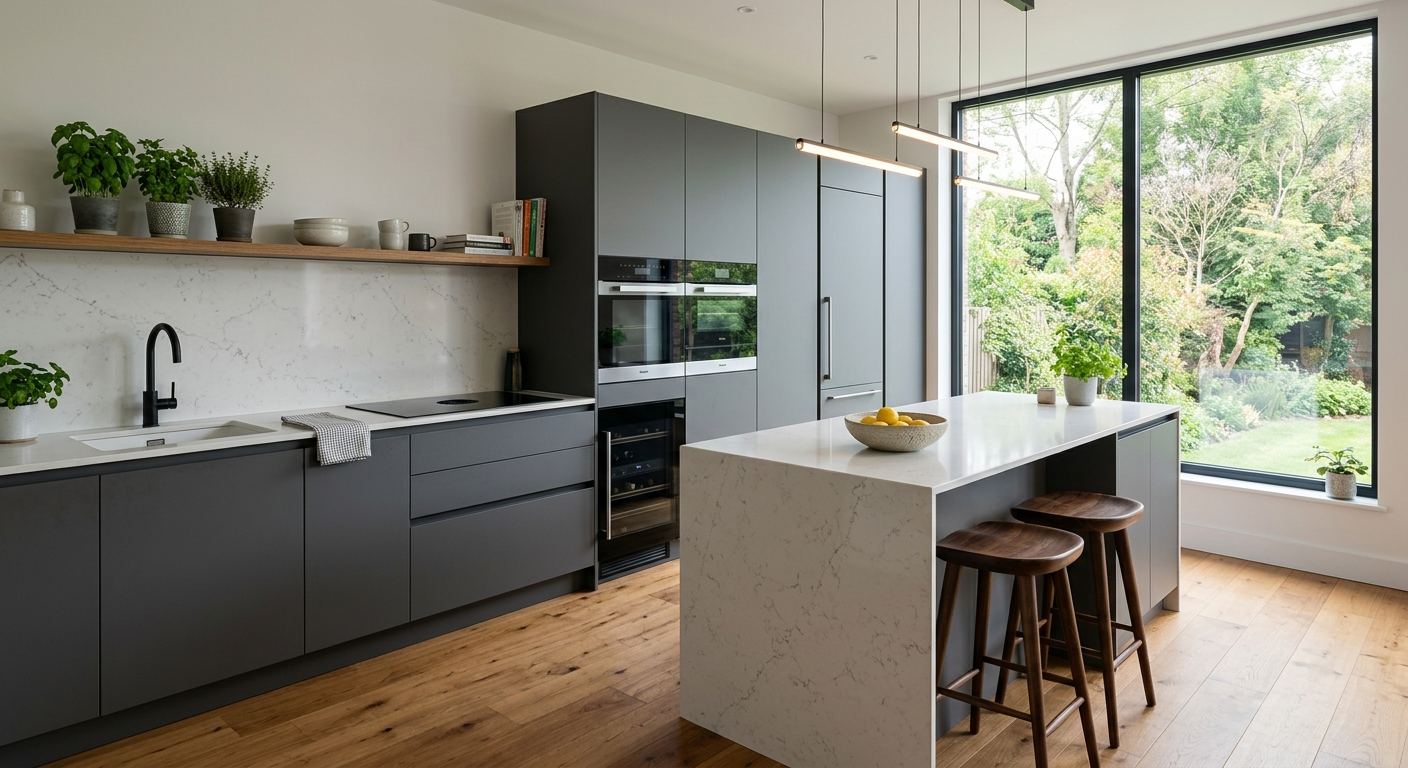
Kitchen renovation options and costs in Canora
Canora homeowners planning a kitchen renovation usually start with the same question: “What can I afford that will still look current in the Calgary region?” With Canora’s population at 3,309 (Statistics Canada, 2021 Census), the town has a smaller pool of specialist trades, so scheduling can affect final pricing if a job runs longer than expected. Also, the Calgary economic region’s higher-value buying mindset typically leads families to choose finishes that feel “buyer-ready,” often pushing projects toward better cabinetry and more durable countertops.
In practice, the biggest cost swings in Canora aren’t driven by Alberta weather so much as by what homeowners expect to get back on resale. In higher-value pockets around the Calgary metro, it’s common to see homeowners invest roughly 10–15% of home value for a kitchen refresh and up to 20–25% for a full redesign—choices that steer many kitchens toward quartz or natural stone and semi-custom or custom millwork. Labour availability matters too: skilled labour in the Calgary area is often priced around 90–140 per hour, so design time, project management, and installation sequencing are a major share of the final total.
In older Canora housing stock, you’ll also see more hidden surprises (out-of-square framing, older supply lines, or uneven subfloors), which can add time even when you’re “only refreshing.” That’s why contractors are especially in demand in established residential areas where timing matters for school schedules and tenant move-outs, and why timelines can be tight during peak renovation months. The options below break down the most common scopes so you can compare proposals side by side before discussing upgrades.
| Renovation Tier |
What's Included |
Typical Duration |
Price Range |
| Cosmetic refresh (paint, hardware, new appliances only) |
Cabinet repaint or touch-ups, new hardware, trim/caulk refresh, appliance swaps (no plumbing/gas changes), simple lighting updates as needed |
1–3 weeks |
$25,000–$40,000 |
| Mid-range full renovation (new cabinets, counters, sink, tile) |
New cabinet installation (stock or semi-custom), new counters, sink + faucet (standard plumbing), backsplash tile, flooring tie-in, basic electrical/lighting allowance |
4–7 weeks |
$45,000–$70,000 |
| High-end full renovation (custom cabinets, stone counters, island) |
Custom cabinetry or full semi-custom, stone counters (quartz/natural stone), island with enhanced cabinetry, upgraded backsplash (often more extensive tile/stone), integrated lighting allowance |
7–12 weeks |
$75,000–$100,000 |
| Cabinet refacing only (new doors + drawer fronts, same boxes) |
Door/drawer-front replacement, refinishing or re-staining existing frames, new hardware, optional backsplash refresh and countertop cleaning/reseal (if not swapping) |
2–4 weeks |
$8,000–$35,000 |
| Countertop swap only (laminate to quartz or stone) |
Remove old tops, install new counters (quartz/stone where applicable), sink/cut-outs where feasible, basic sealing and edge finishing |
3–7 days (+ curing time if needed) |
$3,000–$12,000 |
| Backsplash tile installation only |
Surface prep, tile install, grout/seal where required, caulking transitions at countertop and corners |
3–10 days |
$2,500–$8,000 |
Prices are estimates only and vary by project scope, site access and material selection.
What affects the price of kitchen renovation in Canora
Even when two homeowners describe the “same kitchen,” Canora quotes can still differ by 30–50% across the Calgary and broader Alberta market. The usual reason isn’t climate—it’s finish tier, labour rates, and how many trades need to coordinate (and re-coordinate) due to the layout. In higher-value Calgary-region markets, homeowners often default to quartz or natural stone counters and semi-custom cabinetry because those costs are easier to justify when resale value is the goal. In more modest markets, laminate and stock cabinets tend to dominate because they deliver a strong visual upgrade per dollar.
Layout changes are where budgets become hardest to predict. Removing a wall, adding an island, or moving plumbing or gas lines can add major labour and permit complexity, regardless of whether you choose laminate or stone. As a reference point, a typical mid-range full renovation often lands in the $45,000–$70,000 band, while higher-end redesigns can move into the $75,000–$100,000 band when islands, custom cabinetry, and premium stone are included.
Concrete Canora examples I see frequently: (1) older homes may have undersized electrical capacity for modern appliance loads, so under-cabinet lighting or new circuits trigger additional work; (2) shifting a sink location can uncover outdated drain slope issues, adding time and material; and (3) kitchens with limited access (tight stair landings, narrow driveways, or basement storage) can increase delivery and labour handling costs. Alberta’s freeze–thaw cycles don’t directly dictate cabinet pricing, but they can affect subfloor condition near exterior walls, which matters when you’re replacing flooring and need flat, stable mounting surfaces. In other words, market expectations and construction realities do most of the “heavy lifting” on your budget.
| Price Factor |
Why It Matters |
Cost Impact |
| Cabinet tier — stock vs. semi-custom vs. fully custom millwork |
Higher tiers cost more for materials and time; custom also adds measuring, fabrication and finishing steps |
Often $10,000–$50,000 swing depending on total kitchen size and design complexity |
| Countertop material — laminate vs. quartz vs. granite vs. stone |
Materials and installation difficulty vary; stone/quartz often require specialized templating and heavier support |
Typical range can move by $3,000–$12,000 for countertops alone |
| Layout change — wall removal, island add, plumbing/gas move |
Changes add framing, electrical and trade coordination; plumbing/gas relocations are permissioned and schedule-driven |
Can add $5,000–$30,000+ beyond base kitchen finishes |
| Appliance package tier — builder vs. mid-range vs. pro-grade |
Premium units cost more and may require different clearances/venting and electrical planning |
Often $1,500–$10,000+ depending on what’s being replaced |
| Flooring — refinish existing vs. full replacement |
Kitchen demolitions can damage subfloor; if levels are off, replacement becomes necessary |
Can add $2,000–$12,000 based on flooring choice and layout tie-ins |
| Backsplash — ceramic tile vs. marble vs. full-height slab |
Complex cuts, larger-format stone, and full-height builds require more time and skilled finishing |
Often $2,500–$8,000 for backsplash scope alone |
| Electrical — new circuits for island, under-cabinet lighting |
Adding circuits increases electrical labour, materials, and inspection steps |
Commonly $800–$5,000+ depending on number of additions |
| Permit fees and licensed trade requirements |
Work that touches plumbing/gas/electrical or structural elements needs permits and inspections |
Typically $500–$3,500+ plus scheduling cost when inspections are required |
Permits & regulations in Alberta
In Alberta, you typically do not need permits for cabinet and countertop swaps when you’re keeping existing services where they are. For example, replacing doors/drawer fronts, repainting cabinets, or installing new quartz on the same footprint generally falls under work that doesn’t change plumbing, gas, electrical, or structure.
Where permits and licensed trades do come in is when you change the system. Moving plumbing supply or drain lines, relocating a gas stove or range setup, removing a load-bearing wall, or adding electrical circuits (such as new dedicated circuits for an island or hardwired under-cabinet lighting) usually requires permits and inspections. Gas work must be done by a licensed gas fitter, and electrical work by a licensed electrician—then both need inspections before work is considered complete.
For a homeowner in Canora, a practical way to verify everything before signing is step-by-step:
- Ask the contractor for the Alberta licence numbers for the specific trade(s) involved.
- Check the contractor’s and subcontractor’s licence details via the relevant online registry.
- Request a current certificate of insurance (liability) and confirm the start/end dates cover your project timeline.
- Ask for WSIB/WCB clearance or documentation showing coverage for the workers involved.
- Confirm in writing who pulls permits—do not assume it’s included.
- Make sure the contract lists which work is permitted and which inspections are expected.
Always ensure permit responsibility is spelled out in your written contract so you’re not surprised later by inspection requirements or additional fees.
Cabinets, countertops and layout decisions in Canora
For most Canora kitchens, the three decisions that move both your look and your cost the most are: (1) cabinet tier, (2) countertop material, and (3) whether you change the layout. In the Calgary-area resale market, buyers often expect smooth, modern finishes that handle daily wear—especially in homes where families cook year-round through Alberta’s colder months.
Cabinet tier: Stock cabinets are typically the fastest and cheapest because they’re ready-made. Semi-custom cabinets are the “most popular mid-range” choice because you can adjust sizes, finishes and some interior details without paying full custom pricing. Custom cabinets are the highest cost, but they’re often worth it when you need unusual wall dimensions, a true-to-measure pantry, or a distinctive island footprint.
Countertops: Laminate can look great with the right edge profile, but it’s more vulnerable to heat and cutting damage. Quartz offers a solid balance of durability and low maintenance, and it commonly sits in the mid-to-upper price bands for kitchen refreshes. Granite/natural stone is premium in appearance and value, while butcher block is warm and functional but needs sealing and mindful care. Marble is beautiful but more maintenance-focused because it’s more sensitive to staining and etching.
Layout: Moving a sink or stove can make the kitchen work better, but plumbing/gas relocation is where budgets jump. In many projects, an island is justified when it creates circulation and adds seating; if you’re tight on space, the same money might be better spent on cabinetry storage upgrades instead.
As a dollar example, upgrading from laminate to quartz often fits within the $3,000–$12,000 countertop installation band—so if your cabinet plan is already solid, that change is one of the easiest ways to “buy durability” without triggering the major layout costs that push projects toward the $75,000–$100,000 range.
| Option |
Durability |
Maintenance |
Best For |
Price Range |
| Stock cabinets (big-box) |
Good for typical use; hinges and finishes vary by line |
Low; touch up as needed and keep hardware tight |
Fast timelines and budget-led refreshes |
$8,000–$25,000 |
| Semi-custom cabinets (local dealer) |
Very good; better fit and stronger options for interior storage |
Low to moderate; routine cleaning and occasional hardware adjustments |
Most Canora buyers who want a noticeable upgrade |
$20,000–$45,000 |
| Custom cabinets (local millwork shop) |
Excellent; built to your dimensions and lifestyle needs |
Low; premium finishes hold up well with normal care |
Complex layouts, unusual wall conditions, destination islands |
$35,000–$70,000 |
| Laminate countertop |
Moderate; can mark or burn with direct heat and sharp impacts |
Low for day-to-day; avoid heat and protect the surface |
Budget-friendly refresh where you want a new look fast |
$3,000–$6,500 |
| Quartz engineered countertop |
High; excellent stain resistance and everyday durability |
Low; wipe clean and avoid abrasive pads |
High-traffic families wanting a “set and forget” surface |
$6,000–$12,000 |
| Granite / natural stone countertop |
High; strong surface with natural variation |
Moderate; periodic sealing may be recommended by installer/spec |
Premium appearance with long-term value |
$7,000–$14,000 |
| Butcher block countertop |
Moderate to high; great for cutting but needs protection from moisture |
Moderate; regular oiling/sealing and careful cleaning |
Home chefs and kitchens where warmth matters |
$5,000–$11,000 |
| Marble countertop |
Moderate; can be etched or stained by acidic spills |
Higher; careful cleaning and protective sealing schedule |
Statement kitchens that match a cleaner, more controlled use pattern |
$10,000–$20,000 |
How to choose a kitchen renovation contractor in Canora
Choosing the right kitchen renovation contractor in Canora is mostly about documentation and clarity. Start with Alberta licensing: ask who is responsible for each permitted trade and verify their licence numbers using the appropriate online registry. Then confirm liability insurance—your contractor should provide a current certificate of insurance—and request proof of WSIB/WCB coverage for workers (or a clearance letter, depending on how they handle coverage on site). If the contractor won’t provide documents promptly, treat that as a serious warning sign.
Next, get 2–3 itemised written quotes that break labour and materials down line by line. Avoid “one number includes everything” unless scope details are attached. Read the exclusions: is disposal included, is drywall repair included, does the quote include permit pulling (if needed), and are changes managed with written change orders? Warranty matters too—confirm the workmanship warranty length, whether product warranties apply directly to you, and whether warranties are transferable if you sell your home.
On payments, use a controlled schedule: never pay more than 10–15% upfront, and consider holding back until the job is complete and cleaned. For timing, request a written start date and a realistic completion estimate based on lead times for cabinets and stone templating.
- Licence and proof of coverage (liability + WSIB/WCB) before work begins.
- Clear scope: demolition, cabinet install, countertop templating and install dates.
- Permit responsibility listed in the contract when plumbing/gas/electrical/structural changes happen.
- Separate line items for labour vs materials so you can compare apples-to-apples.
- Disposal and debris handling confirmed (skip bins, dump fees, contractor haul-away).
- Subfloor and underlayment prep described (especially important in older homes).
- Electrical scope spelled out (which circuits, lighting fixtures, and switch locations).
- Plumbing scope described (valves, faucet set-up, supply line replacement where needed).
- Countertop template responsibility confirmed and included in the timeline.
- Change order process in writing: price adjustments and re-scheduling terms.
- Warranty details for workmanship and product coverage, including transferability.
- Payment schedule with holdback and a clear completion checklist.
Red flags I’ve seen in Canora include: (1) refusing to provide licence/insurance/coverage documents, (2) quoting a “full kitchen” price without describing plumbing/electrical scope, (3) asking for large upfront payments beyond 15%, (4) no written start/completion dates, and (5) vague timelines that ignore countertop templating and inspection scheduling.
Frequently asked questions — kitchen renovation in Canora
Do I need a permit for a kitchen renovation in Alberta?
In Alberta, many cosmetic upgrades in a Canora kitchen don’t need a permit—like replacing cabinets as-is, swapping countertops on the same footprint, repainting, or installing a backsplash. Where permits and licensed trades usually come in is when you change services or structure: moving plumbing supply/drain lines, relocating gas for a stove or range hood, removing a load-bearing wall, or adding new electrical circuits. If you’re planning a redesign that lands closer to a full renovation budget (for example, the $45,000–$70,000 mid-range band), it’s common for design changes to trigger permits. Before signing, confirm with your contractor in writing who will pull permits and how inspections are handled, and verify the relevant trades are licensed and insured for the work.
What's the ROI on a kitchen renovation?
Kitchen ROI varies more by layout and finish tier than by the season or “style” alone, and in Canora/Calgary-area buyer markets, the most value-preserving upgrades are functional improvements: better storage, durable countertops, and a clean, modern lighting plan. High-end stone and custom cabinetry can be visually stunning, but ROI is strongest when the upgrade aligns with what typical buyers expect in your price bracket. In the Calgary economic region, many homeowners trend toward quartz or stone and semi-custom millwork in higher-value homes because those choices are easier to defend on resale. If you’re aiming for ROI, a mid-range full kitchen often fits in the $45,000–$70,000 range, while more complex redesigns may push toward $75,000–$100,000 when islands, walls, or major service relocations are involved. The best ROI usually comes from balancing quality finishes with minimal “surprise” structural or service changes.
How do I budget for a kitchen renovation?
Budgeting well starts with a decision about scope, not just finishes. For Canora kitchens, build your plan around a realistic tier: cosmetic refresh projects are commonly the least disruptive, while full redesigns are where labour coordination and trade scheduling drive the total. As a baseline for planning, full kitchen renovations in this tiered market typically cluster in the $25,000–$100,000 overall range. If your goal is a meaningful visual and functional update, consider mid-range full renovations around $45,000–$70,000 (new cabinets, counters, sink, and tile). If you’re adding an island, changing the layout, and upgrading to higher-end cabinetry and stone, plan for $75,000–$100,000. Also set aside contingency for older homes: rough plumbing/electrical, out-of-square framing, or subfloor flattening. Ask your contractor for an itemised quote with labour + materials so you can identify what drives cost before you sign.
Can I move my kitchen sink or stove?
Yes, you can move a sink or stove in a Canora kitchen, but the feasibility and permit requirements depend on how far you’re moving and what services need relocation. Moving a sink typically means extending or rerouting drain and supply lines; moving a stove often involves gas line adjustments and venting considerations, plus electrical if it’s a modern unit. These changes are generally where Alberta permits and licensed trades become necessary, since plumbing/gas/electrical work triggers inspections. If you’re doing this as part of a full renovation, the project can shift from the mid-range budget ($45,000–$70,000) toward the higher end ($75,000–$100,000) due to extra labour, materials, and scheduling time. The best approach is to get a preliminary layout plan first, then confirm the exact trade scope in writing before any demo starts.
What's the most cost-effective kitchen upgrade?
The most cost-effective upgrade is usually the one that changes both appearance and everyday function without forcing major service work. In Canora kitchens, popular value-per-dollar options are countertop swaps (when your layout stays the same) and targeted cabinet upgrades like new doors/drawer fronts. A countertop installation alone often fits in the $3,000–$12,000 band, and it can dramatically modernize the space because counters dominate sight lines. Similarly, backsplash tile installation only is commonly in the $2,500–$8,000 range and is a relatively contained scope. If you want a “bigger look” without major demolition, cabinet refacing can refresh the whole kitchen while keeping the existing box structure. The least cost-effective approach is often changing plumbing or gas lines without a clear layout payoff—those moves can outweigh savings from cheaper finishes.
Custom vs stock cabinets — is custom worth it?
Custom cabinets can be worth it in Alberta when your kitchen has unusual wall dimensions, you want a specific island layout, or you’re investing in storage solutions that match how you live. In the Calgary economic region, higher-value buyers also notice fit, finish, and built-in details—so custom can help a redesign look “intentional” rather than assembled from standard parts. That said, stock cabinets are often the best choice when you want a faster schedule and the lowest upfront cost. A common budgeting pattern in Canora is to stay in the mid-range $45,000–$70,000 full-renovation band when you choose semi-custom (a practical middle ground), and then spend more only if layout complexity or fit issues justify custom. If you’re primarily updating the look, semi-custom or even refacing can deliver most of the visual upgrade for less, while custom becomes most “worth it” when it solves a real planning problem.