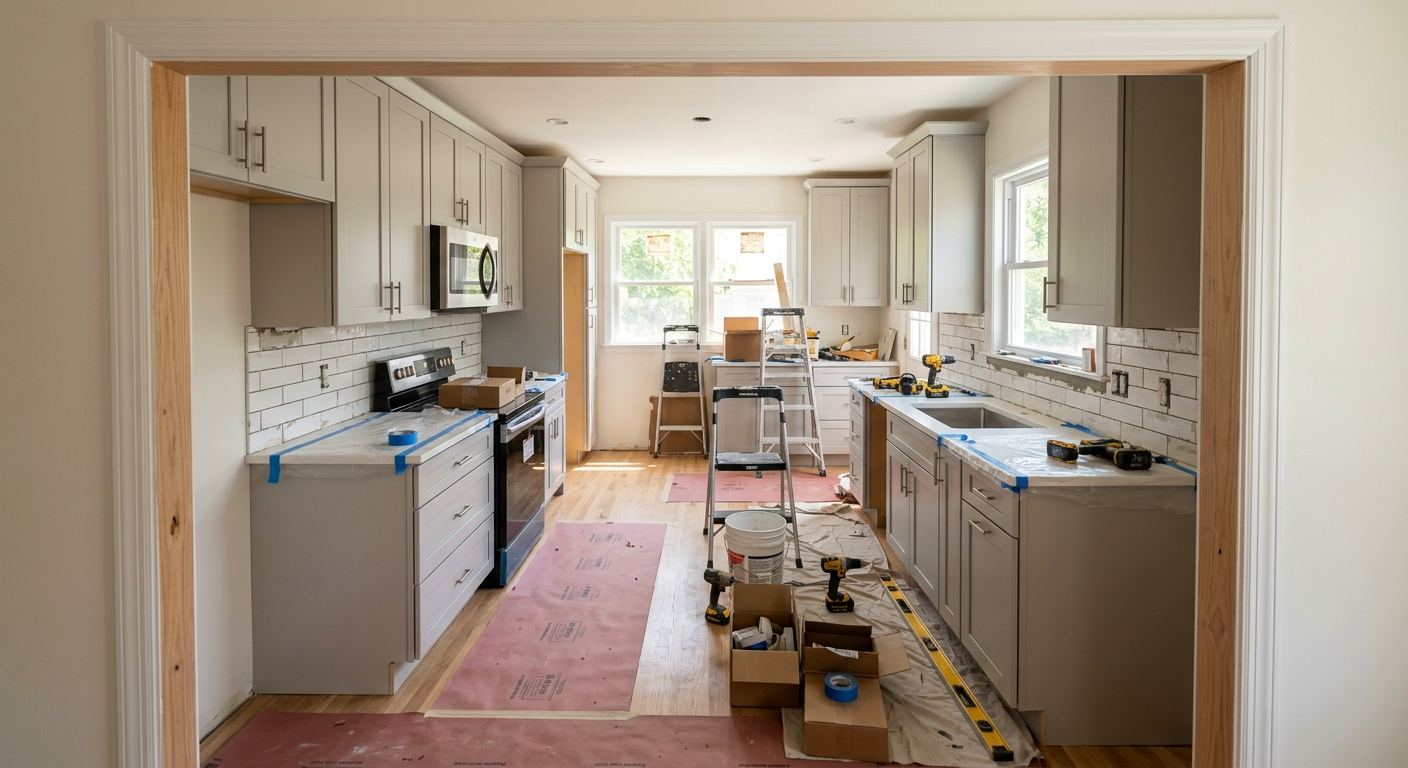
Kitchen renovation options and costs in Blue Quill Estates
In Blue Quill Estates, Alberta, most homeowners start their kitchen plans by balancing what they want to see every day with what the market will still pay for when it’s time to move. With a small local population of 1,296 (Statistics Canada, 2021 Census), there’s a tighter builder and trade pipeline than in bigger Calgary neighbourhoods, so lead times can be slightly more noticeable when you schedule mid-summer. At the same time, Calgary-area buying expectations often track higher-finish preferences: in higher-value pockets across the Calgary economic region, many households choose premium surfaces and cabinetry because renovation spend is easier to recover on resale.
Importantly, Calgary renovation budgets track more closely to home values and household income than to day-to-day climate effects. Alberta’s winters do influence material handling—sealed counters and well-detailed tile assemblies matter when homes shift and humidity swings—but contractors price your project mostly on finish tier, labour intensity, and whether the layout requires moving plumbing, gas, or electrical. In Blue Quill Estates, demand is especially strong around the community’s established service and retail core where trades can park and stage materials with minimal disruption—so cabinet installers and countertop crews often get booked faster for complete reno packages.
Below is a realistic snapshot of renovation tiers you’ll typically see in Calgary’s market. Use this to sanity-check quotes before you compare design details and allowances.
| Renovation Tier |
What's Included |
Typical Duration |
Price Range |
| Cosmetic refresh (paint, hardware, new appliances only) |
Cabinet paint or touch-ups, new hardware, backsplash spot-repair, appliance swap (no plumbing/gas moves) |
3–7 days |
$8,000–$20,000 |
| Mid-range full renovation (new cabinets, counters, sink, tile) |
Semi-custom cabinets, new countertops, sink & tap, backsplash, new flooring/tiling in the kitchen footprint |
3–6 weeks |
$25,000–$55,000 |
| High-end full renovation (custom cabinets, stone counters, island) |
Custom cabinetry, quartz or natural stone counters, island build, integrated lighting, upgraded appliance package, full tile/stone detailing |
6–10 weeks |
$60,000–$100,000 |
| Cabinet refacing only (new doors + drawer fronts, same boxes) |
New door/drawer fronts, hardware updates, refinished exterior, adjust trims and reinstall |
1–3 weeks |
$8,000–$28,000 |
| Countertop swap only (laminate to quartz or stone) |
Remove existing top, fabricate/install new quartz/stone, basic sink cut-out adjustments (no major plumbing changes) |
3–7 days |
$3,000–$12,000 |
| Backsplash tile installation only |
Tile supply and install, proper substrate prep, grouting/sealing where required, finish trim |
3–10 days |
$2,500–$8,000 |
Prices are estimates only and vary by project scope, site access and material selection.
What affects the price of kitchen renovation in Blue Quill Estates
Two quotes for the “same” kitchen can differ by 30–50% across Calgary and the broader Alberta region because contractors price risk differently: unknown conditions behind old cabinets, the amount of demolition required, how complicated the layout is, and whether skilled trades overlap cleanly. In this market, local housing value and household income tend to steer you toward a finish tier far more than the weather does. In higher-value Calgary-region areas, homeowners often default to quartz or natural stone counters and semi-custom cabinetry because the cost is easier to justify on resale. In more modest markets, laminate and stock cabinets dominate because buyers weigh ROI and durability over premium stone.
In Blue Quill Estates specifically, the biggest budget swings usually come from layout changes—not countertops. Moving a wall, adding an island, or relocating plumbing/gas can add significant design time, demolition, and licensed-trade costs regardless of whether you choose laminate or quartz. For example, if you move a sink from the current perimeter run to an island prep zone, you can see countertop installation costs climb toward the mid-band (around $3,000–$12,000 for standalone tops) but the overall project moves into the “mid-range full renovation” band (often $25,000–$55,000) because plumbing and electrical work drive the larger portion.
Concrete cost examples we see often in Blue Quill Estates include: (1) older cabinet boxes that are slightly out of level, which forces longer labour for shimming and trim correction; (2) door-and-drawer refacing where the original boxes are water-damaged near the sink, prompting partial box replacement; and (3) tile backsplashes where uneven drywall requires patching and re-skim to avoid cracked grout. Alberta’s freeze-thaw cycles can also make moisture management more critical around windows and exterior walls, so proper sealing and ventilation details prevent rework.
| Price Factor |
Why It Matters |
Cost Impact |
| Cabinet tier — stock vs. semi-custom vs. fully custom millwork |
Determines material quality, fit/finish, lead time, and how much carpentry is needed onsite |
Largest swing; can move you from a refresh toward full renovation budgets |
| Countertop material — laminate vs. quartz vs. granite vs. stone |
Pricing and installation complexity change with thickness, seams, and stone fabrication |
Typical countertop installs align with $3,000–$12,000 |
| Layout change — wall removal, island add, plumbing/gas move |
Demolition and licensed trades increase scope uncertainty and scheduling |
Often the difference between cosmetic vs full renovation tiers |
| Appliance package tier — builder vs. mid-range vs. pro-grade |
Power requirements, ventilation needs, and trim kits can change install labour |
Can add setup costs even when cabinet/counter choices stay the same |
| Flooring — refinish existing vs. full replacement |
Kitchen renos commonly require removal and re-laying; subfloor condition matters |
Full replacement adds demo and materials; refinishing may reduce cost but has limits |
| Backsplash — ceramic tile vs. marble vs. full-height slab |
Tile complexity and surface prep requirements drive labour and breakage rates |
Backsplashes typically land in the $2,500–$8,000 range |
| Electrical — new circuits for island, under-cabinet lighting |
Requires licensed electrician work and can affect permit requirements |
Under-cabinet lighting and new outlets are common cost adders |
| Permit fees and licensed trade requirements |
Work type determines whether permits are needed and inspections are required |
Can add several thousand dollars and schedule time, depending on scope |
Permits & regulations in Alberta
In Alberta, simple cabinet and countertop swaps generally do not require a permit—most homeowners can refinish, replace doors, or install a new top without triggering inspections. However, permits and licensed trades are typically required when you change the plumbing or gas system, alter structural load paths, or add significant electrical work. Examples of work that usually DO require permits/licensed trades include: relocating a sink that changes supply or drain lines; moving a range, cooktop, or gas equipment; running or extending a gas line; removing a load-bearing wall; and adding new electrical circuits (for example, island receptacles or dedicated lighting circuits).
Work that typically DOES NOT require a permit includes: replacing existing cabinet boxes with like-for-like cabinetry, reinstalling the same sink location without changing plumbing, installing new countertops on the existing footprint, and applying a backsplash where no electrical or plumbing is being relocated. Even when permits aren’t required, you still want licensed installers for components that call for it by code and manufacturer instructions.
For Blue Quill Estates homeowners, the verification process should be step-by-step. First, ask the contractor for their Alberta licence details for any trades involved and confirm on the relevant online registry. Second, request a certificate of insurance (liability) and confirm it matches your address/scope. Third, for labour coverage, ask for WSIB/WCB clearance documentation from the contractor and review it before work starts. Finally, ensure responsibility for permits is written clearly in the contract—who pulls them, who pays, and who schedules inspections.
Cabinets, countertops and layout decisions in Blue Quill Estates
In Blue Quill Estates, the three decisions that most strongly shape both cost and long-term satisfaction are cabinet tier, countertop material, and layout changes. Start with cabinets: stock is the fastest and usually the lowest cost, semi-custom is the “most popular” mid-range choice because you get better sizing and options without custom lead times, and custom cabinetry delivers the tightest fit but typically demands the highest budget. Next, choose countertops. Laminate is budget-friendly and can look modern with the right edge profiles, but it’s more sensitive to heat and can be vulnerable to seam wear. Quartz is a common Calgary compromise: it’s durable, low-maintenance, and tends to match the upscale finish expectations buyers want. Natural stone (granite/stone) offers premium look and character, while butcher block and marble change the maintenance story—great in the right kitchen, but not the simplest for daily heavy use.
Finally, layout decisions matter most when you change plumbing/gas or add an island. If you’re keeping the sink on the same perimeter run, you can stay closer to the mid-band project range (often $25,000–$55,000 for a mid-range full renovation). If you want a new island with water access or you relocate a gas line, budgets usually move toward the higher end (commonly $60,000–$100,000) because design, demolition, and licensed-trade labour stack up. In Calgary’s housing stock, many homes have established mechanical runs behind cabinets; preserving them is one of the quickest ways to avoid unpredictable overruns.
Example: choosing quartz instead of laminate might add a few thousand dollars, but it often won’t change the total budget as much as relocating a sink or adding electrical outlets for island seating. If your goal is a visible upgrade that buyers notice immediately, cabinets + quartz + a clean lighting plan is usually a stronger value move than chasing the most exotic stone while keeping plumbing untouched.
| Option |
Durability |
Maintenance |
Best For |
Price Range |
| Stock cabinets (big-box) |
Good everyday durability; limited sizing options |
Low; depends on finish quality |
Fast remodels where you can work with standard dimensions |
$8,000–$25,000 |
| Semi-custom cabinets (local dealer) |
Very durable; better fit and hardware options |
Low; solid construction reduces warping issues |
Most Blue Quill Estates kitchens aiming for value and fit |
$15,000–$45,000 |
| Custom cabinets (local millwork shop) |
Highest durability and precision fit |
Low to moderate; requires proper cleaning habits |
Unique layouts, full-height detailing, specialty storage |
$30,000–$80,000+ |
| Laminate countertop |
Moderate; seams and heat resistance are limiting factors |
Easy daily cleaning; avoid prolonged heat and standing water at seams |
Budget-focused refresh where you keep layout unchanged |
$3,000–$7,000 |
| Quartz engineered countertop |
High; resists stains and daily wear |
Very low; sealers usually not required |
Busy family kitchens with a premium look at controlled upkeep |
$6,000–$12,000 |
| Granite / natural stone countertop |
High; strong surface with natural variation |
Moderate; may need periodic sealing depending on stone |
Homeowners wanting unique veining and a luxury feel |
$7,000–$14,000 |
| Butcher block countertop |
Moderate to high with proper care; can scratch |
Higher; oiling and maintenance required |
Warm, functional kitchens for regular food prep |
$4,000–$10,000 |
| Marble countertop |
Moderate; more susceptible to etching and staining |
Higher; careful cleaning and protective practices |
Low-spill lifestyles and statement kitchens |
$10,000–$20,000+ |
How to choose a kitchen renovation contractor in Blue Quill Estates
Choosing the right contractor in Blue Quill Estates is mostly about proof and process, not just a low number. Start by verifying Alberta licensing for any trades involved and confirm liability insurance directly with the contractor—ask for a certificate of insurance showing your project address or scope match. For coverage, request WSIB/WCB clearance documentation and review the paperwork before any demolition begins, not after. If a contractor can’t provide clear documentation or refuses to show it, that’s a major risk signal for homeowners.
Next, get 2–3 itemised written quotes. You want labour and materials broken out (cabinets, counters, tile, plumbing/electrical allowances, disposal, and any permit-related line items). Avoid quotes that lump everything into one number without explaining what’s included and what’s excluded. Read the scope carefully: is permit pulling included? Is haul-away/disposal included? Are demolition, drywall patching, and subfloor repairs part of the base price? Also confirm warranty details: ask for the workmanship warranty length, whether the manufacturer’s product warranty transfers to you, and what happens if a cabinet component arrives damaged.
For payment, never pay more than 10–15% upfront. Use a staged schedule tied to milestones and hold back the final portion until completion and punch-list items are finished. Lastly, ensure you receive a written start date and an estimated completion date that matches material lead times—cabinet and stone fabrication delays are common, and timelines should reflect them.
- Ask for proof of insurance and WSIB/WCB coverage before signing.
- Require an itemised quote with allowances clearly listed.
- Confirm who pulls permits and who pays permit fees.
- Check whether disposal/haul-away is included.
- Verify labour warranty terms and duration in writing.
- Confirm product warranty transferability for cabinets and counters.
- Get a detailed schedule: demo, rough-in, cabinets, counters, tile, and final trim.
- Request colour/finish specs and installation standards in the contract.
- Ensure electrical and gas/plumbing work is assigned to licensed trades.
- Agree on change-order process: written changes with pricing and timelines.
- Clarify who is responsible for site protection and cleaning during construction.
- Use a payment schedule with milestone-based releases and a holdback.
Red flags in Blue Quill Estates include: a quote that excludes disposal and drywall patching with no allowances; refusal to provide insurance/coverage documentation; vague timelines that ignore cabinet and stone lead times; and change orders that aren’t itemised with labour/material breakdown. Also be cautious if the contractor won’t explain what triggers permits for your specific layout or insists “nothing needs permits” even when moving plumbing/gas or adding electrical circuits.
Frequently asked questions — kitchen renovation in Blue Quill Estates
What's the most popular kitchen style in Blue Quill Estates right now?
For Blue Quill Estates and the broader Calgary economic region, the most requested style is a clean, modern look with warm neutrals: flat-panel or simple shaker fronts, light-to-medium cabinet colours, and quartz counters that read bright even in winter light. Homeowners often pair this with a subtle backsplash and practical lighting—under-cabinet LEDs and good task lighting near the sink—because it photographs well and feels “new” without being trendy for only a year. In the market, that usually lines up with the mid-range full renovation tier ($25,000–$55,000) when you’re changing cabinets, counters, and tile together. We also see many buyers favour durable, low-maintenance finishes over high-etch surfaces like marble for everyday use.
How do I know if I need to update my kitchen plumbing in Blue Quill Estates?
The best trigger is condition, not the calendar. If you’re only swapping cabinets and counters while keeping the sink in the same location, you can often leave supply and drain connections alone. But if the shutoff valves are old, corroded, leaking, or not reachable for shutoff without removing cabinets, budgeting a plumbing refresh is wise. You also need updates when you’re relocating the sink, adding a dishwasher change in position, or moving to an island setup—those changes involve new supply/drain runs and typically licensed plumbing work. In practice, many kitchens in established Alberta homes have older lines behind toe-kicks or within wall cavities; once demo starts, contractors frequently uncover small leaks or poor connections. A good contractor will inspect access points early and explain which items are safety/maintenance issues versus cosmetic upgrades.
What is the difference between a galley and open-concept kitchen?
A galley kitchen is a narrow layout with counters on two opposing sides, which can be very efficient for cooking and cleanup but often limits seating and gathering space. An open-concept kitchen removes barriers to connect the kitchen to living/dining areas, usually by altering walls or reconfiguring openings. In renovations, changing from galley to more open plans can be a major cost driver because it may involve load-bearing wall assessment, structural changes, and permits, plus electrical and plumbing coordination for how the rooms connect. In Blue Quill Estates, many homeowners keep plumbing in the existing perimeter because it helps avoid large scope surprises, then “open up” with partial walls or repositioned storage rather than moving everything. If your goal is space gain without the highest redesign cost, an informed layout plan can still deliver a modern feel while keeping costs closer to the mid-range band ($25,000–$55,000).
How do I get accurate kitchen renovation quotes in Blue Quill Estates?
Accurate quotes start with clear scope and measurement. Ask for a site visit, then request itemised pricing with allowances for cabinets, countertops, tile, and any rough-in work. Make sure the quote specifies what’s included (demo, drywall patching, disposal, flooring tie-ins, and backsplash prep) and what’s excluded. For Blue Quill Estates homeowners, the biggest accuracy improvements come from confirming whether plumbing/gas locations change and whether new circuits are required for islands and lighting—those decisions affect the permit and licensed-trade path. Also confirm material selections early: quartz thickness, cabinet hardware, and tile style can change labour time and seam/joint planning. A contractor who answers these details clearly usually produces a tighter estimate. Finally, compare quotes side-by-side by line item, not just total, and watch for unrealistic “too good to be true” bundles that omit electrical, disposal, or patching.
What's the best countertop material for a busy Blue Quill Estates kitchen?
For most busy households in Alberta’s Calgary area, quartz is the best balance of durability and low maintenance. It resists staining and everyday wear, and it doesn’t typically require the sealing routine that some natural stones do. If you’re frequently cooking, hosting, or using the kitchen as a main family space, quartz is also forgiving for day-to-day messes compared with more maintenance-heavy options like marble or butcher block. In cost terms, many homeowners land in the countertop band of $6,000–$12,000 depending on thickness, edges, and complexity of cut-outs. If you’re trying to keep the budget tighter, laminate can still work well, but it’s more sensitive to heat and seams over time. For a “busy kitchen” goal, quartz is usually the most practical upgrade that still looks premium to buyers.
How do I add an island to my Blue Quill Estates kitchen?
Adding an island starts with layout and utilities. If you’re adding seating only, you can often keep costs down by avoiding changes to plumbing and gas lines—though you’ll still want electrical planning for outlets and charging ports. If you want a sink or cooktop in the island, plan for plumbing and/or gas relocation, which typically involves permits and licensed gas fitting/plumbing work. Also confirm ventilation requirements for any cooktop and ensure electrical circuits for under-island lighting or outlets are properly planned. In Blue Quill Estates, we often recommend a two-step decision process: first, finalize the island size, circulation clearances, and storage needs; second, confirm where power, plumbing, and ventilation will run without major structural changes. When done well, an island can move a renovation from a mid-range refresh into a higher-cost full redesign tier—so it’s smart to confirm your target budget early against the common full kitchen bands ($25,000–$55,000 to $60,000–$100,000 depending on scope).