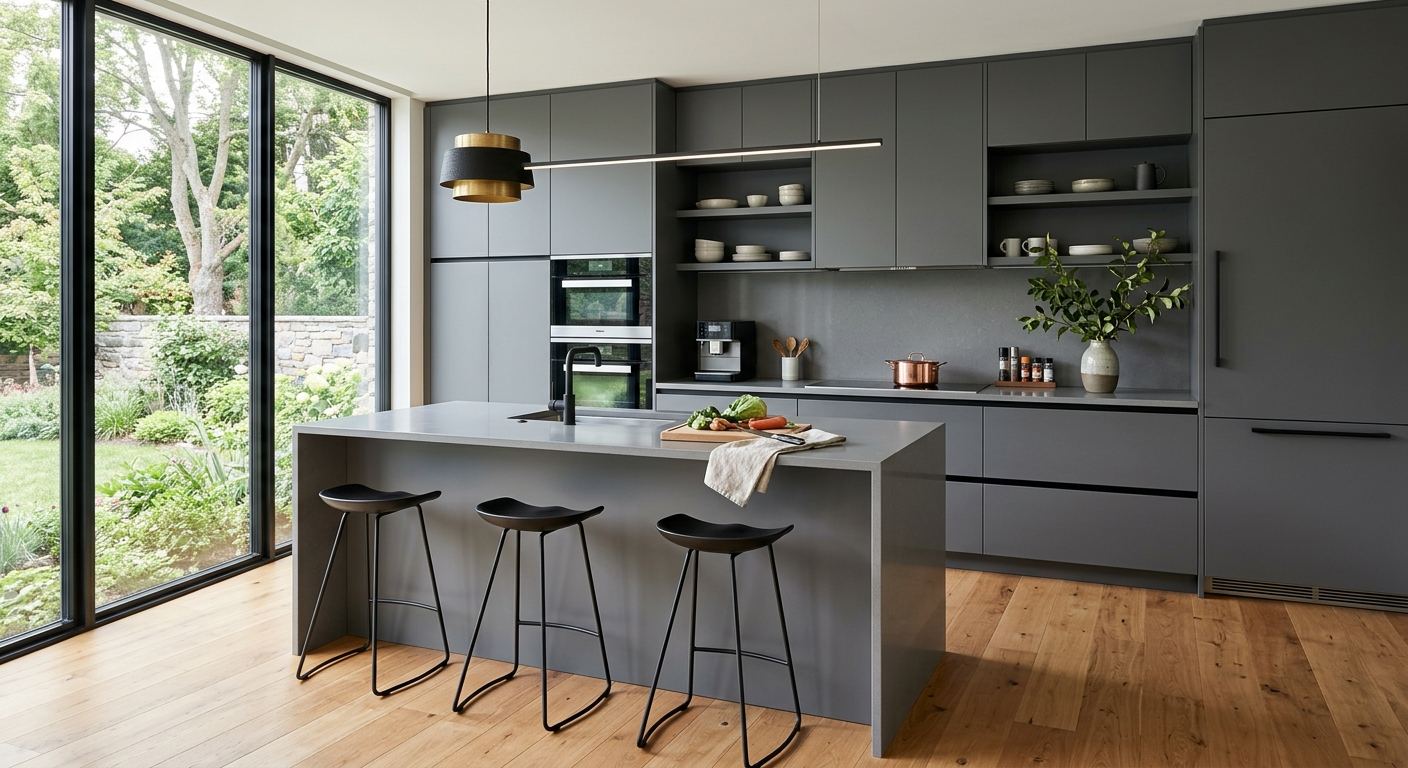
Kitchen renovation options and costs in La Crête
Kitchen renovations in La Crête typically fall into a few predictable tiers, but the price you’re quoted depends on how closely your project matches the finishes that buyers expect around Calgary. With a population of 2,911 in the area (Statistics Canada, 2021 Census), the market can be smaller than big city centres, so scheduling skilled trades can be tighter when multiple homes renovate in the same season. At the same time, kitchen “style upgrades” tend to track what homeowners in the Calgary economic region are willing to pay—often aligning with higher-value finish expectations rather than weather performance. That’s one reason projects cluster into the mid five-figures for full renovations and can rise quickly when layouts change or walls move.
In the Calgary region, costs usually track local home values and household income, not climate. Alberta’s freeze-thaw cycles can stress grout and caulking at exterior seams and around plumbing penetrations, so good water management and proper ventilation matter, but they rarely drive the overall budget the way cabinets, counters, and electrical scope do. Labour availability also affects timelines and pricing; in peak periods, trades are booked in advance, which can influence how fast you can start and how quickly you can keep the project moving.
In La Crête, demand is especially strong in established residential pockets where homes tend to be renovated to support resale and modern open layouts—an area where contractors often focus on cabinet installation, countertop templates, and tile/backsplash packages. Use the table below to compare renovation tiers side-by-side before you request itemised quotes.
| Renovation Tier |
What's Included |
Typical Duration |
Price Range |
| Cosmetic refresh (paint, hardware, new appliances only) |
Paint (walls/ceilings), cabinet hardware, new appliances (typically swap-in only), minor caulking and touch-ups |
3–7 days on site (plus appliance delivery) |
$8,000–$25,000 |
| Mid-range full renovation (new cabinets, counters, sink, tile) |
Semi-custom or quality-stock cabinets, new countertops, sink + faucet, backsplash tile, basic plumbing hookups, flooring patching/adjustments |
2–5 weeks |
$25,000–$70,000 |
| High-end full renovation (custom cabinets, stone counters, island) |
Fully custom cabinetry, quartz/stone counters, island with electrical planning, premium tile/backsplash, upgraded lighting, coordinated appliance package |
5–10 weeks |
$70,000–$100,000+ |
| Cabinet refacing only (new doors + drawer fronts, same boxes) |
New doors/drawer fronts, hardware, re-finish/repair existing boxes as needed, remove/replace toe-kick and trim, optional backsplash refresh |
1–3 weeks |
$8,000–$35,000 |
| Countertop swap only (laminate to quartz or stone) |
Template and install new counters, sink cut-out adjustments, new seals/silicone, disposal of existing counters (scope-dependent) |
3–10 business days (often longer if stone scheduling is tight) |
$3,000–$12,000 |
| Backsplash tile installation only |
Tile supply and install (ceramic/porcelain), cement board prep where required, grout/seal, clean-up and caulking at edges |
2–7 days |
$2,500–$8,000 |
Prices are estimates only and vary by project scope, site access and material selection.
What affects the price of kitchen renovation in La Crête
Two homeowners can receive quotes that are 30–50% apart for the “same” kitchen in the Calgary economic region because scope details get interpreted differently: cabinet tier, counter thickness and edge profiles, electrical add-ons, and how much wall/floor patching is included after demolition. In a market where renovations often follow what buyers expect at resale, local home values and median income typically steer you toward quartz or natural stone counters and semi-custom cabinetry rather than laminate and basic stock boxes. Climate doesn’t usually drive the big-ticket line items—finish choices do. Alberta winters do, however, influence how quickly crews can return after inspections and how carefully moisture-prone areas around plumbing are sealed and ventilated.
Here’s the practical Calgary-region pattern: in higher-value neighbourhoods, homeowners often invest around 10–15% of home value for a refresh and up to 20–25% for a full redesign, which pushes more projects into the mid-range full renovation and high-end tiers. In more modest-value pockets, laminate and stock cabinets dominate because they deliver strong ROI at a lower upfront cost. Regardless of finish, layout changes are the biggest cost wildcard: removing a wall, adding an island, or moving a gas line can trigger permit work, additional trades, and rework risk.
In La Crête specifically, two local conditions can raise costs. First, older homes can have outdated rough-ins, so plumbing/gas adjustments may require wall openings that expand demolition and patching budgets. Second, if your existing flooring needs a full replacement after cabinet removal, the “base” renovation price often jumps even before you select counters—especially when matching tile or LVP patterns is hard after the fact. Those are common reasons a project that starts as a $25,000–$70,000 mid-range renovation can drift toward the upper end of full redesign pricing.
| Price Factor |
Why It Matters |
Cost Impact |
| Cabinet tier — stock vs. semi-custom vs. fully custom millwork |
Dialled-in fit, storage layout, and material quality change labour time and product cost |
Can swing roughly $10,000–$40,000+ |
| Countertop material — laminate vs. quartz vs. granite vs. stone |
Price per square foot, templating complexity, and fabrication tolerances differ |
Often $3,000–$12,000+, with islands pushing higher |
| Layout change — wall removal, island add, plumbing/gas move |
Forces electrical, plumbing, sometimes gas work, plus structural and inspection steps |
Commonly adds $8,000–$35,000+ |
| Appliance package tier — builder vs. mid-range vs. pro-grade |
Electrical requirements, venting needs, and finish specs affect labour and allowances |
Can add $2,000–$20,000 depending on brand tier |
| Flooring — refinish existing vs. full replacement |
Kitchen demolition often reveals subfloor damage and mismatch risks |
Often $1,500–$12,000+ |
| Backsplash — ceramic tile vs. marble vs. full-height slab |
Material weight, cut complexity, and waterproofing details change installation time |
Can shift $2,500–$8,000+ |
| Electrical — new circuits for island, under-cabinet lighting |
New circuits and lighting upgrades require licensed work and inspection |
Typically $800–$6,000+ |
| Permit fees and licensed trade requirements |
Some scope triggers permits; inspections add scheduling and administrative time |
Often $500–$3,500+ depending on permits/inspections |
Permits & regulations in Alberta
In Alberta, not every kitchen change needs a permit. Cabinet and countertop swaps generally do not require permits if you’re keeping the existing layout and not altering plumbing, gas, or electrical rough-ins. However, permits (and licensed trades) become relevant when you move plumbing supply/drain lines, relocate a gas appliance or gas line (including certain range hood configurations), remove or alter a load-bearing wall, or add new electrical circuits (for example, power for an island and additional lighting). Gas and electrical work also require inspections—your contractor should coordinate that with the right trades.
Here’s a homeowner-friendly way to verify your project in La Crête before signing: first, list every task that changes “where things are.” If anything involves moving the sink location, changing the drain path, relocating a cooktop/range, or adding circuits, assume you’ll need permits and licensed trade sign-off. If you’re only painting, swapping hardware, installing new cabinets on the existing footprint, and replacing counters, permits are typically not required for the swap itself.
Step-by-step checks: (1) confirm the contractor’s Alberta trade licence (where applicable) and professional standing; (2) ask for a certificate of liability insurance showing coverage for the term of the work; (3) request proof of WSIB/WCB coverage (or clearance documentation, as applicable); and (4) require the contractor to name who is responsible for permits in writing. Don’t rely on verbal “we’ll handle it”—get it in your contract scope and schedule.
Cabinets, countertops and layout decisions in La Crête
The three biggest decisions that shape your final kitchen renovation in La Crête are cabinet tier, countertop material, and layout changes. First, cabinet tier: stock cabinets are usually the fastest and cheapest; semi-custom cabinets are the most popular mid-range choice because you gain better storage and more options without fully custom pricing; custom cabinets cost more but give the cleanest fit for awkward corners, ceiling heights, and specific storage needs. Second, countertop material: laminate is budget-friendly and practical, quartz offers strong stain resistance with low maintenance, granite/natural stone adds character but can require periodic sealing depending on the stone, and butcher block is warm and repairable but needs more care around water and heat. Third, layout: open-concept wall removal and island additions can create real value by improving flow, but they also trigger the most unpredictable costs because they often require plumbing/gas and electrical modifications.
In the Calgary resale market, buyers commonly expect solid, modern surfaces and good lighting at each price point. That’s why many projects land in the $25,000–$70,000 band when you choose semi-custom cabinets and durable counters, and why high-end redesigns in the $70,000–$100,000+ range often include islands plus premium stone. Alberta’s winters don’t force you to “overbuild” materials, but they do increase the importance of proper sealing at counter edges, grout lines, and under-sink plumbing—areas that get stressed when humidity swings.
A concrete budgeting example: if you keep plumbing where it is and choose quartz, you might stay near the mid-range full renovation band. If you move the sink to support an island, the electrical and plumbing scope can push the project toward the upper end even if cabinetry quality stays mid-tier—because you’re paying for trades, scheduling, and additional demolition/patching. In short: spend on durability and fit, but be cautious when you change services location unless the space gain is worth it.
| Option |
Durability |
Maintenance |
Best For |
Price Range |
| Stock cabinets (big-box) |
Good for everyday use; limited custom sizing |
Low—keep hinges adjusted and clean regularly |
Fast refreshes with predictable layouts |
$8,000–$25,000 |
| Semi-custom cabinets (local dealer) |
Very strong; better internal storage and fit |
Low—wipe surfaces, re-tighten as needed |
Most La Crête renovations aiming for resale appeal |
$20,000–$45,000 |
| Custom cabinets (local millwork shop) |
Excellent; tailored to ceilings, angles, and storage layouts |
Low—follow manufacturer care for finishes/paint |
Unique layouts, full-height designs, and premium builds |
$35,000–$80,000+ |
| Laminate countertop |
Moderate; can chip or blister at edges if water gets in |
Easy daily cleaning; protect seams and avoid prolonged heat |
Budget-conscious upgrades where layout stays unchanged |
$3,000–$6,000 |
| Quartz engineered countertop |
High; very resistant to staining and everyday wear |
Low—no sealing; wipe clean and address spills promptly |
Busy households and resale-friendly modern aesthetics |
$6,000–$12,000 |
| Granite / natural stone countertop |
High; durable surface with natural variation |
Medium—often needs sealing depending on the stone |
Homeowners wanting natural movement and premium look |
$7,000–$15,000 |
| Butcher block countertop |
Good but susceptible to dents and water if unmanaged |
Higher—regular oiling and careful cleaning required |
Warm, traditional kitchens and light-to-moderate cooking |
$4,000–$10,000 |
| Marble countertop |
Beautiful but more porous and can etch with acids |
Higher—requires sealing and careful spill management |
Statement kitchens where you value look over hard-use practicality |
$10,000–$20,000+ |
How to choose a kitchen renovation contractor in La Crête
Choosing the right contractor matters in Alberta because kitchen work touches multiple trades and scheduling is tight during peak construction periods. Start by verifying Alberta licensing and trade credentials where applicable, then confirm liability insurance for the job dates. For worker coverage, request WSIB/WCB clearance or proof of coverage—your contractor should be able to provide documentation, not just assurances. If a subcontractor will be doing gas or electrical, confirm that specific trade’s paperwork is included in the scope and that inspections are planned.
Next, request 2–3 itemised written quotes. You want labour and materials broken out (cabinet supply, countertop fabrication, tile, disposal, electrical/plumbing allowance), not a single lump sum that hides what’s excluded. Read the scope carefully: ask whether permits are included, whether demolition and disposal are included, and whether patching/painting after cabinet install is part of the base price. Clarify who supplies what—fixtures, sink, faucet, under-cabinet lighting, appliance allowances, and tile backer board. For warranties, confirm the workmanship warranty length, what the manufacturer covers on cabinets/counters, and whether warranties are transferable if you sell the home.
Payment scheduling should protect you. Never pay more than 10–15% upfront; use milestones, and hold a portion until completion and close-out are complete. Finally, get a start date and completion estimate in writing. Kitchens often run into delays for stone and cabinet lead times, so a reputable contractor schedules around that and keeps the plan realistic.
- Ask for proof of liability insurance and confirm the job is covered for the full duration.
- Request WSIB/WCB clearance (or coverage documentation) in writing.
- Verify relevant Alberta licences for the trades involved (gas and electrical especially).
- Use itemised quotes with labour + materials breakdown, not a lump-sum only.
- Confirm whether permits, inspections, and permit fees are included or billed separately.
- Clarify demolition scope: haul-away, dumpster, and disposal responsibilities.
- Check exclusions: flooring replacement, drywall patching, paint finishing, trim rebuild.
- Confirm countertop template timing and who is responsible for re-template costs.
- Ask about electrical scope: island circuits, under-cabinet lighting, and dimmers.
- Request a start date, target completion date, and lead-time assumptions for cabinets/stone.
- Review warranty terms for workmanship and whether it covers callbacks and adjustments.
- Confirm payment milestones—no large deposits and a holdback until final walkthrough.
Red flags in La Crête: quotes with missing scope details (especially disposal, patching, or permit responsibility), “one-price” proposals that aren’t itemised, refusal to provide insurance/WSIB/WCB documentation, no written timeline for cabinet/counter lead times, and contracts that allow payment before measurable progress without a holdback.
Frequently asked questions — kitchen renovation in La Crête
How do I add an island to my La Crête kitchen?
Adding an island in La Crête usually comes down to two things: layout and services. First, confirm physical clearances for walkways (so doors and drawers don’t fight traffic), then decide whether the island is purely storage or needs power and possibly seating lighting. If you’re adding outlets for an island or under-cabinet lighting, that typically requires new electrical circuits planned by a licensed electrician. If you also want to move a cooktop or sink, you may trigger plumbing and/or gas scope and the permit/inspection workflow. Budget-wise, an island can be the reason a renovation climbs from a $25,000–$70,000 mid-range tier toward upper full-renovation pricing, not because of the island’s wood alone, but because of electrical/plumbing coordination and added demolition/patching.
How much does a kitchen renovation cost in La Crête?
In La Crête and the surrounding Calgary economic region, typical kitchen renovation budgets often track finish tier and whether you change the layout. A cosmetic refresh (paint, hardware, and new appliances only) commonly starts around the lower end of the estimates, while a mid-range full renovation with new cabinets, counters, a sink, and tile commonly falls in the $25,000–$70,000 band. Full redesigns with custom cabinetry, stone counters, and an island can reach $70,000–$100,000+—especially when you remove walls or move plumbing/gas lines. Prices vary because labour and project management costs are meaningful in Alberta’s strong construction market (Statistics Canada, 2021 Census provides the population context for the local market size), and because cabinet/counter lead times can change scheduling. Get itemised quotes so you can compare “apples to apples.”
How long does a kitchen renovation take in La Crête?
Timelines in La Crête depend on product lead times and how much demolition and trade coordination is required. A cosmetic refresh can take about 3–7 days on site, but you’ll still wait for appliance deliveries. A mid-range full renovation typically runs 2–5 weeks if cabinetry and countertops are available in reasonable time windows. High-end projects with custom millwork, stone templating, and an island often take 5–10 weeks due to fabrication schedules and the additional electrical/plumbing steps. If your scope includes permit inspections, factor in inspection scheduling and potential rework if something doesn’t pass the first inspection. The best contractors provide a written schedule with start date, milestone dates (demo, framing adjustments, cabinet install, countertop template, final trim), and allowances for stone/cabinet lead times.
Quartz vs granite countertops — which is better?
“Better” depends on how you cook and how much maintenance you want. Quartz engineered countertops are typically the safer, lower-maintenance choice for most Alberta households: they resist staining well and usually don’t require periodic sealing. Granite/natural stone offers distinct visual character and can be very durable, but it may require sealing depending on the specific stone and finish. In day-to-day use, both handle heat and impact reasonably well when installed correctly, but quartz is often more consistent across a busy kitchen. Budget also matters: laminate-to-quartz counter swaps commonly land in the $6,000–$12,000 range depending on kitchen size and edge profile, while granite can trend higher for fabrication and selection. For resale in the Calgary market, quartz is a common “most buyers will like it” option, while granite is a premium look that some homeowners love for the natural variation.
Should I reface or replace my cabinets?
Refacing is usually best when your cabinet boxes are solid and the layout is working—refacing replaces doors and drawer fronts, and can keep existing cabinetry in place. It’s often faster and can be a good value if your current boxes are straight, structurally sound, and not swollen from past moisture issues. If your boxes are damaged, you need major storage reconfiguration, or you’re changing dimensions to accommodate a new countertop/plan, replacement is usually the better long-term move. In pricing terms, cabinet refacing commonly sits around $8,000–$35,000, while a full cabinet replacement is what pushes many renovations into the $25,000–$70,000 mid-range band or higher depending on cabinet tier. In Alberta’s freeze-thaw climate, ensure any under-sink and plumbing-adjacent areas are sealed and checked—hidden moisture problems can make refacing a poor choice.
Do I need a permit for a kitchen renovation in Alberta?
In Alberta, cabinet and countertop swaps typically don’t require permits if you aren’t moving plumbing, gas, or electrical rough-ins. However, permits and licensed trade work become necessary when you change anything that affects supply/drain lines, relocate a gas appliance or gas line, remove a load-bearing wall, or add new electrical circuits (like power for an island or new lighting lines). Gas work must be done by a licensed gas fitter, and electrical work must be done by a licensed electrician, both with inspections. For homeowners in La Crête, the simplest verification method is to ask your contractor to list permit-triggering tasks in the written scope and confirm who is responsible for permits. Always review the contract before you sign so you aren’t surprised by inspection timelines or additional fees.