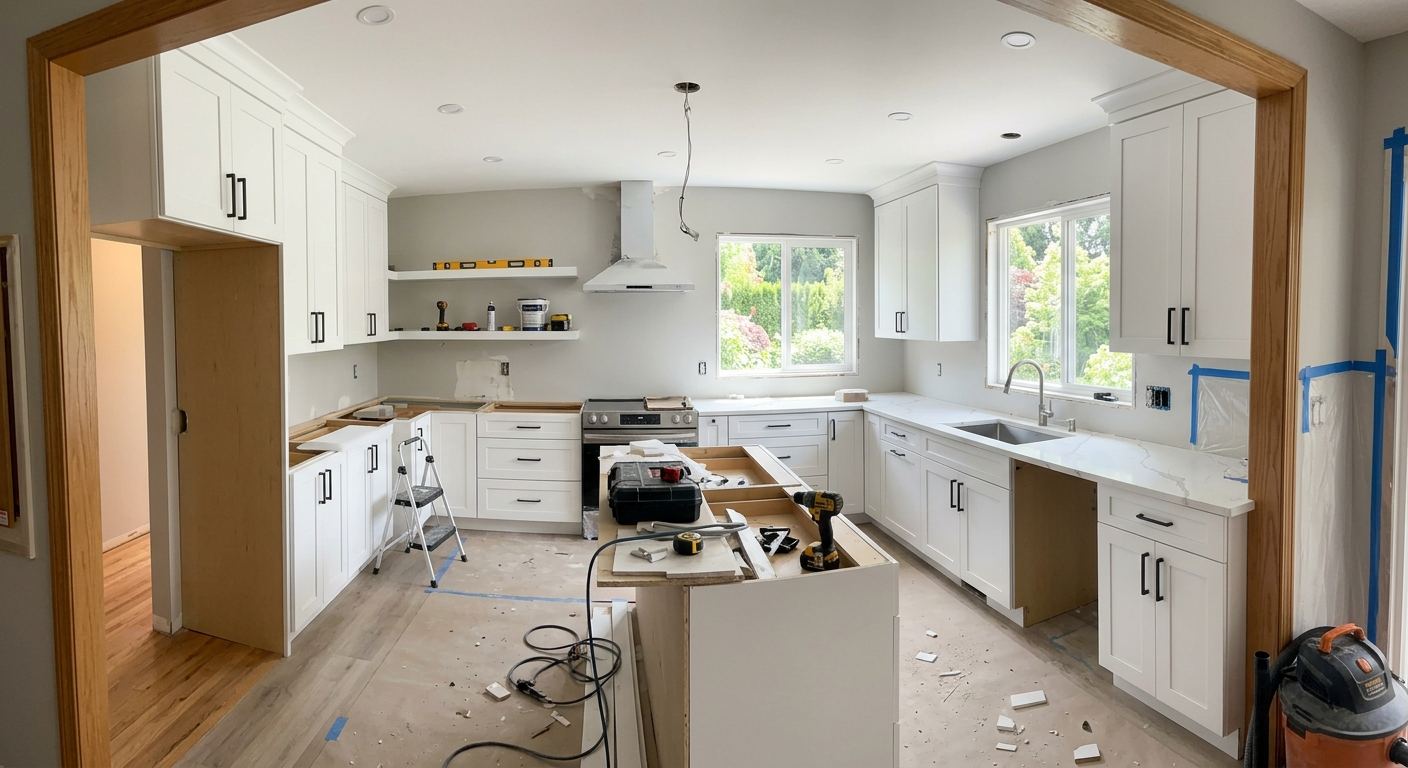
Kitchen renovation options and costs in The Hamptons
In The Hamptons, Alberta, kitchen renovations tend to cluster around what buyers in the Calgary economic region expect to see: clean lines, modern storage, and durable surfaces that still look sharp in winter. With a population of 9,405 (Statistics Canada, 2021 Census), the local market is small enough that contractors get booked quickly, especially in older pockets where original builder kitchens are wearing out. Renovation expectations also rise in line with household capacity—those with higher incomes and higher-end homes often choose finishes that “hold value,” even if the project is a refresh rather than a full redesign. In practice, it’s the local housing mix in the Calgary region—more upscale properties often supporting 10–15% refresh budgets and up to 20–25% full redesigns—that drives the typical finish tier you’ll see in quotes.
Alberta’s climate mainly affects installation details and material handling (humidity swings, long delivery seasons, and the way subfloors settle after freeze-thaw), but it usually doesn’t change the base pricing the way labour demand and resale expectations do. Skilled labour in the Calgary area often runs about $90–$140 per hour, so design time, project management, and the amount of trade coordination matter as much as the material list. In demand areas for trades include newer growth zones and established neighbourhoods where homeowners are upgrading from builder-standard cabinets—local contractors often see the busiest schedules near the heart of The Hamptons where access is easiest for deliveries and staging. That’s why you’ll see larger spreads between bids even when the scope looks similar.
Below is a practical side-by-side of the renovation options most homeowners compare first before we talk specific materials and layout changes.
| Renovation Tier |
What's Included |
Typical Duration |
Price Range |
| Cosmetic refresh (paint, hardware, new appliances only) |
Cabinet paint or touch-up, new hardware, appliance swap, simple organization upgrades; no cabinet box changes |
3–7 days |
$6,000–$18,000 |
| Mid-range full renovation (new cabinets, counters, sink, tile) |
New cabinets (stock or semi-custom), new solid-surface/countertops, sink and faucet, backsplash tile, supply/disposal coordination |
3–6 weeks |
$25,000–$55,000 |
| High-end full renovation (custom cabinets, stone counters, island) |
Custom or upgraded cabinetry, quartz or natural stone counters, island build-out, upgraded lighting, feature backsplash, premium hardware |
6–12 weeks |
$65,000–$100,000 |
| Cabinet refacing only (new doors + drawer fronts, same boxes) |
Reface doors/drawer fronts, new hardware, refinishing trim as needed; counters and tile typically not included |
1–3 weeks |
$12,000–$35,000 |
| Countertop swap only (laminate to quartz or stone) |
Remove and replace existing counters, new backsplash piecework or transition trims; plumbing changes only if tied to sink location |
2–5 days |
$3,500–$12,000 |
| Backsplash tile installation only |
Tile supply and install, backer prep, grout/seal, cleanup; assumes existing countertop edge is serviceable |
2–6 days |
$2,500–$8,000 |
Prices are estimates only and vary by project scope, site access and material selection.
What affects the price of kitchen renovation in The Hamptons
In The Hamptons, you can see quotes for the “same” kitchen that differ by 30–50% across the Calgary economic region because the budget is driven more by finish selections and labour intensity than by Alberta weather. Home values and household income influence what tier you’re effectively shopping: in higher-value neighbourhoods around Calgary and nearby communities, homeowners often default to quartz or natural stone counters and semi-custom cabinetry because the upgrade is easier to recoup at resale. In more modest pockets, laminate and stock cabinet systems dominate since the ROI is usually steadier and the project can stay closer to the lower end of the bands—think $25,000–$55,000 for a mid-range full reno instead of pushing toward $65,000–$100,000.
Layout changes add the biggest uncertainty regardless of finish. Moving a load-bearing wall, adding an island, or relocating plumbing/gas lines introduces extra demolition, framing, inspections, and skilled trade coordination. Even if you choose the same countertop, an electrical add-on for under-cabinet lighting and an island circuit can meaningfully increase labour and material time. In The Hamptons specifically, two common cost drivers are (1) working around older flooring/subfloor conditions under existing cabinets and (2) the way freeze-thaw cycles can reveal gaps after cabinets are removed—causing fill, leveling, and tile re-prep.
Concrete examples we commonly see locally: switching from laminate to quartz often lands in the $3,000–$12,000 countertop band, but if the sink cutout needs rework or edges need full waterproofing, that can stretch upward. Likewise, upgrading cabinetry tier from stock to semi-custom may move you from the “mid five-figures” zone into a higher full-renovation budget when you add upgraded roll-outs, soft-close systems, and a layout that uses more efficient drawers.
| Price Factor |
Why It Matters |
Cost Impact |
| Cabinet tier — stock vs. semi-custom vs. fully custom millwork |
Material quality, door styles, internal storage options, and lead times vary by tier |
Often shifts $10,000–$40,000 within the same overall project |
| Countertop material — laminate vs. quartz vs. granite vs. stone |
Material price, fabrication complexity, edge profiles, and installation labour differ |
Typically adds $3,000–$20,000 depending on the swap or full install |
| Layout change — wall removal, island add, plumbing/gas move |
More demolition, framing, and skilled trade coordination; often needs inspections |
Can add $5,000–$25,000+ even when finishes stay similar |
| Appliance package tier — builder vs. mid-range vs. pro-grade |
Electrical requirements, install complexity, and finish matching (panels/trim) vary |
Commonly swings $2,000–$12,000+ across appliance sets |
| Flooring — refinish existing vs. full replacement |
Demo extent and subfloor preparation change the labour and waste |
Often $1,500–$8,000 depending on condition and coverage |
| Backsplash — ceramic tile vs. marble vs. full-height slab |
Weight, cutting time, sealing, and alignment requirements vary widely |
Typically $2,500–$8,000+ for tile; higher for premium slabs |
| Electrical — new circuits for island, under-cabinet lighting |
Licensed work, breaker changes, and lighting runs increase complexity |
Often adds $1,000–$6,000+ depending on scope |
| Permit fees and licensed trade requirements |
Certain structural, gas, plumbing, and electrical work requires permits/inspections |
Variable, but can add $500–$3,000+ plus scheduling time |
Permits & regulations in Alberta
In Alberta, many “swap-style” kitchen updates do not require a permit, but the moment you change systems, you’re in permit territory. A cabinet and countertop swap—keeping the same sink location and not altering rough-in plumbing—typically does not require permits. Likewise, replacing like-for-like fixtures (for example, a faucet swap) is usually straightforward, as long as you’re not moving supply or drain lines.
Where permits and licensed trades are commonly required is when the job affects building systems: moving plumbing supply or drain lines, relocating gas appliances or changing gas connections (including range/stove work tied to gas), removing a load-bearing wall, or adding new electrical circuits (for example, outlets for an island or under-cabinet lighting tied to new runs). Gas work must be performed by a licensed gas fitter, and electrical work must be done by a licensed electrician—both typically need inspections after completion.
For homeowners in The Hamptons, the verification process should be simple and documented. First, ask your contractor for their licence details and certificate of insurance before work begins. Next, confirm coverage by reviewing their certificate of insurance (liability limits that match kitchen construction risk). Then ask about WSIB/WCB coverage for their workers—don’t assume it; request the clearance letter or evidence of account status. Finally, confirm the permit responsibility in writing: the contract should clearly state who pulls permits and who schedules inspections so the project timeline doesn’t stall midstream.
Cabinets, countertops and layout decisions in The Hamptons
When you renovate a kitchen in The Hamptons, the biggest value drivers are usually the three decisions that change both your day-to-day function and what buyers can “see”: (1) cabinet tier, (2) countertop material, and (3) whether you change the layout. Stock cabinets are the fastest and cheapest path because the design is standardized. Semi-custom cabinets are the most popular mid-range choice in the Calgary market because they offer better storage options while still keeping timelines manageable. Custom cabinets fit best for unusual wall lengths, pantry layouts, and built-ins—at the expense of higher cost and longer lead times.
Countertops follow a similar pattern. Laminate is cost-effective and can be a smart choice if you’re keeping a budget near the lower portion of full renovation bands. Quartz is a strong middle ground: it handles normal kitchen use well and usually brings the most consistent look for resale. Granite or other natural stone is premium but demands more careful sealing and may show more variation—great for buyers who want “real stone” character. In terms of weather fit, Alberta’s heating cycles and indoor humidity swings can expose poor workmanship at seams; quartz typically hides this better than laminate because of how it’s fabricated and sealed.
Layout changes—open-concept wall removal, adding an island, or relocating plumbing/gas—are justified when they create usable storage and better traffic flow, not just “more modern.” For example, if you’re already budgeting around $25,000–$55,000 for a mid-range full renovation, moving the sink footprint could push the project toward the upper end due to added trade time. But if adding an island lets you replace a cluttered peninsula with real drawer storage, that functional gain can be worth the spend—particularly in a resale-focused market where buyers expect seating and power-ready surfaces.
| Option |
Durability |
Maintenance |
Best For |
Price Range |
| Stock cabinets (big-box) |
Good durability with standard hardware and finishes |
Low; wipe-clean surfaces, tighten hardware as needed |
Budget-focused refreshes and shorter timelines |
$8,000–$18,000 |
| Semi-custom cabinets (local dealer) |
Very good durability; better internal organization and softer-close options |
Low; similar care to stock, but higher-end finishes may be more uniform |
Most mid-range full renovations in The Hamptons |
$18,000–$35,000 |
| Custom cabinets (local millwork shop) |
Excellent durability; tailored joinery and fit |
Low to moderate; depends on finish system and hardware |
Odd spaces, full-height pantry walls, and premium design plans |
$35,000–$60,000+ |
| Laminate countertop |
Moderate; resists daily wear but can chip at edges |
Low daily care; avoid heat and sharp impacts at seams/edges |
Staying within tighter budgets |
$3,000–$7,000 |
| Quartz engineered countertop |
High durability; strong resistance to staining and everyday abrasion |
Low; simple cleaner routine, periodic care as recommended |
Resale-friendly look with minimal fuss |
$6,000–$12,000 |
| Granite / natural stone countertop |
High durability; varies by slab hardness and finish |
Moderate; may require periodic sealing and careful stain management |
Premium aesthetic for buyers who want natural variation |
$7,000–$15,000+ |
| Butcher block countertop |
Moderate to high; can dent but handles repairs |
Moderate; regular oiling and mindful moisture control |
Warm design themes and light-to-moderate cooking use |
$4,000–$10,000 |
| Marble countertop |
High aesthetic value; softer than quartz and more prone to etching |
Moderate; sealing and gentle cleaning required |
Low-impact kitchens and premium “statement” finishes |
$9,000–$20,000+ |
How to choose a kitchen renovation contractor in The Hamptons
Choosing the right contractor in The Hamptons is mostly about verification and clarity. Start with licensing and coverage: ask for the contractor’s proof of liability insurance (and check the certificate for current dates and coverage limits). For projects involving gas or electrical work, confirm the licensed gas fitter and licensed electrician credentials through their own documentation. Then verify WSIB/WCB coverage: request a clearance letter or coverage evidence so you’re not financially exposed if a worker is injured on site.
Next, request 2–3 itemised written quotes instead of a single lump sum. You want a labour line-by-line (demo, framing/patching, install, project management) and a materials breakdown (cabinet package, countertop fabrication, tile supplies, underlay/adhesives, disposal). Scope clarity is where many projects go off track: confirm what’s excluded (for example, moving major appliances, any patching beyond cabinet footprint, subfloor leveling beyond a stated allowance), whether permits are included, and whether jobsite disposal and dumpster fees are covered. Also confirm the timeline with a written start date and a realistic completion estimate based on lead times.
Warranty matters too. Ask for the workmanship warranty length and whether the product/manufacturer warranty is transferable to you as the homeowner. For payment, never pay more than 10–15% upfront; then use holdback until key milestones are complete (like countertop install and final punch list). This payment approach protects you during Alberta’s busy construction season.
- Ask for insurance certificate and verify it matches kitchen construction risk.
- Confirm WSIB/WCB clearance letter before demo begins.
- Get itemised quotes with labour and materials separated.
- Ensure permits and inspections responsibilities are written in the contract.
- Confirm disposal/dumpster and jobsite protection are included.
- Request the cabinet and countertop lead-time dates in writing.
- Check warranty: workmanship duration and manufacturer warranty terms.
- Confirm who handles change orders and how pricing is calculated.
- Agree on colours/finishes in writing (hardware, paint sheen, grout type).
- Verify the electrical/gas subcontractors are licensed for the scope.
- Set a payment schedule with 10–15% max deposit and milestone holdback.
- Get a written start date and a completion target tied to lead times.
Red flags I see during kitchen renos in The Hamptons: vague scopes that don’t list what’s included, “cash-only” or unwillingness to provide insurance/coverage paperwork, quotes that don’t include permit responsibility (when plumbing/gas/electrical changes are proposed), missing lead-time details for cabinets/counters, and contractors who push oversized deposits or won’t agree to a holdback until final inspections and punch list completion.
Frequently asked questions — kitchen renovation in The Hamptons
Quartz vs granite countertops — which is better?
In Alberta kitchens, quartz is often the easiest “yes” for homeowners in The Hamptons because it’s consistent, low maintenance, and tends to look uniform across seams—an advantage when winter freeze-thaw and regular heating cycles stress the installation details. Granite is durable and gives natural variation, but it may require periodic sealing and the slab character can vary a lot, so you’ll want your fabricator to confirm the exact slab in advance. If you’re budgeting within a typical countertop-only band, quartz commonly lands around $6,000–$12,000, while granite can push higher depending on slab selection and edge profiles. If resale appeal and predictable upkeep are your priorities, quartz is usually the better balance; if you want natural “one-of-a-kind” character and don’t mind added care, granite is a great choice.
Should I reface or replace my cabinets?
Refacing can be the best move when your cabinet boxes are solid, straight, and well-mounted—common in many older Calgary-region homes where the structure is still fine but doors and drawer fronts look dated. Replacement becomes the smarter option when boxes are warped, failing hinges are hiding behind old hardware, you need layout changes, or you want significantly different storage (like deeper drawers, new pantry configurations, or modified corner systems). In The Hamptons, refacing is typically priced in a way that can keep your project closer to the mid-range renovation plan (often $12,000–$35,000 for refacing scope), while full replacement can move the budget up quickly toward higher tiers. A good contractor will inspect the boxes and mounting points during the quote visit and show you options based on actual cabinet condition, not just preference.
Do I need a permit for a kitchen renovation in Alberta?
In Alberta, many kitchens don’t need permits if you’re only swapping finishes—cabinet and countertop replacements typically fall into “no permit” work as long as you’re not moving systems. Permits are usually required when your project changes building systems: relocating plumbing supply/drain lines, moving a gas connection or gas appliance setup (including stove/range changes), removing a load-bearing wall, or adding new electrical circuits such as new island outlets or lighting runs. For homeowners in The Hamptons, the practical step is to confirm permit responsibility in the contract before work starts and ensure the licensed trades are engaged (gas fitter for gas work; electrician for electrical). Also ask for the inspection schedule so the job doesn’t stall while trades are waiting on approvals.
What's the ROI on a kitchen renovation?
ROI in The Hamptons is less about a single percentage and more about aligning your kitchen upgrade with what buyers in the Calgary market expect to pay for—particularly finish tier. In higher-value Calgary economic region homes, many homeowners treat the kitchen refresh as a recoverable upgrade (often spending in the 10–15% range for a refresh and up to 20–25% for a full redesign), which is why higher-end choices like quartz or natural stone and semi-custom cabinetry show up frequently. If your project budget jumps into the $65,000–$100,000 zone, it tends to be justified when the layout change adds real functional value (like an island with seating and power, or improved storage) rather than purely cosmetic upgrades. If you stay closer to $25,000–$55,000 with strong cabinetry, durable counters, and a sensible backsplash, you often achieve the “looks new” effect that supports resale without overshooting the market’s comfort level.
How do I budget for a kitchen renovation?
Budgeting starts with choosing your tier and keeping a small contingency. In The Hamptons, a cosmetic refresh is usually the quickest path, while full renovations commonly land in the mid five-figures and can reach six figures when walls move or finishes go premium. A practical approach is to set your target within the bands first—for example, $25,000–$55,000 for a mid-range full renovation—and then list everything you’ll need: demo, cabinet install, countertop fabrication, sink/tap, tile/backsplash, electrical updates, and disposal. If your plan includes changing plumbing or adding circuits, add buffer because those items can increase costs more unpredictably than material swaps. Finally, get itemised quotes and confirm what’s excluded (patching beyond a cabinet footprint, permit pull, appliance delivery, and waste removal). Even in a well-run Alberta schedule, a little cushion protects you from delays tied to cabinet or stone lead times.
Can I move my kitchen sink or stove?
Yes, but moving a sink or stove changes the project category from “finish update” to “systems coordination,” which usually means more cost and more scheduling. If you move the sink, you’ll often be relocating plumbing supply and/or drain lines, which typically requires permits and licensed plumbing work (and inspections). Moving a stove that’s gas-powered generally means relocating gas lines as well, which must be done by a licensed gas fitter with inspections. In The Hamptons, homeowners often assume the countertop swap cost will cover it—but the real impact shows up in demo, framing, tile rework, and trade coordination. If your goal is a layout upgrade, it can be worth it when you gain workable clearance, better work triangle flow, and storage; just ensure your contractor provides a clear scope and written timeline before you commit to the move.