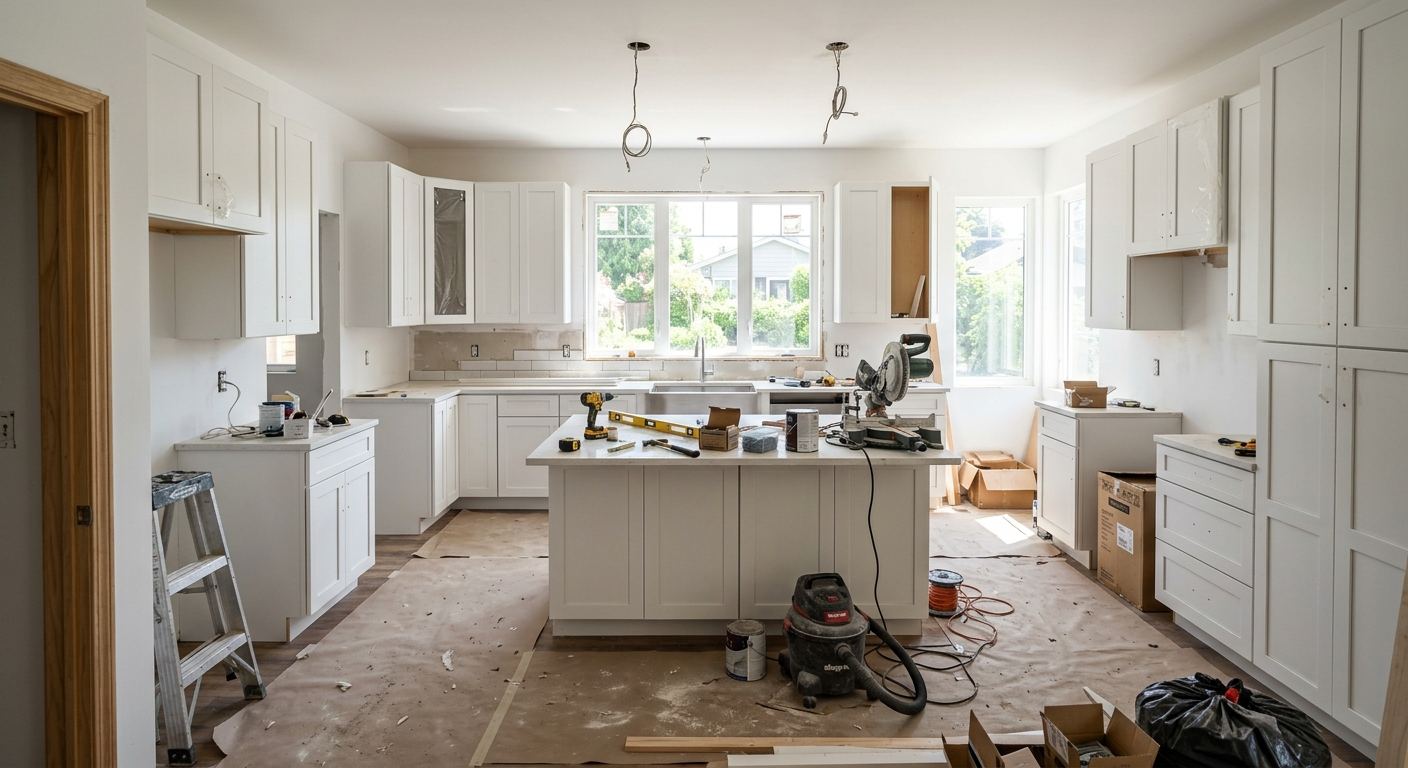
Kitchen renovation options and costs in Virgil
Kitchen renovation in Virgil often comes down to matching your budget to the finish level buyers in the Toronto economic region expect—especially in higher-value pockets where homeowners commonly invest about 8–15% of their home value into the kitchen. For a community of 2,937 residents (Statistics Canada, 2021 Census), most renovations are tied to family upgrades and resale readiness rather than extreme weather. In practice, Toronto-area pricing is driven more by market demand and material selection than climate exposure, so contractor availability and lead times tend to swing with seasonality, cabinet manufacturing schedules, and appliance supply—not by temperature swings.
That said, Ontario’s four-season freeze–thaw cycle still shows up indirectly in kitchens: exterior wall moisture management, ventilation, and the condition of subfloor and wall framing influence how much demo is needed before cabinets and tile can be set correctly. Also, older housing stock in the wider GTA means you may uncover knob-and-tube remnants, undersized electrical supply, or outdated plumbing that changes the scope. Most homeowners in Virgil are also balancing affordability with a practical resale strategy, which is why you’ll see everything from mid-range full renovations to higher-end builds with custom millwork.
In Virgil, the trade is especially busy for homeowners near the Niagara Region–adjacent corridor and along well-established streets where properties have more consistent access for delivery and staging. Once you’ve decided where you land on that spectrum, the table below will help you compare typical tiers side by side.
| Renovation Tier |
What's Included |
Typical Duration |
Price Range |
| Cosmetic refresh (paint, hardware, new appliances only) |
Cabinet paint or touch-ups, new pulls/knobs, caulking/trim, appliance swap (where existing hookups allow), minor hardware alignment |
1–3 weeks |
$6,000–$18,000 |
| Mid-range full renovation (new cabinets, counters, sink, tile) |
Semi-custom or stock cabinets, quartz or laminate countertops, new sink and faucet, backsplash tile, flooring repairs/partial refinishing, basic lighting refresh |
4–8 weeks |
$25,000–$60,000 |
| High-end full renovation (custom cabinets, stone counters, island) |
Custom cabinets, natural stone (granite/stone) and/or premium quartz, island with upgraded surfaces, under-cabinet lighting, upgraded appliance package, more extensive tile and finish detailing |
8–14 weeks |
$65,000–$90,000 |
| Cabinet refacing only (new doors + drawer fronts, same boxes) |
Door/drawer replacement, new veneer surfaces, new hardware, repaint/finish touch-ups to perimeter, backsplash rework if needed |
2–5 weeks |
$8,000–$35,000 |
| Countertop swap only (laminate to quartz or stone) |
Remove existing tops, template and install new countertops, new sink cut-out where required, caulking and countertop-to-tile finishing |
3–7 days (plus template time) |
$3,000–$15,000 |
| Backsplash tile installation only |
Surface prep, tile supply/installation, grout/seal where appropriate, minor trim and caulking around outlet covers |
3–10 days |
$2,000–$10,000 |
Prices are estimates only and vary by project scope, site access and material selection.
What affects the price of kitchen renovation in Virgil
In Virgil and across the Toronto economic region, two homeowners can receive quotes that differ by 30–50% for what looks like the “same” kitchen because the quote depends on hidden scope: what needs demolition, how far trades must travel, what’s included for permits and electrical, and—most importantly—what finish tier you’re building toward. Toronto-area home values and buyer expectations strongly shape the typical finish level, and local budgets often follow market logic rather than climate logic. In higher-value pockets, homeowners more often choose quartz or natural stone and semi-custom cabinetry because the cost is easier to recover on resale when the kitchen is used as a selling feature. In more price-sensitive areas of the region, many projects stay mid-range with stock or refaced cabinetry and laminate or mid-tier quartz while still improving flow and storage.
Layout changes are the wild card regardless of finish tier. Moving a sink, adding an island, or relocating a gas line can add significant labour and trade coordination, even if cabinet styles are modest. For example, if you’re starting from an older kitchen with dated plumbing under the slab, a “quick” swap can turn into a more involved replacement path. Likewise, if you plan a full renovation in the $25,000–$60,000 band, you can often keep costs closer to budget by limiting plumbing moves and selecting laminate or quartz at a mid-price spec. If you jump to a high-end plan closer to $65,000–$90,000, the cost spread often comes from custom millwork and premium surfacing, plus the extra electrical and lighting work that makes an island feel “finished.”
Concretely in Virgil, I see two cost drivers rise most often: older electrical capacity (needing new circuits for an island or ventilation) and tile work over imperfect walls after demo. Both are solvable, but they change timelines and quote amounts.
| Price Factor |
Why It Matters |
Cost Impact |
| Cabinet tier — stock vs. semi-custom vs. fully custom millwork |
Custom doors, internal storage, and built-in details raise material and shop time |
$7,000–$40,000 |
| Countertop material — laminate vs. quartz vs. granite vs. stone |
Material cost, fabrication complexity, and edge profiles affect total installed price |
$2,000–$18,000 |
| Layout change — wall removal, island add, plumbing/gas move |
Requires structural planning, trade coordination, and sometimes additional inspections |
$5,000–$35,000 |
| Appliance package tier — builder vs. mid-range vs. pro-grade |
Higher-end models cost more and may need different venting/clearance and electrical |
$2,500–$20,000 |
| Flooring — refinish existing vs. full replacement |
Demo reveals subfloor condition; matching hardwood or tile can add labour and materials |
$1,500–$12,000 |
| Backsplash — ceramic tile vs. marble vs. full-height slab |
Installation time increases with layout complexity; slabs require precision setting and handling |
$2,000–$12,000 |
| Electrical — new circuits for island, under-cabinet lighting |
New receptacles, dedicated circuits, and lighting increase electrical scope and inspection needs |
$1,000–$7,500 |
| Permit fees and licensed trade requirements |
Permits, inspections, and licensed gas/electrical work can’t be skipped when scope triggers them |
$500–$5,000 |
Permits & regulations in Ontario
In Ontario, many “like-for-like” kitchen swaps do not trigger permits. Cabinet and countertop swaps typically do not require permits because they are finish work on existing elements. However, once you change plumbing routes, gas components, structural load paths, or electrical capacity, permits and licensed trades usually come into play. Specifically, moving supply or drain lines, relocating a gas stove or making changes tied to a gas range or range hood venting, removing a load-bearing wall, or adding electrical circuits for an island are the common permit-triggering items homeowners need to plan for. Gas work must be completed by a licensed gas fitter, and electrical work must be done by a licensed electrician, with required inspections before you can close up walls and proceed.
Here’s a practical step-by-step homeowner check for Virgil projects. First, ask your contractor for their licence numbers and have them provide the proof before the work starts. Second, request a certificate of liability insurance showing they’re covered for the scope, and confirm they have WSIB/WCB coverage for workers (or the appropriate exemption documentation where applicable). Third, verify the licensed trades directly: check the electrician’s and gas fitter’s credentials in their online registries, and ask for a copy of their insurance certificates too. Finally, make sure the contract clearly states who pulls permits, pays fees, schedules inspections, and covers any required rework. That clarity is what prevents budget surprises later.
Cabinets, countertops and layout decisions in Virgil
Your biggest “bang for the buck” in a Virgil kitchen renovation usually comes from three decisions: cabinet tier, countertop material, and whether you change the layout. In the Toronto resale market, buyers look for a clean, durable surface and storage-efficient cabinets—so the right tier matters. Stock cabinets are the fastest and cheapest, while semi-custom hits the most common mid-range sweet spot, and fully custom provides the best fit for unique room dimensions and specialized storage. For countertops, laminate is budget-friendly and can look sharp, but quartz and natural stone are harder-wearing for daily use and generally hold their appeal longer. Butcher block can be beautiful and repairable, while marble is high-end but needs more care around etching.
Climate matters indirectly in Ontario: kitchens need good ventilation and sealing where countertops meet tile and walls, because moisture management protects cabinetry and underlayment over the long run. If you’re building toward a more marketable finish level in the $25,000–$60,000 range, quartz is often the realistic upgrade that feels “premium” without jumping fully into high-end stone pricing. If you’re comparing options, here’s a concrete example: upgrading from laminate to quartz often lands in the $3,000–$15,000 range depending on size and edge profiles. That step can be justified if you want a durable, resale-friendly surface that won’t stain as easily with typical household use.
Layout changes—like opening up with a wall removal, adding an island, or relocating plumbing/gas—can be worth it when they improve traffic flow and add usable workspace. But they cost more because they trigger trade coordination and sometimes permits. The key is to chase the space gain, not just the visual change.
| Option |
Durability |
Maintenance |
Best For |
Price Range |
| Stock cabinets (big-box) |
Solid for everyday use; fixed sizes can limit best fit |
Low; regular cleaning and hardware tightening as needed |
Budget-conscious updates with straightforward measurements |
$8,000–$22,000 |
| Semi-custom cabinets (local dealer) |
Good build quality with more flexibility in storage options |
Low; wipe-down and hardware checks |
Most renovations where you want better function without full custom pricing |
$18,000–$45,000 |
| Custom cabinets (local millwork shop) |
Highest fit and finishing; ideal for complex layouts and storage goals |
Low; premium hardware and finishes last with normal care |
High-end kitchens, unique dimensions, built-ins and tailored storage |
$35,000–$70,000 |
| Laminate countertop |
Decent for general use; seams and edge wear are more noticeable |
Easy daily care; avoid prolonged heat and impact at seams |
Refreshing look with tighter budgets |
$3,000–$7,500 |
| Quartz engineered countertop |
Very durable and stain-resistant; consistent colour and pattern |
Low; wipe with mild cleaner, use trivets for hot cookware |
Resale-friendly, low-maintenance kitchens across Ontario |
$7,000–$15,000 |
| Granite / natural stone countertop |
Hard and heat-tolerant; natural variation is part of the appeal |
Seal and periodic maintenance recommended depending on stone |
Homeowners targeting high-end aesthetics and long-term wear |
$10,000–$18,000 |
| Butcher block countertop |
Durable if maintained; can show cuts over time |
Requires oiling/sanding as needed; protect from standing water |
Warm, traditional or farmhouse-style kitchens |
$6,000–$12,000 |
| Marble countertop |
Beautiful but softer; can be susceptible to etching from acids |
Higher care; seal properly and clean gently |
Statement kitchens where owners accept maintenance |
$12,000–$22,000 |
How to choose a kitchen renovation contractor in Virgil
Choosing the right kitchen renovation contractor in Virgil starts with verification. In Ontario, ask for their Ontario business details and confirm they’re properly set up for the type of work they’ll coordinate. Then verify liability insurance and WSIB/WCB coverage: request certificates of insurance showing current coverage and ask how they handle worker coverage on-site. For electrical or gas-related scope, insist the contractor uses licensed trades and provides their licence proof on request.
Next, get 2–3 quotes that are itemised—not lump sums—so you can compare like-for-like. You want a labour + materials breakdown that lists what’s included for cabinets, countertops, tile, backsplash, disposal, and any electrical/plumbing allowances. Read exclusions carefully: confirm whether permits are included, whether demolition and hauling are included, and whether patching/paint is part of the scope. Ask about timeline commitments: the start date, cabinet/counter template dates, and a completion estimate should be in writing. Also check warranty terms: there should be a workmanship warranty (often longer for cabinetry and installation tasks) and clear product/manufacturer warranty documentation, including whether warranty coverage is transferable if you sell the home.
Payment schedule matters. For most reputable GTA-area contractors, you should never need more than 10–15% upfront; hold back a portion until key milestones are complete. If a contractor pressures you for larger deposits or won’t provide an itemised scope, that’s a signal.
- Ask for proof of liability insurance and WSIB/WCB coverage before signing.
- Get 2–3 itemised written quotes (labour and materials separated).
- Confirm permit responsibility and whether permits/inspection fees are included.
- Verify disposal/hauling is included (or explicitly excluded).
- Ensure demolition scope is clear (what gets removed, what gets protected).
- Check who supplies appliance hookup requirements and final appliance positioning.
- Confirm countertop templating and cutout responsibilities (sink, cooktop, taps).
- Ask how electrical scope is handled if you add circuits or under-cabinet lighting.
- Request a detailed schedule: demo, rough-in, cabinet install, countertop install, tile, paint.
- Confirm warranty length for workmanship and the exact manufacturer warranty terms.
- Use a milestone payment plan; avoid paying large sums early.
- Review change-order process: written approvals, itemised pricing, and timelines.
Red flags I commonly see with kitchen renovation contractors in Virgil include: refusing to provide WSIB/WCB or insurance documents, quoting with vague “materials allowance” numbers that change later, skipping details on permits or licensed trades for plumbing/gas/electrical scope, missing a demolition-to-finish timeline (especially around countertop templating), and pushing for more than 10–15% upfront without a signed scope and schedule.
Frequently asked questions — kitchen renovation in Virgil
Custom vs stock cabinets — is custom worth it?
In Virgil, stock cabinets are often the best choice when your layout is straightforward and you want to stay in the lower end of a renovation budget. Semi-custom is usually where most homeowners land because you get better storage options and flexibility without custom lead times. Custom cabinets can absolutely be worth it if your room has challenging dimensions, you want built-ins (pantry pull-outs, appliance garages, integrated appliance zones), or you’re aiming for a high-end finish that stands out on resale.
Cost-wise, custom tends to push total projects higher because cabinetry is labour- and shop-time intensive. As a reference point, full kitchen renovations in the Toronto economic region commonly range from mid-$20k for modest refreshes up to $80k+ for larger custom builds, and cabinet tiers drive that swing. If you’re trying to keep the project closer to $25,000–$60,000, semi-custom plus quartz is frequently a better ROI than fully custom millwork.
How do I choose a kitchen contractor in Virgil?
Start with verification. Ask the contractor to provide proof of liability insurance and WSIB/WCB coverage for their workers, then request licence details for any licensed trades they’ll use. In Ontario, electrical work must be done by a licensed electrician, and gas-related work must be done by a licensed gas fitter, with inspections when required. For kitchen cabinet and countertop swaps, permits are often not needed, but changes like plumbing/gas moves can trigger them.
Next, get 2–3 itemised quotes showing a labour and materials breakdown (not lump sums). Confirm what’s included for permits, demolition and disposal, and where responsibilities sit for countertop templating and cutouts. Finally, check warranty terms: workmanship coverage should be clear and product warranties should match the actual brands being installed. A contractor who won’t put scope and timeline in writing is usually not set up for predictable results.
What order do kitchen renovation steps happen in?
In most Virgil kitchen renovations, the workflow is designed to keep trades from stepping on each other. Typically, you begin with site protection, demo, and disposal. Next comes rough-in work: any required plumbing or gas changes, plus electrical rough wiring for outlets, an island circuit, or under-cabinet lighting. If you’re changing walls or opening up a space, structural steps happen before cabinets.
After rough-ins are inspected (when applicable), surfaces are prepared and any subfloor/patch work is completed. Then cabinets get installed and levelled, countertop templating follows, and countertop fabrication/install happens. Tile and backsplash are generally staged after cabinets (so edges and outlets align), followed by final trim, caulking, paint touch-ups, and final appliance connection/fit. If you’re planning a countertop-only upgrade, it still usually involves template time first, so the “swap” won’t be same-day.
Budgets often align to your tier—for example, a full mid-range renovation in the $25,000–$60,000 band typically needs more sequencing than a simple hardware-and-appliance refresh.
Can I live at home during a kitchen renovation in Virgil?
Many homeowners in Virgil can live at home during a kitchen renovation, but it depends on the scope and your tolerance for noise and limited cooking. For cosmetic refreshes (paint, hardware, and appliance swaps only), living at home is usually straightforward because major plumbing/electrical changes typically aren’t involved. For full renovations—especially ones in the $25,000–$60,000 or $65,000–$90,000 range—expect periods where the kitchen can’t be used normally due to demo, cabinet installation, countertop fabrication delays, and tile curing.
A practical approach is setting up a temporary cooking station in another room (microwave, kettle, toaster oven), protecting floors and doorways with dust control, and confirming daily work hours and dust mitigation measures in your contract. Also plan for water access; if plumbing moves are happening, there may be a short window where water use is limited. The contractor should coordinate “ready-to-cover” milestones so the site is kept clean and secure each day.
Should I renovate my kitchen before selling in Virgil?
Often, yes—if the goal is to improve buyer perception and address functional issues that would turn into negotiation leverage at showings. In the Toronto area, kitchens are a high-impact room, and homeowners frequently refresh cabinets, countertops, and lighting to align with what buyers expect. Because market demand in higher-value pockets tends to favour quartz/stone and well-organized cabinetry, a renovation can strengthen resale appeal.
That said, timing matters. If your current cabinets are structurally sound, a refacing or countertop upgrade can be a cost-conscious way to upgrade the “visible surface” while limiting disruptions. A cabinet refacing-only project is commonly in the $8,000–$35,000 range, while a countertop swap only often sits in the $3,000–$15,000 range, making them easier to do quickly before listing.
If you’re considering a full renovation, keep the scope tied to the neighbourhood’s buyer expectations—modest updates can help you avoid over-improving for the area. For reference, full renovations in this region commonly track from mid-$20k up into the $80k+ range depending on finish tier and whether you change the layout.
What's the most popular kitchen style in Virgil right now?
In Virgil and the broader Toronto economic region, the most popular styles right now tend to be modern transitional: clean lines, neutral colours, and practical lighting. Many homeowners are choosing warm whites, greiges, and natural wood tones to keep the kitchen looking current but not overly trendy. Quartz countertops in solid or subtle veining are common because they pair well with modern hardware and are easy to maintain in everyday life.
Layout-wise, many renos are adding or improving central work zones—whether that’s a functional island or better pantry storage—because it photographs well and improves day-to-day flow. Backsplash choices often lean toward sleek tile patterns or extended coverage that feels more “complete” than a small accent strip.
If you want a quick indicator of budget vs style: cosmetic refreshes with new appliances and hardware can be the simplest path, while a mid-range full renovation in the $25,000–$60,000 band is where you’ll typically see quartz and a more cohesive look. Higher-end builds in the $65,000–$90,000 range usually add custom cabinetry details and premium stone surfaces.