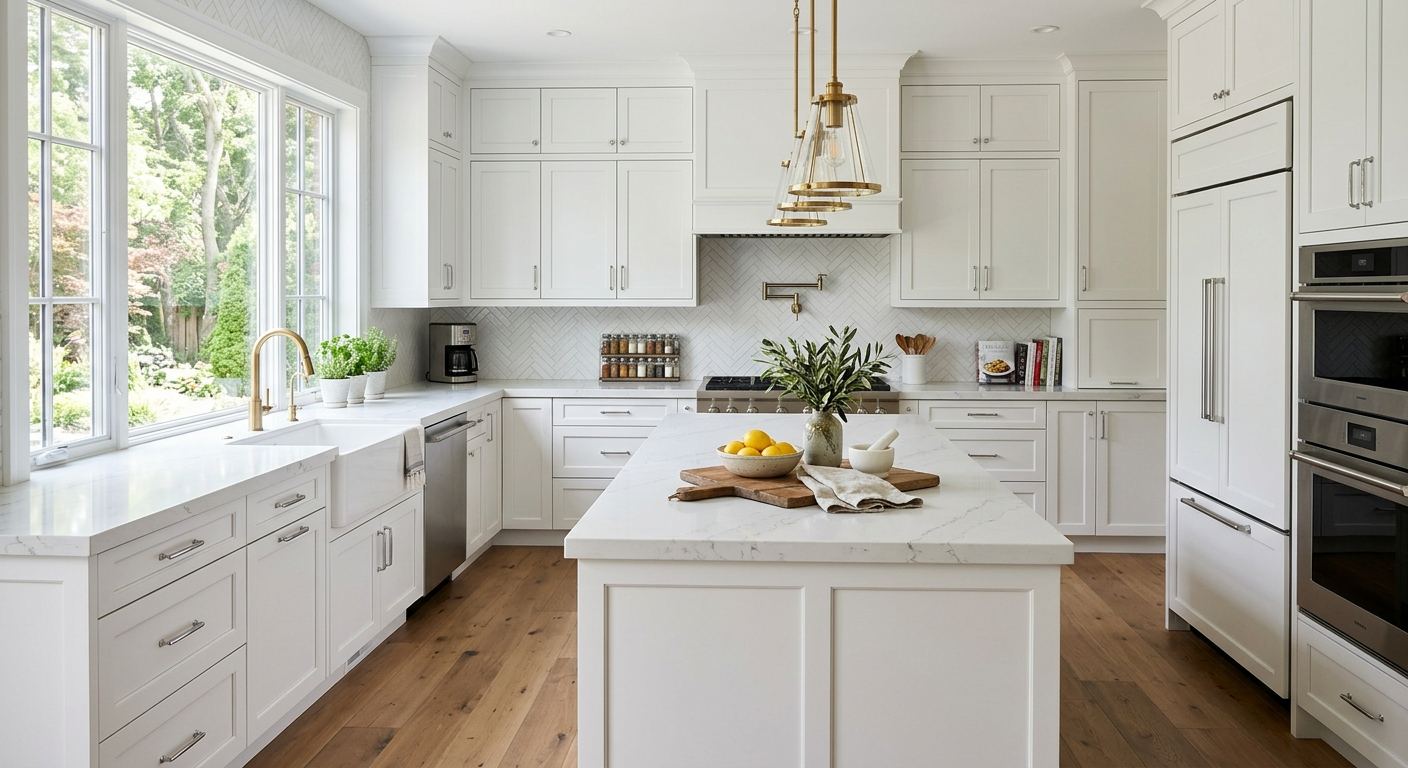
Kitchen renovation options and costs in Shelburne
Kitchen renovations in Shelburne usually start with a simple question: do you want a noticeable refresh, or a full remodel that looks and functions like a new kitchen? With Shelburne’s homeowner profile—2,425 homeowner households and a median household income of about $99,000 (Statistics Canada, 2021 Census)—many projects land in the “value upgrade” lane rather than the top-tier luxury lane. That matters because it typically drives homeowners toward semi-custom or upgraded finishes that still feel purchase-ready, especially in the Kitchener–Waterloo–Barrie economic region where buyers often expect cleaner lines, modern lighting, and durable countertops.
Also, Shelburne’s housing stock includes a significant share of older homes (38.5% built before 1981, Statistics Canada, 2021 Census). Older construction can mean thicker walls, less room for service runs, and surprises when contractors open up plumbing/electrical paths—so labour and site time can climb even when finishes stay “mid-range.” On top of that, the region’s market demand influences contractor availability: when more homeowners choose quartz, semi-custom cabinets, and island upgrades, scheduling can tighten and labour pricing typically follows.
In Shelburne’s older neighbourhood pockets near the downtown/core where many houses share similar layouts, we often see high demand for cabinet + countertop packages paired with upgraded lighting and backsplash. From there, the price differences become clearer when you compare the renovation tiers below.
| Renovation Tier |
What's Included |
Typical Duration |
Price Range |
| Cosmetic refresh (paint, hardware, new appliances only) |
Cabinet paint or repaint, new pulls/hinges, paint prep, appliance swap (no plumbing/gas relocation), minor caulking and touch-ups |
1–3 weeks |
$8,000–$18,000 |
| Mid-range full renovation (new cabinets, counters, sink, tile) |
New stock or semi-custom cabinets, quartz or laminate counters, new sink + faucet, backsplash tile, flooring patch/replacement as needed, upgraded lighting |
4–8 weeks |
$30,000–$65,000 |
| High-end full renovation (custom cabinets, stone counters, island) |
Fully custom cabinetry, higher-end stone (e.g., granite or premium engineered options), island with upgraded lighting and possible seating, more extensive tile, refined finish details |
8–14 weeks |
$65,000–$90,000 |
| Cabinet refacing only (new doors + drawer fronts, same boxes) |
Refacing materials, door/drawer replacement, new hardware, new trim where needed, counters may be adjusted but not replaced |
2–4 weeks |
$10,000–$28,000 |
| Countertop swap only (laminate to quartz or stone) |
Remove laminate, template, install quartz/stone, re-seal/finish edges, basic sink/faucet adjustment as required |
1–2.5 weeks |
$3,500–$12,000 |
| Backsplash tile installation only |
Surface prep, tile installation (ceramic/porcelain), grout/seal, matching outlet detailing, silicone at counters/walls |
3–7 days |
$1,500–$8,000 |
Prices are estimates only and vary by project scope, site access and material selection.
What affects the price of kitchen renovation in Shelburne
In Shelburne and across the Kitchener–Waterloo–Barrie economic region, two homeowners can receive quotes that differ by 30–50% for what sounds like the same kitchen. The usual drivers aren’t climate so much as the local value-for-money expectations: home prices and incomes in the region support higher finish tiers, especially where buyers are used to quartz counters and semi-custom cabinetry. In practical terms, that means contractor labour, cabinetry pricing, and stone availability can all shift when more projects are chasing premium specs.
Climate still plays a role indirectly. Shelburne’s seasonal swings and winter heating/cooling cycles affect how buildings move—older homes (38.5% built before 1981, Statistics Canada, 2021 Census) can be more susceptible to minor settling and differential movement. That influences prep time (drying/level checks, substrate correction) and can affect how carefully installers detail caulking at toe-kicks, backsplashes, and countertop edges.
Most importantly, finish tier is shaped more by resale logic than by weather. In higher-value regional markets, quartz or stone counters and semi-custom cabinetry are chosen because renovation costs are easier to recover on resale. In more modest budgets, laminate or stock cabinetry can deliver a strong ROI at a lower spend. For example, a kitchen sitting in the mid-range band of $30,000–$65,000 often focuses on durable surfaces and lighting upgrades, while a high-end scope like $65,000–$90,000 usually adds custom millwork, premium stone, and island-level detailing. Layout decisions—removing a wall, adding an island, or moving a gas line—are the cost wildcards regardless of finish level.
Concrete Shelburne examples we commonly price differently: (1) if your home has older shutoff/valving or dated drain routing, a sink move can add work hours and materials; (2) if a wall removal exposes old wiring, electrical rework rises; and (3) if your kitchen floor framing isn’t level, cabinet installation and tile alignment take longer, even with the “same” cabinet line.
| Price Factor |
Why It Matters |
Cost Impact |
| Cabinet tier — stock vs. semi-custom vs. fully custom millwork |
Different tolerances, interior options (pull-outs, organizers), hinge quality, and lead times |
Often the largest swing; can change a full renovation by roughly 15–40% |
| Countertop material — laminate vs. quartz vs. granite vs. stone |
Material cost, template complexity, edge finishing, and sink cutout difficulty |
Typical change can be several thousand dollars (commonly 20–60% of the countertop portion) |
| Layout change — wall removal, island add, plumbing/gas move |
Structural, framing, venting, and code-compliant service routing create unpredictable trade coordination |
Can add $5,000–$25,000+ depending on complexity (sometimes more than you expect) |
| Appliance package tier — builder vs. mid-range vs. pro-grade |
Fit/finish, venting needs, electrical requirements, and compatibility with cabinetry |
Can shift pricing by a few thousand to double-digit thousands for a full package |
| Flooring — refinish existing vs. full replacement |
Removal and subfloor prep, matching transitions, and tile/engineered product thickness |
Often adds $1,500–$8,000+ when full replacement is required |
| Backsplash — ceramic tile vs. marble vs. full-height slab |
Labour intensity, weight/handling, wall flatness requirements, and finishing details |
Can shift by $1,000–$5,000+ depending on coverage and material |
| Electrical — new circuits for island, under-cabinet lighting |
Licensed work, panel capacity, and layout changes for lighting and receptacles |
Frequently adds several thousand dollars when circuits or panel upgrades are needed |
| Permit fees and licensed trade requirements |
Covers inspections, admin time, and scheduled work by required licensed professionals |
Typically a few hundred to a few thousand dollars, plus schedule impact |
Permits & regulations in Ontario
In Ontario, many “swap-in-place” kitchen items do not require permits. Cabinet and countertop replacements are typically permit-free as long as you’re not changing the building’s core systems. For example, replacing existing cabinets, swapping countertops, and installing a new backsplash usually don’t require a permit.
Where permits do become necessary is when you change plumbing/electrical/gas pathways or the structure. In Shelburne (and throughout Ontario), you generally need a permit and licensed trades for moving plumbing supply or drain lines, relocating a gas stove or any gas-related appliance, removing a load-bearing wall, or adding/altering electrical circuits (such as new circuits for island outlets or under-cabinet lighting if it involves new wiring or service changes). Gas work must be completed by a licensed gas fitter, and electrical work must be done by a licensed electrician—both should be inspected.
To verify a contractor properly before signing, follow this step-by-step approach:
- Ask for their Ontario licence details (trade-specific), and confirm it via the appropriate online licence/search registry.
- Request a certificate of insurance showing liability coverage for the job period.
- Confirm WSIB/WCB coverage (or provide clearance documentation if applicable for their situation) and ensure it’s current.
- In writing, confirm who is pulling permits (if required) and who pays any fees.
- Have them list which scopes require licensed trades and inspections in the contract scope of work.
Always keep permit responsibility in the written contract—“we’ll handle it” should include who pulls the permit, who schedules inspections, and what’s included in the price.
Cabinets, countertops and layout decisions in Shelburne
In Shelburne, the three most consequential decisions in a kitchen renovation are (1) cabinet tier, (2) countertop material, and (3) layout changes. Start with cabinets: stock cabinets are the fastest and usually the cheapest because they’re standardized and readily available. Semi-custom cabinets are the most popular mid-range choice in this area because you can get better options for storage (drawers, organizers) without the longer lead times and higher price of fully custom millwork. Custom cabinets deliver the best fit and detailing, but they’re where budgets most often jump.
Next is countertop material. Laminate can be cost-effective and looks good with the right design, but it’s less tolerant of heavy impacts and can show wear sooner. Quartz is a strong balance for busy families: it resists stains well and typically needs only routine cleaning. Granite or other natural stones offer unique patterning and heat resistance, though they may need periodic sealing and can be more expensive to fabricate. Butcher block can bring warmth and a “kitchen hobby” feel, but it requires ongoing maintenance (oiling and protection), especially around sinks.
Finally, layout changes. Open-concept wall removal, island additions, and moving gas/plumbing are justified when the space gain improves everyday flow (clearances, work zones, seating) rather than simply “for looks.” A realistic dollar example: if your kitchen is trending toward the $30,000–$65,000 mid-range band, adding an island might push you to hire additional trades and extend the schedule—often consuming budget that would otherwise upgrade to higher-end quartz or better cabinetry. By contrast, in a $65,000–$90,000 high-end renovation, island-level electrical/lighting and custom millwork are typically easier to absorb because the overall finish package is already premium.
When buyers in the Kitchener–Waterloo–Barrie region evaluate listings, they commonly respond to clean cabinetry lines, durable counters, and sensible lighting—so choose layout upgrades only when they meaningfully improve function.
| Option |
Durability |
Maintenance |
Best For |
Price Range |
| Stock cabinets (big-box) |
Good durability with standard construction; hinges vary by brand |
Low; occasional adjustment for alignment and soft-close hardware upkeep |
Short timelines, clean modern look on a controlled budget |
$8,000–$18,000 |
| Semi-custom cabinets (local dealer) |
Very good durability; better hardware and interior storage options |
Low; keep hardware tightened and clean finishes regularly |
Most Shelburne renovations that target strong resale appeal |
$15,000–$30,000 |
| Custom cabinets (local millwork shop) |
Excellent durability; best fit, finish, and longevity when built well |
Low to moderate; refinishing is possible but should be rare |
Unique layouts, premium details, and maximum storage efficiency |
$25,000–$50,000+ |
| Laminate countertop |
Decent everyday durability; vulnerable to deep scratches/edge impacts |
Low; avoid prolonged water exposure at seams/edges |
Budget-forward renovations that still want a fresh look |
$1,500–$4,500 |
| Quartz engineered countertop |
Very durable and stain-resistant; resists everyday impacts better than laminate |
Low; no sealing required for typical installations |
Busy households and resale-minded upgrades |
$4,500–$9,500 |
| Granite / natural stone countertop |
High durability; natural hardness varies by slab |
Moderate; periodic sealing depending on stone type and use |
Premium appearance and heat resistance |
$6,000–$12,000 |
| Butcher block countertop |
Good durability; can be dented but repairable |
Moderate; regular oiling and careful sink/edge protection |
Warm, lived-in kitchens where maintenance is acceptable |
$3,000–$7,500 |
| Marble countertop |
Beautiful but softer; more prone to etching and staining |
Higher maintenance; sealing and careful daily use required |
Low-to-moderate kitchen wear or “statement” kitchens |
$7,000–$14,000 |
How to choose a kitchen renovation contractor in Shelburne
Choosing the right contractor in Shelburne is less about flashy ads and more about proof: Ontario licensing, insurance, and clear scope. Start by verifying their trade licensing (where applicable to their crews), then request liability insurance documents showing coverage for your project period. For coverage related to work activity, confirm they have current WSIB/WCB coverage (or provide proper clearance documentation when relevant). A trustworthy contractor won’t hesitate to show certificates and answer licensing questions in plain language.
Next, get 2–3 itemised written quotes—ideally broken down into labour and material lines. Avoid quotes that combine “everything” into a single number without stating what’s included for cabinets, counters, tile, electrical/plumbing coordination, disposal, and any site protection. Read the scope carefully: ask whether permits are included, whether demolition disposal is included, and whether the price covers adjustments like drywall patching, level correction, or countertop edge/undermount sink upgrades.
Warranty matters too. Confirm the workmanship warranty length (and what it covers), the manufacturer warranty for products (cabinets, countertops, appliances if supplied), and whether warranties are transferable if you sell the home.
On payments, be cautious: never pay more than 10–15% upfront, and use holdback tied to completion (especially for final countertop install and punch list). Finally, lock the schedule in writing with a start date and completion estimate. Kitchen renos often depend on lead times for cabinetry and stone—your contractor should name those dependencies.
- Confirm licensing and that any licensed trades (gas/electrical) are subcontracted appropriately.
- Collect certificate of insurance and verify coverage limits match project risk.
- Verify WSIB/WCB coverage or clearance documentation before work starts.
- Require 2–3 itemised quotes (labour vs materials) not a single lump sum.
- Make disposal responsibilities explicit: demolition haul-away included or not.
- Confirm permit pull responsibility in writing if any plumbing/electrical/gas changes occur.
- Ask who handles substrate repair (drywall patching, subfloor leveling) and how it’s priced.
- Verify cabinet measurement process and who performs templating for countertops.
- Get countertop edge details, sink cutout type, and faucet drilling included in scope.
- Confirm electrical scope: receptacles, under-cabinet lighting, and island lighting plan.
- Review warranty terms: workmanship duration, exclusions, and product coverage.
- Set payment milestones: keep holdback until the final punch list is complete.
Red flags we frequently see in Shelburne: (1) quotes without line items for labour/materials; (2) “permit not needed” statements even when moving plumbing, gas or adding circuits; (3) contractors who won’t provide insurance/WSIB/WCB documentation; (4) no written timeline tied to lead times; and (5) payment schedules asking for large deposits before templating or demolition starts.
Frequently asked questions — kitchen renovation in Shelburne
Should I reface or replace my cabinets?
In Shelburne, refacing is usually best when your cabinet boxes are solid, level, and not water-damaged, and you want the fastest upgrade with less demolition. If the existing boxes are out of square or you’re planning a major layout change, replacement is typically the better long-term value. As a budgeting guide, a refacing-only scope commonly falls in the $10,000–$28,000 range, while a mid-range full renovation with new cabinets and counters often lands around $30,000–$65,000. That extra spend can buy better storage layouts and easier alignment with modern countertops and backsplash detailing. For older homes built before 1981 (38.5% of dwellings, Statistics Canada, 2021 Census), we also check for hidden moisture around sinks before recommending refacing.
Do I need a permit for a kitchen renovation in Ontario?
In Ontario, many kitchen “swap” projects don’t require a permit—typically cabinet and countertop replacements and most backsplash installs when plumbing/electrical/gas isn’t changed. You generally do need permits and licensed trade involvement when you move plumbing supply or drain lines, relocate gas appliances (including changes involving stove/range hood with gas), remove a load-bearing wall, or add/alter electrical circuits. In Shelburne, the practical step is to confirm scope in writing before you sign: ask your contractor exactly who will pull permits (if any) and what inspections are included. Also, insist that the contract assigns permit responsibility clearly—if something changes mid-project, ask for an updated scope and pricing, not verbal assurances.
What's the ROI on a kitchen renovation?
ROI depends on how much you spend relative to your home’s market and how “buyer-ready” the finishes are. In the Kitchener–Waterloo–Barrie economic region, homeowners often choose durable, broadly appealing upgrades (quartz, updated lighting, sensible layouts) because they’re easier for future buyers to understand and value. For Shelburne households with a median household income around $99,000 (Statistics Canada, 2021 Census), renovations that land in the mid-range—often $30,000–$65,000 for a full remodel—tend to balance improvement and affordability better than going straight to fully custom. If you go very high—like $65,000–$90,000—you’ll typically need the design to match the quality level of the cabinetry and stone so it won’t feel out of proportion on resale.
How do I budget for a kitchen renovation?
A solid approach for Shelburne is to budget by scope tier and then control the biggest variables: cabinetry and layout changes. Use the regional band as your backbone—full kitchen renovations often run $25,000–$90,000, with a mid-range full remodel frequently in $30,000–$65,000. Plan for cabinetry roughly 30–35% of budget and countertops another 10–15%, but don’t forget labour when plumbing/electrical and finishing trades are coordinated. For older homes (38.5% pre-1981, Statistics Canada, 2021 Census), add contingency in your planning for hidden repairs discovered after demo (subfloor leveling, wiring adjustments, or framing corrections). Finally, request itemised quotes so you can see what’s included for disposal, permits, and tile/floor transitions—those line items quietly impact totals.
Can I move my kitchen sink or stove?
Yes, you can often move a kitchen sink or stove, but the cost and permitting requirements increase when you change plumbing or gas/electrical runs. Moving a sink usually means new supply and drain work, plus more time for drywall access and finishing. Moving a stove can involve venting and, if gas is involved, licensed gas fitter work—along with inspections where required. In Ontario, if you’re relocating plumbing supply or drain lines or changing gas appliances/locations, you should expect permits and licensed trades. Budget accordingly: layout moves can be the most unpredictable expense regardless of whether you’re aiming for a mid-range or high-end look. If your goal is primarily aesthetics, you’ll usually get more impact by keeping plumbing/gas where possible and focusing on cabinets, counters, backsplash, and lighting.
What's the most cost-effective kitchen upgrade?
For many Shelburne homeowners, the most cost-effective upgrade is the one that delivers the biggest visual change while staying close to the existing layout. In practice, that’s often either refacing (when boxes are in good shape) or a countertop swap paired with updated lighting and hardware. Refacing commonly sits around $10,000–$28,000, and swapping countertops only can range roughly $3,500–$12,000 depending on material and sink cutouts. If your cabinets are structurally sound, refacing plus quartz (instead of laminate) can look “new” without the demolition time and coordination costs of a full renovation. Just make sure the surfaces are prepped properly—especially in older homes—so the finished backsplash and countertop edges seal well and stay looking sharp through the seasons.