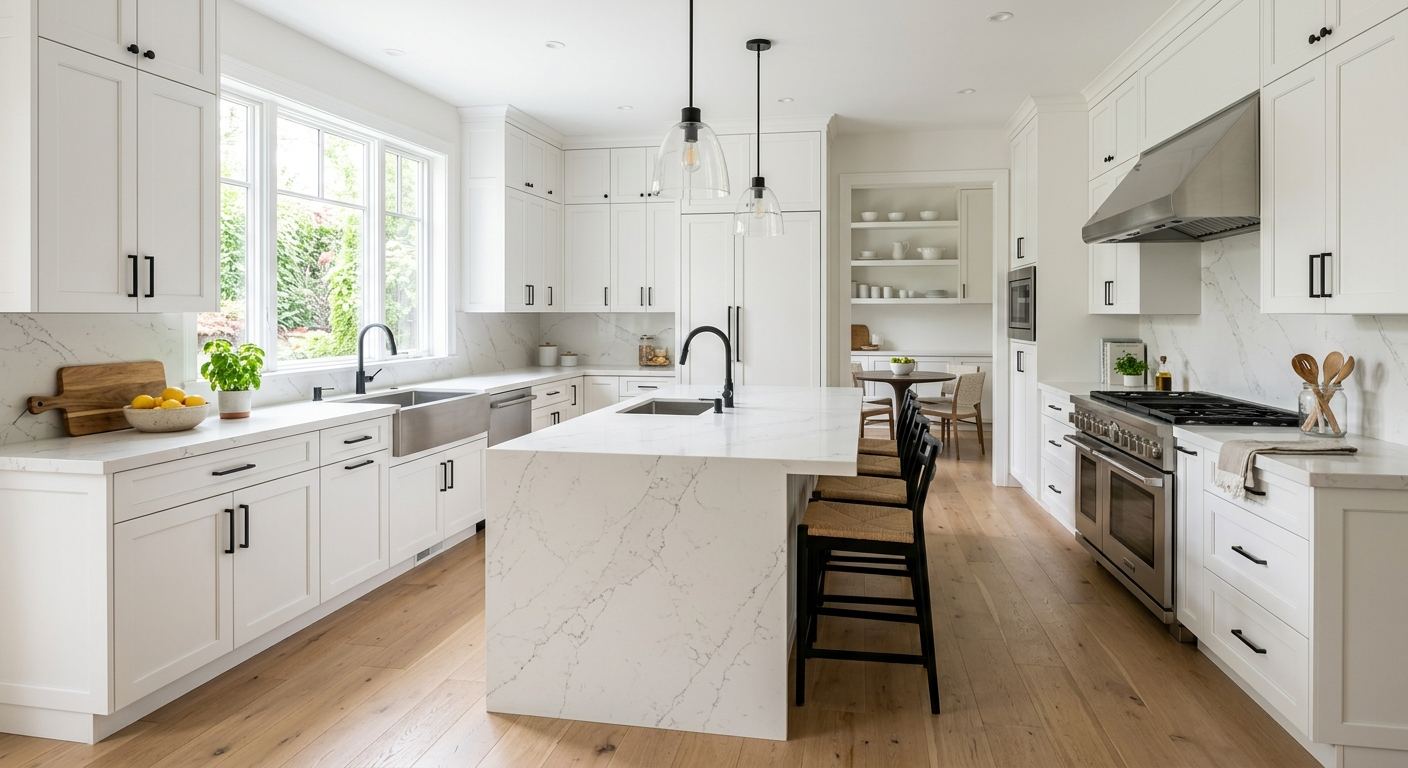
Kitchen renovation options and costs in Stirling
Stirling is a compact Ontario community of about 2,030 residents (Statistics Canada, 2021 Census), and that size shapes how homeowners plan kitchen projects: many renovations are practical, resale-friendly updates rather than full showpiece builds. In the broader Toronto economic region, kitchen budgets also tend to track local property values and buyer expectations—often pushing finish choices upward in higher-value pockets, where people may invest roughly 8% to 15% of the home’s value into the kitchen. That market reality is why a “standard” kitchen scope can land anywhere from a modest refresh to a full custom build, even when the layout looks similar.
Pricing in Ontario kitchens isn’t driven mainly by weather; it’s driven by finishes and trade demand. Still, Stirling’s seasonal temperature swings matter indirectly: if your cabinets and countertop materials are exposed during winter jobsites (cold storage, delayed installation, or rushed acclimation), installers may need extra time for proper settling and safer fit-up—especially for laminate, solid-wood elements, and caulking/adhesive selections. Meanwhile, labour availability in the Toronto region can affect lead times for cabinet delivery and counter fabrication. That’s why it’s common to see cosmetic work move faster, while “full” renovations are scheduled around cabinet and quartz/stone production.
In Stirling, trade demand is especially steady for renovations on older housing stock along the main residential corridors, where homeowners often replace dated cabinets and upgrade counters and backsplash for a modern, brighter look. With that in mind, here’s a quick comparison of renovation tiers and typical ranges before you request a quote.
| Renovation Tier |
What's Included |
Typical Duration |
Price Range |
| Cosmetic refresh (paint, hardware, new appliances only) |
Cabinet paint or repaint, new hardware, paint prep, new appliances (no major plumbing/gas moves), trim touch-ups |
3–7 days |
$8,000–$18,000 |
| Mid-range full renovation (new cabinets, counters, sink, tile) |
Semi-custom or stock cabinets, new countertop (quartz or laminate), sink + basic faucet, backsplash tile, flooring/underlayment refresh (as needed), electrical allowance for lighting |
3–5 weeks |
$25,000–$55,000 |
| High-end full renovation (custom cabinets, stone counters, island) |
Fully custom cabinetry, premium stone (granite or natural stone) or high-end quartz, island with electrical and seating allowance, full-height or upgraded backsplash, more extensive layout planning, upgraded appliance package |
6–10 weeks |
$60,000–$90,000 |
| Cabinet refacing only (new doors + drawer fronts, same boxes) |
Remove/replace doors and drawer fronts, new end panels as needed, new hardware, new interior mouldings (if offered), basic prep and paint/stain finish system |
1–2 weeks |
$8,000–$25,000 |
| Countertop swap only (laminate to quartz or stone) |
Remove existing tops, fabricate/install new quartz/stone, re-caulk and reseal transitions, sink cut-out and basic plumbing tie-in (no major line moves) |
2–5 days |
$3,000–$15,000 |
| Backsplash tile installation only |
Demo of existing backsplash (if required), tile layout and install, grout/seal, caulking at corners, allowance for outlets and trim finishes |
2–4 days |
$2,000–$10,000 |
Prices are estimates only and vary by project scope, site access and material selection.
What affects the price of kitchen renovation in Stirling
Even for the same kitchen, quotes in the Toronto economic region can vary by 30% to 50% because contractors price different levels of risk and allowances. Some bids include structural check-ins, electrical scope, and proper cabinet/counter installation tolerances; others bundle fewer items and then add change orders later. Material choices are the biggest driver, but the second-largest driver is how much of the “infrastructure” you change—plumbing, gas, electrical, and sometimes ventilation.
Local home values and typical buyer expectations shape finish tier more than climate. In higher-value Toronto-area pockets, homeowners more often choose quartz or natural stone counters and semi-custom cabinetry because the cost is easier to justify on resale. In more price-sensitive areas, people tend to prioritize practical upgrades—refaced or stock cabinets with durable laminate or select quartz—keeping a full renovation closer to the mid-range band (for example, $25,000–$55,000 for a typical mid-range scope). Once you add custom millwork, an island with electrical, and premium stone, projects commonly move into the higher band (often $60,000–$90,000).
In Stirling specifically, a few local conditions tend to raise or lower cost. First, older homes frequently have uneven walls or dated subfloors, which can add time for shimming, re-levels, and more floor patching—small changes, big labour impacts. Second, if your kitchen sits adjacent to exterior walls, you may find cold spots that affect caulking/adhesive performance during winter scheduling. Third, replacing a cramped layout (moving a sink, adding an island) can trigger electrical and plumbing work, which is typically where the most unpredictable costs show up.
| Price Factor |
Why It Matters |
Cost Impact |
| Cabinet tier — stock vs. semi-custom vs. fully custom millwork |
Higher tiers mean better fit, more design options, and often higher material/craft labour |
Can shift a full kitchen by roughly $15,000–$35,000 |
| Countertop material — laminate vs. quartz vs. granite vs. stone |
Material price, thickness, edge profiles, and install complexity change labour and fabrication costs |
Often about $3,000–$12,000 difference depending on size and edges |
| Layout change — wall removal, island add, plumbing/gas move |
Reconfiguring plumbing/gas/electrical requires trades, inspections, and more demolition/restoration |
Frequently adds $8,000–$25,000+ even with “similar” finishes |
| Appliance package tier — builder vs. mid-range vs. pro-grade |
Voltage requirements, ventilation needs, and trim/installation details vary by tier |
Often $2,000–$10,000+ beyond cabinet/counter pricing |
| Flooring — refinish existing vs. full replacement |
Kitchen demo can expose subfloor damage; full replacement adds underlayment and finishing work |
Commonly $1,500–$8,000 depending on product and repairs |
| Backsplash — ceramic tile vs. marble vs. full-height slab |
Surface prep, handling of large-format panels, and finishing complexity drive labour |
Typically $2,000–$10,000+ for tile-only scopes |
| Electrical — new circuits for island, under-cabinet lighting |
Additional circuits and lighting runs affect labour and inspection requirements |
Often $1,000–$6,000+ |
| Permit fees and licensed trade requirements |
When permits apply, you need licensed trades and inspections, which add administrative and labour time |
Can add $500–$5,000+ depending on scope |
Permits & regulations in Ontario
In Ontario, a straight cabinet or countertop swap generally does not require a permit, as long as you are not changing plumbing, gas, structural elements, or adding new electrical circuits. For most Stirling homeowners, that means repainting/refacing cabinets and installing new tops (including cutting for a sink) is typically handled as a finish replacement.
Permits and licensed trade work usually become necessary when you move or modify systems. If you relocate plumbing supply/drain lines, relocate a sink, move a dishwasher hookup, relocate gas lines for a stove/range setup, remove a load-bearing wall, or add electrical circuits for an island (or upgrade wiring for new loads), you should expect permits and inspection steps. Gas work must be performed by a licensed gas fitter, and electrical work must be done by a licensed electrician, with inspections completed before covering work.
How to verify before you sign: (1) ask for the contractor’s Ontario business registration/licensing details where applicable, (2) request a current certificate of insurance (liability) naming you appropriately as required, and (3) confirm WSIB/WCB coverage for the workers who will be on-site. You can verify licensing and insurance by asking for certificates directly and cross-checking with provincial licence/registry information when available. Make sure the written contract clearly states who pulls permits (and who pays), because that responsibility must be explicit, not assumed.
Cabinets, countertops and layout decisions in Stirling
The three most consequential decisions in a Stirling kitchen renovation are: cabinet tier, countertop material, and layout changes. Cabinet tier affects not just cost, but how quickly you can finish, how well the kitchen fits your space, and how modern it looks. Stock cabinets are the fastest and cheapest, semi-custom is usually the sweet spot for Ontario resale expectations, and custom cabinets are where you pay for perfect fit, special storage, and premium face frames or frameless systems.
Countertops then determine daily-life durability. In the Toronto region, buyers commonly expect “stone look” surfaces that hold up to spills and regular use. Quartz is often chosen because it resists staining better than laminate and is more predictable than natural stone in terms of maintenance. Granite/natural stone looks premium, but it’s heavier, requires proper sealing practices, and can come with a wider variation in flecking. Laminate remains a budget-friendly option, while butcher block can be great for warmth—but only if you’re comfortable with sealing and mindful use.
Finally, layout decisions—like removing a wall for an open concept, adding an island, or relocating plumbing/gas—are the decisions that justify cost when they create real space and function. A clear example: upgrading from laminate to quartz may cost about $4,000–$8,000 on many full kitchen scopes, but if it’s paired with improved lighting and better workflow storage, homeowners often feel it’s “worth it.” By contrast, paying for layout changes without a clear seating/work triangle plan usually doesn’t deliver value.
Because Stirling’s home stock includes many older homes with tighter dimensions, small layout tweaks often outperform major structural moves—unless you’re clearly gaining usable floor area that aligns with Toronto buyers’ expectations.
| Option |
Durability |
Maintenance |
Best For |
Price Range |
| Stock cabinets (big-box) |
Good everyday durability when installed level; standard sizes can limit perfect fit |
Low—typically wipe-clean; touch up only if paint/finish is chosen |
Fast timelines and smaller budgets |
$8,000–$25,000 |
| Semi-custom cabinets (local dealer) |
Very good durability with better storage options and more size flexibility |
Low—keep hardware aligned and wipe spills; handle humidity with ventilation |
Most Ontario renovations and resale-focused upgrades |
$15,000–$45,000 |
| Custom cabinets (local millwork shop) |
Excellent durability; tailored construction and fit |
Low to moderate—quality finish, but still requires normal care |
Unique layouts, high storage, and premium finishes |
$30,000–$70,000+ |
| Laminate countertop |
Moderate—can chip at edges and wears faster with heavy cutting |
Very low; avoid soaking at seams and protect against heat |
Budget refreshes and rental-style practicality |
$3,000–$7,000 |
| Quartz engineered countertop |
High—resists staining and holds up well for busy kitchens |
Low; wipe clean and use cutting boards to protect edges |
Busy homes that want a stone look without extra upkeep |
$6,000–$12,000 |
| Granite / natural stone countertop |
High—very durable with good care; natural variation |
Moderate—sealing schedule matters; clean with stone-safe products |
Premium look and buyers who want true stone character |
$8,000–$15,000 |
| Butcher block countertop |
Good—durable if treated and protected; can scratch |
Moderate—regular oiling and sealing; protect from standing water |
Warm, traditional kitchens and prep-focused cooking |
$5,000–$10,000 |
| Marble countertop |
Moderate—beautiful but more prone to etching/staining than quartz |
Higher—requires sealing and careful day-to-day practices |
Low-traffic show kitchens or buyers who love a classic look |
$9,000–$18,000 |
How to choose a kitchen renovation contractor in Stirling
To choose a kitchen renovation contractor in Stirling, verify three things early: Ontario licensing where relevant, liability insurance, and WSIB/WCB coverage for workers. Ask for the certificate of insurance (liability) and ensure it is current for the project start date. For WSIB/WCB, don’t accept verbal assurances—request proof of coverage for the people who will actually be on-site.
Then get 2–3 itemised written quotes. You want line items that show labour and materials separately (cabinets, counters, tile, electrical allowance, disposal, and any sub-trade work). A lump sum can hide differences in inclusions—like whether countertop fabrication/templating is included, or whether demolition and disposal are part of the base price.
Read the scope carefully: what’s excluded? Is permit pulling included when needed? Is waste disposal included (dump fees, hauling), or does the homeowner handle it? Warranty matters, too—ask for workmanship warranty length, whether it covers installation defects and timing, and whether product/manufacturer warranties are transferable to you. Lastly, payment schedule should protect you: never pay more than 10% to 15% upfront. Use a holdback (often the final 10% to 15%) until completion and final walkthrough.
Finally, insist on a timeline in writing: start date, fabrication lead time assumptions, inspection scheduling, and completion estimate. In the GTA market, cabinet and countertop lead times can shift, but reputable contractors build realistic buffers.
- Request insurance certificate (liability) and confirm it covers renovations and the term of work.
- Confirm WSIB/WCB coverage for all workers/sub-trades.
- Ask for Ontario licence details where applicable and how sub-trades are sourced.
- Get 2–3 itemised quotes with labour and material breakdowns, not just one total.
- Confirm whether demolition and disposal are included (including dump fees/hauling).
- Verify countertop scope: templating, fabrication, delivery window, and installation are included.
- Ensure electrical and gas/plumbing work is itemised with allowances if you have any changes.
- Ask who pulls permits when needed and whether permits are included in the quoted price.
- Review warranty terms in writing: workmanship start/end date and coverage for callbacks.
- Set a payment schedule with no more than 10%–15% upfront and a final holdback.
- Get a written schedule with lead-time assumptions for cabinets and stone/quartz.
- Confirm site protection practices (floor protection, dust control) and cleanup expectations.
Red flags to watch for in Stirling: (1) quotes that are “too low” but don’t list what’s included for counters/templating or disposal, (2) refusal to provide insurance/WSIB proof, (3) no written scope or schedule, (4) asking for large upfront payments beyond 10%–15%, and (5) vague warranty wording like “covers defects” without dates or workmanship specifics.
Frequently asked questions — kitchen renovation in Stirling
What's the most popular kitchen style in Stirling right now?
In Stirling (and across the Toronto region), the most common “go-to” look right now is a bright, modern transitional style: shaker-style cabinetry in a light neutral, clean hardware, a quartz countertop with subtle movement, and a simple backsplash (often tile with a clean grout line). Homeowners also tend to prioritize functional storage—corner pull-outs and deeper pantry drawers—because it helps day-to-day use and resale appeal. If you’re renovating on a mid-range budget (for example, a typical full renovation budget band of $25,000–$55,000), you’ll most often see semi-custom or upgraded stock cabinets paired with quartz. For higher-end projects, custom cabinetry and an island with upgraded lighting become more common. (Statistics Canada, 2021 Census)
How do I know if I need to update my kitchen plumbing in Stirling?
In Ontario kitchens, you usually don’t need to replace plumbing just because you’re replacing cabinets or countertops—plumbing work is typically only necessary if performance problems exist or if you’re changing the layout. Signs you may need updates include frequent slow drains, leaks under the sink or dishwasher, water pressure drops, recurring disposal issues, or corrosion at supply connections. Also consider the age of your home’s plumbing runs: older kitchens can have hidden deterioration inside walls. If you’re moving the sink, dishwasher, or adding an island with a bar sink, that’s a clear trigger for plumbing relocation and typically pushes the job into a more complex permit/licensed-trade scope. Even a countertop swap (like laminate to quartz/stone) won’t require permits, but relocating lines usually does, so confirm responsibility before signing.
What is the difference between a galley and open-concept kitchen?
A galley kitchen is a narrow, corridor-style layout with counters on one or both sides, usually with a straight path through. It’s efficient for cooking but can feel tight—so homeowners often improve it by adding better lighting, optimizing cabinet depth, and possibly expanding one end for a small table or seating. An open-concept kitchen blends cooking space with living/dining areas, which often requires more planning for ventilation, floor transitions, and (if structural walls are involved) permits and engineered decisions. Cost differences are mostly about layout changes: moving plumbing or adding an island can involve more demolition and licensed work, which increases labour and inspection steps. Budget-wise, galley refreshes can sometimes stay closer to cosmetic or mid-range territory, while open-concept renovations commonly land higher because they’re more likely to include structural and utility changes.
How do I get accurate kitchen renovation quotes in Stirling?
To get accurate quotes in Stirling, start with an itemised scope and real measurements. Provide floor plans, cabinet dimensions, and photos of the existing kitchen, and be specific about what you want to change: cabinets, countertop material, backsplash extent, and whether you’re moving plumbing/gas or adding electrical for an island. Ask each contractor for a written breakdown that separates labour, materials, and any allowances for tile, disposal, and sub-trades. If you’re comparing different finish tiers, make sure the quotes match on cabinet tier and countertop material—otherwise you’re comparing apples to oranges. For example, a countertop-only change can be in the $3,000–$15,000 band, but that number can balloon if the sink, cut-outs, or any plumbing tie-ins are part of the scope. Also confirm whether permits are included when needed and who pulls them.
What's the best countertop material for a busy Stirling kitchen?
For most busy kitchens in Stirling and the broader GTA, quartz is often the “best overall” choice because it’s resilient, consistent, and low-maintenance. It resists staining better than laminate and doesn’t require the same sealing routine as many natural stones. If you want durable daily use without constant care, quartz is usually the practical sweet spot. Laminate can be a good budget option, particularly for refreshes, but it can be more vulnerable at seams and edges if heavy wear is expected. Granite/natural stone offers premium character and durability, but it may require periodic sealing and stone-safe cleaning habits. If you’re budgeting a full kitchen, quartz countertops often fit within typical mid-range project planning; if you’re doing a targeted swap, that countertop-only range is commonly $3,000–$15,000 depending on size and edges.
How do I add an island to my Stirling kitchen?
Adding an island is a great upgrade when it improves the work triangle and gives you real circulation space, but it’s also the renovation decision most likely to increase costs. First, measure clearance: you generally want enough aisle width for comfortable movement and door swing. Second, decide whether you need plumbing/gas for a sink or cooktop on the island—moving those lines typically requires licensed trades and often permits. Third, plan the electrical if you want pendants, under-cabinet lighting updates, or outlets for small appliances; that usually means new electrical circuits. From a budgeting standpoint, an island-focused upgrade can move you from a simple refresh toward mid- or high-end full renovation scopes, especially if cabinets must be reconfigured. If you’re aiming for a fuller upgrade, many projects land in the $25,000–$55,000 range, while custom islands and stone/major electrical scope can push beyond that.