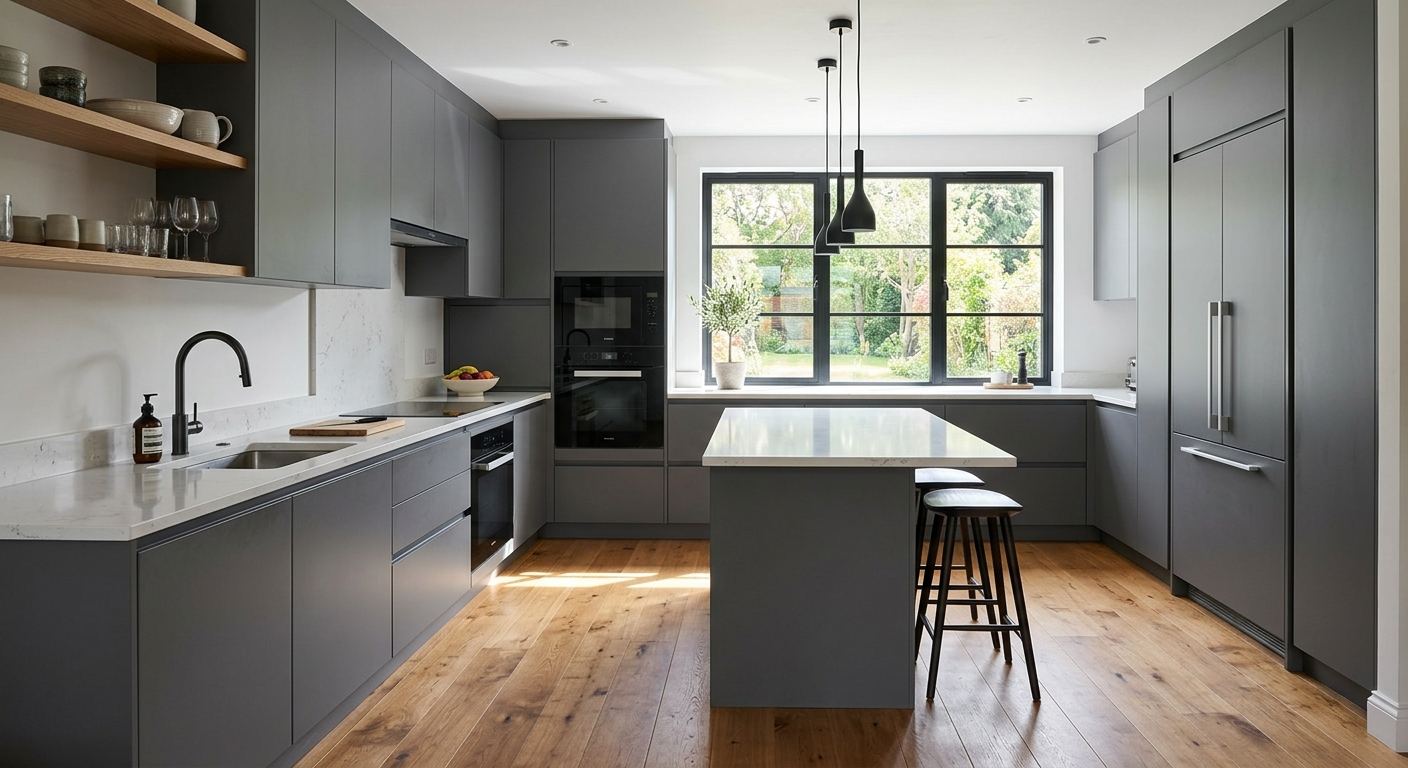
Kitchen renovation options and costs in Greenway-Chaplin
Greenway-Chaplin homeowners typically feel kitchen-renovation pricing in the same way as the rest of the Toronto economic region—costs track more to home values and buyer expectations than to weather. With a 2021 population of 14,146 locally (Statistics Canada, 2021 Census), most projects are driven by resale planning and the kind of finishes that hold well for Ontario buyers. In higher-value pockets of the Greater Toronto Area, owners often invest roughly 8%–15% of home value into the kitchen, which pushes projects toward quartz or natural stone and semi-custom cabinetry. In more price-sensitive areas, the same layout and materials can be delivered at lower cost through stock or refaced cabinets paired with laminate or cost-effective quartz.
Ontario’s climate affects kitchens mainly through durability and maintenance choices—ice-cold winters and indoor humidity swings mean doors, hardware and caulking need to be installed correctly, and countertops must tolerate seasonal temperature changes. Also, in Toronto, contractor availability is cyclical: demand tends to spike in spring and early summer, which can move labour pricing and scheduling windows by several weeks.
In Greenway-Chaplin, the trade is especially busy with families updating their mid-century and newer infill homes on the broader west-side corridor where people often want brighter, more open kitchens for day-to-day living. From there, the most common decision is whether you’re doing a cosmetic refresh, a mid-range full renovation, or a high-end custom build—so you can budget using the tier comparisons below.
| Renovation Tier |
What's Included |
Typical Duration |
Price Range |
| Cosmetic refresh (paint, hardware, new appliances only) |
Cabinet paint or touch-ups, new hardware, new/like-for-like appliances, minor touch-up repairs, basic cleaning/trim work |
1–3 weeks |
$10,000–$18,000 |
| Mid-range full renovation (new cabinets, counters, sink, tile) |
New semi-custom or quality stock cabinets, new counters, sink + faucet, backsplash tile, flooring patching/repair, electrical allowances for under-cabinet lighting (if needed) |
4–8 weeks |
$25,000–$55,000 |
| High-end full renovation (custom cabinets, stone counters, island) |
Fully custom millwork, quartz or natural stone counters, island build and seating, upgraded appliance package, upgraded backsplash (often stone or premium tile), coordinated lighting and finishes |
8–14 weeks |
$60,000–$90,000 |
| Cabinet refacing only (new doors + drawer fronts, same boxes) |
Door/drawer front replacement, new hardware, matching panel adjustments, re-sealing and trim, backsplash touch-up where applicable |
2–4 weeks |
$8,000–$22,000 |
| Countertop swap only (laminate to quartz or stone) |
Remove and dispose of old top, new templating, new quartz/stone install, sink/faucet re-set if compatible, basic backsplash adjustments |
1–2 weeks |
$3,500–$12,000 |
| Backsplash tile installation only |
Surface prep, waterproofing where required, ceramic tile install, grout/seal, finish trim, caulking at countertop/wall transitions |
4–8 days |
$2,000–$8,500 |
Prices are estimates only and vary by project scope, site access and material selection.
What affects the price of kitchen renovation in Greenway-Chaplin
In Toronto and across Ontario, it’s common to see quotes for the “same” kitchen differ by 30%–50%. The reason usually isn’t climate—it’s finish tier, how much real work is hidden behind the walls, and whether the plan includes layout and utility changes. In higher-value local pockets within the Toronto region, homeowners more often choose quartz or stone counters and semi-custom cabinetry because the renovation cost is easier to justify at resale (often aligning with the 8%–15% of home value mindset). Where budgets are tighter, more projects stay in the lower-mid bands by using stock or refaced cabinets and laminate or budget-friendly quartz, while still achieving a refreshed look.
In Greenway-Chaplin specifically, two local conditions typically push costs up. First, many homes have older plumbing runs or tight service clearances, so changing a sink location can require extra demolition and re-routing. Second, kitchens in homes built before modern air-sealing practices can have more seasonal movement; that means the installer may spend more time on shimming, fastening, and crack control—especially around exterior-wall cabinets and backsplash lines. If you’re aiming for a mid-range full renovation near the $25,000–$55,000 band, layout changes are the biggest “unpredictable” cost add-on. If you’re planning a high-end build closer to the $60,000–$90,000 range, premium millwork and island details are usually the primary drivers, not the weather.
A concrete example: adding an island often means new electrical for receptacles and/or under-cabinet lighting; that labour plus electrical materials can move a project upward even when cabinet and countertop tiers stay similar. Another example: swapping to granite/stone can be a direct upgrade, but if it requires sink changes or undermount cutouts, the countertop swap-only budget can expand quickly into a broader renovation scope.
| Price Factor |
Why It Matters |
Cost Impact |
| Cabinet tier — stock vs. semi-custom vs. fully custom millwork |
Cabinet quality affects materials, door styles, warranty, and the labour time to fit perfectly |
Biggest driver inside the cabinet line; can shift overall budget by tens of thousands |
| Countertop material — laminate vs. quartz vs. granite vs. stone |
Material price, template complexity, and installation method change total cost |
Laminate is typically lowest; natural stone often pushes you toward higher bands |
| Layout change — wall removal, island add, plumbing/gas move |
Utility relocations trigger more demolition, labour, and sometimes permits |
Most unpredictable; commonly adds the largest variance to quotes |
| Appliance package tier — builder vs. mid-range vs. pro-grade |
Installation complexity and finish requirements increase with pro-grade brands |
Can noticeably raise the budget even if cabinets/counters stay mid-range |
| Flooring — refinish existing vs. full replacement |
Kitchen renos often need flooring repair/transition work that can escalate with uneven subfloors |
Full replacement usually costs more but can prevent future movement issues |
| Backsplash — ceramic tile vs. marble vs. full-height slab |
Coverage height and material type change labour hours and substrate requirements |
Full-height premium surfaces can move projects toward the upper backsplash band |
| Electrical — new circuits for island, under-cabinet lighting |
Adding power points and lighting affects both labour and material allowances |
Often a medium-to-high add-on depending on how much changes |
| Permit fees and licensed trade requirements |
When plumbing/electrical/gas changes are involved, licensed work and fees apply |
Adds cost and time, but prevents scope gaps and inspection delays |
Permits & regulations in Ontario
In Ontario, you can usually swap cabinets and countertops without pulling permits. A like-for-like cabinet replacement and a countertop change (even to quartz or stone) are typically handled as finish work—no permit required in most straightforward cases. Where permits do come in is when you change the “systems” behind the kitchen: moving plumbing supply or drain lines, relocating a gas stove, adding or altering gas-related components (including some venting/hood scenarios), removing a load-bearing wall, and adding new electrical circuits or substantial electrical work for features like an island receptacle or built-in lighting.
For a Greenway-Chaplin homeowner, the best step-by-step approach is to verify everything before work starts. First, ask the contractor to provide their Ontario business licence details (where applicable), plus a certificate of insurance showing liability coverage. Second, confirm the contractor has WSIB/WCB clearance for the trades involved (or confirm coverage is in place for their employees/subcontractors). Third, for licensed work: gas fitting must be performed by a licensed gas fitter, and electrical work must be done by a licensed electrician.
To verify, check Ontario’s online registry pages for trade licensing, then request copies of the clearance letter and keep the certificate of insurance on file. Finally, confirm in writing who is responsible for the permit pulls and inspections—permit responsibility belongs in the signed contract, not just in conversation.
Cabinets, countertops and layout decisions in Greenway-Chaplin
For most Greenway-Chaplin kitchens, three decisions determine both the look and the long-term satisfaction: (1) cabinet tier, (2) countertop material, and (3) whether you change layout. In the Toronto resale market, buyers typically expect clean lines, durable surfaces and good lighting—so stock cabinetry can look great if installed well, but semi-custom and custom options better handle uneven walls and more precise storage planning. Cabinet tier also affects timelines: stock is the fastest, semi-custom hits the sweet spot for mid-range renovations, and custom millwork is the priciest but can maximize storage where the plan is awkward.
Countertops come down to durability versus maintenance. Laminate is budget-friendly and can fit tight renovation budgets, but it’s less forgiving with cuts and heat. Quartz engineered stone offers a strong balance of stain resistance and day-to-day durability, making it common in projects targeting mid-range budgets. Granite and other natural stones are premium in appearance; they generally require more care (including sealing schedules), and they can be costly when you need special edge profiles or multiple pieces for complex layouts.
Layout changes are where cost spikes unpredictably. If you’re removing a wall to open a galley into a more social space, or adding an island, you must factor plumbing/gas/electrical work and possible permitting. For example, if your mid-range plan is around the $25,000–$55,000 band, relocating a sink or stove can quickly add enough trades work to push the kitchen toward the higher side of that range—sometimes better used to upgrade cabinetry doors or move to quartz. Conversely, if the layout stays the same, a direct countertop upgrade from laminate to quartz can be a justified “value-per-dollar” move that upgrades the entire feel without opening walls.
| Option |
Durability |
Maintenance |
Best For |
Price Range |
| Stock cabinets (big-box) |
Good for typical household use; fit may require more shimming |
Low—avoid standing water at seams and touch up dings |
Fast updates and tighter budgets with a straightforward layout |
$8,000–$20,000 |
| Semi-custom cabinets (local dealer) |
Very good durability; better hardware options and more sizing flexibility |
Low—standard cleaning and periodic hardware tightening |
Most Toronto-area homeowners targeting a balanced mid-range renovation |
$18,000–$35,000 |
| Custom cabinets (local millwork shop) |
Excellent longevity with best-fit construction for your room |
Low to moderate—ongoing care like any wood cabinet system |
Complex layouts, premium storage, and design-forward kitchens |
$30,000–$60,000 |
| Laminate countertop |
Moderate; sensitive to heat and can chip at edges |
Low—keep away from prolonged moisture and avoid hot pans directly |
Budget-focused renovations that still want a clean, modern look |
$3,000–$7,000 |
| Quartz engineered countertop |
High; resistant to stains and daily wear |
Low—no sealing required for most quartz brands |
Families wanting premium performance without heavy upkeep |
$6,000–$12,000 |
| Granite / natural stone countertop |
High; extremely durable but sensitive to improper sealing |
Moderate—periodic sealing and careful stain protection |
Premium aesthetics where you’re okay maintaining natural stone |
$8,000–$15,000 |
| Butcher block countertop |
Good; can dent but repairs are possible |
Moderate—regular oiling and protection from long water exposure |
Warm, farmhouse-style kitchens and active cooking households |
$4,500–$10,000 |
| Marble countertop |
Moderate to high; beauty is premium but it can etch |
Higher—requires careful cleaning and sealing/acid protection |
Low to moderate “showpiece” kitchens where maintenance is acceptable |
$10,000–$18,000 |
How to choose a kitchen renovation contractor in Greenway-Chaplin
Choosing the right contractor in Ontario is mainly about proving competence before money changes hands. Start by verifying licensing and coverage in a simple, documented way. Ask for their liability insurance certificate (make sure it names your address/project as the certificate holder if possible), then confirm WSIB/WCB clearance for employees or the relevant trades. For licensed trades: electricians must be licensed for any new circuits or island wiring, and gas fitters must be licensed for any gas relocation work. You can verify trade licences through Ontario’s online licensing resources and request a clearance letter from the contractor for coverage proof—don’t rely on a verbal statement.
Next, get 2–3 itemised written quotes. You want separate line items for labour, cabinets, countertops, tile, electrical allowance, demolition/disposal, and any permits—because a lump-sum “estimate” hides the cost drivers. Read the scope carefully: confirm what’s excluded (old cabinet disposal, appliance disconnect/reconnect, backsplash materials, floor protection, or patching of drywall). Also confirm whether permit pulling is included or billed separately, and whether inspections are booked by the contractor.
For warranty, insist on both workmanship duration and product/manufacturer warranty details. Ask if warranties are transferable to future owners—helpful for resale in the Toronto market. Payment should be staged: never pay more than 10%–15% upfront, and use a holdback until completion and punch-list items are finished. Finally, require a written start date and realistic completion estimate.
- Request proof of liability insurance and keep the certificate on file for your records.
- Confirm WSIB/WCB clearance for the contractor and ask how sub-trades are covered.
- Verify electrician and gas fitter licensing where any wiring or gas relocation is proposed.
- Get itemised labour/material breakdown (no “all-in” pricing only).
- Confirm whether demolition and disposal are included (and what volume is assumed).
- Ask who is responsible for permits and inspections—spelled out in the contract.
- Ensure backsplash, caulking, and countertop sealing/edge finishing are included in scope.
- Confirm cabinet adjustments for out-of-square walls and ceiling height tolerances.
- Ask about lead times for cabinets and countertops (and included rush options).
- Confirm protection for flooring and adjacent rooms during demolition and install.
- Review the warranty terms: workmanship length, product warranty, and transferability.
- Use a staged payment schedule with a holdback for punch-list completion.
Common red flags in Greenway-Chaplin include contractors who won’t itemise quotes, missing or outdated insurance/WSIB/WCB proof, unclear responsibility for permits, “too-good-to-be-true” pricing that skips disposal or electrical allowances, and contracts that don’t list start dates, tolerances, or a defined warranty period.
Frequently asked questions — kitchen renovation in Greenway-Chaplin
Quartz vs granite countertops — which is better?
In Ontario kitchens, quartz is usually the safer “set-it-and-forget-it” choice for busy households. Quartz is engineered, so it’s generally more consistent in colour and pattern and doesn’t typically require the same sealing routine as natural granite. Granite can be excellent and very premium-looking, but it does require more maintenance over time—especially sealing and stain management—so it’s a better fit if you’re comfortable with periodic upkeep. If you’re budgeting in Greenway-Chaplin, a typical countertop swap lands in the $3,000–$15,000 band depending on material and sink cut-outs; quartz often keeps you closer to the middle of that range, while granite can push higher when you add complex edges or multiple slabs.
Should I reface or replace my cabinets?
Refacing is usually the right move when your cabinet boxes are solid, level, and not water-damaged. It can be far more cost-effective than replacement while still giving you updated doors, drawer fronts and hardware. Replacement makes more sense if your boxes are warped, the layout is outdated (or you want to change cabinet sizes), or you’re dealing with moisture issues behind older plumbing runs. In Greenway-Chaplin, refacing commonly falls around the $8,000–$22,000 range, while a full mid-range cabinet-and-counter renovation tends to sit around $25,000–$55,000 once you include counters, sink, tile and installation labour.
Do I need a permit for a kitchen renovation in Ontario?
Generally, cabinet and countertop swaps do not require permits in Ontario. However, if your Greenway-Chaplin renovation includes moving plumbing supply/drain lines, relocating gas appliances or making changes related to gas work, removing a load-bearing wall, or adding electrical circuits (like power for an island or new lighting circuits), permits and inspections are typically required. Gas work must be performed by a licensed gas fitter and electrical by a licensed electrician. The critical homeowner step is to confirm—before signing—who pulls the permits and who is responsible for inspections. A well-written contract will state permit responsibility, because it’s not something you want to figure out mid-project.
What's the ROI on a kitchen renovation?
ROI varies by how closely your project matches the price point buyers expect and by whether the renovation is purely cosmetic or includes big system/layout changes. In the Toronto economic region, homeowners in higher-value areas often invest about 8%–15% of home value into the kitchen because many upgrades (custom or semi-custom cabinetry, quartz or stone counters, improved lighting) are easier to justify at resale. Smaller refresh projects can also help sale readiness, but they tend to recoup less when buyers expect “turn-key” finishes. A realistic way to plan is to match your finishes to your neighbourhood and targeted buyer: a cosmetic refresh may keep you closer to the low–mid range, while a full renovation with cabinets and stone is usually in the $25,000–$90,000 spectrum depending on tier. The best ROI usually comes from avoiding major layout changes unless you truly gain usable space.
How do I budget for a kitchen renovation?
Budgeting in Greenway-Chaplin is easiest when you start with the tier and then allocate for the biggest cost drivers: cabinets, countertops, tile, labour, and any electrical/plumbing changes. A practical approach is to set a “base scope” number first: for example, mid-range full renovations commonly land in the $25,000–$55,000 band, while larger high-end builds can reach $60,000–$90,000. Then add allowances for layout surprises—especially if you’re moving a sink or stove—because demolition may uncover hidden issues in older homes. Get itemised quotes, not lump sums, and ensure the quote includes disposal, any permit costs (if required), and clear allowances for appliances and lighting. That keeps your budget aligned with what actually changes on-site.
Can I move my kitchen sink or stove?
Yes, you can move a kitchen sink or stove, but it’s where Ontario permits and licensed trades come into play. Moving a sink usually means rerouting plumbing supply and drainage lines, which typically requires planning, permits, and work by licensed trades. Moving a gas stove or changing gas venting involves licensed gas-fitter work, and you may face additional constraints depending on venting and cabinet/counter layout. The practical point for Greenway-Chaplin homeowners: moving utilities can add significant labour and materials, and it’s often the main reason a renovation quote changes by 30%–50%. If you’re trying to stay in the $25,000–$55,000 mid-range, consider keeping the rough-in where possible and doing upgrades like quartz counters, better lighting and updated cabinet storage.