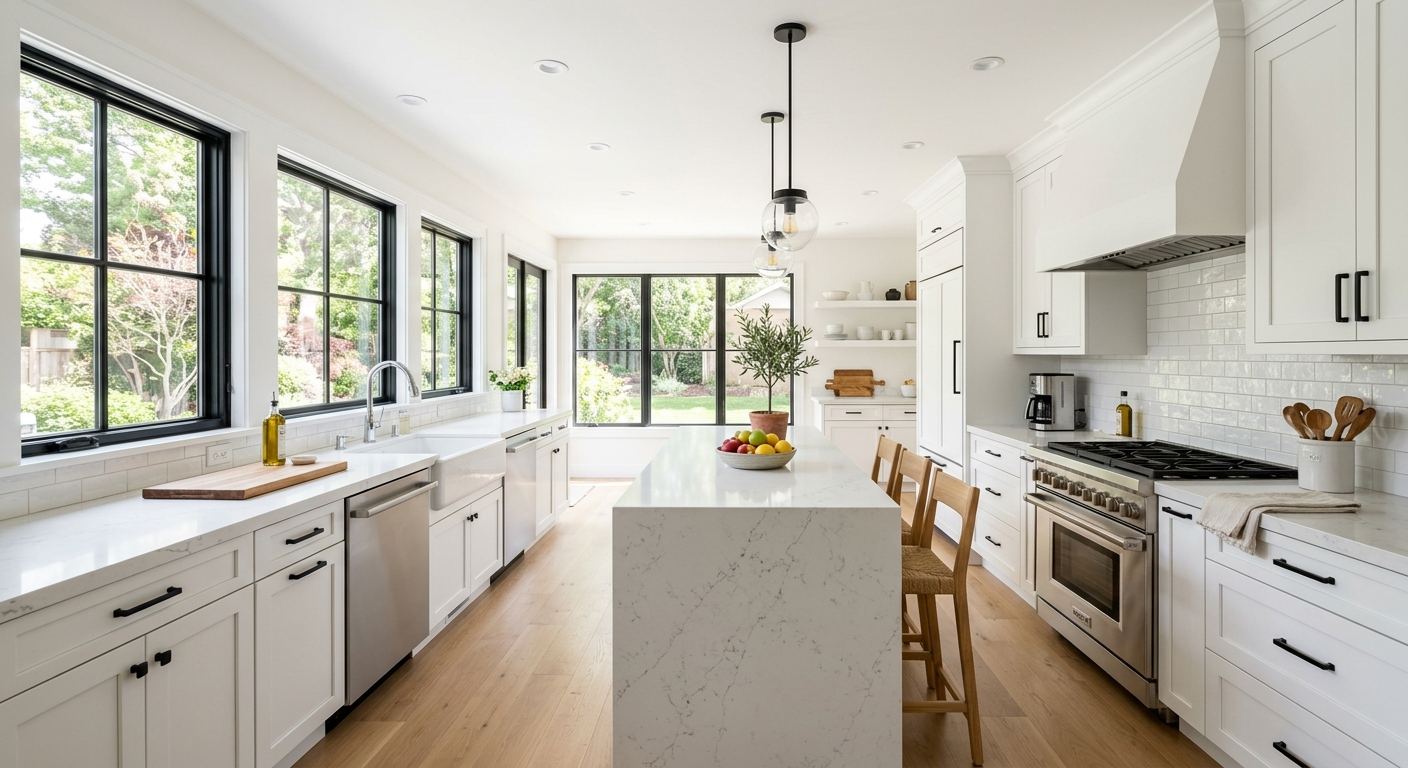
Kitchen renovation options and costs in Lexington
Lexington homeowners typically see kitchen renovation pricing move in line with the broader Toronto housing market, not with weather swings. With Lexington’s population at 7,330 (Statistics Canada, 2021 Census), many projects are driven by resale planning and maintaining day-to-day comfort rather than major, citywide construction surges. In higher-value pockets across the Toronto economic region, homeowners often allocate a meaningful share of their home value to the kitchen—commonly in the 8–15% range—so you’ll see more demand for custom cabinetry, quartz, and upgraded appliances. That same expectation filters into Lexington quotes, especially for families upgrading for buyer appeal.
When contractors price kitchens in this area, the biggest cost lever usually isn’t Ontario climate; it’s the finish tier and how much work touches plumbing, electrical, and structure. Labour rates and material pricing are relatively uniform across the GTA, but higher-end neighbourhoods skew average project costs upward because the majority of owners choose premium countertops (quartz or stone) and more customized layouts. Lexington tends to feel that effect most when the project includes an island, updated electrical (often for under-cabinet lighting), or moving a sink/gas line to improve workflow.
In Lexington, “especially in demand” areas for renovation planning are near the older housing stock pockets where kitchens were built with earlier cabinet sizing and standard appliance rough-ins—these layouts often benefit from refacing or semi-custom cabinetry and selective counter upgrades. Below is a practical comparison of renovation tiers to help you budget before you get site-specific quotes.
| Renovation Tier |
What's Included |
Typical Duration |
Price Range |
| Cosmetic refresh (paint, hardware, new appliances only) |
Cabinet paint or refinishing (where permitted), new handles/knobs, new appliance set, countertop protection (no major swap), basic caulking and touch-ups |
3–7 days |
$8,000–$20,000 |
| Mid-range full renovation (new cabinets, counters, sink, tile) |
New semi-custom or upgraded stock cabinets, quartz or good laminate counters, sink and faucet replacement, backsplash tile, new flooring prep/spot replacement, basic electrical refresh (no major rewire) |
3–5 weeks |
$25,000–$60,000 |
| High-end full renovation (custom cabinets, stone counters, island) |
Fully custom millwork, premium stone counters, island with electrical, upgraded appliance package, full-height or premium backsplash, sink/gas/plumbing adjustments where required, coordinated lighting |
6–10 weeks |
$70,000–$90,000 |
| Cabinet refacing only (new doors + drawer fronts, same boxes) |
New door and drawer fronts, new hardware, optional interior upgrades (shelves/organizers), surface prep, re-installation, typical backsplash re-seal (not full tile replacement) |
1–3 weeks |
$8,000–$35,000 |
| Countertop swap only (laminate to quartz or stone) |
Remove existing counters, install new quartz/stone, new sink cut-out (if staying with same location), new edges and sealing, backsplash caulking/trim touch-ups |
5–10 days |
$3,000–$15,000 |
| Backsplash tile installation only |
Surface prep, tile layout and setting, grout/seal, trim and caulking, allowance for small patching around outlets (no major electrical changes) |
2–5 days |
$2,000–$10,000 |
Prices are estimates only and vary by project scope, site access and material selection.
What affects the price of kitchen renovation in Lexington
Two quotes for the “same” kitchen can differ by 30–50% in Toronto and Ontario because contractors price risk, access, and the true amount of unseen work (subfloor condition, hidden electrical conflicts, cabinet box condition, and the cost of bringing older rough-ins up to current expectations). In practice, Lexington kitchens feel that same spread: the finish tier and how your layout interacts with plumbing and electrical determine the majority of the total.
Local home values and household purchasing power shape the typical finish tier far more than climate. In higher-value economic pockets, homeowners more often default to quartz or natural stone counters and semi-custom cabinetry because the upgrade tends to be easier to justify on resale. In more price-sensitive projects, laminate counters and stock or refaced cabinets keep budgets closer to the lower end of the range—useful when you want a clean look without overhauling the whole room.
Layout changes add the most unpredictable cost regardless of finish. Examples in Lexington: adding an island usually requires electrical rough-in and can add cost quickly even if your appliance footprint stays the same; moving a sink can require drain and supply line work that drives permit and inspection requirements; and relocating a gas stove or range hood for better venting can escalate both materials and scheduling. Even at similar finish levels, those variables can shift a project from the mid band (mid-$20k to $60k) toward the higher band (around $70k+) very quickly.
Ontario’s housing stock also matters. Older homes in the region often have dated service panels and less flexible rough-ins, so an “upgrade” that touches electrical circuits or includes new lighting can cost more than owners expect. The good news: if you keep the plumbing footprint and focus on cabinetry and counters, you can often stay within tighter budget bands like countertop swaps (around $3,000–$15,000) while still upgrading the look significantly.
| Price Factor |
Why It Matters |
Cost Impact |
| Cabinet tier — stock vs. semi-custom vs. fully custom millwork |
Cabinet construction, finish options, internal organization, and custom sizing change material and install time |
Typically a mid-project swing of about $8,000–$25,000 depending on complexity |
| Countertop material — laminate vs. quartz vs. granite vs. stone |
Material cost, fabrication difficulty, and edge profiles affect labour and install time |
Often changes the countertop line item by roughly $2,000–$12,000+ |
| Layout change — wall removal, island add, plumbing/gas move |
Structural work, longer supply/drain runs, and code requirements increase labour and trades coordination |
Commonly adds $10,000–$30,000+ over a no-change plan |
| Appliance package tier — builder vs. mid-range vs. pro-grade |
Premium brands cost more and can require different cut-outs, ventilation, and electrical configurations |
Typically $3,000–$15,000+ difference depending on the package |
| Flooring — refinish existing vs. full replacement |
Protected access can allow less demolition; removing and replacing adds subfloor prep and labour |
Often $1,500–$6,000+ depending on scope |
| Backsplash — ceramic tile vs. marble vs. full-height slab |
Tile complexity, slab handling, and waterproofing details change labour and material waste |
Can shift by $1,000–$7,000+ |
| Electrical — new circuits for island, under-cabinet lighting |
New circuits require licensed work and inspection; lighting adds wiring and installation time |
Often $1,500–$8,000+ depending on wiring runs and number of fixtures |
| Permit fees and licensed trade requirements |
Permits and inspections add admin time and licensed trade scheduling, especially for plumbing and gas |
Commonly a few hundred to $2,000+ depending on what’s triggered |
Permits & regulations in Ontario
In Ontario, simple cabinet and countertop swaps typically do not require permits. If you’re replacing existing cabinets with the same layout footprint, and swapping the countertop (even from laminate to quartz or stone) without changing plumbing or gas lines, you generally proceed without a building permit. Likewise, a backsplash installation usually doesn’t trigger permits unless it involves significant electrical work (for example, relocating outlets or adding wiring for lighting).
Where permits and inspections do come into play is when the work changes the “service” or structure. Moving plumbing supply or drain lines, relocating a gas stove or making changes related to gas venting, removing a load-bearing wall, adding an island that requires new electrical outlets/circuits, or upgrading major electrical feed work generally requires permits and licensed trades. Gas work must be performed by a licensed gas fitter, and electrical work must be done by a licensed electrician. Both trades typically require inspections tied to the permitting process.
For a Lexington homeowner, the practical verification steps are: ask for the contractor’s Ontario licence details (and confirm they match the trade they’re performing), request a certificate of insurance (liability) and confirm WSIB/WCB coverage for workers, and then review documentation before signing. Your contract should clearly assign permit pull responsibility—don’t assume it’s “handled.”
Finally, keep your scope list tight: ensure the quote specifies what requires permits, who pulls them, and whether disposal, inspection scheduling, and any electrical/gas shutdowns are included.
Cabinets, countertops and layout decisions in Lexington
For most Lexington homeowners, the three decisions that shape both cost and resale appeal are: (1) cabinet tier, (2) countertop material, and (3) layout changes. Cabinet tier determines your baseline look and long-term usability. Stock cabinets are the fastest and cheapest route, semi-custom is the most popular mid-range choice because it balances storage and design, and custom cabinetry delivers the tightest fit and best use of awkward spaces—at the highest price.
Countertop choice is usually the biggest “visual upgrade” and should be matched to Ontario’s real-life wear and tear. Quartz is a strong all-around option because it resists staining and handles everyday cooking well. Granite or other natural stone can be gorgeous but may require more careful sealing routines. Butcher block adds warmth and can work beautifully in family kitchens, but it demands maintenance to protect it from moisture and heat cycles. In this Toronto region, buyers often expect quartz or natural stone at higher budget points, while mid-range refreshes frequently land on laminate or more budget-conscious stone selections to hold value per dollar.
Layout changes—like removing a wall for open-concept flow or adding an island—are justified when the space gain improves circulation and task flow. If you’re moving plumbing or gas to support an island or relocate the sink/stove, costs can climb quickly into the high-end renovation band (around $70,000–$90,000). If you keep plumbing where it is and focus on cabinetry plus counters, you can often stay closer to a mid-range full renovation (roughly $25,000–$60,000). For example, upgrading just countertops can fall in the $3,000–$15,000 range, while doing full cabinet replacement plus new tile and sink typically pushes much higher.
Overall, plan decisions with Toronto resale expectations in mind: your kitchen should look current, but the smartest spending is on elements that buyers can’t easily “see as optional” later—cabinet doors, counter surfaces, and a coherent layout.
| Option |
Durability |
Maintenance |
Best For |
Price Range |
| Stock cabinets (big-box) |
Good everyday durability; limited custom sizing may leave small gaps or compromises |
Low—standard cleaning and routine hardware tightening |
Fast remodels, tighter budgets, keeping the layout footprint |
$25,000–$45,000 |
| Semi-custom cabinets (local dealer) |
Very durable construction options; better storage planning and fit |
Low to moderate—depends on finish and hardware selection |
Most Lexington renovations targeting a balanced look and value |
$45,000–$65,000 |
| Custom cabinets (local millwork shop) |
Highest durability and fit; designed for odd angles and full-height storage |
Low with quality materials; expect longer-term refinement and adjustments |
Premium aesthetics, unique layouts, maximizing storage and resale appeal |
$65,000–$90,000 |
| Laminate countertop |
Moderate durability; can chip at edges if impact occurs |
Low—cleaning is simple, but avoid heat damage to the surface/edges |
Budget-conscious upgrades where appearance refresh is the priority |
$3,000–$7,000 |
| Quartz engineered countertop |
High durability; strong resistance to staining and everyday wear |
Low—typical wipe-down cleaning; no sealing needed |
Busy family kitchens and resale-friendly upgrades |
$6,000–$12,000 |
| Granite / natural stone countertop |
High durability; individual slab variation |
Moderate—often requires periodic sealing depending on the stone |
Owners who want a distinctive, upscale look |
$8,000–$15,000 |
| Butcher block countertop |
Durable but more sensitive to moisture and heat than quartz |
Moderate—needs regular oiling and careful drying |
Warm, casual design and kitchens used for prep |
$4,000–$10,000 |
| Marble countertop |
Beautiful but softer; can etch or stain without careful use |
Higher—requires more diligence to prevent etching and staining |
Statement kitchens where owners accept extra care |
$10,000–$18,000 |
How to choose a kitchen renovation contractor in Lexington
Choosing the right contractor in Ontario starts with proof, not promises. Before work begins, verify licensing for the trades involved (or confirm the contractor only employs licensed trades for gas and electrical scopes), then check liability insurance and WSIB/WCB coverage. To verify, ask for your contractor’s certificate of insurance and ensure it’s current, request the WSIB/WCB clearance documentation for their workers, and confirm they can provide details for the trades they subcontract (especially for any gas fitter and licensed electrician work). If you’re moving beyond cabinet and counter swaps and touching plumbing or electrical, this step becomes non-negotiable.
Next, request 2–3 itemised written quotes rather than a single lump sum. The best quotes break labour and materials into lines (demolition, cabinet supply, countertop fabrication, plumbing/electrical allowances, tile setting, disposal). Then read the scope carefully: what’s excluded (for example, subfloor repairs, structural engineering, or replacement flooring), is permit pulling included, and is waste disposal part of the price? For warranty, look for both a workmanship warranty (commonly 1–2 years for many renovations) and product/manufacturer warranty details. Also confirm whether warranties are transferable if you sell your home.
For payments, protect yourself: never pay more than 10–15% upfront, and use holdbacks tied to substantial completion (especially for cabinets and countertop installation). Finally, get a written start date and a completion estimate that accounts for countertop fabrication lead times and inspection scheduling.
- Confirm the contractor’s licence/registration details for the scopes they advertise.
- Verify liability insurance is active and request the certificate of insurance.
- Ask for WSIB/WCB clearance letters or proof of coverage.
- Require an itemised quote (labour + materials) with allowances listed.
- Check what disposal includes (dump fees, hauling, drywall/cartons).
- Confirm whether permits and inspections are included in the contract price.
- Make sure electrical and gas scopes are priced under licensed trades.
- Specify demolition limits (what stays protected; what gets removed).
- Clarify countertop template timing and who pays if revisions are needed.
- Ask about lead times for cabinets, appliances, and stone/quartz fabrication.
- Confirm the warranty is in writing and specify who honours it.
- Use a payment schedule with a holdback until punch list completion.
Red flags to watch for in Lexington: (1) a quote that’s not itemised or hides material allowances, (2) no written start date or timeline plan, (3) refusal to provide insurance/WSIB proof, (4) vague statements like “we handle permits” without contract clarity on responsibility, and (5) pushing for large upfront payments (beyond 10–15%) or demanding cash deposits with no receipt trail.
Frequently asked questions — kitchen renovation in Lexington
How much does a kitchen renovation cost in Lexington?
In Lexington, Ontario, kitchen renovation costs are best planned using realistic Toronto-region price bands rather than one-size-fits-all internet numbers. For many homeowners, a cosmetic refresh (paint, hardware, new appliances only) lands around $8,000–$20,000. A mid-range full renovation with new cabinets, counters, a sink, and backsplash typically fits around $25,000–$60,000, depending on whether plumbing stays in the same location. If you’re aiming for custom cabinetry, stone counters, and an island with electrical, budgets often move into the high-end band near $70,000–$90,000. Site access, cabinet tier, and whether you need permits (for plumbing/electrical/gas changes) are what most commonly drive the final total.
How long does a kitchen renovation take in Lexington?
Timelines in Lexington generally follow the project tier and trade scheduling in Ontario. Cosmetic refreshes are usually quick—about 3–7 days—because they avoid major demolition and permit triggers. A mid-range full renovation typically takes 3–5 weeks, assuming your countertop and cabinet lead times are within normal ranges. High-end projects with custom millwork and an island can take 6–10 weeks due to fabrication and more trades coordination (especially electrical and any plumbing or gas scope that requires inspection). The biggest schedule risk is often countertop fabrication timing or delayed appliance delivery. To keep things predictable, ask your contractor for a start date, a completion estimate, and a written plan showing when measurements and templates occur.
Quartz vs granite countertops — which is better?
Quartz and granite are both durable, but “better” depends on how you cook and how much maintenance you’re willing to do. Quartz is engineered, so it’s consistent in appearance and is typically low maintenance—no routine sealing is usually required for everyday use. Granite is natural stone with unique patterning, and many slabs are very heat- and scratch-resistant, but maintenance can be higher because sealing intervals depend on the specific stone and how your household uses the kitchen. In Lexington and across the Toronto economic region, quartz is a common buyer-friendly choice for renovations in the mid range because it blends durability with predictable care. If you want a one-of-a-kind look and can commit to maintenance, granite can be worth the premium within bands like $8,000–$15,000 for natural stone countertops.
Should I reface or replace my cabinets?
Refacing is a strong option when your cabinet boxes are structurally sound and the layout already works. It’s often faster and can stay within a range such as $8,000–$35,000, depending on door/drawer choices and any internal upgrades. Replacing cabinets is better when boxes are water-damaged, badly out of level, or when you want major storage reconfiguration, new sizes, or full-height changes. In older Lexington homes with earlier rough-ins, refacing can deliver a modern look without moving plumbing or electrical, which helps keep permits and disruption lower. A good contractor will inspect box condition, hinge placement, and wall alignment before recommending refacing versus full replacement—and they should clearly explain what changes (and what won’t) be corrected.
Do I need a permit for a kitchen renovation in Ontario?
Often, you don’t need permits for straightforward cabinet and countertop swaps in Ontario. If you’re replacing cabinets in the same footprint and swapping the countertop without moving plumbing or gas lines, it’s typically permit-light. Permits generally become necessary when you move plumbing supply or drain lines, relocate gas components (including changes tied to stove/range venting), remove a load-bearing wall, or add/modify electrical circuits (for example, new island outlets, under-cabinet lighting with new wiring, or other significant electrical changes). Gas work must be done by a licensed gas fitter, and electrical by a licensed electrician, with inspections tied to the permit process. Always confirm permit responsibility in your written contract before signing so there are no surprises.
What's the ROI on a kitchen renovation?
Kitchen renovations can improve resale value, but ROI depends heavily on matching the local buyer’s expectations and the scope you choose. In the Toronto economic region, owners in higher-value areas frequently invest a larger share of home value into the kitchen—often in the 8–15% range—because kitchens with quartz/stone and more tailored cabinetry tend to photograph well and appeal to buyers. In more budget-sensitive projects, staying in mid-range totals around $25,000–$60,000 can be a smarter ROI strategy because it upgrades the visible surfaces without overbuilding. The best ROI usually comes from: keeping the kitchen layout reasonable (avoiding costly plumbing/gas moves), choosing durable, broadly appealing finishes, and ensuring workmanship is clean. Your contractor should help you align your finish tier to Lexington’s buyer expectations and your resale timeline.