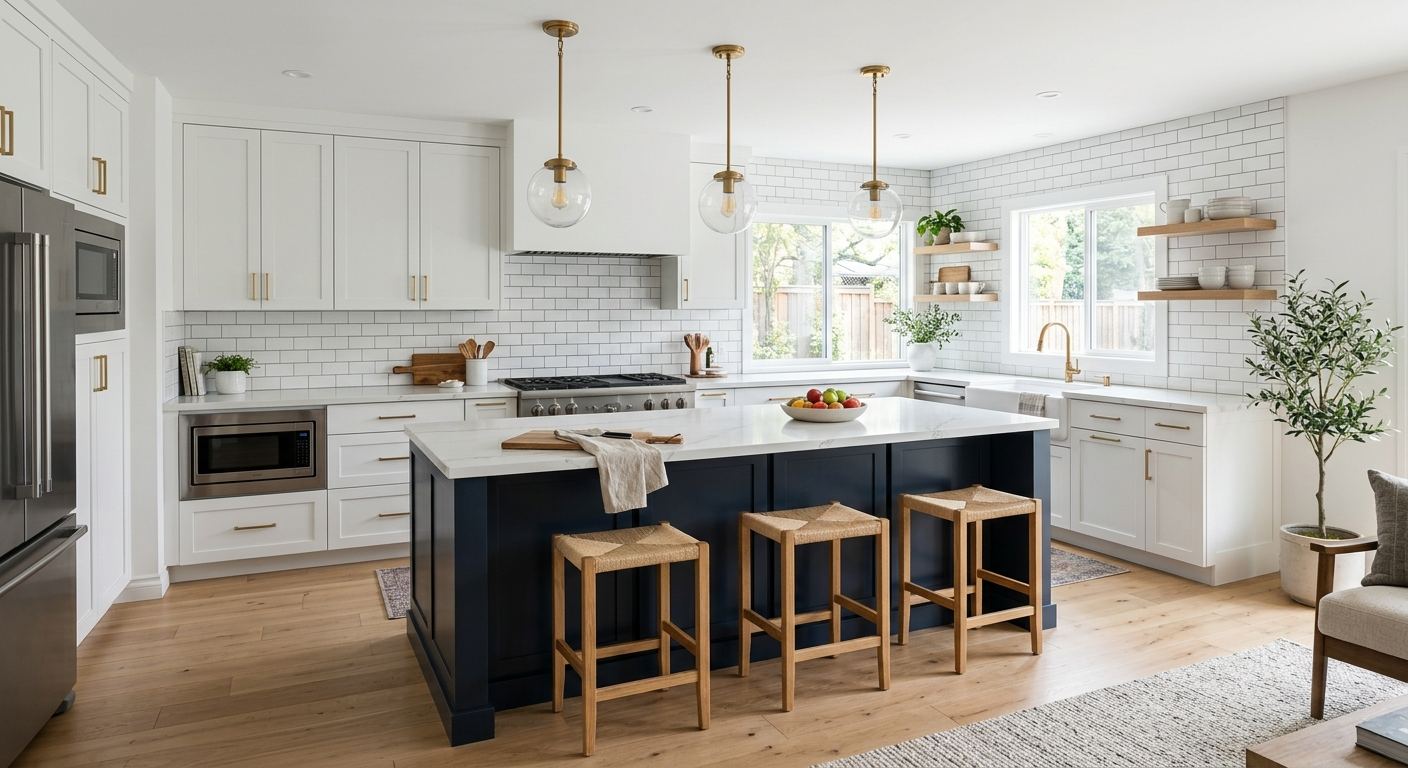
Kitchen renovation options and costs in Lakeshore Village
Lakeshore Village homeowners typically start planning their kitchen renovation by asking one question: “What can we afford without over-improving the house for the resale market?” With a population of 6,620 (Statistics Canada, 2021 Census), the area has a steady flow of homeowners updating older homes, especially around established residential pockets where turn-key remodels are common. In Toronto’s broader economic market, local home values and buying expectations often push clients toward upgraded finishes—many owners aim for a kitchen spend that aligns with how buyers price properties in the region.
In practice, the biggest cost differences here are driven less by climate and more by market-driven finish choices and labour availability across the Toronto economic region. Even though Ontario experiences freeze–thaw cycles that can be hard on moisture-prone materials, kitchens are mainly interior spaces; costs still rise when contractors have to address ventilation, under-sink plumbing access, and old subflooring that’s discovered once cabinets come out. The Toronto market also supports a strong contractor bench, but higher-end custom work moves faster when you book early—particularly for island installs and stone countertop scheduling.
Demand is especially strong in well-established areas close to commercial corridors where homeowners want a “modern, bright, move-in ready” look before listing. If you’re weighing options, the table below gives a grounded range for common renovation tiers, from a focused refresh to a full custom build.
| Renovation Tier |
What's Included |
Typical Duration |
Price Range |
| Cosmetic refresh (paint, hardware, new appliances only) |
Cabinet paint or touch-ups, new hardware/pulls, appliance swap, minor caulking/silicone, basic trim and hardware alignment |
3–7 days |
$8,000–$18,000 |
| Mid-range full renovation (new cabinets, counters, sink, tile) |
Semi-custom or quality stock cabinets, new countertops, new undermount sink and faucet, backsplash tile, flooring patching/trim, standard electrical hookups |
3–6 weeks |
$25,000–$60,000 |
| High-end full renovation (custom cabinets, stone counters, island) |
Custom millwork, premium quartz or natural stone, island (with lighting and possibly updated plumbing/gas), full-height backsplash option, upgraded appliance package |
6–10 weeks |
$65,000–$90,000+ |
| Cabinet refacing only (new doors + drawer fronts, same boxes) |
Door and drawer front replacement, new end panels, laminate or upgraded finishes, hardware, clean build-out of existing layout |
2–4 weeks |
$8,000–$35,000 |
| Countertop swap only (laminate to quartz or stone) |
Removal and install of new tops, sink cut-outs, backsplash return as applicable, disposal and sealing/installation as required |
3–7 days |
$3,000–$15,000 |
| Backsplash tile installation only |
Tile supply and install, waterproofing/board where needed, removal of old backsplash where required, grouting and caulking |
5–10 days |
$2,000–$10,000 |
Prices are estimates only and vary by project scope, site access and material selection.
What affects the price of kitchen renovation in Lakeshore Village
In Toronto and across Ontario, you can easily see 30–50% quote swings for what looks like the same kitchen on paper. The reason is that contractors price uncertainty differently: one quote may include electrical rough-in, protected subfloor work, and cabinet leveling allowance, while another keeps those items vague. That’s why finish tier, layout scope, and how much “hidden work” is acknowledged in writing matter more than the brochure photo you brought to the meeting.
Local home values and median income shape the typical finish tier far more than climate. In higher-value pockets across the Toronto economic region, homeowners often default to quartz or natural stone and semi-custom cabinetry because the renovation cost is more easily recovered on resale. In more price-sensitive areas of Brampton and outer Mississauga, many projects stay in the mid-range using refaced or stock/sem i-custom cabinets and cost-controlled countertop choices—keeping ROI in mind when buyers compare listings. For Lakeshore Village, the practical takeaway is that most kitchens trend toward $25,000–$60,000 for full renovations unless you’re adding an island and upgrading to premium stone.
Concrete examples that commonly move the needle locally: older Ontario homes may have out-of-level floors, requiring shimming and sometimes partial subfloor repair before cabinets go in; that can add time and labour even when your finish tier is mid-range. If you upgrade to $65,000–$90,000+ with custom millwork and an island, schedule gaps can appear because stone templating and appliance backorders stack delays. Also, freeze–thaw humidity swings can expose weak ventilation or aging caulking around sinks—once we remove cabinets, we sometimes find need-for-rework that wasn’t visible during the walk-through.
| Price Factor |
Why It Matters |
Cost Impact |
| Cabinet tier — stock vs. semi-custom vs. fully custom millwork |
Material quality, door styles, internal organization, fit tolerances, and finish options drive labour and product cost |
Can shift your budget by roughly $10,000–$35,000 |
| Countertop material — laminate vs. quartz vs. granite vs. stone |
Fabrication method, thickness/edge profiles, and installation requirements change both material and labour time |
Often $2,000–$12,000 difference |
| Layout change — wall removal, island add, plumbing/gas move |
Structural, plumbing/drain, gas routing, and electrical rework add unpredictable scope |
Typically $5,000–$30,000 depending on complexity |
| Appliance package tier — builder vs. mid-range vs. pro-grade |
Brand tiers change warranty/service support, power requirements, and installation fit |
Usually $1,500–$10,000+ |
| Flooring — refinish existing vs. full replacement |
Surface prep and patching quality can decide whether the floor blends seamlessly |
Can swing $2,000–$8,000 |
| Backsplash — ceramic tile vs. marble vs. full-height slab |
Material weight, cutting, waterproofing needs, and finish details increase labour |
Often $2,000–$10,000 |
| Electrical — new circuits for island, under-cabinet lighting |
Adding outlets/lighting usually requires licensed rough-in and inspection |
Commonly $800–$6,000 |
| Permit fees and licensed trade requirements |
Work that triggers permits must be executed and inspected by the proper licensed trades |
Often $300–$5,000+ depending on scope |
Permits & regulations in Ontario
In Ontario, a straightforward cabinet and countertop swap generally does not require a permit because you’re not changing the building’s core services. Replacing cabinets and setting new countertops over existing positions typically stays in the “finish work” category. Similarly, a backsplash install usually falls under renovation finishes unless it’s tied to significant electrical or structural modifications.
Where permits do come into play in Lakeshore Village is when you touch plumbing, gas, structure, or circuits. Moving supply or drain lines under the sink, relocating a dishwasher, adding or rerouting gas lines for a cooktop, and installing/relocating a hood vent that involves gas are typical examples that require permits and licensed trades. Removing a load-bearing wall (or altering structural supports) is also permit-driven. Any new electrical work—like adding circuits for an island, increasing load capacity, or installing under-cabinet lighting that requires wiring—should be handled by a licensed electrician and inspected.
Step-by-step homeowner verification: (1) ask for the contractor’s Ontario business registration details and the specific trade licences for gas/electrical work (as applicable); (2) request a current certificate of insurance and confirm liability coverage; (3) ask for WSIB/WCB coverage documentation where required; (4) confirm whether the contractor or the homeowner is responsible for permits in writing; and (5) ensure the contract names the trades that will submit/close out inspections. Where relevant, you’ll also want written proof that any safety-critical work (gas and electrical) was performed by the correct licensed professional, not by a subcontractor “under supervision.”
Cabinets, countertops and layout decisions in Lakeshore Village
The three most consequential decisions in a Lakeshore Village kitchen renovation are cabinet tier, countertop material, and layout changes. Cabinet tier sets your timeline and “feel”: stock cabinets go in fastest and keep labour predictable, semi-custom is the most popular mid-range balance, and custom millwork gives the tightest fit and the strongest resale-friendly look when you’re chasing a specific style. Countertops then determine day-to-day satisfaction—especially around cooking heat, cleaning chemicals, and water exposure near sinks. Finally, layout changes—like opening an interior wall, adding an island, or relocating plumbing/gas—should be justified by actual space gain, not just aesthetics, because these are the areas where permits, licensed trades, and unknown conditions add cost.
In Toronto’s resale market, buyers increasingly expect durable, low-maintenance surfaces and clear, functional traffic paths. A practical example: upgrading from laminate to quartz often costs more upfront, but the “no special sealing, consistent colour, and good stain resistance” helps kitchens look newer longer during showings. If your base renovation is in the $25,000–$60,000 mid-range, a quartz upgrade is usually your most defensible spend; pushing into $65,000–$90,000+ with custom cabinets and premium stone makes sense when you’re also reworking the layout or building an island that becomes the centre of the home.
Ontario’s seasonal temperature swings matter most at interfaces: under-sink leaks, ventilation performance, and how well the installer seals countertop edges and backsplash transitions. Those details protect cabinetry from moisture and reduce the chance of future swelling—so layout and material choices should be made with installation quality in mind, not just product price.
| Option |
Durability |
Maintenance |
Best For |
Price Range |
| Stock cabinets (big-box) |
Solid for typical family use; depends on thickness/hinge quality and installation level |
Low maintenance; hardware upgrades recommended for long-term smooth operation |
Cost-controlled refreshes and fast turnarounds |
$10,000–$25,000 |
| Semi-custom cabinets (local dealer) |
Better fit and options for storage (pantries, trays, soft-close); robust for busy kitchens |
Low maintenance; keep edges sealed and clean spillovers promptly |
Most homeowners balancing budget and resale appeal |
$20,000–$45,000 |
| Custom cabinets (local millwork shop) |
Highest dimensional control and style flexibility; best when layouts are irregular |
Low maintenance; premium finishes resist everyday wear when properly installed |
High-end builds, awkward spaces, and statement kitchens |
$35,000–$75,000+ |
| Laminate countertop |
Good impact resistance; can be sensitive to heat and water exposure at seams if improperly sealed |
Easy daily care; avoid prolonged moisture on seams and use heat protection |
Smart budget choice where layout and sealing are well handled |
$3,000–$7,000 |
| Quartz engineered countertop |
Excellent stain and scratch resistance; holds up well with busy household cleaning |
Low maintenance; no sealing required and generally less worry about spills |
Families who want premium look without natural-stone care |
$6,000–$12,000 |
| Granite / natural stone countertop |
Very durable; natural variations and proper sealing are key for long-term performance |
Moderate maintenance; periodic sealing and quick spill cleanup recommended |
Owners prioritizing natural texture and high-end visual depth |
$7,000–$15,000 |
| Butcher block countertop |
Durable with proper care; sensitive to standing water and heat without protection |
Requires regular oiling and careful drying around the sink |
Warm, traditional styles where you’re comfortable with upkeep |
$4,000–$10,000 |
| Marble countertop |
Elegant and durable structurally, but more prone to staining/etching than quartz |
Higher maintenance; sealing and careful cleaning are essential |
Statement look in kitchens used with moderate wear |
$9,000–$18,000+ |
How to choose a kitchen renovation contractor in Lakeshore Village
Choosing the right contractor in Lakeshore Village is mostly about proof and paper, not promises. Start by verifying Ontario licensing where it applies: electrical work should be performed by a licensed electrician, and any gas-related changes must be done by a licensed gas fitter. Ask the contractor for the certificate of insurance (liability coverage) and current WSIB/WCB documentation, then confirm the certificates are active and match the company name on the quote.
Next, get 2–3 itemised written quotes with a labour-and-materials breakdown, not just one lump sum. You’re looking for clarity: cabinet install labour separate from cabinet supply, countertop template and install listed as distinct line items, and disposal/demolition included or excluded. Pay attention to permit pull responsibility in the contract—what you want to see is who applies, who pays, and what triggers permit requirements based on the scope. A good quote will also list whether electrical upgrades, under-cabinet lighting wiring, and floor leveling are included.
Warranty matters too. Confirm workmanship warranty length (common to see coverage for install-related issues), manufacturer product warranty terms, and whether the warranty is transferable if you sell your home. For payment scheduling, never pay more than 10–15% upfront. Hold back a portion until the work is complete and inspected to your satisfaction. Finally, require a written start date and an end date estimate tied to materials lead times, especially for stone countertops and premium appliances.
- Verify licences for any gas and electrical work before signing.
- Request active certificates of insurance and confirm coverage limits.
- Confirm WSIB/WCB coverage status (and keep copies).
- Get itemised quotes: labour, materials, demolition, disposal, and taxes where applicable.
- Check what’s excluded (e.g., ceiling/paint touch-up, flooring replacement, trim build-out).
- Confirm permit responsibility and inspections: who pulls permits, who pays fees.
- Ask about countertop templating timelines and whether scheduling is included.
- Confirm appliance requirements (power/cut-outs/venting) are handled in the scope.
- Look for a start date, milestones, and a completion estimate in writing.
- Ensure waste removal and site protection (floor coverings, dust control) are included.
- Clarify warranty terms: workmanship duration and manufacturer warranty coverage.
- Use a payment schedule with 10–15% maximum upfront and a final holdback.
Red flags I see often in Lakeshore Village: quotes that omit disposal or demolition and then charge change orders; a contractor who can’t show insurance/WSIB/WCB documentation; vague “allowances” with no quantities or materials listed; no mention of who applies for permits when plumbing/electrical changes are included; and timelines that assume stone fabrication will be “in two weeks” with no lead-time plan.
Frequently asked questions — kitchen renovation in Lakeshore Village
How do I get accurate kitchen renovation quotes in Lakeshore Village?
To get accurate quotes in Lakeshore Village, you need line-item scope clarity. Ask for 2–3 itemised written estimates that break out labour and materials (cabinet supply vs. installation, countertop templating and install, backsplash tile, electrical changes). Make sure the contractor measures on-site and notes conditions like out-of-level floors, existing water shut-offs accessibility, and ventilation performance around the range. If you’re considering changes that trigger permits—like moving drain lines, relocating a gas cooktop, or adding island circuits—confirm who pulls permits and whether licensed trades are included. For budgeting, use the local GTA price bands as a reference point: a mid-range full renovation commonly lands in the $25,000–$60,000 range, while custom stone/island work often moves toward $65,000–$90,000+. A detailed quote usually prevents surprises later.
What's the best countertop material for a busy Lakeshore Village kitchen?
For a busy Lakeshore Village kitchen, quartz is often the safest “best overall” choice because it’s low-maintenance and stays consistent with everyday cleaning. Unlike laminate, quartz is far more resistant to staining and scrubbing, which matters when you’re cooking often and wiping spills quickly. If you love the look of natural variation, granite can be a great choice too, but it typically needs periodic sealing and careful cleanup of acidic spills. Marble is beautiful, but it’s higher maintenance because it can etch or stain more easily. Butcher block can work well for warmth, as long as you’re careful at sink areas—standing water can be a problem in any Ontario home. In cost terms, many homeowners fit quartz into a full renovation budget, where countertop swaps often fall inside the broader $3,000–$15,000 band depending on size and edge profiles.
How do I add an island to my Lakeshore Village kitchen?
Adding an island in Lakeshore Village is usually the point where scope expands beyond cabinets and paint. First, confirm clearance: walkways need room for comfortable passing and door swings, especially in older homes where room dimensions can be tight. Then decide whether the island needs plumbing or gas service—moving a sink drain/supply line or relocating gas for a cooktop can trigger permits and require licensed trades. Electrical for island outlets and under-cabinet lighting is also commonly needed and should be planned early so wiring rough-ins aren’t missed. A good contractor will include island dimensions, lighting style, and appliance cut-outs in the quote. If your goal is an island with seating, the cost is often justified when it creates real workflow improvement (prep + cooking + cleanup). Budget-wise, island projects frequently push you toward the higher end of the $25,000–$60,000 band, and sometimes into $65,000–$90,000+ once plumbing/gas and stone finishes are added.
How much does a kitchen renovation cost in Lakeshore Village?
In Lakeshore Village, realistic kitchen renovation budgets typically align with GTA pricing tiers rather than weather-driven costs. For modest changes—like new cabinets plus counters and a backsplash—many projects land in the mid-range. As a practical reference, a mid-range full renovation commonly falls within $25,000–$60,000, especially when you choose semi-custom or quality stock cabinets and quartz or good laminate countertops. If you’re doing a full high-end build with custom cabinetry, premium stone counters, and an island (with lighting and possibly plumbing/gas updates), budgets more often move into the $65,000–$90,000+ territory. For smaller scopes, cabinet refacing typically sits in the $8,000–$35,000 range, countertop swaps alone can be around $3,000–$15,000, and backsplash tile installation often falls within $2,000–$10,000. Your final number depends most on finish tier and whether layout changes trigger licensed trades and permits.
How long does a kitchen renovation take in Lakeshore Village?
Timelines in Lakeshore Village depend mainly on scope and material lead times. A cosmetic refresh (paint, hardware, and appliance-only swaps) is usually the fastest—often about 3–7 days. A mid-range full renovation with new cabinets and countertops typically takes around 3–6 weeks once measurements, cabinet delivery, and countertop templating are scheduled. High-end projects with custom millwork and stone counters commonly require 6–10 weeks because stone fabrication and detailed cabinet lead times add steps. Countertop-only swaps are often a quick 3–7 days, but templating and scheduling can affect the calendar. Cabinet refacing projects are commonly about 2–4 weeks. The best way to protect your start date is to lock materials early and confirm whether the quote includes scheduling for templating, demolition, protected dust control, and any permit/inspection lead time when plumbing, gas, or electrical work is involved.
Quartz vs granite countertops — which is better?
Quartz is usually the better “performance per hassle” choice for most Lakeshore Village households. It’s engineered, generally more consistent in colour, and it doesn’t require sealing like many natural stones. That makes it ideal if you cook frequently, wipe down often, and want a countertop that stays looking sharp with minimal upkeep. Granite is also durable and can look stunning with natural movement, but it typically needs periodic sealing and you’ll want to clean spills promptly—especially acidic products. If you’re deciding based on daily life rather than appearance, quartz often wins. If you’re choosing based on natural character and you’re comfortable with maintenance, granite can be a great option. In terms of budgeting within Ontario GTA pricing tiers, quartz and granite often land in the broader countertop spend range of about $6,000–$15,000 depending on thickness, edge profile, and overall project size.