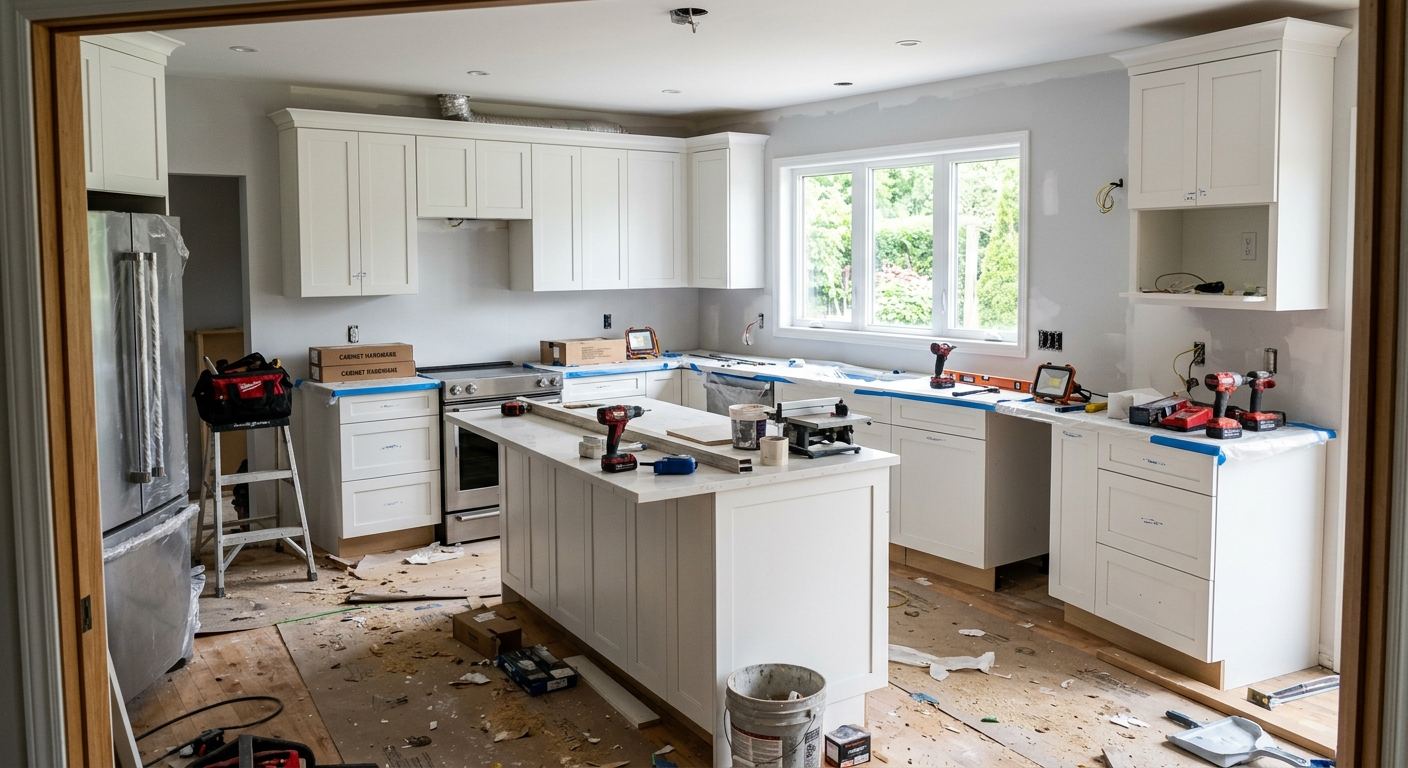
Kitchen renovation options and costs in Kingsville
Kitchens in Kingsville can be upgraded in several ways, and the cost depends on how much you change—not just what you pick. With a median household income of about $94,000 (Statistics Canada, 2021 Census), many homeowners are targeting durable, mid-market finishes that hold up for daily use and still look “current” for resale. Kingsville’s homeowner-heavy mix (7,015 owner households, 84.7% of households) also means most projects are planned with longevity and resale value in mind rather than short-term flips.
In the Windsor–Sarnia economic region, renovation budgets are shaped mainly by local home values and buyer expectations, not by weather extremes. Ontario’s seasonal swings and humidity still matter for installation quality—especially tile setting, cabinet shimming, and sealing—but they rarely change the overall pricing the way layout changes do. Contractors tend to be in greatest demand in the East Kingsville area and along Highway 3 corridors, where older homes are being refreshed and updated for modern cooking and entertaining. That demand can affect scheduling, but it doesn’t typically push finish pricing as much as labour scope and material tier.
For reference, a typical full renovation in Ontario commonly lands in the $25,000–$70,000 range, while smaller projects—like cabinet refacing or counter swaps—fit tighter bands. Use the table below to compare options and see how fast budgets move as you go from “refresh” to a full redesign.
| Renovation Tier |
What's Included |
Typical Duration |
Price Range |
| Cosmetic refresh (paint, hardware, new appliances only) |
Cabinet paint (or just doors if needed), hardware, wall paint, appliance install only, basic caulking/touch-ups, minor trim work |
3–7 days |
$8,000–$20,000 |
| Mid-range full renovation (new cabinets, counters, sink, tile) |
New semi-custom or quality stock cabinetry, countertops (quartz or laminate), sink/faucet, backsplash tile, flooring patching/transition, electrical allowances, basic layout refresh |
3–5 weeks |
$25,000–$55,000 |
| High-end full renovation (custom cabinets, stone counters, island) |
Custom millwork, stone counters (granite or higher-grade quartz), island build (carpentry + electrical allowance), full-height or premium backsplash, enhanced lighting, deeper layout changes |
6–10 weeks |
$55,000–$90,000 |
| Cabinet refacing only (new doors + drawer fronts, same boxes) |
New cabinet doors/drawer fronts, refinishing where boxes remain, new hardware, hinge/soft-close upgrades, minor filler repairs, optional interior re-lamination |
2–4 weeks |
$8,000–$30,000 |
| Countertop swap only (laminate to quartz or stone) |
Remove/install counters, new sink cut-outs as needed, faucet/sink re-set, sealer or edge finishing where applicable, backsplash transition as needed |
1–3 weeks |
$3,000–$15,000 |
| Backsplash tile installation only |
Demo and prep, tile supply & installation, waterproofing membranes where appropriate, grout sealing, caulking at edges |
4–8 days |
$2,000–$8,000 |
Prices are estimates only and vary by project scope, site access and material selection.
What affects the price of kitchen renovation in Kingsville
Even when two homeowners request the “same” kitchen update in the Windsor–Sarnia region, quotes can differ by 30–50% because the hidden work varies. In practice, labour scope is often the wildcard: removing old finishes, correcting subfloor or wall irregularities, reworking ventilation runs, and adjusting electrical or plumbing plans can add time quickly. On top of that, local finish expectations shift with buyer sentiment—especially for countertops and cabinet fit—so material tier can swing the total faster than most people anticipate.
In higher-value pockets within the region, homeowners frequently choose quartz or stone counters and semi-custom cabinetry because the renovation cost is more easily recovered on resale. That expectation is reinforced by Windsor–Sarnia household income levels—aligned with a median around $94,000 (Statistics Canada, 2021 Census)—which supports mid-market budgets and better stock selection. In more modest budget scenarios, laminate and good-quality stock cabinets dominate, delivering durability at a more predictable cost. Regardless of tier, layout changes are what add risk: removing a wall, adding an island, or moving a gas line can change plumbing/electrical coordination and trigger extra inspections.
In Kingsville specifically, older housing stock is common (55.7% of homes were built before 1981, Statistics Canada, 2021 Census). That can mean surprises behind the walls—older wiring routes, out-of-square framing, or finishes that hide rot—so projects often land toward the upper end of the $25,000–$55,000 mid-range band when the team has to correct more than “surface” issues. Conversely, if you stay in the same footprint and do a countertop swap or a cabinet refacing, you can often keep the project closer to the $3,000–$15,000 countertop band or the $8,000–$30,000 cabinet band.
As you plan your budget, treat layout decisions and site conditions as the biggest cost drivers; finish upgrades are important, but they’re usually the more controllable part of the quote.
| Price Factor |
Why It Matters |
Cost Impact |
| Cabinet tier — stock vs. semi-custom vs. fully custom millwork |
Higher tiers change door style options, internal features, fit/finish tolerance, and lead times |
- Stock: lower labour & faster installs
- Semi-custom: balanced cost/performance for most Kingsville homes
- Custom: highest labour, longer fabrication, premium hardware and adjustments
|
| Countertop material — laminate vs. quartz vs. granite vs. stone |
Material price, sink/edge complexity, and install handling affect total cost |
- Laminate: most budget-friendly
- Quartz: strong “value durability” tier
- Granite/stone: premium material and often more complex templating
|
| Layout change — wall removal, island add, plumbing/gas move |
Triggers structural, plumbing, electrical, venting coordination and more scheduling |
Often the largest jump regardless of finishes; can push a mid-range plan toward upper full-renovation pricing. |
| Appliance package tier — builder vs. mid-range vs. pro-grade |
Electrical/venting requirements and installation tolerances increase with pro-grade units |
Can add significant cost through allowances and specialized installation parts. |
| Flooring — refinish existing vs. full replacement |
Kitchen work exposes subfloor; mismatched transitions can force replacement |
Spot patching is cheaper; full replacement increases labour and material. |
| Backsplash — ceramic tile vs. marble vs. full-height slab |
Higher-end materials require more careful layout, sealing, and finishing |
Can increase the backsplash line from a few thousand to premium tiers depending on height and material. |
| Electrical — new circuits for island, under-cabinet lighting |
More circuits and lighting points require licensed trade work and inspection coordination |
Usually moderate, but can become costly when discovery work happens behind existing walls. |
| Permit fees and licensed trade requirements |
Work categories that affect plumbing, gas, electrical, or structural changes add paperwork and coordination |
Costs vary by scope, but permit/inspection needs can add time and trade scheduling impact. |
Permits & regulations in Ontario
In Ontario, many straightforward kitchen updates do not require permits—especially “like-for-like” upgrades. Cabinet and countertop swaps typically do not need permits. That includes replacing existing cabinet units and setting new counters, provided you’re not changing the plumbing or gas connections behind the scenes. Similarly, a backsplash install is usually treated as finishing work and is commonly done without a permit.
Permits generally become necessary when the work changes a system or structure. That includes moving plumbing supply or drain lines, relocating a gas stove, or changing the gas range hood venting route where applicable. Removing a load-bearing wall or making structural modifications also requires permits and appropriate engineering/approvals. Adding new electrical circuits (for example, for island outlets or upgrading to new under-cabinet lighting circuits) typically requires permit work and licensed electrical trade involvement.
For a homeowner in Kingsville, verify before signing: (1) confirm the contractor is properly licensed where required by the trade(s) they subcontract; (2) request a Certificate of Insurance (liability) and ask for WSIB/WCB clearance details; (3) review the written contract to see who pulls permits and who is responsible for inspections. To check licences, use the appropriate Ontario trade licensing/regulatory registry online (by trade) and confirm the names match the team on the job. Always insist on clear documentation—don’t rely on verbal promises.
Cabinets, countertops and layout decisions in Kingsville
Your three biggest decisions in a Kingsville kitchen renovation are usually cabinet tier, countertop material, and whether you change the layout. Start with cabinet tier: stock cabinets are the fastest and cheapest path because they come pre-manufactured. Semi-custom cabinets (common with local dealers) are the most popular mid-range choice in Windsor–Sarnia because you get better sizes, door/finish options, and internal storage without custom-millwood pricing. Custom cabinets fit perfectly, but the trade-off is higher labour and longer lead times.
Next, choose countertops with maintenance and durability in mind. Laminate is budget-friendly and practical, but it can show wear faster and seams need careful sealing. Quartz is the “most balanced” option for many mid-market renovations: it resists staining better than laminate and usually offers straightforward care. Granite and natural stone can be stunning, but they demand more attention to surface sealing and can be more expensive to template and install. Butcher block adds warmth and can be great for active households, but it requires regular oiling and good drying practices—important in Ontario homes where seasonal humidity swings can affect wood.
Finally, consider layout changes. Open-concept wall removal or adding an island is worth it only if you’re gaining real function—more workspace, better traffic flow, or seating that you will actually use every day. Moving plumbing or gas connections is the part that tends to justify the cost, not the “look.” If you’re upgrading to quartz, for example, you may be better spending your budget on counters and leaving the plumbing where it is; a countertop upgrade can fit the $3,000–$15,000 band, while moving lines usually pushes you toward a larger renovation scope.
In Kingsville’s resale-focused market, buyers typically pay attention to cabinet finish quality and countertop appearance first. Choosing a semi-custom cabinet plan with quartz counters often lands in the sweet spot for value in the $25,000–$55,000 mid-range renovation band.
| Option |
Durability |
Maintenance |
Best For |
Price Range |
| Stock cabinets (big-box) |
Solid for typical daily use; depend on model quality and hardware |
Low—periodic tightening and gentle cleaning |
Budget-conscious refreshes and quicker timelines |
$8,000–$22,000 |
| Semi-custom cabinets (local dealer) |
Better fit, improved storage options, more durable finishes |
Low—normal cleaning and hardware checks |
Most Kingsville mid-range full renovations |
$15,000–$35,000 |
| Custom cabinets (local millwork shop) |
Highest precision fit and longevity with premium hardware options |
Low—keep surfaces protected; replace components as needed |
Challenging layouts, premium builds, and exact storage requirements |
$30,000–$60,000 |
| Laminate countertop |
Good for everyday use; edges and seams are the wear points |
Wipe clean; avoid prolonged moisture at seams |
Renovations aiming to control budget |
$3,000–$7,000 |
| Quartz engineered countertop |
Very durable and consistent; resistant to staining and typical household wear |
Low—regular soap-and-water type care |
Value durability for most owner-occupied homes |
$6,000–$12,000 |
| Granite / natural stone countertop |
Extremely durable surface; varies by slab and finish |
Moderate—often requires periodic sealing |
Premium look and uniqueness |
$8,000–$15,000 |
| Butcher block countertop |
Durable but can scratch; best with proper care |
Higher—regular oiling and careful drying |
Families that want warmth and don’t mind upkeep |
$4,000–$9,000 |
| Marble countertop |
Beautiful but softer; sensitive to etching from acids |
Higher—needs sealing and careful stain/acid management |
Low-impact cooking spaces and a strong premium aesthetic |
$10,000–$18,000 |
How to choose a kitchen renovation contractor in Kingsville
Choosing the right contractor is what separates a smooth renovation from a long, expensive “schedule shuffle.” In Ontario, you should verify both licensing and coverage. Start with licence checks: ask for the specific trade names involved and their Ontario licence details. For liability insurance, request a current Certificate of Insurance and confirm the limits are appropriate for a kitchen job. Then verify WSIB/WCB coverage: ask for documentation or clearance letters showing the subcontractors and the main contractor are properly covered—this protects you if a worker is injured on site.
Next, get 2–3 itemised written quotes. Don’t accept a lump sum without line items—insist on a breakdown for labour and materials (cabinet supply vs. install, countertop templating/install, tile labour, electrical/plumbing allowances if included). Read the scope: what’s excluded for demo, drywall patching, disposal, and any permit pulls? Make sure the quote clarifies whether labour includes moving appliances, disconnect/reconnect, and flooring transition work.
Warranty matters. Ask for workmanship warranty length (for example, cabinet installation and tile setting), and separate it from product manufacturer warranties. Confirm whether the warranty transfers to you if you resell. For payment, never pay more than 10–15% upfront; hold back a portion until substantial completion and punch-list items are resolved. Finally, insist on a start date and a realistic completion estimate in writing—especially important when cabinet and countertop lead times affect sequencing.
- Provide itemised quote with labour + materials line items
- List inclusions and exclusions for demo, drywall repairs, and disposal
- Confirm who pulls permits and who coordinates inspections (if required)
- Verify contractor liability insurance (ask for the certificate)
- Verify WSIB/WCB coverage via clearance letter or documentation
- Check trade licensing for gas work and electrical scope
- Ask for manufacturer warranty documents for cabinets/counters
- Ask for workmanship warranty duration and what it covers
- Insist on a written change-order process (pricing and timelines)
- Confirm lead times for cabinets and countertops before signing
- Ask how they protect floors and openings during demo
- Set payment milestones tied to completed scope and punch-list
Red flags to watch for: vague scopes that don’t list what you get, quotes without measurable allowances, refusing to provide insurance/WSIB/WCB documentation, promising cabinet or countertop delivery dates without lead-time details, and pressure to pay large deposits before any work starts.
Frequently asked questions — kitchen renovation in Kingsville
Quartz vs granite countertops — which is better?
In a Kingsville Ontario kitchen, “better” depends on how you cook and how much care you want to take. Quartz is engineered for consistency and typically offers easier day-to-day maintenance—most homeowners find it suits busy households because it resists staining and doesn’t require periodic sealing like many natural stones. Granite is very durable and has unmatched natural variation, but it generally needs sealing to keep it performing well and it can be more sensitive to acidic spills. If you’re budgeting in the countertop swap bands, quartz often fits the $6,000–$12,000 range, while granite commonly sits closer to the $8,000–$15,000 range. For resale in the Windsor–Sarnia market, quartz is also a safe “no regrets” choice for most mid-range renovations.
Should I reface or replace my cabinets?
Refacing is usually the smart move when your existing cabinet boxes are solid, square, and still structurally sound—common in older Kingsville homes built before 1981, where the finishes may be dated but the framing can be worth saving. Refacing gives you new doors and drawer fronts, refreshed hardware, and a new look without the full demo and rebuild that comes with replacement, often fitting the $8,000–$30,000 range depending on kitchen size and door style. Replacement is better if boxes are sagging, water-damaged, or poorly laid out—because you’ll want new internal storage, new drawer systems, and sometimes a layout adjustment. If you’re planning a mid-range full renovation around $25,000–$55,000, replacing can be justified by improving function, not only appearance. A contractor should inspect the boxes before advising the most cost-effective route.
Do I need a permit for a kitchen renovation in Ontario?
Often, no permit is needed for purely cosmetic or “surface-level” upgrades in Ontario. Cabinet and countertop swaps typically do not require permits, and backsplash installation is commonly treated as finishing work. However, you should expect permits (and licensed trades) when you change systems: moving plumbing supply/drain lines, relocating a gas stove or other gas appliances/venting, removing a load-bearing wall, or adding/altering electrical circuits (for example, new island outlets or additional lighting). In Kingsville projects, the permit question usually comes down to whether your plan touches plumbing, gas, structural changes, or new electrical work. Before you sign, confirm in writing who is responsible for permits, inspections, and compliance. Don’t rely on assumptions—scope descriptions in the quote matter.
What's the ROI on a kitchen renovation?
ROI varies because kitchens don’t just add features; they can correct functional issues and reset dated finishes that affect buyer perception. In Kingsville and the broader Windsor–Sarnia area, owner-occupied homeowners tend to prioritize durable cabinets and countertops that look current—especially since the median household income is about $94,000 (Statistics Canada, 2021 Census). That means mid-range renovations with quality quartz, good cabinet hardware, and a clean layout typically perform better than highly customized “one-buyer” designs. As a budgeting anchor, cosmetic refreshes cost less but usually recoup less, while a balanced mid-range full renovation (commonly $25,000–$55,000) tends to align with what local buyers expect in the market. High-end work can pay off when it matches the overall home value and layout needs, but ROI drops if the kitchen footprint doesn’t improve usability. Your contractor can help you tie choices to likely buyer appeal rather than purely aesthetics.
How do I budget for a kitchen renovation?
Budgeting starts with deciding the scope you can live with during the work. If you’re not changing the layout or mechanical services, you can often keep to tighter bands—countertop swaps commonly run $3,000–$15,000, and cabinet refacing often fits $8,000–$30,000. If you want a full redesign with new cabinets, counters, a sink, and tile, the realistic mid-range band is roughly $25,000–$55,000. For a high-end approach—custom cabinetry, stone counters, and an island—expect to move well beyond that range. In older Kingsville homes, plan a contingency for demo surprises (electrical routes, drywall patching, uneven framing), because those are the costs that inflate quotes without changing your “shopping list.” A good tactic is to get itemised quotes with allowances and then compare apples-to-apples before selecting materials.
Can I move my kitchen sink or stove?
Yes, but it’s one of the biggest factors in cost and schedule, especially in Ontario where moving plumbing or gas typically triggers permits and licensed trade work. Moving a sink usually means relocating drain and supply lines and ensuring proper venting and slope, which adds labour and inspection coordination. Moving a stove can involve gas line work and venting considerations; gas work must be performed by a licensed gas fitter. If you’re in an older Kingsville home, plan for additional patching and possibly more wall-opening to reach existing lines safely. Sometimes the smartest approach is to keep the “plumbing footprint” and move within adjacent cabinet spaces, while focusing your budget on counters, hardware, lighting, and backsplash. If you do relocate plumbing or gas, build the project around the trade sequence—plumbing/gas and electrical first, then cabinetry and finishes—so you avoid rework.