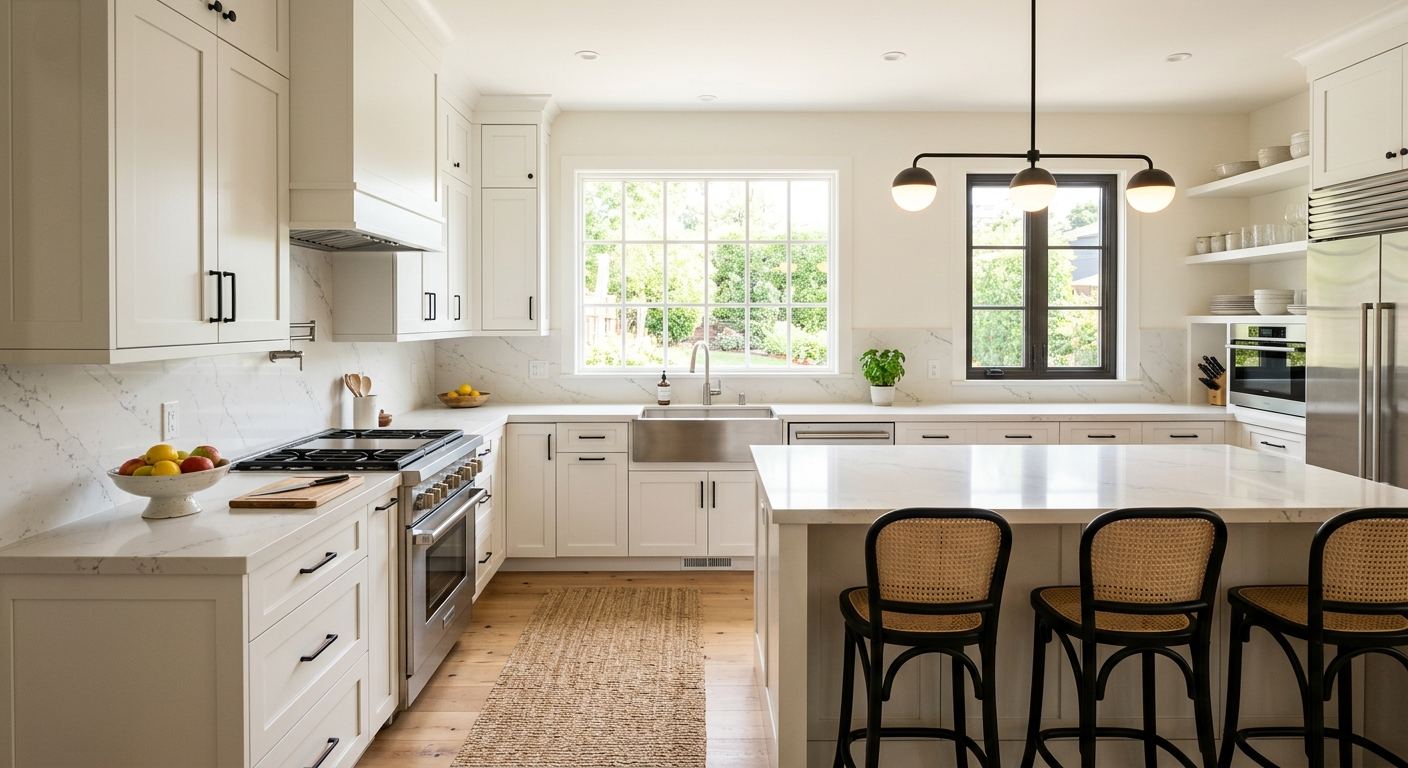
Kitchen renovation options and costs in Fiddlesticks
In Fiddlesticks, homeowners usually start their kitchen renovation by deciding how big a change they want to make—because that choice quickly sets your budget. With a population of 17,576 (Statistics Canada, 2021 Census), the area follows the broader Toronto economic pattern: kitchens are often treated as a resale and daily-lifestyle upgrade rather than a purely functional remodel. In Toronto-region markets, many owners align kitchen spending with household purchasing power, and that’s why finish expectations are commonly higher than in smaller towns. In the Toronto economic region, projects tend to track local home value and income more than weather; you’ll see more quartz, upgraded hardware, and custom detailing where property values are higher, since the cost is easier to “recover” at resale.
Even though kitchens aren’t exposed like exterior systems, Ontario’s freeze–thaw cycles still matter indirectly. If your home is older, seasonal movement can loosen caulking around sink and backsplashes, making a “refresh” less straightforward than it sounds. Also, contractor availability in the GTA concentrates around peak spring–summer schedules, which can tighten labour capacity and push start dates.
Within the Fiddlesticks-area demand pattern, contractors often see the strongest booking interest on the more established residential pockets near the community’s busy service corridors—where homeowners commonly update cabinetry and countertops to keep pace with buyer expectations. Once you know which renovation tier you’re aiming for, you can compare what’s typically included and how long each scope takes.
| Renovation Tier |
What's Included |
Typical Duration |
Price Range |
| Cosmetic refresh (paint, hardware, new appliances only) |
Cabinet paint or stain touch-ups, new hardware/pulls, appliance swap, minor patching, basic cleaning |
1–2 weeks |
$10,000–$25,000 |
| Mid-range full renovation (new cabinets, counters, sink, tile) |
Semi-custom or stock cabinets, new countertops, undermount sink and faucet, backsplash tile, under-cabinet lighting (optional), flooring refresh where needed |
3–6 weeks |
$25,000–$60,000 |
| High-end full renovation (custom cabinets, stone counters, island) |
Fully custom millwork, premium quartz or natural stone, larger island cabinetry, upgraded appliance package, upgraded lighting, expanded tile/feature backsplash, plumbing/electrical upgrades as needed |
6–10 weeks |
$60,000–$90,000 |
| Cabinet refacing only (new doors + drawer fronts, same boxes) |
New door/drawer fronts, veneer/laminate face on existing boxes, new hardware, simple trim adjustments (where feasible) |
1–3 weeks |
$8,000–$30,000 |
| Countertop swap only (laminate to quartz or stone) |
Removal and install of new counters, sink/faucet cut-outs (if reusing fixtures), adhesive/seal work, caulking, basic backsplash tie-in (as scope allows) |
3–7 days |
$3,000–$15,000 |
| Backsplash tile installation only |
Ceramic tile backsplash, grout/seal, surface prep, edge trim, allow for minor outlet cover adjustments |
3–7 days |
$2,000–$10,000 |
Prices are estimates only and vary by project scope, site access and material selection.
What affects the price of kitchen renovation in Fiddlesticks
Even when two homeowners ask for the “same” kitchen in Fiddlesticks, quotes can differ by 30–50% across the Toronto area because labour availability, material procurement, and scope definitions vary. In practice, the largest drivers are local home value and median-income purchasing power, which determine how likely a household is to choose quartz or natural stone and semi-custom (or custom) cabinetry versus laminate and stock options. In higher-value pockets of the GTA, homeowners often default to premium finishes because buyers tend to expect them, and the renovation cost is more easily justified at resale. In more price-sensitive areas, many projects stay in the mid-range: refacing or semi-custom cabinets plus durable laminate or standard quartz to balance affordability with resale value.
Layout changes are the most unpredictable cost regardless of finish tier. Removing a wall, adding an island, or moving plumbing/gas lines changes trade coordination and can trigger permit and inspection requirements, which adds both time and cost. In Fiddlesticks homes that are older, you may also find out after demolition that subfloor or cabinet walls need shimming, re-fastening, or moisture correction—small fixes that add labour.
Concrete examples that commonly move price up or down locally: (1) switching from a laminate top to quartz typically lands you in the countertop band of about $3,000–$15,000, but if you require sink cut-outs and edge profiles, the job leans high-end; (2) upgrading to full-height backsplash with tile from counter to hood height can push your tile installation toward the upper end of $2,000–$10,000; (3) adding an island often requires new electrical runs, which tends to be a major line-item even when the cabinets themselves are mid-range. Whether you’re targeting a mid-range full renovation around $25,000–$60,000 or planning higher-end work near $60,000–$90,000, the finish tier is the main cost driver—but the plumbing/electrical and layout scope decides your final number.
| Price Factor |
Why It Matters |
Cost Impact |
| Cabinet tier — stock vs. semi-custom vs. fully custom millwork |
Higher tiers improve fit, hardware options, interior organization and customization for odd angles or ceiling heights |
$8,000–$35,000 (cabinet-related scope varies widely) |
| Countertop material — laminate vs. quartz vs. granite vs. stone |
Material cost, install complexity (seams, thickness), and edge profiles affect both labour and waste |
$3,000–$15,000 (countertop installation) |
| Layout change — wall removal, island add, plumbing/gas move |
Trade coordination and structural/electrical/plumbing complexity increases unpredictability |
$5,000–$25,000 added for typical “real” layout changes |
| Appliance package tier — builder vs. mid-range vs. pro-grade |
Differences in finish quality, power requirements, ventilation needs and warranty terms |
$2,000–$10,000 |
| Flooring — refinish existing vs. full replacement |
If subfloor or adhesive issues are found during demo, full replacement costs rise |
$1,500–$8,000 |
| Backsplash — ceramic tile vs. marble vs. full-height slab |
More cuts, heavier materials and full-height installs increase labour and material handling |
$2,000–$10,000 |
| Electrical — new circuits for island, under-cabinet lighting |
New receptacles, lighting runs and panel capacity checks drive electrician time |
$1,500–$7,000 |
| Permit fees and licensed trade requirements |
Work involving gas, structural changes, or new/changed electrical circuits can trigger permits and inspections |
$500–$4,000 (varies by scope) |
Permits & regulations in Ontario
For most straightforward kitchen upgrades in Ontario, you can move quickly without permits. For example, cabinet and countertop swaps typically do not require permits. Likewise, swapping finishes like paint, installing a backsplash, and replacing fixtures (as long as plumbing points don’t move) are generally permit-light.
Permits and inspections do come into play when you change the building systems. In Fiddlesticks, that means work such as moving plumbing supply or drain lines, relocating a gas stove or gas-fired range hood, removing a load-bearing wall, or adding new electrical circuits (like extra receptacles for an island or adding more dedicated lines) usually requires permits and licensed trades. Gas work must be completed by a licensed gas fitter, and electrical work must be completed by a licensed electrician—both must be inspected where required.
To verify your contractor before you sign, follow a simple checklist:
- Ask for contractor licence details (and confirm the licence online using Ontario’s trade/regulatory resources where applicable).
- Request a current certificate of insurance (liability) and confirm it covers renovations and includes an appropriate coverage amount.
- Confirm WSIB/WCB coverage for workers (request proof before work starts).
- Request a clearance letter or proof of clearance if your contractor uses sub-trades.
- Ensure the contract clearly states who pulls permits (and who is responsible for inspection sign-offs).
If permit responsibility isn’t clearly written into your contract, it’s a risk you’ll pay for later—usually through delays, rework, or denied inspections.
Cabinets, countertops and layout decisions in Fiddlesticks
Your Fiddlesticks kitchen renovation should start with three decisions that have the biggest impact on cost and satisfaction: (1) cabinet tier, (2) countertop material, and (3) layout changes. Cabinet tier sets the foundation. Stock cabinets are usually the fastest and cheapest, but they’re less forgiving for out-of-square walls and unusual dimensions common in older housing stock. Semi-custom cabinets are typically the most popular mid-range choice in the Toronto market because they balance better fit with predictable pricing. Custom cabinets deliver the best fit and organization, but they’re where timelines and costs grow quickly—especially when you’re adding specialty corners or ceiling-height storage.
Countertops are the second lever. Laminate is budget-friendly and easy to update, but it’s less resilient to heat and sharp impacts. Quartz is the most common “upgrade” because it’s durable and low maintenance, while granite/natural stone offers premium appearance at a higher material and installation cost. Butcher block is warm and forgiving for daily cooking, but it requires ongoing sealing and care to prevent staining and warping. Marble looks high-end, but it’s more stain-sensitive and needs mindful maintenance.
The third decision is layout. In many GTA homes, the most justified cost is adding functional circulation—like improving sightlines or adding an island—when it improves daily workflow. If you’re moving plumbing or gas lines, that’s often where the budget jumps regardless of cabinet/stone choice.
Here’s a practical dollar example: if you’re choosing between a mid-range full renovation around $25,000–$60,000 with laminate counters and a higher-end spec with quartz and a feature island near $60,000–$90,000, the extra cost usually makes sense when you’re also upgrading layout and lighting—not just swapping materials on the same layout.
| Option |
Durability |
Maintenance |
Best For |
Price Range |
| Stock cabinets (big-box) |
Good for standard sizes; can be impacted by uneven walls if not adjusted |
Low—focus on hardware and routine cleaning |
Fast refreshes with predictable measurements |
$8,000–$20,000 |
| Semi-custom cabinets (local dealer) |
Very solid; better adjustment for common non-standard spaces |
Low—typical cleaning; more options for organizers and finishes |
Most renovations targeting resale value and a modern look |
$15,000–$35,000 |
| Custom cabinets (local millwork shop) |
Excellent fit and finishing; designed for your exact wall conditions |
Low—built for longevity with premium hardware and finishes |
Complex kitchens, ceiling-to-floor storage, and premium styling |
$30,000–$55,000 |
| Laminate countertop |
Decent impact resistance; vulnerable to heat and deep cuts |
Low—avoid hot pans directly and use cutting boards |
Budget-friendly refreshes and quick resale upgrades |
$3,000–$7,000 |
| Quartz engineered countertop |
High durability; resists staining and everyday wear well |
Low—regular soap-and-water cleaning |
Families who want a premium look without heavy upkeep |
$7,000–$14,000 |
| Granite / natural stone countertop |
Very durable and heat-tolerant; unique patterning varies by slab |
Moderate—may require periodic sealing depending on stone |
Premium style seekers and classic, timeless kitchens |
$9,000–$15,000 |
| Butcher block countertop |
Good everyday durability; can scratch and dent but looks natural over time |
Higher—regular sealing/maintenance recommended |
Home chefs and warm, casual kitchen aesthetics |
$6,000–$12,000 |
| Marble countertop |
Beautiful but more prone to etching and staining than quartz |
Higher—needs careful use of cleaners and protection |
Low-traffic kitchens aiming for a luxury aesthetic |
$10,000–$18,000 |
How to choose a kitchen renovation contractor in Fiddlesticks
Choosing the right contractor in Fiddlesticks comes down to verification and clarity. First, confirm Ontario licensing where it applies to their trades, and request documentation for liability insurance and WSIB/WCB coverage. For liability insurance, ask for a certificate of insurance showing renovation coverage and the correct insured party. For WSIB/WCB, request proof of clearance or coverage documentation before work begins—don’t wait until the first day on site. If the contractor uses sub-trades, ask who is responsible for pulling permits and who holds each trade’s coverage and insurance.
Next, get 2–3 itemised written quotes. You want a breakdown that separates labour vs. materials, and clearly lists line items for demo, cabinet installation, countertop install, backsplash tile, electrical/plumbing allowances, and disposal. A lump-sum number without scope detail is where surprises hide.
Read the scope carefully for exclusions: is permit pulling included or billed separately? Is demolition disposal included? Are appliances included or “allowances”? What happens if your home’s existing plumbing connections need rework after demo?
Also review warranty terms. A good contractor provides a workmanship warranty (often covering installation-related issues) and specifies the product/manufacturer warranty. Confirm whether any warranty is transferable if you sell the home.
For payment, use a schedule that never spikes upfront. In practice, many homeowners should limit initial deposits to about 10–15%, then hold back a portion until key completion milestones.
- Confirm WSIB/WCB and liability insurance before signing the contract.
- Ask for a detailed, itemised quote (labour + materials, not just a total).
- Verify who pulls permits and who pays for inspections if required.
- Check that demolition and disposal are included (or explicitly excluded).
- Ensure electrical/plumbing allowances are clearly stated.
- Get start date and completion target in writing.
- Confirm product lead times for cabinets and countertops.
- Ask about backsplash prep requirements and who does surface correction.
- Review warranty length for workmanship and manufacturers’ warranties.
- Ask whether the warranty is in writing and who provides it.
- Use milestone-based payments; avoid large upfront deposits.
- Request references for recent kitchens with similar scope and finishes.
Red flags: (1) contractor won’t provide insurance/WSIB proof; (2) quote is only a single number with no line-item scope; (3) no written timeline or start/completion dates; (4) “permit included” is promised but not defined in the contract; (5) pressure to pay more than 10–15% upfront or demanding payment before milestones.
Frequently asked questions — kitchen renovation in Fiddlesticks
Custom vs stock cabinets — is custom worth it?
In Ontario kitchens like those in Fiddlesticks, custom cabinets are worth it when your space has layout quirks—out-of-square walls, awkward ceiling heights, or a layout that needs specialty storage (pantries, appliance garages, or unusual corner systems). If your measurements are standard and you want the project done fast, stock or semi-custom is often a better value. The budget shift is real: stock kitchens often land in the mid-to-low cabinet-related ranges, while custom millwork pushes you toward higher total renovation tiers. If your plan is a mid-range full renovation around $25,000–$60,000, you’ll usually get a more balanced upgrade by choosing semi-custom cabinets plus quartz. Going fully custom usually makes sense when the total scope is closer to the $60,000–$90,000 range and the design needs truly justify the extra labour and material time.
How do I choose a kitchen contractor in Fiddlesticks?
Start by verifying Ontario trade coverage: request liability insurance documentation and confirm WSIB/WCB coverage (or clearance proof) before any demo work begins. Ask for itemised quotes that show labour and materials separately, plus allowances for electrical/plumbing and disposal. In Fiddlesticks, where many homes are older, you also want a contractor who budgets time for discovery—like confirming plumbing lines and checking subfloor condition after cabinets come out. Make sure the contract clearly states permit responsibility (what’s required and who handles it), and that it includes a written schedule with start and completion dates. A reliable contractor will also outline warranty terms: a workmanship warranty and clear manufacturer warranty documentation. If a quote feels too vague, or if the contractor refuses to put scope details in writing, that’s usually the biggest risk.
What order do kitchen renovation steps happen in?
A typical kitchen renovation sequence in Ontario starts with measuring and finalizing layout and selections, then scheduling materials (especially cabinets and countertops). Next comes site protection and demolition of existing finishes (and cabinets, if applicable). Once the rough opening is exposed, trades handle “rough” work in order: plumbing/electrical adjustments, then framing/patching where needed. After inspections (when required), drywall repairs and priming happen, followed by cabinet installation. Then counters are templated/installed, sinks and faucets are fitted, and backsplash tile is completed. Flooring and final trim usually land near the end, followed by caulking, sealing, and appliance installation. If you’re only doing a countertop swap or backsplash tile installation, the sequence compresses, but the principle remains: rough work first, cabinetry/counters next, then finish details. For many mid-range renovations around $25,000–$60,000, the full sequence takes about 3–6 weeks depending on trade scheduling and material lead times.
Can I live at home during a kitchen renovation in Fiddlesticks?
Sometimes, yes—but it depends on how invasive your scope is. In Fiddlesticks, many homeowners choose to remain in the home for cosmetic refreshes or partial renovations (like refacing or a countertop swap), because the disruption is localized and a temporary kitchen setup is easier to arrange. For a mid-range full renovation around $25,000–$60,000 that includes new cabinets, countertops, and tile, you can often stay if another cooking area is available (commonly a temporary BBQ setup and a microwave/portable cooktop strategy). If your renovation involves moving plumbing/gas lines or opening walls for layout changes, it usually becomes harder to live comfortably day-to-day due to dust, schedule length, and system shutoffs. A good contractor will plan staging, dust control, and a realistic timeline so you know which days you’ll have limited use of sink, stove, or power. When unsure, ask for a phased plan and expected “no-water/no-power” windows.
Should I renovate my kitchen before selling in Fiddlesticks?
In many GTA-style markets around Fiddlesticks, renovating before selling can be smart, but the key is choosing improvements buyers can quickly see and trust. High-end custom work can add appeal, yet it must match the home’s overall market expectations. Many homeowners get stronger resale results by upgrading the visible “high-impact” components: cabinets and countertops, and updating lighting and backsplash. If you’re aiming for a refresh that preserves budget, a mid-range renovation around $25,000–$60,000 often targets the finish tier buyers expect without overspending relative to the rest of the property. If you’re considering a bigger transformation (island, premium stone, expanded electrical), it can still work—just ensure it aligns with your neighbourhood’s buyer profile and the kitchen’s functional layout. Also consider timeline: if your home will list in the next few months, delays in countertops/cabinets can harm your schedule. A contractor should help you plan lead times and sequence so you’re not stuck mid-install when you want to list.
What's the most popular kitchen style in Fiddlesticks right now?
Right now in the Fiddlesticks/greater Toronto market, the most popular direction is a clean, modern look with practical finishes: flat-panel or simple shaker profiles, warm neutral colour palettes (soft whites, greige, or light taupe), and quartz countertops that read consistently in daylight. Many homeowners pair this with a functional backsplash—often full-height tile behind the main cooking run—to look complete and feel “new” to buyers. Hardware is also trending toward brushed finishes and streamlined pulls. From a cost perspective, quartz and semi-custom cabinetry commonly land in the mid-to-upper renovation ranges, which is why you’ll often see projects that sit around the $25,000–$60,000 band for balanced upgrades, and higher-end selections trending toward $60,000–$90,000 when islands and more involved electrical/plumbing are included. If your home has older trim or darker flooring, ask your contractor how colours and lighting will work together so the kitchen doesn’t look mismatched as seasons change.