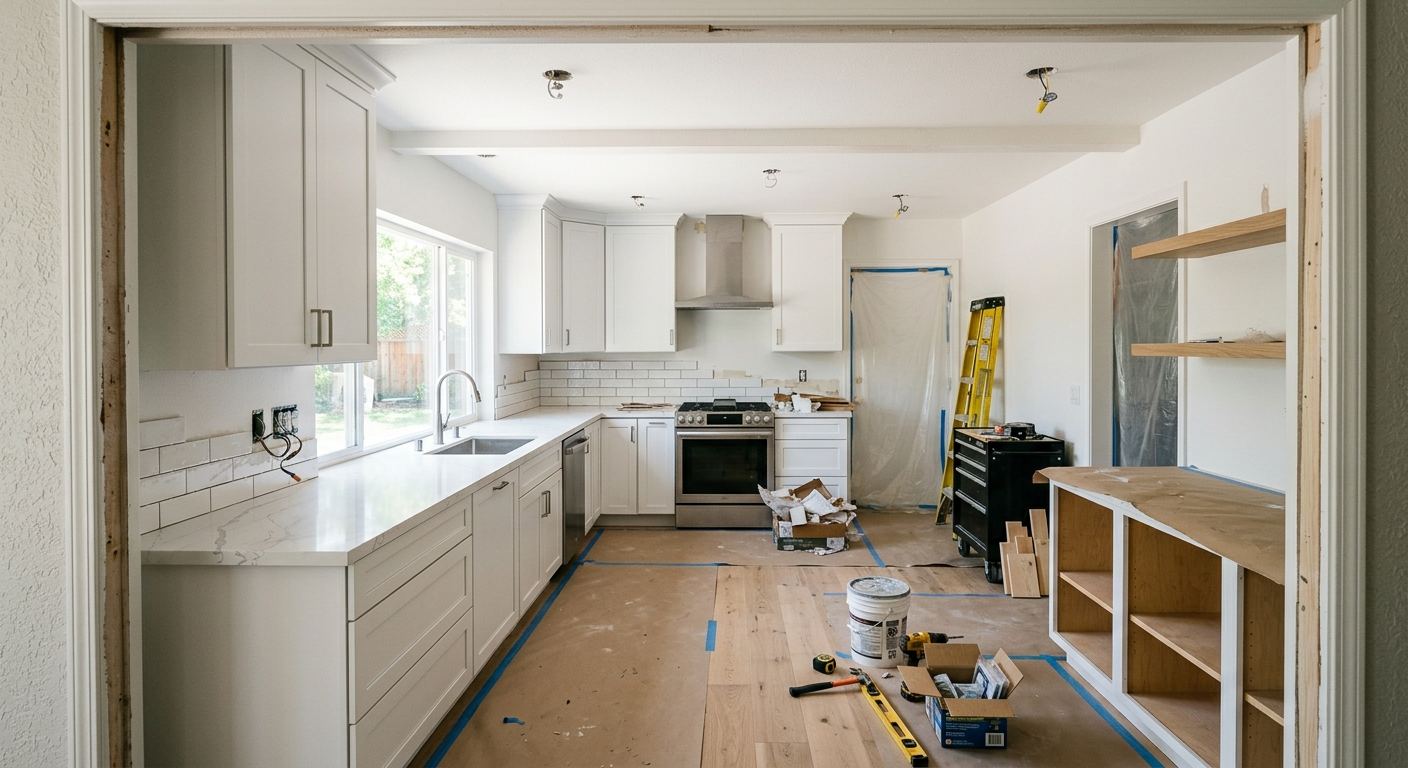
Kitchen renovation options and costs in Millet
Millet homeowners can choose from several kitchen renovation paths, and the price difference usually comes down to finish tier and how much the layout changes. With a median household income of $81,000 (Statistics Canada, 2021 Census) and a homeowner-heavy market (82.5% of households own), most bids in the Edmonton economic region are built around mid-range value and resale expectations rather than “over-custom” one-off designs. In Millet specifically, the trade is active around the hamlet’s more established pockets and older subdivisions—especially where many homes were built before 1981—because buyers tend to want an updated, modern kitchen without the delays of a full rebuild.
While Edmonton-area conditions are cold and snowy, climate doesn’t usually drive kitchen budgets the way market value and buyer expectations do. Contractors still plan for slower drying times for adhesives and coatings, and for easier jobsite protection during freeze–thaw weather, but the biggest cost swings come from cabinetry style and whether plumbing or gas lines move. In practice, local quoting patterns also reflect contractor availability: the more trades involved (carpentry, electrical, gas fitting, flooring, counter installation), the more scheduling affects total cost.
To help you compare apples to apples, below are the common renovation tiers and realistic ranges used by Edmonton-area crews that work in Millet—followed by how to read your estimate.
| Renovation Tier |
What's Included |
Typical Duration |
Price Range |
| Cosmetic refresh (paint, hardware, new appliances only) |
Cabinet paint or repaint (or trim/paint package), new pulls/knobs, backsplash patch/refresh if needed, swap select appliances (no major plumbing/gas moves), basic lighting refresh |
3–7 days |
$8,000–$18,000 |
| Mid-range full renovation (new cabinets, counters, sink, tile) |
Semi-custom or quality stock cabinets, quartz countertops, new sink + faucet, tile flooring or LVP/tile hybrid, backsplash tile, updated lighting, disposal/venting hook-up where applicable |
2–4 weeks |
$35,000–$65,000 |
| High-end full renovation (custom cabinets, stone counters, island) |
Fully custom millwork, stone countertops (granite or premium engineered stone), island with upgraded lighting, more complex tile pattern, enhanced trim and finish details, higher-spec appliances |
4–8 weeks |
$70,000–$90,000 |
| Cabinet refacing only (new doors + drawer fronts, same boxes) |
Door/drawer replacement, new hinges/slides hardware, paint or prep on existing carcasses as required, minimal countertop and plumbing changes |
1–2 weeks |
$8,000–$22,000 |
| Countertop swap only (laminate to quartz or stone) |
Remove/replace countertop, new undermount sink re-set if included, fresh caulking at edges, reuse existing cabinets (unless damage is found), backsplash cut-in/adjustments as needed |
3–7 days |
$2,500–$12,000 |
| Backsplash tile installation only |
Tile supply and install for standard-height backsplash (or partial to full height if specified), surface prep, trim/edge pieces, grout/seal, clean-up |
2–5 days |
$2,000–$8,000 |
Prices are estimates only and vary by project scope, site access and material selection.
What affects the price of kitchen renovation in Millet
In Edmonton-area quoting, it’s common to see the “same” kitchen renovation come in 30–50% apart—mostly because contractors build estimates around different assumptions for cabinetry tier, finish level, and how much hidden work is discovered once demolition starts. Even in a smaller community like Millet, the labour mix is still Edmonton-sourced: if your job requires more coordination between countertop installers, electricians, gas fitters and floorers, the schedule complexity can raise labour costs. That’s why two projects with identical cabinet footage can land very differently.
Homeowner income and home values tend to steer the finish tier far more than weather does. In higher-value Edmonton pockets, owners more often choose quartz or stone counters and semi-custom cabinetry because the upgrade is easier to recover on resale. In more price-sensitive areas, laminate and stock cabinets dominate to keep your project closer to a controlled mid-range budget (for example, a mid-range full renovation often targets roughly $35,000–$65,000). Layout changes—removing a wall, adding an island, or moving a gas line—create the most unpredictable costs because they trigger additional trades and sometimes permit requirements. Those same factors can also push you toward high-end investment levels (commonly $70,000–$90,000) even if the square footage stays the same.
Millet’s housing stock matters too: since 47.5% of homes were built before 1981 (Statistics Canada, 2021 Census), older plumbing runs, dated electrical panels, or uneven walls can increase labour time for prep and re-installation. Freeze–thaw can also affect caulking and floor levelling—an extra day spent on proper subfloor prep is often the difference between a floor that holds and one that needs rework.
| Price Factor |
Why It Matters |
Cost Impact |
| Cabinet tier — stock vs. semi-custom vs. fully custom millwork |
Tier affects material quality, door profiles, internal layout, warranty terms, lead times, and how much trim/fit work is needed on older walls. |
Typically the largest driver; can swing total budget by 20–35% depending on scope. |
| Countertop material — laminate vs. quartz vs. granite vs. stone |
Material cost, fabrication complexity, weight, and edge/detail options change both product and installation labour. |
Often adds $3,000–$15,000+ versus laminate depending on size and edges. |
| Layout change — wall removal, island add, plumbing/gas move |
Triggers structural considerations, new lines, potential inspections, and drywall/finish work that expands labour. |
Can add $8,000–$25,000+ even with mid-range finishes. |
| Appliance package tier — builder vs. mid-range vs. pro-grade |
Pro-grade appliances cost more and often require clearer ventilation and fit tolerances for cabinetry. |
Can vary $2,000–$10,000+ based on package and venting needs. |
| Flooring — refinish existing vs. full replacement |
If subfloors are out of level or damaged, replacements expand work beyond the visible surface. |
Usually $1,500–$7,000+ depending on surface area and prep. |
| Backsplash — ceramic tile vs. marble vs. full-height slab |
Premium materials and full-height installs demand more cutting, more labour hours, and careful waterproofing details. |
Often ranges from a few thousand up to $8,000+ or more. |
| Electrical — new circuits for island, under-cabinet lighting |
Electrical upgrades require licensed trades, wiring runs, and sometimes panel capacity review. |
Commonly adds $1,000–$6,000+ depending on circuits and complexity. |
| Permit fees and licensed trade requirements |
Some changes require permits and inspections; paperwork and scheduling impact the project timeline and cost. |
Can add $500–$3,000+ (plus labour coordination time) where applicable. |
Permits & regulations in Alberta
In Alberta, a simple cabinet and countertop swap typically does not require a permit, because you’re not changing the building’s major systems. That said, kitchen renovations in Millet often go beyond “swap only” work. The big line to watch is anything that alters plumbing, gas, structure, or electrical circuits. If you’re moving water supply lines or drains, relocating a range, adding or rerouting a gas line, removing a load-bearing wall, or adding electrical circuits (for example, wiring a new island power point or adding multiple under-cabinet circuits), you should plan for permits and licensed trades. Gas work must be carried out by a licensed gas fitter, and electrical work must be done by a licensed electrician; both require inspections before cover-up.
Here’s a practical verification process homeowners can follow before signing in Millet: first, ask the contractor for their Alberta licence numbers and confirm them through the applicable online licence registry. Next, request a current certificate of insurance (liability coverage) and confirm the policy is active for the renovation period. Also ask for proof of WSIB/WCB coverage (or the applicable coverage evidence used by the contractor) so you’re not left exposed if a worker is injured on site. Finally, check that their quote clearly states who pulls permits (and who pays permit/inspection fees). If it’s not written into the contract, add language—responsibility must be clear from day one.
Cabinets, countertops and layout decisions in Millet
In a Millet kitchen renovation, three decisions usually determine 80% of your experience and cost: (1) the cabinet tier, (2) the countertop material, and (3) whether you change the layout. Cabinet tier affects both look and day-to-day usability. Stock cabinets are typically the fastest and cheapest, with limited door styles and standard internal layouts. Semi-custom cabinets are the most common mid-range pick in the Edmonton economic region because they balance reasonable pricing with better fit—especially on older Millet walls. Custom cabinets are best when you need unusual dimensions, integrated storage, or a truly built-to-fit design that reduces gaps and awkward fillers.
Countertops are where buyers often “feel” the upgrade immediately. Laminate is budget-friendly and durable for everyday use, but it doesn’t carry the same resale appeal as quartz or natural stone. Quartz is the practical step-up: it’s low-maintenance, consistent in colour, and easier to live with through Edmonton-area temperature swings. Granite and marble look premium, but they require more careful sealing and can cost more to fabricate. Butcher block can be a great warmth choice, yet it needs sealing and more homeowner attention.
Layout changes are where costs jump unpredictably. Opening up a wall or adding an island can justify the expense if it improves traffic flow and adds seating/storage—however, moving plumbing or gas lines can turn a “mid-range” project into a “high-end” one quickly. As a concrete example: if a mid-range refresh sits around $35,000–$65,000, adding a new island location with electrical plus plumbing/gas rework can push you toward the $70,000–$90,000 band even if you keep cabinetry semi-custom.
| Option |
Durability |
Maintenance |
Best For |
Price Range |
| Stock cabinets (big-box) |
Good everyday durability; most doors are built for typical household use but limited to standard sizes. |
Low; wipe clean, inspect hardware, and keep moisture away from seams. |
Cost control, quick turnarounds, and straightforward layouts. |
$8,000–$20,000 |
| Semi-custom cabinets (local dealer) |
Very durable; better internal options (drawers, organizers) and improved fit for uneven walls. |
Low; routine cleaning and hardware tightening as needed. |
Most Millet renovations targeting strong resale value. |
$18,000–$40,000 |
| Custom cabinets (local millwork shop) |
Highest durability potential with best fit and material choices for your exact dimensions. |
Low to moderate; same care as quality cabinetry, plus protection from steam at cooking zones. |
Unique layouts, integrated storage, and “built-in” design look. |
$35,000–$60,000+ |
| Laminate countertop |
Solid for daily wear; seam quality matters and heavy impact can chip edges. |
Low; avoid standing water at seams, use cutting boards, and replace damaged sections if needed. |
Budget-first upgrades where you want new faces without premium stone. |
$2,500–$6,500 |
| Quartz engineered countertop |
Highly durable and consistent; resists staining and daily wear extremely well. |
Low; wipe clean, no sealing, and use normal care for hot items (trivets). |
Millet kitchens that need a “premium look” with homeowner-friendly upkeep. |
$6,000–$12,000 |
| Granite / natural stone countertop |
Very durable; unique veining and heat tolerance, with performance depending on the specific stone. |
Moderate; usually requires periodic sealing and careful stain prevention. |
When you want real stone character and the highest visual impact. |
$7,000–$14,000 |
| Butcher block countertop |
Durable for food prep but susceptible to dents and moisture at edges if not maintained. |
Moderate; regular oiling and prompt drying after spills. |
Warm, rustic or transitional styles; homeowners willing to maintain. |
$4,000–$10,000 |
| Marble countertop |
Premium look; can be more porous and sensitive to etching than quartz unless well sealed and cared for. |
Higher; requires sealing and careful protection from acids and hard water spots. |
High-end aesthetic kitchens where homeowners want a luxury finish. |
$10,000–$18,000+ |
How to choose a kitchen renovation contractor in Millet
When you’re picking a kitchen contractor for a Millet renovation, licensing and coverage matter as much as the design. Start by asking for their Alberta licence information (for the trades involved) and proof of liability insurance. Then verify WSIB/WCB coverage for worker safety—request documentation, don’t just “assume it’s in place.” If the contractor is coordinating subcontractors, make sure you receive insurance certificates for each trade (or confirm they’re covered under the main contractor’s arrangements). In a kitchen, you’ll commonly have carpentry, electrical, plumbing/gas fitting (when required), flooring and countertops—all of which should be covered.
Next, get 2–3 itemised written quotes. You want labour and materials broken out (cabinets, countertop fabrication, demolition, flooring prep, electrical lines, permit pull if included). Avoid quotes that only give you a lump sum with no scope details. Read the scope line-by-line: what’s excluded (old cabinet removal, dump fees, subfloor repair, disposal, wiring for new lights)? Is permit pulling included, and who pays the permit/inspection costs? Ask about waste disposal and whether dump fees are included.
Warranty should be explicit: workmanship warranty length, product/manufacturer warranty terms, and whether it transfers if you sell the home. For payment schedule, keep it controlled—never pay more than 10–15% upfront, and use a holdback until completion or key milestones. Finally, require a written start date and completion estimate, and ask how they handle winter work delays.
- Confirm the contractor’s Alberta licence (and licences for involved trades) before signing.
- Ask for certificate of liability insurance with coverage amounts and renovation-period validity.
- Request WSIB/WCB clearance documentation for their workers.
- Get 2–3 quotes with line-item labour and materials (not just “kitchen package”).
- Ensure the scope states who removes and disposes of old materials and whether dump fees are included.
- Confirm permit responsibility and whether permits/inspections are included in the price.
- Check exclusions: subfloor repairs, drywall patching, electrical upgrades, and lighting fixtures.
- Ask about lead times for cabinets and stone; confirm installation date assumptions.
- Require countertop fabrication specs (edges, sink cut-out, overhangs) in writing.
- Verify warranty: workmanship duration, what voids it, and manufacturer warranty details.
- Use a payment schedule with no large deposits (target 10–15% max upfront) and a holdback.
- Ask for a timeline that includes inspection lead times if electrical/gas permits apply.
Red flags I see in Millet when projects go sideways: a quote that’s not itemised, promises like “no permits ever” even when moving plumbing/gas/electrical, refusal to share insurance and coverage proof, no clear warranty terms in writing, and pressure for a large upfront deposit before any measured drawings or final selections.
Frequently asked questions — kitchen renovation in Millet
What's the most cost-effective kitchen upgrade?
The most cost-effective upgrade in Millet is usually a targeted refresh that upgrades the “visible surfaces” without triggering major trades—think new cabinet hardware, a quality cabinet paint, updated lighting, and a modern appliance swap. If your goal is a noticeable change with minimal disruption, pairing that with a backsplash install can be a strong value. For budgets closer to $8,000–$18,000, this approach can deliver a modern look while avoiding the biggest cost drivers like cabinet tiers, stone fabrication, and layout work. If your cabinets are structurally sound but dated, cabinet refacing can also be a smart mid-cost step. The key is to avoid adding layout changes unless you’re certain you need them for functionality and resale.
Custom vs stock cabinets — is custom worth it?
Custom cabinets can be worth it when Millet’s layout (often tighter older home plans) needs perfect fit—like non-standard wall dimensions, integrated pantry details, or a specific storage system that stock options can’t match. However, if your kitchen is “square and simple” and you mainly want a fresh look, stock or semi-custom usually delivers better cost-to-results. In Edmonton-area resale expectations, most buyers respond strongly to clean lines, durable finishes and sensible storage, which semi-custom can cover well. Custom often pushes you into the higher end of total renovation investment—commonly $70,000–$90,000 for full renovations when combined with premium stone and island work. So the real question isn’t “is custom better,” it’s whether the extra fit and millwork design solves a specific problem in your kitchen.
How do I choose a kitchen contractor in Millet?
Start by verifying Alberta compliance: ask for proof of liability insurance and WSIB/WCB coverage, and confirm the trades involved are properly licensed (especially electrical or gas work). Then compare 2–3 itemised written quotes that separate labour and materials—this is how you see whether one contractor is underpricing with exclusions (like disposal fees or drywall patching) or cutting corners. In Millet, where many homes were built before 1981 (Statistics Canada, 2021 Census), hidden prep issues are common, so a contractor should walk you through how they handle uneven walls, older plumbing connections, and subfloor condition. Finally, read the warranty and payment schedule carefully: limit upfront payment to about 10–15%, hold back until milestones are met, and ensure timelines are in writing.
What order do kitchen renovation steps happen in?
In a typical Millet renovation, the order matters because it prevents rework. Generally: (1) measure and finalize selections (cabinets, counters, tile, appliances), (2) protect the jobsite and remove old cabinets/countertops, (3) complete any framing/drywall work and rough electrical/plumbing/gas changes if required, (4) install flooring (or prep subfloor first if the design requires it), (5) install cabinets (leveling and fit), (6) install countertops and sink/faucet cut-outs, (7) install backsplash tile, (8) finish electrical (lights, outlets), then (9) set appliances, caulk, and final clean-up. If permits are required, inspections happen after rough-in and before cover-up. Your contractor should provide a written sequence aligned with their subcontractor schedule, especially for stone fabrication lead times.
Can I live at home during a kitchen renovation in Millet?
Often yes, especially for cosmetic refreshes, refacing, or countertop/backsplash-only projects, where the disruption is limited. For a mid-range full renovation (commonly $35,000–$65,000), living at home is possible but typically requires a plan for dust control, a temporary cooking setup, and access to at least one bathroom. For full high-end renovations with structural or layout changes, you may want to consider moving out for the noisiest or highest-disruption stages (demolition and rough-ins). Winter conditions in the Edmonton area also affect comfort—contractors need space to protect doors/windows and keep adhesives/fillers within workable temperatures. The right approach is to agree on “work zones,” parking/access, and how trash and debris will be managed daily before the project starts.
Should I renovate my kitchen before selling in Millet?
If you’re selling in the Millet market, a kitchen renovation should be tied to buyer expectations and not just personal preference. The smartest renovations usually focus on what buyers can see quickly: clean cabinetry lines, modern countertops (quartz is a common “safe” choice), updated lighting, and a layout that feels functional. For many homes, upgrading cabinetry and counters is where you get the best perceived value without over-improving the house for the neighbourhood. Since homeowner households dominate (82.5% own, Statistics Canada, 2021 Census) and median household income is around $81,000, buyers often respond well to mid-range upgrades rather than extremely high custom millwork. If your plan pushes you into $70,000–$90,000 full renovation territory, consider whether your house will actually benefit on resale or whether a mid-range project in the $35,000–$65,000 range would deliver the strongest “move-in ready” outcome.