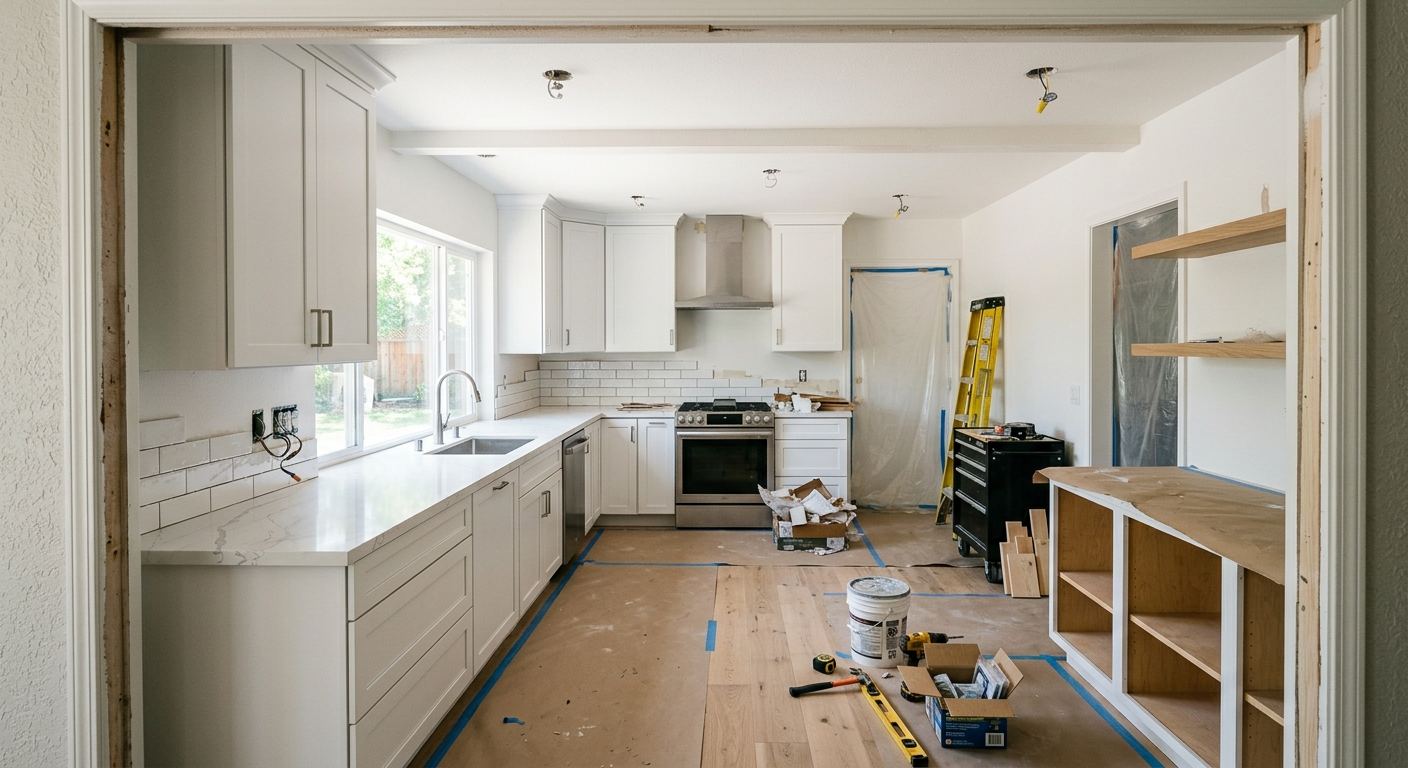
Kitchen renovation options and costs in Springbank Hill
Springbank Hill, Alberta homeowners typically renovate kitchens with resale in mind, and that’s why your budget choices often look different than the same job in lower-value markets. With a population of 9,840 (Statistics Canada, 2021 Census), the area draws steady demand for turn-key upgrades from contractors who know Calgary buyers want clean lines and durable finishes. In the Calgary economic region, higher-value neighbourhoods often steer projects toward quartz or natural stone counters and semi-custom cabinetry—less because of weather and more because homeowners can justify the spend as part of overall home value. Market expectations matter: in these higher-value pockets, kitchen refreshes frequently land around 10–15% of a home’s value, while full redesigns can climb toward 20–25% when layouts change.
Calgary’s winter isn’t what drives the price per se, but it does affect scheduling. Trades are busier between fall and spring, and delivery times for cabinetry and stone can stretch if a shop is at capacity—so lead times become a budget variable. You’ll also see labour pressure translate into higher labour lines, because skilled installation in Calgary often runs about 90–140 per hour, and kitchens bundle carpentry, electrical, plumbing, and tile work. In Springbank Hill specifically, trade demand is especially noticeable around the west and northwest residential corridors where larger, established homes are commonly updated.
Below is a practical comparison of renovation tiers you’ll see in Springbank Hill, followed by the factors that push bids higher or lower.
| Renovation Tier |
What's Included |
Typical Duration |
Price Range |
| Cosmetic refresh (paint, hardware, new appliances only) |
Cabinet/trim paint or staining, new pulls/knobs, minor caulking, appliance swap (no plumbing/gas moves), and basic re-sealing |
1–3 weeks |
$6,000–$18,000 |
| Mid-range full renovation (new cabinets, counters, sink, tile) |
Semi-custom or quality stock cabinets, countertop replacement, new sink/faucet, backsplash tile, and flooring/tile repairs around the work zone |
3–7 weeks |
$25,000–$65,000 |
| High-end full renovation (custom cabinets, stone counters, island) |
Fully custom cabinetry, premium stone (quartz or natural stone), island construction, upgraded backsplash (often to ceiling height), and integrated lighting/appliance package |
6–12 weeks |
$70,000–$100,000 |
| Cabinet refacing only (new doors + drawer fronts, same boxes) |
New door/drawer fronts, veneer/edge updates where applicable, hardware refresh, and touch-up of adjacent finishes |
1–3 weeks |
$8,000–$35,000 |
| Countertop swap only (laminate to quartz or stone) |
Remove and install new countertop, cutouts for sink/cooktop (if unchanged), reseal/caulk and polish seams as required |
3–10 days (not counting ordering time) |
$3,000–$12,000 |
| Backsplash tile installation only |
Demo (if needed), tile layout and install, waterproofing prep where required, grouting/sealing, and finishing around outlets |
4–10 days |
$2,500–$8,000 |
Prices are estimates only and vary by project scope, site access and material selection.
What affects the price of kitchen renovation in Springbank Hill
In Springbank Hill and across the Calgary economic region, you can easily see the same kitchen renovation swing by 30–50% between bids. That variation usually comes down to finish tier and scope risk—not Alberta’s climate. Home values and household spending power shape what buyers expect: higher-value areas tend to default to quartz or stone counters and semi-custom cabinetry because the cost is easier to recover on resale, while more budget-focused markets lean toward laminate and stock cabinets for stronger ROI. Calgary’s strong construction demand also tightens scheduling; when trades are booked, labour and project-management costs rise because crews are coordinating multiple sites.
Layout changes are the biggest unpredictable driver regardless of finish. Removing a wall, adding an island, or moving a gas line can change the work from “swap and install” to “build and reconcile,” which affects plumbing/gas, electrical, subflooring, and permits. For example, a countertop swap only may land in the $3,000–$12,000 band, but if you’re moving the cooktop and venting, you’re commonly adding electrical/gas scope that pulls the project toward the $25,000–$65,000 mid-range full renovation band.
Two local condition examples in Springbank Hill: first, many homes are older than a brand-new infill, so walls and floors can include surprises like out-of-level framing that requires extra shimming or partial floor work—often showing up after demolition. Second, the cold season influences site logistics: if your job runs into winter, we typically plan better for dry-in timing because cure times for adhesives and patching products matter, and extended timelines increase labour days.
Next, use the table below to see which line items commonly drive those bid gaps.
| Price Factor |
Why It Matters |
Cost Impact |
| Cabinet tier — stock vs. semi-custom vs. fully custom millwork |
Custom sizing, upgrades like soft-close systems, dovetail drawers, and more finish/wood options affect both material and build time |
Often ranges from a few thousand up to a major portion of the full renovation budget (commonly +$10,000 to +$35,000 when moving from stock to custom) |
| Countertop material — laminate vs. quartz vs. granite vs. stone |
Material cost plus fabrication complexity; stone/quartz also require precise templating to avoid rework |
Can swing by roughly $2,000–$8,000+ depending on size, thickness, and edge profile |
| Layout change — wall removal, island add, plumbing/gas move |
Creates hidden work: framing, drywall repairs, new vents, drain re-routing, and electrical rework |
Often adds $8,000–$30,000+; can move a job from countertop-only into full renovation pricing |
| Appliance package tier — builder vs. mid-range vs. pro-grade |
Trim kits, electrical requirements, and integration (built-in vs standalone) increase labour and parts |
Typical swing of $2,000–$12,000+ depending on models and whether ventilation specs change |
| Flooring — refinish existing vs. full replacement |
Kitchen layouts often expose subfloor damage after demo; matching older floors can be difficult |
Refinish may add $1,500–$4,000; full replacement can add $4,000–$15,000+ |
| Backsplash — ceramic tile vs. marble vs. full-height slab |
Surface prep, specialty stone, and height coverage change labour hours and installation risk |
Full-height or marble often adds $2,000–$8,000+ beyond basic tile |
| Electrical — new circuits for island, under-cabinet lighting |
Islands frequently need additional receptacles and lights; wiring requires licensed work and coordination |
Commonly +$1,500–$6,000+ (sometimes more if panel capacity is tight) |
| Permit fees and licensed trade requirements |
Permits and inspections add administrative time; licensed scope can also change sequencing |
May add a few hundred to a couple thousand, plus schedule/inspection delays that affect labour days |
Permits & regulations in Alberta
In Alberta, not every kitchen change needs a permit—but several common upgrades do. Cabinet and countertop swaps typically do not require permits as long as you’re not altering plumbing, gas lines, load-bearing structure, or moving electrical circuits. However, if your Springbank Hill renovation involves moving plumbing supply or drain lines, relocating a gas appliance (stove/range) or any gas-connected components, removing a load-bearing wall, or adding new electrical circuits (for example, new island outlets or under-cabinet lighting tied to new wiring), you’ll usually need permits and licensed trades.
Step-by-step, here’s how homeowners can verify a contractor is set up correctly. First, ask for the exact scope in writing and which parts require permits. Next, verify the licensed trades: gas work must be done by a licensed gas fitter; electrical work must be done by a licensed electrician. Then confirm coverage: request a certificate of insurance (liability) showing the company is insured for your project, and ask how workers’ compensation is handled. In Alberta, you should confirm whether coverage is in place for the workers involved (commonly via WSIB/WCB-style clearance or equivalent proof provided through the business’s accounts).
Before signing, make sure the contract spells out who pulls permits (and who pays), who schedules inspections, and what happens if inspections uncover required changes. A reputable team will clarify responsibility up front—without pushing it into “we’ll see later.”
Cabinets, countertops and layout decisions in Springbank Hill
For a Springbank Hill kitchen renovation, three decisions drive most of the budget and the long-term satisfaction: (1) cabinet tier, (2) countertop material, and (3) whether you change the layout. Cabinet tier sets your timeline and how “custom” the fit feels. Stock cabinets are the fastest and cheapest, semi-custom is the most popular balance for Calgary buyers, and fully custom millwork gives the best fit for odd angles and built-ins.
Countertops matter for both durability and maintenance in Calgary’s active household pace. Laminate is budget-friendly and easy to install, but it’s more vulnerable to heat and moisture at seams. Quartz offers a strong middle ground: it resists staining well and handles everyday life with less fuss. Granite and natural stone look premium and can be very durable, but they’re typically higher maintenance for sealing and may be more sensitive to certain cleaners. Butcher block is warm and functional, yet it needs regular oiling and careful drying around sinks—worth it if you want a lived-in look.
Layout changes are the cost justification test. Removing a wall, adding an island, or relocating plumbing/gas can cost more than upgrading materials alone, but it can be justified if it improves flow, creates better prep space, or supports family routines. For example, if you keep plumbing where it is and only swap from laminate to quartz, the countertop portion often sits in the $3,000–$12,000 band. But if you add an island and need a plumbing/gas or electrical relocation, the job commonly moves toward the $25,000–$65,000 mid-range full renovation band due to framing, wiring, and coordination.
Next table summarizes realistic trade-offs to help you choose quickly without overpaying.
| Option |
Durability |
Maintenance |
Best For |
Price Range |
| Stock cabinets (big-box) |
Good for day-to-day use, but limited sizes can create compromises at walls/angles |
Low; hinges and hardware quality varies by line |
Fast timelines and budget-conscious refreshes |
$8,000–$20,000 |
| Semi-custom cabinets (local dealer) |
Very strong day-to-day durability; better drawer construction and finish options |
Low; soft-close and quality hardware reduce wear |
Most Springbank Hill renos targeting strong resale appeal |
$18,000–$45,000 |
| Custom cabinets (local millwork shop) |
Highest fit and finish; best for non-standard spaces and premium hardware |
Low once installed; hardware and materials are typically top tier |
Architectural layouts, built-ins, and high-end redesigns |
$35,000–$70,000 |
| Laminate countertop |
Decent impact resistance, but seams and edges are the weak points |
Moderate; avoid soaking and heavy heat exposure |
Cost-controlled projects when you want updated looks fast |
$3,000–$6,000 |
| Quartz engineered countertop |
Excellent stain resistance and strong everyday durability |
Low; wipe clean with mild products, minimal sealing needs |
Most popular choice for mid-range and upscale Calgary buyer expectations |
$6,000–$10,000 |
| Granite / natural stone countertop |
Very durable surface; depends on stone selection and finishing |
Higher than quartz; sealing and correct cleaners are important |
Premium look for buyers who want real stone character |
$8,000–$12,000 |
| Butcher block countertop |
Strong for prep; can be dented and needs protection at joints |
Higher; oil regularly and protect from prolonged moisture |
Warm, casual kitchens with active cooking routines |
$4,500–$9,000 |
| Marble countertop |
Premium surface with susceptibility to etching/staining vs quartz |
High; regular sealing and careful cleaning are essential |
Showpiece kitchens where maintenance is acceptable |
$9,000–$14,000 |
How to choose a kitchen renovation contractor in Springbank Hill
Choosing the right contractor in Springbank Hill comes down to proof, clarity, and sequencing—not just a competitive number. Start with Alberta licensing verification. For gas scope, confirm the contractor uses a licensed gas fitter for any gas relocation or venting-related work. For electrical scope, ensure a licensed electrician is assigned. Ask for liability insurance certificates for the business and confirm worker coverage is in place (WSIB/WCB-style clearance or proof depending on their account set-up). Don’t accept verbal reassurance—request documents you can keep with your contract package.
Next, request 2–3 itemised written quotes that break labour and materials separately, including cabinet supply, countertop fabrication, tile installation, electrical/plumbing allowance, and any permit or disposal line items. A lump sum quote is harder to compare and makes it easier for scope to drift. Read the scope section carefully: are permits included? Who pulls them? Is disposal and dump trailer cost included? Are protection measures (floor and door protection, dust control) part of the scope? Warranty matters too: confirm the workmanship warranty length and whether product warranties (cabinets/counters) transfer to you if you sell.
On payment, a safe approach is never paying more than 10–15% upfront. Hold back a portion until the job is complete, especially after final countertop/finish touch-ups and walkthrough corrections. Finally, insist on a start date and completion estimate in writing, since Calgary lead times for cabinets and stone can affect your usable kitchen timeline.
- Ask for licence proof for trades relevant to your scope (gas/electrical) and keep copies.
- Request liability insurance certificate and confirm limits are appropriate for a multi-trade renovation.
- Get proof of workers’ coverage (WSIB/WCB-style clearance/proof) before work begins.
- Use itemised quotes with labour/material breakdown—not just “kitchen renovation” line items.
- Confirm whether permits are included and who is responsible for pulling them.
- Clarify exclusions: ceiling repairs, subfloor fixes, drywall patching, and matching paint.
- Confirm disposal and site protection (dust control, floor covering) are included.
- Verify timeline assumptions: cabinet and stone fabrication lead times.
- Ensure allowance items are clearly listed (appliance allowances, tile allowances, grout type).
- Review warranty details in writing: workmanship duration and what’s covered.
- Agree on payment schedule: max 10–15% upfront; holdback until punch-list is finished.
- Require a walkthrough checklist at completion with a stated date for punch-list follow-up.
Red flags to watch for in Springbank Hill: contractors who won’t show insurance/licensing documents, quotes that omit permit/disposal scope, heavy reliance on “allowances” without showing what they cover, pressure to pay large deposits early, or schedules that ignore cabinet/stone lead times (then blaming delays on you).
Frequently asked questions — kitchen renovation in Springbank Hill
Can I move my kitchen sink or stove?
Yes, you can move a kitchen sink or stove in Springbank Hill, but it’s not just a cabinetry change—it’s a plumbing and possibly gas scope. Moving a sink typically means drain re-routing and water supply work, plus adjustments to the cabinet base and underlay. Moving a stove/range involves additional considerations if it’s gas: gas line relocation must be done by a licensed gas fitter, and you’ll likely need permits depending on the scope. If you’re trying to stay near a simpler budget, keeping plumbing/gas where it is helps keep pricing in the kitchen-counter and cabinet bands (for example, countertop-only work commonly sits in the $3,000–$12,000 range), whereas relocating services can push the project toward full renovation pricing (often $25,000–$65,000 in mid-range builds).
What's the most cost-effective kitchen upgrade?
The most cost-effective upgrade is often a cosmetic refresh combined with targeted “impact” swaps—like new cabinet hardware, a fresh paint/stain package, and a backsplash—especially when your existing layout is working. If your cabinets are still structurally solid, refacing can also be a strong value: cabinet refacing commonly lands in the $8,000–$35,000 band and can update the look without the demolition disruption of a full tear-out. For many Springbank Hill homes, upgrading countertops provides the biggest visual payoff per dollar. If you keep the sink/cooktop locations the same, a countertop swap only typically sits in the $3,000–$12,000 range. The key is choosing upgrades that avoid moving plumbing/gas/electrical, because layout/service moves are what most often create the biggest cost jumps.
Custom vs stock cabinets — is custom worth it?
Custom cabinets can be worth it in Springbank Hill when your kitchen has challenging dimensions, you want built-ins (like pantry walls, appliance garages, or integrated seating), or you’re aiming for a high-end resale look. Stock cabinets are fastest and usually cheapest, but they can leave gaps or require compromises where your walls aren’t perfectly square. Semi-custom is often the “best buy” for many homeowners: it offers better flexibility than stock and often lands as the most popular mid-range tier, especially when paired with quartz counters. A realistic budget difference is that moving from stock cabinets to semi-custom/custom can add several thousand to tens of thousands, depending on size and features—so “worth it” depends on whether you’re buying fit and function or simply style. If you’re undecided, start by pricing a mid-range package, then compare to custom once you see the change in the full project.
How do I choose a kitchen contractor in Springbank Hill?
Choose a contractor by verifying Alberta licensing/coverage for the trades involved, demanding itemised quotes, and reading the scope line-by-line. Start with proof of liability insurance and workers’ coverage (WSIB/WCB-style proof or clearance) before work begins. For your specific scope, confirm that gas work is handled by a licensed gas fitter and electrical work by a licensed electrician; kitchens often cross both categories when you’re adding circuits for under-cabinet lighting or relocating appliances. Get 2–3 itemised quotes (labour and materials separately), and confirm whether permits, disposal, and site protection are included. Also check warranties: workmanship duration, product warranty coverage, and whether warranties are transferable. Finally, agree on a timeline with realistic lead times for cabinets and stone—avoiding the common problem where “start dates” ignore fabrication scheduling.
What order do kitchen renovation steps happen in?
In Springbank Hill, a typical kitchen renovation follows a workflow that protects finishes and keeps trades coordinated. First is design and ordering: confirm measurements, cabinet specs, and countertop templating timelines. Then you schedule demo and site protection, followed by rough-ins if you’re moving services (plumbing/gas/electrical). After rough-ins, trades complete drywall/patching and floor prep. Next comes cabinet installation, then countertop fabrication/template verification, and finally countertop installation. After countertops are set, backsplash tile goes in, and you complete trim, caulking, painting touch-ups, and hardware installation. Appliances are usually last. If you’re changing gas or adding electrical, inspections can affect sequencing, so your contractor should provide a step-by-step schedule that includes permit/inspection days.
Can I live at home during a kitchen renovation in Springbank Hill?
Often yes, but it depends on the renovation scope and your tolerance for disruption. For a cosmetic refresh (paint/hardware/appliance-only), many homeowners stay home comfortably because the work zone is smaller and services aren’t heavily disturbed. For mid-range full renovations, staying in the home is possible if you plan a temporary cooking setup (microwave/hot plates) and provide access for trades while protecting other rooms from dust. If you’re doing a full redesign with plumbing/gas moves and island construction, expect longer demo and more daily mess, which usually makes “living in” harder. Even then, contractors can sometimes stage work so one area stays usable. A practical approach is to agree on dust control, a safe path for trades, and a clear timeline for when the sink and appliances will return to function. Your contract should reflect any temporary-use expectations.