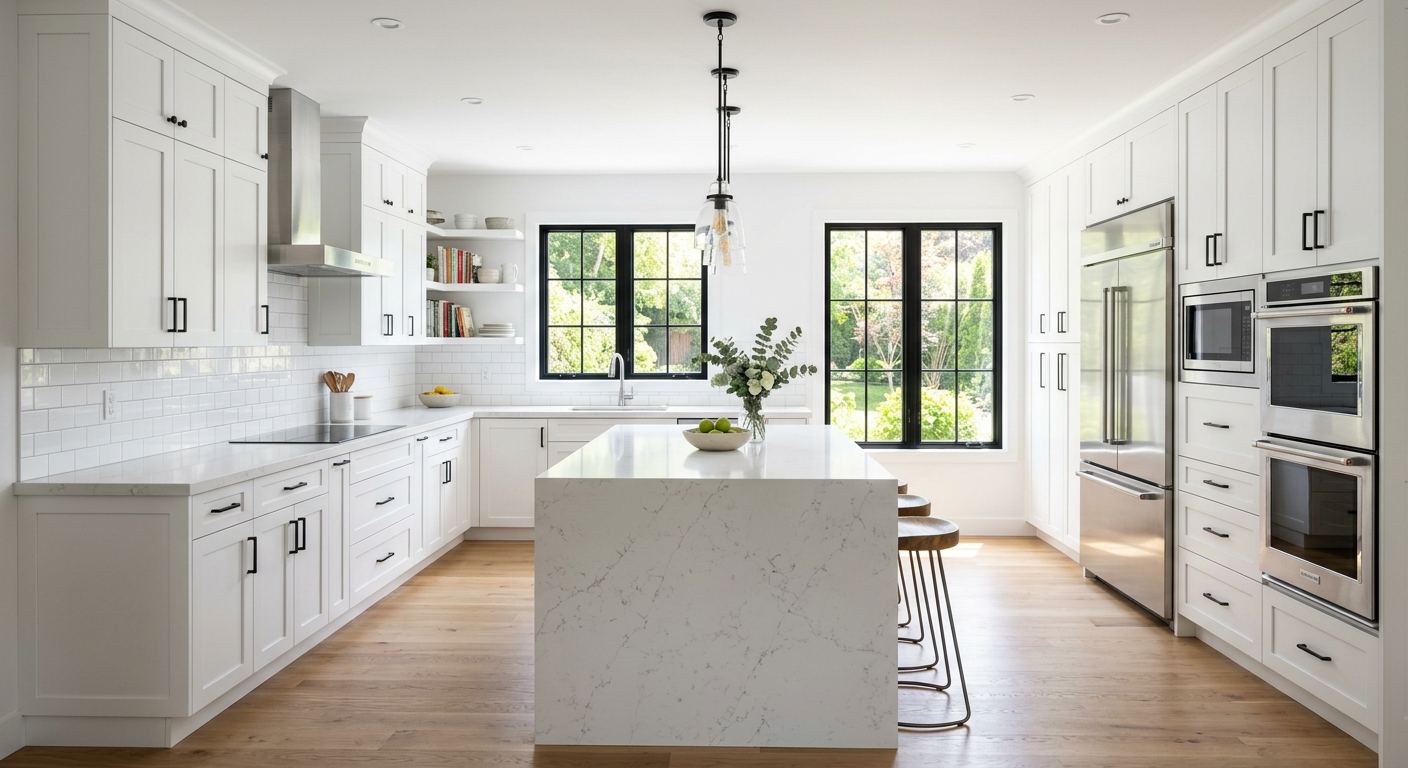
Kitchen renovation options and costs in Country Hills Village
Country Hills Village is a great place to plan a kitchen renovation because many homes are owned by established families and the area’s demand supports a steady pool of local trades. With a population of 2,480 (Statistics Canada, 2021 Census), the renovation market is smaller than downtown Calgary, so reputable cabinet and countertop installers can book quickly when schedules open up. In the broader Calgary economic region, higher-value home ownership tends to shift expectations toward durable finishes—especially when projects are easy to recoup at resale—rather than purely chasing short-term “looks.” Across Alberta’s Calgary region, households often budget to align with what buyers expect, and that’s why “basic” full renovations commonly still include solid-surface counters and quality cabinetry. Calgary-area homeowners also tend to prioritize practical upgrades that hold up under Alberta’s temperature swings and moisture cycles, but in budgeting terms the market matters more than climate: skilled labour availability and finish tier drive costs.
In Country Hills Village and nearby Country Hills, contractors see strong demand because homeowners want kitchens that fit busy routines—walk-in storage, functional islands, and lighting that works in winter evenings. Availability and trade rates are a major driver; skilled labour in Calgary is frequently quoted around $90–$140 per hour, so design time, project management, and demo-to-install coordination become a significant share of the total. That’s why two kitchens that “look similar” can land 30–50% apart when one includes layout changes (moving plumbing or adding an island) while the other stays in the same footprint. Use the ranges below as a starting point for your scope, then compare quotes in the table’s categories.
| Renovation Tier |
What's Included |
Typical Duration |
Price Range |
| Cosmetic refresh (paint, hardware, new appliances only) |
Cabinet paint or repaint, new hardware/pulls, touch-up trims, appliance swap, minor caulking/replace sink strainer and fittings (no cabinet box changes) |
3–7 days |
$8,000–$18,000 |
| Mid-range full renovation (new cabinets, counters, sink, tile) |
New cabinet install (semi-custom or good stock), countertop installation, sink + faucet, backsplash tile, under-cabinet basics (where existing wiring allows), flooring refresh or spot repair |
2–4 weeks |
$25,000–$55,000 |
| High-end full renovation (custom cabinets, stone counters, island) |
Custom cabinetry or upgraded semi-custom with full-height features, quartz/natural stone counters, island with integrated lighting, upgraded backsplash (e.g., full-height or premium tile), appliance package, enhanced electrical scope |
4–8 weeks |
$60,000–$100,000 |
| Cabinet refacing only (new doors + drawer fronts, same boxes) |
Reface panels, new doors/drawers, new hardware, re-seal/align, basic backsplash adjustments, countertop only if you choose separate scope |
1–2 weeks |
$8,000–$35,000 |
| Countertop swap only (laminate to quartz or stone) |
Measure/template, removal of old surfaces, countertop install, new cutouts for sink/faucet, seam finishing, backsplash adjustment as needed |
2–5 days (+ template time) |
$3,000–$12,000 |
| Backsplash tile installation only |
Tile supply and install, surface prep, waterproofing/membrane where appropriate, edge trims/finishing, grout + sealing |
2–6 days |
$2,500–$8,000 |
Prices are estimates only and vary by project scope, site access and material selection.
What affects the price of kitchen renovation in Country Hills Village
In Country Hills Village, you can see quotes for the “same” kitchen land 30–50% apart across Calgary and the rest of Alberta because contractors price for risk and uncertainty—not just materials. Home value and typical household income levels shape the finish tier most homeowners select. In higher-value Calgary-area markets, many homeowners default to quartz or natural stone counters and semi-custom cabinetry because the upgrade is easy to justify on resale; in more modest budget plans, laminate and stock cabinet systems dominate because they provide a clearer return per dollar. It’s less about Alberta’s climate directly and more about the Calgary construction market and the way trade crews schedule work; when demand is high, project management, staging, and labour availability influence your total.
Layout changes create the biggest cost swings regardless of finish level. Examples: (1) adding an island often triggers new electrical (and sometimes new ducting/venting), which can add labour and materials quickly; (2) moving plumbing for a sink or dishwasher can raise costs even if your new cabinets are mid-range; (3) relocating a gas range (or changing venting) adds complexity and typically requires licensed gas work plus inspection coordination.
Concrete Country Hills Village scenarios I see often: older homes with dated rough-ins may require extra patching when new cabinet depths and countertop overhangs don’t line up perfectly; that can push a “countertop swap only” from the $3,000–$12,000 band toward the higher end. Likewise, if your plan is a mid-range full renovation in the $25,000–$55,000 band but you decide to open a wall to brighten the space, the budget usually climbs because demolition, framing, and inspection coordination stack on top of the same cabinet and countertop choices. Even with strong Alberta housing stock, your kitchen’s age affects how much hidden prep is required—sometimes by thousands of dollars.
| Price Factor |
Why It Matters |
Cost Impact |
| Cabinet tier — stock vs. semi-custom vs. fully custom millwork |
Material quality, hardware, door styles, and installation complexity change the budget |
Can swing major portions of the total—often the biggest driver after layout |
| Countertop material — laminate vs. quartz vs. granite vs. stone |
Pricing per square foot and fabrication/seaming requirements vary widely |
Laminate is lowest; quartz/natural stone adds cost but tends to last longer |
| Layout change — wall removal, island add, plumbing/gas move |
Creates demolition, framing, new rough-ins, and permit/inspection coordination |
Often adds the most unpredictable “spike” cost to any tier |
| Appliance package tier — builder vs. mid-range vs. pro-grade |
Professional series appliances can require different electrical/venting expectations |
Can add thousands depending on venting, size, and finish requirements |
| Flooring — refinish existing vs. full replacement |
Matching finishes and dealing with subfloor damage after demo affects labour and materials |
Refinish/repair keeps costs down; full replacement adds time and scope |
| Backsplash — ceramic tile vs. marble vs. full-height slab |
Surface prep, cut complexity, and waterproofing requirements change the install hours |
Premium tile/stone elevates both material and labour |
| Electrical — new circuits for island, under-cabinet lighting |
New loads require licensed work, wall opening, and inspection |
Can be a noticeable add-on even when cabinets and counters stay in place |
| Permit fees and licensed trade requirements |
Scope that touches gas, electrical circuits, load-bearing walls, or new plumbing requires compliance steps |
Costs are usually manageable, but delays and rework can increase total project spend |
Permits & regulations in Alberta
For Alberta homeowners in Country Hills Village, the permit picture is fairly straightforward—what you change determines what paperwork you need. Cabinet and countertop swaps typically do not require permits when you’re keeping existing connections and not altering rough plumbing, gas, or electrical. However, moving plumbing supply or drain lines, relocating gas appliances (including changing the location of a stove), removing a load-bearing wall, or adding new electrical circuits (like dedicated island circuits or significant under-cabinet lighting updates) generally triggers permit requirements and licensed trade involvement. Gas work must be completed by a licensed gas fitter, and electrical work by a licensed electrician; both require inspections before you can safely close up walls or proceed.
How to verify a contractor step-by-step before you sign: start by requesting their licence details in writing and then checking their registration online through the relevant provincial trade registry portals for gas fitting and electrical contractors. Next, ask for a current certificate of insurance (general liability) and confirm they carry appropriate coverage for renovation work on occupied homes. For workers, confirm WSIB/WCB clearance (or equivalent proof of coverage status), which you should request as documentation, not “a quick email promise.” Finally, before demolition begins, ensure the contract clearly states who pulls permits (and pays permit fees) for any scope that needs them.
This is also where many delays happen—if permits are not pulled early, crews wait on inspections, and your project timeline stretches. Always confirm permit responsibility in your written contract, not just in conversation.
Cabinets, countertops and layout decisions in Country Hills Village
The three most consequential decisions for a Country Hills Village kitchen renovation are (1) cabinet tier, (2) countertop material, and (3) whether you change the layout. Your cabinet tier sets the “frame” for everything else: stock cabinets are usually fastest and cheapest, semi-custom is the most popular balance in Calgary-area renovations, and custom millwork gives the best fit for unusual wall lengths and storage needs—at a higher cost. For countertops, laminate is typically the budget option, quartz is a common mid-to-high choice for durability and low maintenance, and granite/natural stone bring premium look but require more careful selection and sealing expectations. Butcher block can add warmth and resale appeal in the right kitchen; marble looks high-end but is more demanding in day-to-day care.
Layout decisions are where you either create real value or spend money without payoff. Opening an adjacent wall for open-concept living can be justified if it improves flow and usable sightlines—buyers often notice space gain in showings. Adding an island is often worth it when you can maintain comfortable clearances and create practical work zones; if your kitchen is already tight, an island can reduce functionality and feel cramped. Plumbing/gas relocation is the highest uncertainty: even a beautiful quartz counter can’t outweigh the cost if you move the sink or range just to “make it look different.”
Dollar example: if you’re targeting a mid-range full renovation, say around $25,000–$55,000, upgrading from laminate to quartz is often a relatively efficient improvement. But if you also move the sink and add a new island, your project frequently shifts toward the upper bands—closer to $60,000–$100,000—because rough-in work, electrical, and coordination add labour and materials beyond the same cabinet/stone choices.
| Option |
Durability |
Maintenance |
Best For |
Price Range |
| Stock cabinets (big-box) |
Good day-to-day durability when installed level and sealed properly |
Low—wipe clean; occasional hardware adjustments |
Fast refreshes, tight budgets, straightforward layouts |
$8,000–$22,000 |
| Semi-custom cabinets (local dealer) |
Very solid for family use; better storage options and door styles |
Low—typical cabinet care |
Most Country Hills Village renovations aiming for resale-friendly upgrades |
$18,000–$45,000 |
| Custom cabinets (local millwork shop) |
Highest build quality; tailored fit and stronger bespoke storage solutions |
Low—designed for long service life |
Complex spaces, ceiling-height detail, premium finishes and islands |
$35,000–$75,000 |
| Laminate countertop |
Decent for light use; can be less resistant to impact and heat than stone |
Simple daily cleaning; avoid prolonged heat and abrasive scraping |
Budget refreshes and rental-friendly plans |
$3,000–$6,000 |
| Quartz engineered countertop |
High durability; consistent look and strong stain resistance |
Low—typical stone-safe cleaner; protect from extreme heat |
Busy households in Alberta who want “set it and forget it” performance |
$6,000–$12,000 |
| Granite / natural stone countertop |
Excellent durability; unique patterns and premium feel |
Moderate—periodic sealing depending on the stone |
Premium looks and a more natural, bespoke aesthetic |
$8,000–$15,000 |
| Butcher block countertop |
Durable but can scratch; best with proper sealing and cutting practices |
Higher than stone—oil/finish maintenance and careful water control |
Warm, casual kitchens and chefs who like working surfaces |
$4,000–$9,000 |
| Marble countertop |
Beautiful but softer; susceptible to etching and staining without care |
Higher—requires disciplined cleaning and protection |
Showpiece kitchens where daily mess is minimal |
$10,000–$18,000 |
How to choose a kitchen renovation contractor in Country Hills Village
Choosing the right contractor in Alberta is mostly about proof. First, verify licensing and coverage: ask for the contractor’s Alberta business details, plus proof of general liability insurance and any specific trade contractor certifications for gas fitting or electrical when those scopes are included. To check WSIB/WCB/WCB clearance, request documentation (often a clearance letter or proof of coverage status) before work starts—don’t accept “we’ll handle it later.” Liability insurance should include renovation work; the certificate should be current and list the correct legal entity.
Then get 2–3 itemised written quotes, not a single lump sum. Your quote should break out labour and materials (demo, framing/patching, cabinet supply vs. install, countertop fabrication and install, tile labour, electrical/plumbing allowances, and disposal). Make sure the scope is clear: what’s excluded, whether permits are included, and whether they include garbage removal, drywall patching, caulking/finishing, and floor protection. Also confirm warranty terms in writing—workmanship warranty length, product/manufacturer warranties, and whether warranties transfer if you sell the home. Finally, payment scheduling matters in renovations: never pay more than 10–15% upfront; use milestones and hold back a portion until the job is substantially complete and deficiencies are corrected. Ask for a start date and an estimated completion window in writing so you can plan around cabinetry lead times and inspection scheduling.
- Request itemised quotes with labour and materials listed separately.
- Confirm who pulls permits and who pays permit fees for any gas/electrical/plumbing changes.
- Ask for a countertop template/install date and lead-time assumptions.
- Verify disposal and site cleanup are included (not “as available”).
- Confirm floor protection and how walls will be protected during demo.
- Check that the quote includes caulking, trim, and final hardware adjustments.
- Review the warranty: workmanship coverage and exclusions.
- Confirm manufacturer warranty documentation for cabinets and countertops.
- Use milestone payments with a holdback until punch list completion.
- Ask for proof of insurance before work begins.
- Get clearance/coverage proof for workers (WSIB/WCB where applicable).
- Insist on a written schedule with inspection-dependent milestones.
Red flags in Country Hills Village: (1) quotes that aren’t itemised and don’t list allowances for electrical/plumbing or disposal; (2) “we’ll pull permits” with no written responsibility or details; (3) contractors asking for large upfront deposits beyond 10–15%; (4) no proof of insurance/coverage or vague answers about licences for gas/electrical; and (5) missing warranty terms or a refusal to define what’s included in the scope.
Frequently asked questions — kitchen renovation in Country Hills Village
What order do kitchen renovation steps happen in?
In Country Hills Village, a typical kitchen sequence starts with confirmation of the final layout (measurements and cabinet specs) and utility planning, especially if you’re moving a sink or adding an island. Step one is usually demo (removing cabinets, counters, and backsplash) followed by inspection-ready rough work when permits are required. Next comes framing/repairs, electrical/plumbing rough-ins (by licensed trades where needed), and insulation/air-sealing touches. After that, you’ll see drywall patching and surface prep, then installation of cabinets, countertops templating, and finally countertop install. Backsplash and tile work come after counters go in, followed by finishing trim, hardware, caulking, and a final punch list.
Can I live at home during a kitchen renovation in Country Hills Village?
Often yes, but it depends on the scope and how your home is set up. For a cosmetic refresh or a countertop swap only, many homeowners stay put because the work area is contained and there’s minimal disruption. For mid-range full renovations (commonly around $25,000–$55,000), you can usually live at home if you create a temporary kitchen zone—microwave, kettle, and storage in an alternate room—while the main kitchen is under construction. If you’re opening walls, moving plumbing/gas, or doing substantial electrical work, expect more dust and longer shutdowns of water/gas to the work areas during tie-ins. In Alberta winters, dust control and maintaining heat are critical—plan for plastic containment and verify the schedule so critical rough-ins happen quickly. Your contractor should outline daily work hours, protection measures, and how utilities will be handled.
Should I renovate my kitchen before selling in Country Hills Village?
Usually, renovations make sense if your kitchen has functional issues (layout flow, storage deficits, outdated finishes) rather than purely cosmetic preferences. In the Calgary region, buyers often respond to clean lines, durable surfaces, and modern lighting. If you’re considering a countertop and cabinet update, a smaller scope can be a smarter pre-sale move than a full redesign. For example, a countertop swap toward the $3,000–$12,000 band can refresh the look without the disruption of moving plumbing. However, if you’re thinking of a high-end full renovation (often $60,000–$100,000), you want to be confident the layout and finishes match the resale expectations of your buyer segment. Also check your home’s age and condition: older rough-ins can add unseen costs, which can erode ROI if you’re racing a listing timeline. A good contractor can help you choose a finish tier that aligns with what local buyers will pay for.
What's the most popular kitchen style in Country Hills Village right now?
Right now, many Country Hills Village kitchens lean toward modern transitional: clean cabinet lines, warm neutral tones, quartz counters, and practical island layouts. Homeowners commonly choose semi-custom or quality stock cabinetry in finishes that won’t look dated quickly—think matte or satin textures and popular colour palettes that photograph well in Calgary lighting. Integrated lighting under the cabinets is also a frequent request because winter evenings in Alberta can make kitchen task lighting feel “dim” without upgrades. Stone counters (especially quartz) remain popular because they’re low-maintenance and durable for daily cooking. The “exact” style varies by budget: cosmetic refresh projects may focus on paint and hardware, while full redesigns tend to include an island, upgraded backsplash, and an appliance package that looks cohesive on day one.
How do I know if I need to update my kitchen plumbing in Country Hills Village?
You may need to update plumbing if your renovation includes moving the sink, dishwasher, or gas-range-related components (where applicable) or if inspection finds aging supply/drain lines. Signs include slow drains, frequent under-sink leaks, water staining around fittings, inconsistent hot water delivery, or corrosion you can see at accessible connections. In a kitchen project, the need can also become clear once the walls open—older homes may have rough-ins that don’t match current valve spacing or drain slope expectations. If you’re staying in the same layout and only swapping counters and cabinet fronts, you may not touch plumbing. But if you’re targeting a mid-range full renovation (often $25,000–$55,000) and planning layout improvements, budget should include plumbing tie-in allowances and the possibility of replacing worn sections to avoid post-renovation callbacks. A reputable contractor will assess before wall closure and will coordinate any required licensed work.
What is the difference between a galley and open-concept kitchen?
A galley kitchen is typically narrow with cabinets on two opposite sides, creating an efficient “work corridor.” An open-concept kitchen removes walls or barriers so the kitchen connects visually and functionally to living/dining space. In Country Hills Village, many existing homes have layouts that are naturally more galley-like, so an open-concept approach usually requires serious planning if you want to remove a wall or relocate plumbing/gas/electrical. Open-concept designs can be great for entertaining and natural light, but they can also increase costs because of potential structural considerations, finish coordination, and the need to manage permits when walls are load-bearing. If your budget is closer to a refresh (often under mid-range full renovation), a galley update with upgraded countertops and lighting can be a strong value path. If you’re aiming for a redesign closer to the higher bands, open-concept changes are usually part of the scope, and that’s where planning and contractor experience matter most.