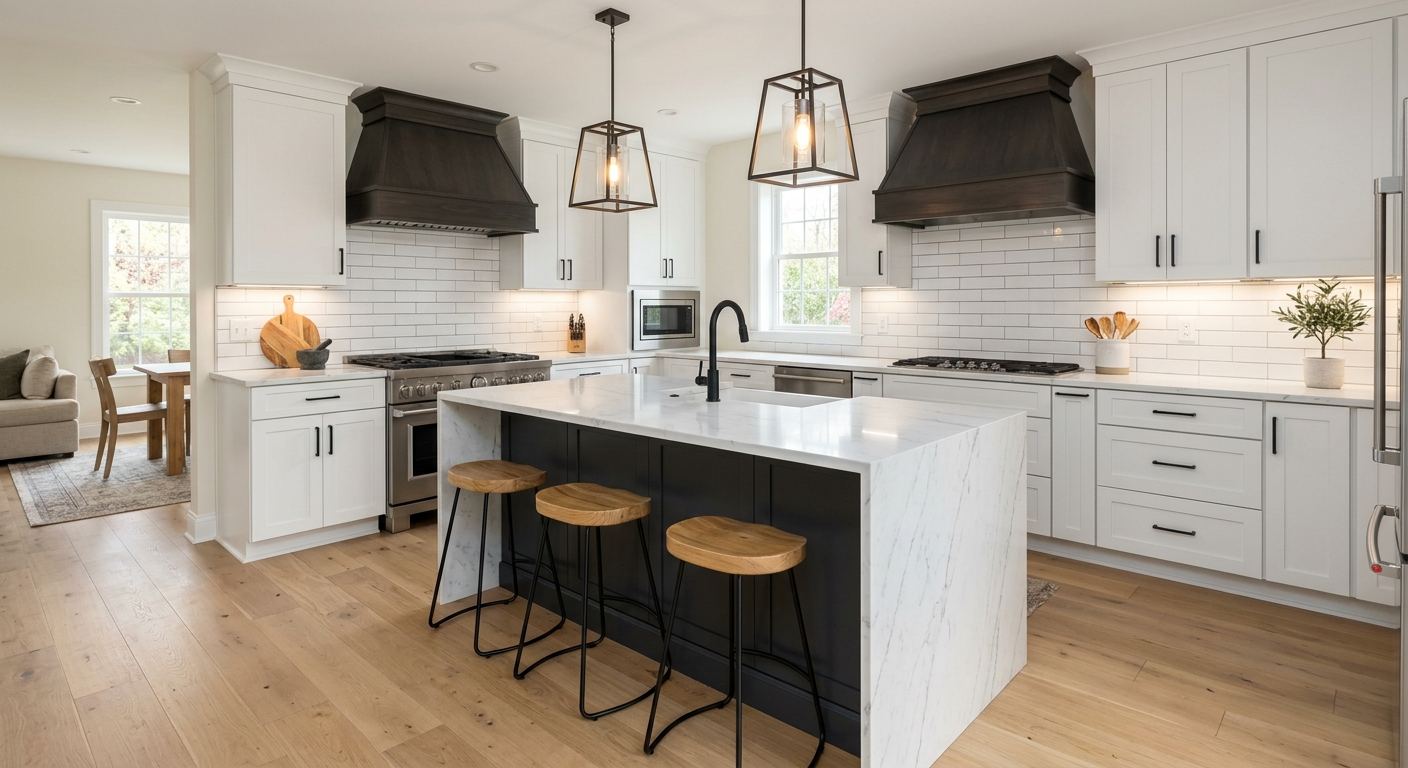
Kitchen renovation options and costs in Petrolia
Petrolia homeowners can approach a kitchen renovation in several ways, depending on budget, how “move-ready” they want the home to feel, and how much change they’re planning. With a median household income of $86,000 (Statistics Canada, 2021 Census) and a homeowner-heavy housing profile (79.1% of households own), most projects we see in Petrolia are designed to be durable and resale-friendly rather than purely experimental. Windsor–Sarnia’s owner-occupied market also tends to support mid-market finishes—enough for quartz, good-quality laminates, and semi-custom cabinetry, without the full premium of high-end custom millwork.
In practice, Petrolia pricing is shaped more by the Windsor–Sarnia home-value and income mix than by climate conditions. Ontario’s seasonal swings can affect materials over time, but cabinetry installation methods, ventilation, and countertop selection drive the long-term performance more than temperature alone. Where costs do shift locally is contractor availability and scheduling: when multiple trades are needed (carpentry, electrical, plumbing/gas, flooring and tile), timelines tighten around peak renovation periods, and that can influence labour quotes.
Another factor is housing age. With 55.1% of homes built before 1981 (Statistics Canada, 2021 Census), older kitchens often have narrower soffits, dated electrical runs, and plumbing layouts that aren’t “standard” for modern cabinet depths—so the same package can cost more if it requires structural tweaks, rerouting, or filler work.
In Petrolia, we also see steady demand in the downtown / historic core and surrounding residential blocks, where homeowners commonly choose mid-range full renovations to refresh functionality for family living. Use the table below to compare realistic tiers before you request a site visit.
| Renovation Tier |
What's Included |
Typical Duration |
Price Range |
| Cosmetic refresh (paint, hardware, new appliances only) |
Cabinet/surface prep and paint or refinishing, new hardware, appliance swap, minor caulking and trim touch-ups (no cabinetry reconfiguration) |
3–7 business days |
$5,000–$18,000 |
| Mid-range full renovation (new cabinets, counters, sink, tile) |
New stock or semi-custom cabinets, new countertop (laminate or entry-level quartz), sink and tap, tile backsplash, new LED under-cabinet lighting (where feasible), standard flooring transition work |
3–6 weeks |
$25,000–$55,000 |
| High-end full renovation (custom cabinets, stone counters, island) |
Custom cabinetry, premium quartz/stone countertops, island (often with new electrical and/or plumbing provisions), full-height backsplash or statement tile, upgraded lighting and finishing details |
6–12 weeks |
$55,000–$85,000 |
| Cabinet refacing only (new doors + drawer fronts, same boxes) |
Door and drawer-front replacement, new end panels and trim as required, hardware swap, re-sealing and touch-up; keeps existing cabinet boxes in place |
1–3 weeks |
$8,000–$30,000 |
| Countertop swap only (laminate to quartz or stone) |
Removal of old countertop, new engineered quartz or stone installation, new cut-outs for sink cooktop (if applicable), re-caulking and standard trim finishing |
3–10 business days |
$3,000–$15,000 |
| Backsplash tile installation only |
Tile supply and installation, wall preparation, waterproofing where needed, grout/caulk detailing, standard allowance for outlet trims |
2–5 business days |
$2,000–$8,000 |
Prices are estimates only and vary by project scope, site access and material selection.
What affects the price of kitchen renovation in Petrolia
Two quotes for what looks like the same Petrolia kitchen can differ by 30–50% across the Windsor–Sarnia region and Ontario because labour intensity, material tier, and how much “hidden work” is required vary from house to house. In higher home-value pockets of Windsor–Sarnia, homeowners often choose quartz or stone counters and semi-custom cabinetry because the investment tends to be easier to recapture on resale. In more modestly priced segments, laminate and stock cabinets still deliver strong durability for the money, and owners typically spend the saved dollars on functional upgrades like better lighting or a layout tweak.
For Petrolia’s housing stock—many homes built before 1981—old electrical locations, older plumbing runs, and non-standard stud or soffit dimensions can add carpenter time, filler work, and additional finishing. That’s why layout changes frequently drive the biggest uncertainty: removing a wall, adding an island, or moving a gas line generally changes the budget more than switching from mid-range quartz to a higher-tier slab.
Concrete examples we see locally: (1) if your kitchen has dated knob-and-tube wiring or a short circuit path near the range, new under-cabinet lighting and modern appliance loads can require extra electrical routing; (2) if a sink drop and drain line doesn’t align with the new cabinet base, we may need re-plumbing the P-trap and adjusting cabinet framing; (3) if your countertop overhangs were built for older cabinet frames, replacing them can mean reworking fascia and edge details. Depending on what’s uncovered, a renovation that targets the mid-range band around $25,000–$55,000 can move upward if layout and servicing changes are required, even if finish levels stay reasonable.
At the same time, selective upgrades can keep costs controlled. A countertop-only swap at $3,000–$15,000 can look dramatic in Petrolia without triggering a full tear-out, as long as the plumbing cut-outs and sink fit are planned properly from day one.
| Price Factor |
Why It Matters |
Cost Impact |
| Cabinet tier — stock vs. semi-custom vs. fully custom millwork |
Door/box quality, internal features (soft-close, organizers), and how well the units fit older walls without excessive filler |
Often the biggest swing; cabinetry can represent ~30%–40% of the total kitchen budget |
| Countertop material — laminate vs. quartz vs. granite vs. stone |
Material cost, fabrication complexity, and the finish details (seams, edge profiles) that affect labour |
Can shift the project by several thousand dollars depending on slab size and seam locations |
| Layout change — wall removal, island add, plumbing/gas move |
Triggers framing, inspection, and coordination between trades; adds demolition and patching |
Frequently the largest unpredictable cost regardless of finish tier |
| Appliance package tier — builder vs. mid-range vs. pro-grade |
Brand fit/trim standards, electrical requirements, ventilation needs, and install complexity |
Can add meaningful cost even when cabinetry is unchanged |
| Flooring — refinish existing vs. full replacement |
Surface conditions and how much gets removed during cabinet set and tile transitions |
Full replacement can increase both labour and material totals |
| Backsplash — ceramic tile vs. marble vs. full-height slab |
Weight, cutting difficulty, waterproofing expectations, and finishing time |
Premium backsplashes can outpace the intended “small upgrade” budget |
| Electrical — new circuits for island, under-cabinet lighting |
Any new lighting, outlets, or circuit changes typically require licensed work and inspections |
Varies widely; can be low for replacements or high for new feeds |
| Permit fees and licensed trade requirements |
Work scope that changes services or adds circuits typically requires permits and scheduling for inspections |
Adds administrative and coordination cost; timing impacts labour totals |
Permits & regulations in Ontario
In Ontario, a typical cabinet and countertop swap usually doesn’t need a permit, because it’s considered a like-for-like improvement. However, when you move beyond “surface changes” into modifying services, permits and licensed trades commonly come into play. For example, moving plumbing supply or drain lines (including relocating a sink), relocating gas lines or making gas-fired appliance changes (stove/range connections), removing a load-bearing wall, or adding new electrical circuits for outlets, an island, or upgraded ventilation generally requires permits and licensed work.
Gas work must be completed by a licensed gas fitter. Electrical work must be completed by a licensed electrician. Both categories typically require inspections once the rough-in and final stages are complete.
For Petrolia homeowners, the practical step is to verify the contractor and the trade coverage before signing. Ask for: (1) their Ontario licence documentation (where applicable for the work they perform), (2) a current certificate of liability insurance, and (3) proof of coverage for workplace safety—WSIB/WCB clearance letters or equivalents. Then confirm subcontractors: if a contractor is coordinating trades, you should still be given the insurance certificates for those trades and be able to confirm they’re licensed for gas/electrical work.
Most importantly, make sure permit responsibility is written in the contract. Contractors who expect you to “figure it out later” are a risk—scope creep is where budgets typically unravel.
Cabinets, countertops and layout decisions in Petrolia
In Petrolia, three decisions control both the look and the long-term satisfaction: (1) cabinet tier, (2) countertop material, and (3) layout changes. Start with cabinetry, because it sets the planning dimensions. Stock cabinets are the fastest and typically cheapest, and they work well when your walls are square enough and you don’t need unusual sizes. Semi-custom cabinets are the most popular mid-range choice in Windsor–Sarnia because they balance cost with better fit and upgraded features. Custom cabinets cost more but provide the best accuracy for older homes with off-plumb walls, unusual corners, or integrated pantry and appliance garages.
Countertops should match your lifestyle. Laminate is budget-friendly and durable for everyday use, but it won’t have the same heat and scratch tolerance as quartz. Quartz is a strong choice for busy kitchens: it resists staining better than many alternatives and keeps maintenance simple. Granite/natural stone can look exceptional and adds prestige, but sealing and careful handling matter. Butcher block brings warmth and can be forgiving for casual cooking, though it needs more ongoing maintenance and attention to moisture seams—especially important in Ontario’s humid-to-dry seasonal swings.
Layout is where cost becomes “justified or not.” Adding an island or opening up a wall can cost significantly because it may require new electrical and sometimes plumbing/gas provisions. For example, if your plan is to move toward the mid-range $25,000–$55,000 renovation tier, an island addition can be worth it when it improves workflow and storage for daily use. If the goal is mainly cosmetic, staying with a countertop upgrade or refresh can avoid service relocation costs.
In older Petrolia kitchens, we often see the best value when homeowners choose semi-custom cabinets and a quartz upgrade without changing plumbing locations unless the layout gain is clearly measurable.
| Option |
Durability |
Maintenance |
Best For |
Price Range |
| Stock cabinets (big-box) |
Good day-to-day durability; hinges and drawers vary by line |
Low; wipe clean, tighten hardware as needed |
Fast turnarounds, straightforward layouts, tighter budgets |
$8,000–$20,000 |
| Semi-custom cabinets (local dealer) |
Very good; better options for height, widths and interior organization |
Low; modern soft-close hardware typically needs minimal service |
Petrolia mid-range renovations seeking better fit in older homes |
$15,000–$35,000 |
| Custom cabinets (local millwork shop) |
Excellent fit and build quality tailored to your room |
Low to moderate; depends on finish type and care |
Challenging spaces, integrated features, premium resale look |
$25,000–$55,000 |
| Laminate countertop |
Good for normal household use; seams should be protected |
Simple cleaning; avoid prolonged moisture at edges |
Cost control with a clean, modern appearance |
$3,000–$7,000 |
| Quartz engineered countertop |
High durability; generally excellent stain resistance |
Low; wipe clean and handle heat carefully |
Busy Petrolia kitchens needing a “set it and forget it” surface |
$6,000–$12,000 |
| Granite / natural stone countertop |
Very durable; unique pattern and strong wear resistance |
Moderate; sealing and mindful stain prevention |
Owners targeting a higher-end look and character |
$8,000–$15,000 |
| Butcher block countertop |
Durable but susceptible to cuts and moisture if not maintained |
Regular oiling/conditioning; keep edges sealed |
Casual cooking styles and families who accept maintenance |
$4,000–$10,000 |
| Marble countertop |
Beautiful but more sensitive to acids and scratching than quartz |
Higher care; sealing schedule and quick spill cleanup |
Statement kitchens where aesthetics outweigh wear concerns |
$10,000–$20,000 |
How to choose a kitchen renovation contractor in Petrolia
Choosing the right kitchen renovation contractor in Petrolia is mostly about verification and paperwork, not just photos. Start with licensing and coverage: confirm the contractor’s Ontario licensing (for the scope they perform), ask for a certificate of liability insurance, and request WSIB/WCB clearance (or equivalent documentation) so you’re not exposed if something goes wrong on site. Then check subcontractor coverage too—especially if electrical or gas components are involved.
Next, get 2–3 itemised written quotes. You want labour and materials broken out (demolition, framing/carpentry, plumbing/electrical provisions if applicable, cabinet install, countertop fabrication and install, tile work, disposal). A lump-sum quote with unclear allowances often leads to surprises.
Read the scope line by line: what’s excluded, what’s included, and what assumptions are being made about access, patching, and disposal? Confirm whether permits are included or charged separately, and whether waste hauling is part of the price. For warranty, ask for the workmanship warranty length and what it covers, plus the manufacturer/product warranty details and whether it’s transferable if you sell the home.
For payment, never pay more than 10–15% upfront. Hold back a meaningful portion until key milestones are complete (cabinet set, countertop template/install, tile and final trim, and clean-up). Finally, get a start date and completion estimate in writing—especially in Ontario, where lead times and inspection scheduling can affect cabinet and countertop timelines.
- Ask for proof of liability insurance before any site work begins.
- Request WSIB/WCB clearance and confirm subcontractors carry their own coverage.
- Verify their Ontario licensing for the trade scopes they perform.
- Require an itemised quote (labour + materials) with clear allowances.
- Confirm whether permit pulling is included and who applies for permits.
- Check if disposal/dump fees are included or billed separately.
- Ensure electrical/gas work is listed as licensed scope with inspections.
- Clarify countertop measurements responsibility and how remakes are handled.
- Review the cabinet spec sheet: door styles, hardware, soft-close, and finishes.
- Ask about warranty: workmanship duration, product warranty, and transferability.
- Confirm the payment schedule—no more than 10–15% upfront, with holdback.
- Get a written timeline with milestones, not just a final completion date.
Red flags we commonly see in Petrolia include: a contractor who won’t provide written scopes and specs, offers only a lump-sum without allowances, requests large upfront payments beyond 10–15%, has no clear warranty terms, or can’t show evidence of insurance/WSIB/WCB clearance. Another warning sign is vague language about permits (“we’ll handle it later”) when gas, electrical, or structural changes are planned.
Frequently asked questions — kitchen renovation in Petrolia
How do I know if I need to update my kitchen plumbing in Petrolia?
If you’re in a Petrolia home built before 1981, it’s smart to plan for plumbing review during demolition, even if your sink location stays the same. Signs you may need an update include slow drains, recurring under-sink leaks, corrosion at supply connections, outdated shutoffs, or drains that don’t align cleanly with modern cabinet base dimensions. If you’re also moving the sink, adding an island with a second sink, or changing the countertop and undermount arrangement, the plumbing typically needs adjustment for proper P-trap routing and venting. A good contractor will include a plumbing assessment in the pre-site phase and confirm rough-in compatibility. If your plan is mainly surface refresh, you may avoid major plumbing replacement—while a full mid-range renovation can still stay in the $25,000–$55,000 band if service relocation isn’t required. If drains or supply lines require rerouting, budget and scheduling should reflect licensed plumbing work and inspection coordination.
What is the difference between a galley and open-concept kitchen?
A galley kitchen is a narrower layout where counters run along two parallel walls, often with a walkway down the centre. It works well in many older Petrolia homes because it fits smaller footprints and can be efficient for prep and cooking. An open-concept kitchen removes barriers between the kitchen and living area, typically improving sightlines and making entertaining easier. The key difference for renovation cost is not just walls—it’s servicing and finishes. Converting from galley to open-concept can involve removing a wall (which may require permits and licensed oversight), rerouting electrical outlets, and coordinating ventilation for the range. Because older housing stock can have structural or wiring constraints, costs vary more with open-concept changes than with cabinet-only upgrades. If you’re staying in a cosmetic or countertop range, you can control budget—cosmetic refreshes are often far below full remodels, while full renovations typically land around the $25,000–$55,000 mid-range band when you’re keeping systems relatively stable.
How do I get accurate kitchen renovation quotes in Petrolia?
Accurate quotes come from good scope and site verification. In Petrolia, ask contractors to visit your home and measure on-site, because older rooms often have out-of-square walls, unusual soffits, and existing cabinet depths that affect everything from seam layout to filler requirements. Get 2–3 itemised quotes that separate labour and materials (cabinet install, countertop fabrication and install, tile, electrical/plumbing allowances if applicable, and disposal). Ensure the quote specifies what’s included: permit pull responsibility, whether appliances are supply-only or installed, what happens if the wall surface needs patching, and whether flooring transitions are included. For countertop quotes, confirm measurement responsibilities and whether the price includes template, fabrication, and any standard rework. If you’re targeting a defined upgrade like new quartz, you can estimate using the countertop swap range—typically $3,000–$15,000 depending on size and edge/seam details—then add cabinet and tile work on top.
What's the best countertop material for a busy Petrolia kitchen?
For most busy households in Ontario—including Petrolia—quartz engineered countertops are a top choice because they combine durability with low day-to-day maintenance. They resist staining better than many laminate surfaces and usually avoid the sealing routine required for natural stone like granite or marble. If you cook often and don’t want to baby the surface, quartz is typically the most practical balance. Laminate can still be a smart option for budget control and looks good with modern cabinet styles, but it’s less forgiving around seams if moisture sits at the edges. Natural stone like granite delivers a high-end appearance and strong wear resistance, but sealing and stain prevention are part of ownership. Butcher block can be great for families who prefer prep-and-chop convenience, though it needs more maintenance and attention to moisture from Ontario’s seasonal swings. In budget terms, many owners choose quartz within the $6,000–$12,000 countertop range and build the rest of the renovation toward the mid-tier $25,000–$55,000 complete kitchen band.
How do I add an island to my Petrolia kitchen?
Adding an island starts with workflow and floor planning, then quickly becomes a trade coordination exercise. In many Petrolia homes, the island can be added without relocating plumbing if you keep it “dry” (seating and prep only). However, if you want a sink, dishwasher, or a hood vented to the exterior, you may need to move plumbing and add electrical and ventilation work, which can trigger permits and licensed trade requirements. The most common island cost drivers are: electrical circuits for outlets and lighting, plumbing provisions for a future sink, and any modifications to gas connections (if applicable). From a budgeting standpoint, island projects can push a kitchen toward the higher end of the renovation range because demolition and rebuild time increases. If your plan is to keep spend controlled, pair the island with a stable cabinet plan and consider staying within the mid-range renovation budget target rather than upgrading everything to premium stone. A contractor should confirm measurements, ensure adequate clearance, and outline the exact sequence so template-to-install timing works with countertop fabrication.
How much does a kitchen renovation cost in Petrolia?
In Petrolia, kitchen renovation cost usually falls into a few predictable bands, depending on how much is changing. Cosmetic upgrades—like paint, hardware, and new appliances only—are often handled quickly and can be far below a full remodel. For a full mid-range renovation (new cabinets, new counters, sink, and tile), realistic project budgets typically land around $25,000–$55,000, which matches the way many owner-occupied homes in the Windsor–Sarnia area are finished. If you’re doing custom cabinetry, premium stone, and an island with added electrical/plumbing provisions, the total can move beyond that and approach the $55,000–$85,000 tier. If you want a smaller step, a cabinet-only refacing project is commonly in the $8,000–$30,000 range, and countertop swaps often run $3,000–$15,000 depending on size and material. Because many Petrolia homes are older (55.1% built before 1981, Statistics Canada, 2021 Census), hidden electrical/plumbing or framing adjustments can move the budget—so itemised quoting and on-site assessment are key.