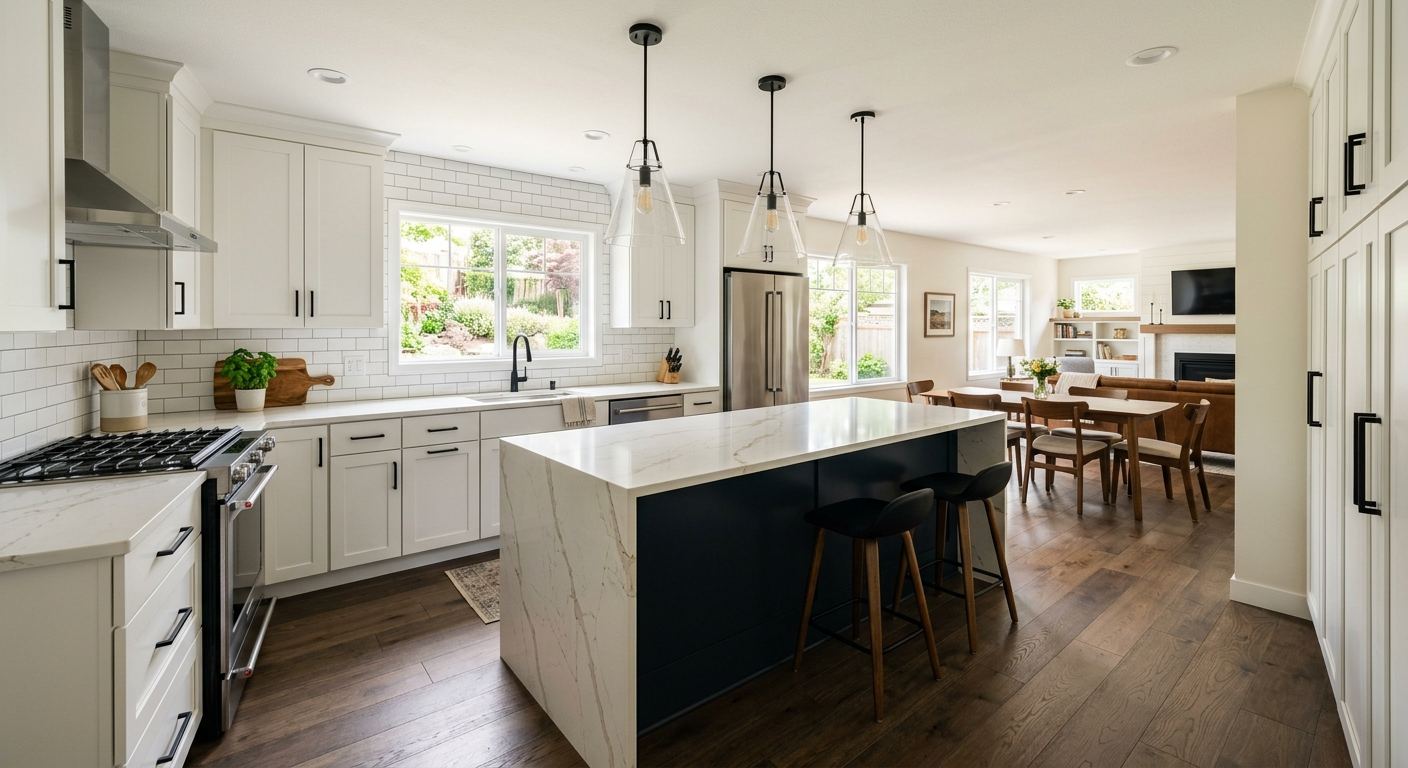
Kitchen renovation options and costs in Haileybury
Kitchen renovation in Haileybury usually starts with a simple question: do you want a refresh, a mid-range upgrade, or a full custom rebuild? With a population of just 3,247 (Statistics Canada, 2021 Census), Haileybury doesn’t have the density of larger GTA centres, so popular trades and cabinet lead times can feel tighter during peak spring and early summer. At the same time, the Toronto economic region’s spending habits shape what homeowners expect when they invest in their kitchens—often tied more to home values and resale strategy than to local weather.
In higher-value parts of the Toronto region, homeowners commonly allocate closer to 8–15% of home value toward kitchen work, and that’s where you’ll see more quartz or natural stone and custom millwork. In more value-conscious pockets, many projects stay mid-range with refaced or semi-custom cabinetry, laminate or quartz counters, and selective layout changes. For a small-town market like Haileybury, the same finish trends arrive, but the choices often get tempered by how quickly you want the project done and how much disruption you can tolerate.
Ontario’s seasonal swings also matter indirectly: winter schedules can extend countertop templating and delivery windows, and contractors often plan around weather and road access. That doesn’t usually change the “rate” of labour, but it can affect timing, protection costs (floor and countertop handling), and how quickly trades can mobilize. If you’re renovating near the more established residential strip around downtown Haileybury, demand for kitchen installers and countertop crews tends to run steady as homeowners coordinate around school schedules and resale timelines—then the conversation naturally shifts to budgets and timelines.
Here’s a practical comparison to help you line up expectations before you request quotes.
| Renovation Tier |
What's Included |
Typical Duration |
Price Range |
| Cosmetic refresh (paint, hardware, new appliances only) |
Paint, new hardware, appliance swap, minor caulking/trim touch-ups |
3–7 days |
$6,000–$14,000 |
| Mid-range full renovation (new cabinets, counters, sink, tile) |
Semi-custom or stock cabinets, new countertops, sink + faucet, backsplash tile, new flooring prep, disposal and trim work |
3–6 weeks |
$25,000–$55,000 |
| High-end full renovation (custom cabinets, stone counters, island) |
Fully custom millwork, premium stone (quartz/stone), island build, enhanced lighting, upgraded plumbing detailing, full backsplash/tile package |
6–12 weeks |
$65,000–$90,000 |
| Cabinet refacing only (new doors + drawer fronts, same boxes) |
Door/drawer front replacement, new panels, hardware, re-seal and adjust, basic prep paint/touch-ups |
1–3 weeks |
$8,000–$25,000 |
| Countertop swap only (laminate to quartz or stone) |
Templating, removal and install of countertops, seam finishing, sink cut-in (if changing sink), basic backsplash adjustments if needed |
3–10 days |
$4,500–$15,000 |
| Backsplash tile installation only |
Tile layout, waterproofing membrane (as required), tile + grout, sealant at transitions, minor wall patching |
3–7 days |
$2,000–$10,000 |
Prices are estimates only and vary by project scope, site access and material selection.
What affects the price of kitchen renovation in Haileybury
Two homeowners in Haileybury can receive quotes for the “same” kitchen, yet see swings of 30–50% across the Toronto economic region and Ontario because pricing reflects more than just the number of cabinets—it reflects how the finish tier, layout, and required trades line up with your house’s constraints. In markets where buyers expect higher-end visuals, homeowners often default to quartz or natural stone and semi-custom or fully custom cabinetry, because the renovation cost is easier to justify at resale. Where budgets are more sensitive, laminate counters and stock cabinets keep projects closer to the low–mid ranges, while still allowing improvements like updated lighting, fresh tile, and better storage.
Layout work is the biggest wild card regardless of finish. Moving plumbing for a new sink location, relocating a gas line (where applicable), adding an island that changes electrical and ventilation needs, or removing a wall to open the plan can add unpredictable labour, inspection time, and sometimes structural considerations. Even when the labour rate is similar, the “scope uncertainty” drives the higher end of the quote range.
Local conditions raise or lower costs in a few concrete ways. First, Haileybury-area supply timing can affect countertop lead times; if your start date is fixed, you may pay a premium for scheduling and staging. Second, many older Ontario homes have less flexible cabinet wall conditions—out-of-plumb walls and older venting routes can add shimming and rework. Third, winters can complicate jobsite protection and drywall drying schedules, which is why projects that require more patching and paint often land closer to the upper band of a $25,000–$55,000 mid-range renovation.
Next, we’ll break down the specific price factors so you can compare quotes line-by-line.
| Price Factor |
Why It Matters |
Cost Impact |
| Cabinet tier — stock vs. semi-custom vs. fully custom millwork |
Material quality, door/drawer construction, interior features, and fit/finish drive install time and cost |
Typically a major driver; can shift the overall project by tens of thousands |
| Countertop material — laminate vs. quartz vs. granite vs. stone |
Supply cost, cutting/seam complexity, and fabrication requirements affect labour and total pricing |
Often moves you from “affordable” to “premium” budgets quickly |
| Layout change — wall removal, island add, plumbing/gas move |
Triggers structural review, licensed trade work, and additional inspection steps |
Most unpredictable; commonly adds the largest single jump |
| Appliance package tier — builder vs. mid-range vs. pro-grade |
Electrical requirements, ventilation needs, and finish hardware vary by brand tier |
Can add several thousand depending on package and installation complexity |
| Flooring — refinish existing vs. full replacement |
Existing floor condition determines how much prep, patching, and finish labour is required |
Refinish can save; full replacement adds demo, underlayment, and time |
| Backsplash — ceramic tile vs. marble vs. full-height slab |
Material weight, cutting accuracy, waterproofing, and special sealing change the install scope |
Full-height and premium stone typically push higher |
| Electrical — new circuits for island, under-cabinet lighting |
Adding outlets, moving switches, and lighting requires licensed work and coordination |
Often a few thousand; can increase if wiring paths are difficult |
| Permit fees and licensed trade requirements |
Any required permitting and inspections adds administration, schedules, and compliance labour |
Varies by scope; structural/plumbing/electrical changes cost more than cosmetic swaps |
Permits & regulations in Ontario
In Ontario, many “like-for-like” kitchen updates don’t require a building permit—cabinet and countertop swaps typically fall into that category when you’re not changing the footprint or utilities. You generally can replace cabinets, change counter materials, and update a backsplash surface without a permit, assuming there’s no structural change and no relocation of plumbing or electrical services.
Permits and inspections usually come into play when you change the utilities or structure. If you move plumbing supply or drain lines, relocate a gas stove/range hood connected to gas, remove a load-bearing wall (or any wall that may affect structure), or add new electrical circuits (for an island, additional receptacles, or new lighting circuits), you should expect permitting and licensed trades. Gas work must be completed by a licensed gas fitter, and electrical work by a licensed electrician; both require inspections where applicable.
For homeowners in Haileybury, a practical approach is to verify licensing and coverage before you sign:
- Request the contractor’s Ontario licence/registration details and confirm them through the relevant online registry.
- Ask for a current certificate of insurance (liability) and verify the coverage is active for the project dates.
- Confirm WSIB/WCB coverage for workers (or the appropriate clearance letter/statement) before work begins.
- Make sure each permit-responsible trade lists their scope clearly in the written contract.
- Get clarity on who pulls permits, who pays permit fees, and which inspections are scheduled.
Put simply: confirm permit responsibility in writing—don’t rely on verbal “we’ll handle it” promises.
Cabinets, countertops and layout decisions in Haileybury
When you’re planning a kitchen renovation in Haileybury, three decisions tend to determine both the final look and the total cost: (1) cabinet tier, (2) countertop material, and (3) whether you change the layout. Cabinet tier shapes the timeline and the “feel” of the kitchen every day. Stock cabinets are the quickest and cheapest path, semi-custom is the most common mid-range choice because you get better sizing and interior options without fully custom pricing, and custom cabinets deliver the best fit and premium details—at a higher price.
Countertops then set the maintenance reality. Laminate is budget-friendly and works well if you don’t need heavy-duty seams or complex edges. Quartz is a popular Toronto-region middle ground—consistent, durable, and easier to maintain. Granite and other natural stone offer prestige and unique patterning, but require more careful sealing and match the kitchen’s resale “premium tier.” Butcher block can be beautiful in homes that want warmth, yet it needs routine oiling and is more sensitive to standing water in a busy household.
Layout changes are where costs can justify themselves. If adding an island improves circulation and seating, it can be worth the expense—especially when you’re already investing in a full renovation and can coordinate electrical and ventilation efficiently. However, opening up a plan or relocating plumbing/gas is only justified when the space gain solves a real usability issue, not just a cosmetic desire.
Here’s a realistic dollar example: upgrading from laminate to quartz often costs enough to move you into a higher mid-range budget, but if that upgrade is paired with semi-custom cabinetry and efficient layout (rather than adding a new plumbing run), it’s frequently where resale expectations are met without inflating the project toward a high-end rebuild.
| Option |
Durability |
Maintenance |
Best For |
Price Range |
| Stock cabinets (big-box) |
Solid for everyday use; limited custom sizing |
Minimal; depends on door material and finish |
Fast installs and tight timelines |
$8,000–$20,000 |
| Semi-custom cabinets (local dealer) |
Better fit, stronger design flexibility |
Low to moderate; choose durable finishes and hardware |
Most Haileybury homeowners targeting resale-ready style |
$18,000–$35,000 |
| Custom cabinets (local millwork shop) |
Highest fit quality; built around your exact space |
Low; premium materials typically hold up well |
Irregular layouts, premium design, and long-term ownership |
$30,000–$60,000 |
| Laminate countertop |
Good everyday durability; seam care matters |
Easy; avoid prolonged heat and standing water |
Budget-conscious refreshes |
$3,000–$7,000 |
| Quartz engineered countertop |
Very durable and consistent; resists staining better than many surfaces |
Low; routine cleaning only |
Toronto buyers who expect a modern, maintenance-light surface |
$6,000–$15,000 |
| Granite / natural stone countertop |
Hard and durable; varies by stone type |
Requires periodic sealing and careful stain prevention |
Premium look with unique veining |
$8,000–$18,000 |
| Butcher block countertop |
Durable for chopping when properly maintained |
Higher; regular oiling and moisture protection |
Warm, homey style in kitchens used heavily |
$4,500–$11,000 |
| Marble countertop |
Beautiful but more porous; can be sensitive to acids |
Higher; sealing and careful cleaning required |
Statement kitchens where you want an elegant, high-end finish |
$10,000–$22,000 |
How to choose a kitchen renovation contractor in Haileybury
Choosing a contractor in Haileybury is mostly about verification and transparency. Start by confirming Ontario licensing and coverage. Ask for proof of liability insurance (certificate of insurance showing the policy is active for your project period) and ensure the contractor can provide WSIB/WCB clearance or proof of coverage for their workers. For any licensed trade work—especially electrical and gas-related changes—verify each specialist’s credentials as well. If a contractor can’t provide documents promptly, treat that as a major warning sign.
Next, request 2–3 itemised written quotes. You want a labour-and-materials breakdown, not one lump-sum figure. The scope should specify what’s included in cabinet installation, countertop templates, electrical work scope, plumbing changes (if any), disposal/hauling, and whether permits are included or billed separately. Check exclusions like demolition limits, subfloor repairs, drywall patching, and what happens if your existing walls aren’t square—this is where many budget surprises come from.
Warranty matters too. Look for a workmanship warranty length for install and cabinet/finish handling, and understand the product/manufacturer warranty separately. Ask whether warranties are transferable if you sell the home. For payment scheduling, avoid large upfront payments: a good rule is no more than 10–15% upfront, with a holdback until key milestones are complete. Finally, get a start date and completion estimate in writing, with allowances for countertop fabrication and scheduling windows.
- Provide proof of liability insurance and confirm effective dates.
- Confirm WSIB/WCB coverage or clearance documentation before work starts.
- Use 2–3 itemised quotes (labour vs materials) and compare like-for-like scopes.
- Ensure permit responsibility is spelled out in the written contract.
- Confirm disposal/hauling is included (demolition debris, packaging, old materials).
- Ask who protects floors/counters during install and how damage is handled.
- Get a written timeline including countertop templating and delivery windows.
- Clarify cabinet/trim warranty and whether adjustments are included after installation.
- Check that electrical work includes new circuits if you add an island or under-cabinet lighting.
- Confirm plumbing/gas scope is coordinated with licensed trades and inspections.
- Review change-order process: who authorizes, how pricing is calculated.
- Confirm payment milestones align with completion (avoid upfront overages).
Red flags to watch for: (1) only giving a verbal price without a written scope, (2) refusing to list permit and trade responsibilities clearly, (3) asking for large upfront payments beyond 10–15%, (4) no warranty details on workmanship, and (5) vague timelines like “a couple weeks” with no allowance for countertop fabrication.
Frequently asked questions — kitchen renovation in Haileybury
How long does a kitchen renovation take in Haileybury?
In Haileybury, timelines usually depend on whether you’re doing a quick refresh or a full kitchen. A cosmetic refresh (paint, hardware, and new appliances only) can be done in about 3–7 days. A mid-range full renovation with new cabinets, countertops, sink and tile typically lands around 3–6 weeks, while high-end builds with custom millwork and an island can run 6–12 weeks. The most common schedule bottlenecks are cabinet readiness and countertop fabrication/templating—especially when road conditions or delivery windows push dates. Ontario’s seasonal workload can also shift start dates, so contractors may schedule around winter constraints to protect finishes and drying times.
Quartz vs granite countertops — which is better?
Quartz is usually the “best overall” choice for Ontario homeowners who want a modern look with low daily effort. It’s engineered for consistent colour and generally resists staining better than many natural stones, which is practical in a busy kitchen. Granite is incredibly durable and offers unique veining, but it often needs periodic sealing and more attentive care with acidic spills. If you’re aiming for a resale-ready finish within a realistic budget—many homeowners land in the mid-range price band (for example, mid-range full renovations often sit around $25,000–$55,000)—quartz tends to deliver a cleaner, more predictable result. If you’re prioritizing a premium, natural statement and you’re comfortable with sealing and maintenance, granite can be worth it.
Should I reface or replace my cabinets?
Refacing is typically the smarter choice when your existing cabinet boxes are structurally sound, level, and well-anchored. It’s also faster and often keeps you in a lower cost tier—for many refacing-only projects, budgets commonly fall around $8,000–$25,000 depending on door/drawer selection and prep work. Replacing cabinets makes more sense if you have water damage, sagging, poorly fitting boxes, or you want major storage changes that require a different internal layout. In Ontario homes, older installations sometimes need extra shimming or wall correction either way, so a good contractor will assess your boxes before recommending refacing. If the kitchen is already aging out and you’re planning to redo tile, counters and lighting, replacement often pairs better with a full renovation scope.
Do I need a permit for a kitchen renovation in Ontario?
Often, you don’t need a permit for straightforward cabinet and countertop swaps, including many backsplash updates, as long as you’re not moving utilities or altering structure. However, permits are typically required when you move plumbing supply or drain lines, relocate gas appliances or gas-connected equipment, remove a load-bearing wall, or add new electrical circuits (like new island receptacles or lighting circuits). In Haileybury and across Ontario, those triggers are what matter—not the kitchen’s overall appearance. A safe homeowner approach is to confirm in writing who will pull permits, who pays permit fees, and what inspections are scheduled. Also ensure licensed trades complete their work—gas by a licensed gas fitter and electrical by a licensed electrician.
What's the ROI on a kitchen renovation?
ROI in Haileybury usually depends on the finish tier you choose and whether your improvements match buyer expectations in the Toronto region. In many higher-value neighbourhood pockets across the region, homeowners may invest closer to 8–15% of home value into the kitchen, often leaning toward quartz or stone and more custom cabinetry because resale value responds better to premium visuals. In more price-sensitive areas, projects often keep a tighter budget using refaced or semi-custom cabinets and laminate or mid-tier quartz to balance affordability and resale appeal. Practically, if you spend toward a realistic full renovation band like $25,000–$90,000, you’ll generally see stronger payback when the changes improve usability (better storage, sensible layout) as much as they improve aesthetics. Pure “finish-only” upgrades can perform well, but disruptive layout changes need careful planning to avoid overspending.
How do I budget for a kitchen renovation?
Budgeting starts with deciding the renovation tier and then building in realistic line items. For a refresh, plan for a shorter timeline and a lower spend; for example, cosmetic upgrades can often stay roughly in the $6,000–$14,000 range. For a fuller kitchen, mid-range full renovations commonly land in the $25,000–$55,000 range, while higher-end custom builds with stone counters and islands can move to $65,000–$90,000. From there, set aside a contingency for older Ontario construction realities—unlevel walls, unexpected repairs behind cabinets, and schedule overlaps can add cost. Always ask for an itemised quote that separates labour and materials, clarifies disposal/hauling, and spells out whether permits are included. A strong contractor will also discuss lead times for cabinets and countertops so your budget isn’t derailed by delays.