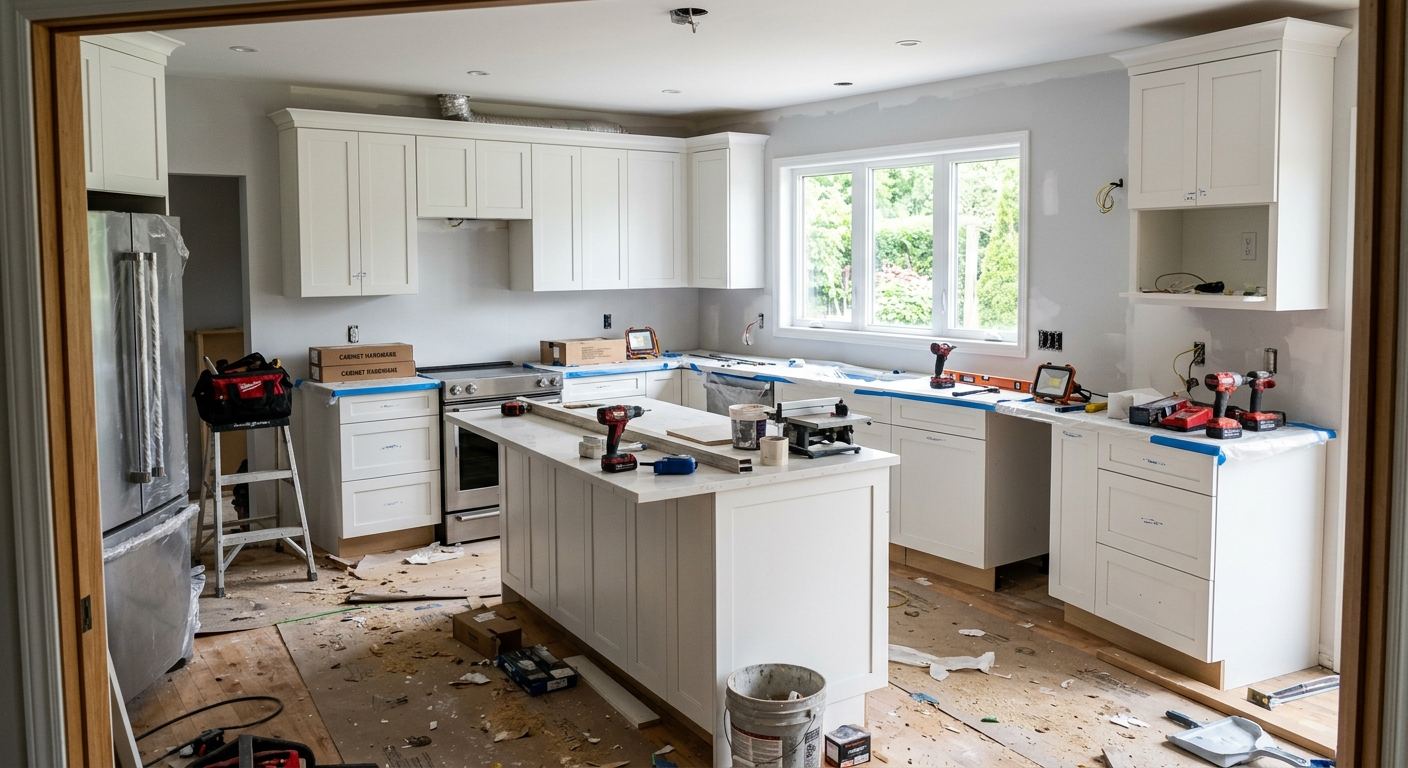
Kitchen renovation options and costs in Wetaskiwin
Kitchen renovations in Wetaskiwin typically start with the same reality: most homeowners are balancing resale expectations against what they want to live with day-to-day. With a median household income of $69,500 (Statistics Canada, 2021 Census), many households aim for mid-range finishes rather than “fully custom at any cost.” At the city scale, homeowner households make up 63.4% owner-occupancy (Statistics Canada, 2021 Census), which also nudges projects toward durable, buyer-friendly upgrades that won’t look dated in a few years.
In the Edmonton economic region, budgets usually track closely to neighbourhood home values and household income more than to cold weather. That said, Alberta’s freeze–thaw swings still matter indirectly: if your subflooring or exterior wall detailing has moisture risk, you may find more prep work during demo. Also, kitchens compete for labour with other trades in the shoulder seasons around Edmonton, so availability can affect schedules and labour allowances.
In Wetaskiwin, trades are especially busy in established residential areas where most homes are older—55.7% of dwellings were built before 1981 (Statistics Canada, 2021 Census)—because those homes often need upgraded wiring, tighter plumbing runs, and refreshed layouts. If you’re near downtown or along the more mature residential corridors, it’s common to see requests for under-cabinet lighting, refreshed cabinet styles, and stone-like counters that modernize the look without major structural work.
Below are common renovation tiers contractors quote in Wetaskiwin, followed by how long each project typically takes and what usually drives the price within the given range.
| Renovation Tier |
What's Included |
Typical Duration |
Price Range |
| Cosmetic refresh (paint, hardware, new appliances only) |
Cabinet paint or refinish, new pulls/knobs, backsplash refresh (spot), appliance swap, basic lighting updates, minor surface prep |
1–3 weeks |
$8,000–$18,000 |
| Mid-range full renovation (new cabinets, counters, sink, tile) |
Semi-custom or stock cabinets, quartz (or similar), new sink and faucet, backsplash tile, updated lighting, new flooring (LVP or tile), disposal and trim/finish work |
3–6 weeks |
$25,000–$55,000 |
| High-end full renovation (custom cabinets, stone counters, island) |
Custom millwork, granite/stone counters, island (often with upgraded electrical/plumbing), extended backsplash or full-height features, premium lighting, higher-end flooring and detailed finishing |
6–10 weeks |
$60,000–$90,000 |
| Cabinet refacing only (new doors + drawer fronts, same boxes) |
New doors and drawer fronts, new trim, hardware upgrades, cabinet box prep, re-seal/repair of existing boxes, paint/stain blending |
1–3 weeks |
$8,000–$25,000 |
| Countertop swap only (laminate to quartz or stone) |
Remove existing top, install new quartz/stone, new sink cut and connection adjustments as required, edge finishing, basic caulking and cleanup |
3–7 days |
$2,500–$12,000 |
| Backsplash tile installation only |
Tile supply and installation, waterproofing membrane where needed, grout sealing, clean-up, matching trim profiles |
3–7 days |
$2,000–$8,000 |
Prices are estimates only and vary by project scope, site access and material selection.
What affects the price of kitchen renovation in Wetaskiwin
Even when two homeowners in Wetaskiwin want “the same kitchen,” contractor quotes in the Edmonton region can differ by 30–50% due to hidden scope and finish tier expectations. In practice, local home values and median income shape what most buyers see as “worth it,” so homeowners in higher-value pockets often default to quartz or stone counters and semi-custom cabinetry. In more price-sensitive pockets, laminate and stock cabinets dominate, helping the project land closer to the lower end of the full renovation band (commonly $25,000–$90,000) by keeping cabinet and stone costs under control.
Layout changes create the biggest unpredictability, regardless of whether you choose laminate, quartz, or granite. Removing a wall, adding an island, or moving a gas line typically triggers extra demolition, patching, and inspection work—plus trade coordination. That’s why two “mid-range renovations” can land far apart even if both choose similar counters.
In Wetaskiwin, older housing stock built before 1981 (55.7% of dwellings) often means dated electrical runs, older shutoffs, and sometimes narrower cabinet bays—costs rise if the original wall is out of plane or the subfloor needs repair. A common scenario: upgrading from builder-grade laminate to quartz may look like a straightforward countertop swap, but if the base cabinets aren’t level, you’ll pay more for shimming and rework. Conversely, if the kitchen already has solid, level cabinets and a straightforward sink location, a countertop-only upgrade (often $2,500–$12,000) can be a budget-friendly way to modernize without redoing the whole room.
Contractor availability also affects cost: when schedules tighten across the Edmonton region, some teams price in material sourcing time and crew allocation. Still, compared with finishes and layout, climate doesn’t directly drive most kitchen renovation dollars—the market does.
| Price Factor |
Why It Matters |
Cost Impact |
| Cabinet tier — stock vs. semi-custom vs. fully custom millwork |
Custom sizing, internal organization, and craftsmanship change both material cost and installation time. |
Large swing; often the single biggest driver within the $25,000–$90,000 range. |
| Countertop material — laminate vs. quartz vs. granite vs. stone |
Material price and fabrication complexity affect labour, template time, and install difficulty. |
Medium to large; quartz is a common step-up from laminate with higher installed cost. |
| Layout change — wall removal, island add, plumbing/gas move |
Reframing, rerouting lines, and coordination among trades add unpredictable work. |
Often the most unpredictable; can push a mid-range job into high-end territory quickly. |
| Appliance package tier — builder vs. mid-range vs. pro-grade |
Higher tiers add features that may require electrical readiness and venting/plumbing adjustments. |
Medium; can add noticeable cost even if cabinetry/stone stay the same. |
| Flooring — refinish existing vs. full replacement |
Subfloor condition, moisture tolerance, and leveling determine prep scope. |
Medium; full replacement typically adds labour plus materials. |
| Backsplash — ceramic tile vs. marble vs. full-height slab |
Higher-end tile/stone needs stricter setting, alignment, and more cutting around outlets. |
Smaller to medium; can still escalate if full-height or slab detailing is requested. |
| Electrical — new circuits for island, under-cabinet lighting |
More outlets, dedicated circuits, and lighting pulls a licensed electrician into the schedule. |
Medium; impacts both permit/inspection and coordination time. |
| Permit fees and licensed trade requirements |
Permits and inspection timing can add administrative and scheduling cost. |
Low to medium individually, but can raise project overhead when changes trigger multiple trades. |
Permits & regulations in Alberta
In Alberta, simple cabinet and countertop swaps usually do not require permits. That means replacing existing cabinets, installing new countertop material, or setting a backsplash in the same footprint is typically treated as a non-permitted renovation. However, once your project touches plumbing, gas, structural elements, or electrical, permits and licensed trades commonly come into play.
Work that typically does require a permit and licensed trades includes: moving supply or drain lines for a sink or dishwasher, relocating a gas stove or changing the venting/routing for a range hood that involves gas equipment, removing a load-bearing wall or making structural changes, and adding new electrical circuits (for example, island receptacles, adding a new dedicated circuit for a microwave hood, or expanding the panel capacity). Gas work must be performed by a licensed gas fitter, and electrical work by a licensed electrician; both generally need inspections before you can close up walls.
To verify a contractor in Wetaskiwin, ask for three things before work begins: (1) their Alberta licence information (or trade registration number as applicable), (2) proof of liability insurance with your project’s named address, and (3) WSIB/WCB clearance (coverage confirmation) for the contractor and any subcontractors. Where to look: use the trade registry search provided by the provincial government for licensing status, review the certificate of insurance for effective dates and coverage limits, and request a clearance letter or equivalent coverage confirmation document.
Always confirm who pulls which permit and who is responsible in the written contract—“we’ll handle it” isn’t enough unless it’s stated clearly.
Cabinets, countertops and layout decisions in Wetaskiwin
In Wetaskiwin kitchens, three decisions determine both your budget and how happy you’ll be when the dust settles: (1) cabinet tier, (2) countertop material, and (3) whether you change the layout. The Edmonton-area resale market tends to reward clean lines, durable surfaces, and functional storage—especially in homes where 55.7% of the dwelling stock is older than 1981 (Statistics Canada, 2021 Census), so buyers are often comparing “update level,” not square footage.
Cabinet tier: stock cabinets are the fastest and usually the cheapest because they’re produced in standard sizes. Semi-custom cabinets (the most common mid-range choice) balance lead time, cost, and fit—particularly if your room is slightly out of square. Custom cabinets cost more but make sense when you need unique sizing around windows, vents, or awkward bays, or when you want deep pantry organizers and soft-close hardware throughout.
Countertops: laminate is budget-friendly and easy to replace later, but it’s less resistant to heavy daily abrasion and seam wear. Quartz engineered tops are a strong Wetaskiwin default: they’re durable, relatively low maintenance, and install-friendly. Granite/natural stone offers premium look and heat tolerance but brings higher material and fabrication cost. For a specific example: upgrading from laminate to quartz can be done as a focused install (often within the countertop swap band of $2,500–$12,000), while a full high-end renovation with custom cabinetry and stone counters typically lands in the broader $60,000–$90,000 range.
Layout changes: adding an island or relocating plumbing/gas can justify the cost only when it improves workflow—more storage, better seating clearance, or a true “triangle” between sink, fridge, and range. If you’re simply chasing aesthetics, keep plumbing where it is; if you’re gaining real space and function, that’s where the extra dollars pay back.
| Option |
Durability |
Maintenance |
Best For |
Price Range |
| Stock cabinets (big-box) |
Good for everyday use; limited customization around odd dimensions |
Standard cleaning; focus on gentle hardware tightening |
Fast timelines and best value when your measurements are straightforward |
$8,000–$18,000 |
| Semi-custom cabinets (local dealer) |
Very good durability; better fit and storage options |
Easy upkeep; hinges and soft-close hardware reduce wear over time |
Most Wetaskiwin mid-range renovations targeting resale-friendly upgrades |
$18,000–$35,000 |
| Custom cabinets (local millwork shop) |
Excellent durability; tailored joinery and consistent fit |
Simple cleaning; higher-quality components often last longer |
Complex layouts, unique sizing, and “built-in” features (pantries, hood surrounds) |
$35,000–$60,000 |
| Laminate countertop |
Moderate durability; seam and edge wear can appear sooner |
Low maintenance; avoid heavy impact at seams and corners |
Budget-first refresh where you plan to upgrade later |
$2,500–$5,500 |
| Quartz engineered countertop |
High durability; strong stain resistance and consistent surface |
Low maintenance; wipe clean, no yearly sealing |
High-demand resale look with predictable performance |
$5,500–$10,500 |
| Granite / natural stone countertop |
Very high durability; natural heat tolerance |
Moderate maintenance; periodic sealing depending on stone type |
Premium styling for buyers who expect real stone |
$8,000–$12,000 |
| Butcher block countertop |
Good durability with care; can be dented by heavy use |
Higher maintenance; oiling required and water management is key |
Warm, lived-in style and kitchens used for frequent meal prep |
$4,500–$9,000 |
| Marble countertop |
Beautiful but more sensitive to etching and staining |
Higher maintenance; sealing and careful chemical use |
Showpiece kitchens where aesthetics matter most |
$10,000–$16,000 |
How to choose a kitchen renovation contractor in Wetaskiwin
Choosing the right contractor in Wetaskiwin comes down to proof, not promises: confirm Alberta licensing where applicable, validate liability insurance, and verify WSIB/WCB coverage for the trades working on your home. To check licensing, ask for their Alberta registration details and then verify status using the provincial online registry. For insurance, request a certificate of insurance and confirm the coverage dates align with your start and completion window. For WSIB/WCB, ask for a clearance letter or coverage confirmation and confirm it includes subcontractors if they’ll be on site.
Next, get 2–3 itemised written quotes. You want a breakdown that separates labour and materials (cabinets, countertops, flooring, demolition, electrical, plumbing, disposal) rather than a single lump sum. Ensure the scope is explicit: what’s included for permit pull (if required), what disposal haul-away covers, whether the quote includes tile backer/waterproofing, and how backorders are handled. A quality quote will also list allowances for fixtures like faucets and lights so you’re not surprised at the purchase stage.
Warranty matters on both the build and the product. Ask for workmanship warranty length, whether product warranties are manufacturer-backed, and whether those warranties are transferable to you if ownership changes. Pay attention to payment schedule: never agree to more than 10–15% upfront. Use a holdback until the job is complete and defects are corrected. Finally, demand a timeline with a start date and completion estimate in writing, plus what happens if materials are delayed.
- Ask for contractor and subcontractor contact information before work begins.
- Confirm Alberta licensing for gas and electrical scopes (when included in your project).
- Review liability insurance certificate and ensure it lists your project/address.
- Request WSIB/WCB clearance for the contractor and any subcontractors.
- Get 2–3 itemised quotes with labour + materials, not lump sums.
- Check the scope: demolition, disposal, and site protection are clearly listed.
- Verify permit pull responsibility and whether inspections are included.
- Confirm cabinet lead times and what “backorder” means for your schedule.
- Ensure flooring prep (levelling/subfloor work) is included where required.
- Ask how plumbing/gas shutoffs and reconnects will be handled and tested.
- Require a written warranty statement for workmanship and product terms.
- Use a payment schedule with a holdback until punch list items are done.
Red flags in Wetaskiwin include: quotes that are “too good to be true” with no itemization, no written warranty terms, refusing to provide insurance/clearance documents, vague timelines without start/completion dates, and workmanship that’s discussed verbally but excluded in the contract scope.
Frequently asked questions — kitchen renovation in Wetaskiwin
Do I need a permit for a kitchen renovation in Alberta?
In Alberta, many cosmetic kitchen updates in Wetaskiwin—like painting cabinets, swapping countertops, installing new flooring, or adding a backsplash—typically do not require permits. Permits are commonly needed when your project changes plumbing or gas lines, removes or alters structural elements, or adds/changes electrical circuits. For example, relocating a sink by moving supply/drain lines or moving a gas range usually triggers permitting and requires licensed trades (gas fitter and electrician). The best approach is to ask your contractor to list permit-triggering scopes in writing and confirm who pulls the permits. If your quote is aiming for a mid-range full renovation (often $25,000–$55,000), make sure plumbing/gas/electrical portions are clearly itemised and tied to permit responsibility and inspection timing.
What's the ROI on a kitchen renovation?
ROI (return on investment) depends on neighbourhood buyer expectations more than weather. In the Edmonton economic region, kitchen renovations often track 15–25% of the home’s value when done with solid mid-range finishes, consistent with common kitchen-and-bath industry rules of thumb. With Wetaskiwin’s homeowner base and older housing stock, buyers usually pay attention to how modern and maintenance-friendly the kitchen feels—especially countertops, lighting, and cabinet storage. If you stay in a predictable scope like a mid-range full renovation (often $25,000–$55,000) with quartz counters and a reasonable layout, it tends to be easier to recover value than an oversized “high-end only” spend. If you jump to a high-end full renovation (commonly $60,000–$90,000) but keep a poor or inefficient layout, the ROI can soften because buyers may discount functionality.
How do I budget for a kitchen renovation?
Budgeting for a Wetaskiwin kitchen usually works best when you anchor your plan to tiered costs and then “stress-test” the scope. Start by deciding whether you’re doing a cosmetic refresh, mid-range full renovation, or high-end renovation. For many homeowners, a mid-range approach lands within $25,000–$55,000, while high-end projects commonly sit in $60,000–$90,000 depending on custom millwork, stone, and layout changes. Build in a contingency for the parts that can’t be fully seen before demo—older wiring, subfloor levelling, and hidden plumbing conditions in homes built before 1981 (Statistics Canada, 2021 Census). A smart strategy is to keep plumbing/gas in place if your goal is modernisation. If you want impact without full demolition, countertop-only upgrades (often $2,500–$12,000) and backsplash installations (often $2,000–$8,000) can be budget-friendly levers.
Can I move my kitchen sink or stove?
Yes, you can move a sink or stove in Wetaskiwin, but it’s often the cost driver. Moving a sink typically means altering supply and drain lines—work that commonly requires permits and licensed plumbing, inspections, and careful planning to avoid drainage issues. Moving a gas stove can involve rerouting gas lines and ensuring safe venting and connection compliance with licensed gas fitting. If you’re chasing a layout change, plan it early so trades coordinate and you don’t end up with rework after cabinets and flooring are installed. For many homeowners, the best compromise is to keep plumbing within the same general zone and focus on cabinet/storage upgrades and countertop replacement. That’s where countertop swap pricing (often $2,500–$12,000) can deliver a big visual upgrade without the uncertainty that comes with moving lines.
What's the most cost-effective kitchen upgrade?
In most Wetaskiwin homes, the most cost-effective upgrade is usually one that modernises the “big visual surfaces” without forcing rework of plumbing, gas, or wiring. Two common wins are (1) swapping countertops to quartz and (2) doing targeted cabinet upgrades. If your existing cabinets are structurally sound, cabinet refacing (often $8,000–$25,000) can dramatically update the look while avoiding full cabinet removal. If the cabinet boxes are solid but the tops are dated, a countertop swap (often $2,500–$12,000) can refresh the entire kitchen for a fraction of a full renovation. Pairing the change with new hardware and a backsplash tile install (often $2,000–$8,000) gives a “complete” look. The most cost-effective option is usually the one that keeps you from triggering permits and licensed-trade rework for plumbing/electrical.
Custom vs stock cabinets — is custom worth it?
Custom cabinets can be worth it in Wetaskiwin when you have a challenging layout (out-of-square walls, unusual dimensions, or a window/door configuration that needs exact fit) or when you want specific interior storage features—deep pantries, specialty drawers, and tailored organization. If your measurements are straightforward and you’re primarily aiming to modernise, stock or semi-custom often offers better value. Stock cabinets are typically the fastest and cheapest, while semi-custom is usually the “best middle” for durability, fit, and resale appeal. Fully custom millwork pushes costs quickly and is more often seen in high-end renovations (commonly $60,000–$90,000). A practical rule: if you’re choosing between stock/sim-custom and custom, prioritise good installation and functional layout first. A well-executed semi-custom kitchen with quartz can outperform a poorly planned “custom” project on ROI and buyer satisfaction.