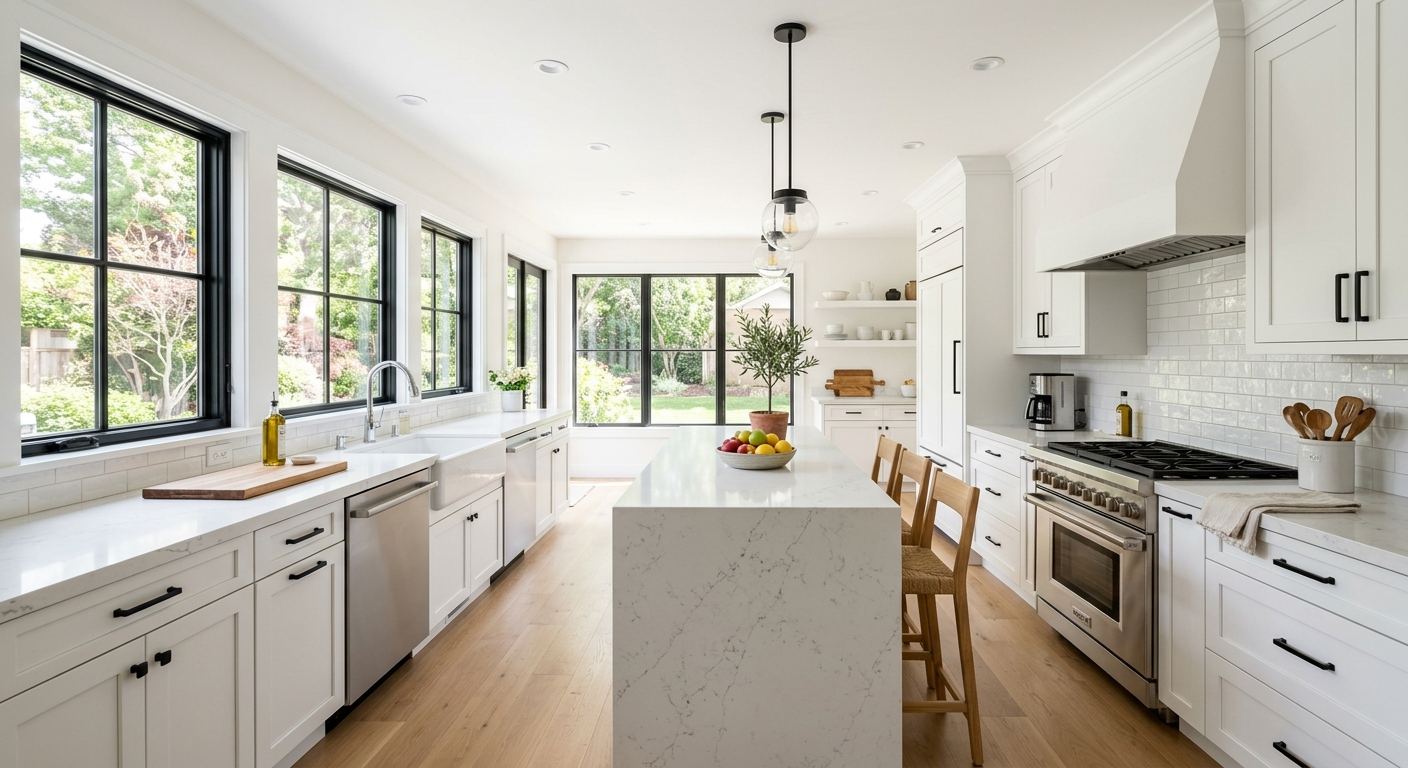
Kitchen renovation options and costs in Devon
Devon, Alberta homeowners usually have three clear kitchen renovation paths: a cosmetic refresh, a mid-range full renovation, or a higher-end custom upgrade. With a median household income of $95,000 (Statistics Canada, 2021 Census) and about 77.2% of households owning their homes, many projects are planned as long-term upgrades rather than short-term flips. That matters in the Edmonton region, where budgets typically track closely to local purchasing power and expected resale performance—especially in streets with newer families and more frequent home sales.
Seasonality also affects timing more than pricing. In winter months, scheduling can tighten and concrete-setting trades (tile/flooring) may have limited indoor curing windows, but labour rates generally remain tied to market demand. The bigger cost driver is the finish tier: cabinetry and stone often set the ceiling, while plumbing, electrical changes, and demolition determine how far you stretch your budget. In Devon, older housing stock is common—46.6% of homes were built before 1981—so it’s not unusual to uncover dated subflooring, uneven walls, or knob-and-tube-era electrical conditions behind older finishes. That’s one reason contractor availability and site assessment are critical when you’re budgeting.
Because demand can concentrate where homeowners want practical upgrades without major structural work, contractors tend to be especially busy around Strathcona County-area commuter corridors and newer subdivisions near Devon’s retail core. Next, use the table below to compare realistic “what you get” ranges across renovation tiers.
| Renovation Tier |
What's Included |
Typical Duration |
Price Range |
| Cosmetic refresh (paint, hardware, new appliances only) |
Paint, cabinet hardware, appliance replacement (like-for-like), faucet swap, minor caulking/trim touch-ups |
3–7 days |
$6,000–$18,000 |
| Mid-range full renovation (new cabinets, counters, sink, tile) |
Semi-custom cabinets, quartz counters, sink + faucet, backsplash tile, LVP/tile flooring, updated lighting, labour for demo/installs |
3–6 weeks |
$25,000–$65,000 |
| High-end full renovation (custom cabinets, stone counters, island) |
Fully custom millwork, granite/stone counters, island with upgraded plumbing, full backsplash (often to full height), premium lighting, flooring upgrades |
6–12 weeks |
$65,000–$90,000 |
| Cabinet refacing only (new doors + drawer fronts, same boxes) |
New door/drawer fronts, new hardware, resurfaced/painted cabinet boxes, basic install and alignment, optional under-cabinet lighting prep |
1–3 weeks |
$8,000–$25,000 |
| Countertop swap only (laminate to quartz or stone) |
Remove old countertop, new quartz or stone installation, sink cutout adjustments, reseal and caulking, backsplash detail patching as needed |
3–7 days |
$2,500–$12,000 |
| Backsplash tile installation only |
Tile supply and install, underlayment/patching if needed, trim pieces, grout/seal where applicable |
3–10 days |
$2,000–$8,000 |
Prices are estimates only and vary by project scope, site access and material selection.
What affects the price of kitchen renovation in Devon
You can see quotes swing by 30–50% for the “same” kitchen in Devon and across the Edmonton economic region, even when the visible finishes look similar. The reason is that kitchen scope is rarely identical: one quote includes hidden repairs (subfloor flattening, electrical corrections, new shims), another assumes everything behind the walls is ready to go. In this market, home values and household income tend to set what finish tier homeowners choose—more than climate. For higher-value pockets, quartz or stone counters and semi-custom cabinetry are commonly chosen because the upgrade is easier to justify on resale. In more price-sensitive areas, laminate and stock cabinets still dominate because they protect your return.
Layout work adds the most uncertainty. Removing a wall, adding an island, or moving a gas line typically changes trades, inspection requirements, and material lead times, which can push labour and contingency higher regardless of whether you choose mid-range or high-end finishes. In Devon’s older housing stock (46.6% pre-1981), you’re more likely to encounter electrical rework or uneven framing, which can turn a “countertops only” plan into a bigger scope.
Concrete examples we see often in Devon: (1) upgrading under-cabinet lighting can require additional electrical circuits—sometimes adding time and labour beyond the cabinet install; (2) swapping laminate for quartz may require structural support and careful sink cutouts, especially if the existing base is out of level; (3) upgrading tile flooring from small format to large format can add prep time when older floors have dips or unevenness. Budgeting around the mid-range band of $25,000–$65,000 or the higher-end band of $65,000–$90,000 helps you plan for those realities early.
| Price Factor |
Why It Matters |
Cost Impact |
| Cabinet tier — stock vs. semi-custom vs. fully custom millwork |
Build quality, door/drawer construction, fit tolerances, and lead times differ |
Large swing; cabinetry commonly drives roughly 30% of total project cost |
| Countertop material — laminate vs. quartz vs. granite vs. stone |
Material price, fabrication complexity, and installation requirements change significantly |
Typically around 10% of total budget for many mid-range builds, more for premium stone |
| Layout change — wall removal, island add, plumbing/gas move |
Triggers additional labour, inspections, and potential framing/structural work |
One of the biggest unpredictable cost items; can raise scope even if finishes stay mid-range |
| Appliance package tier — builder vs. mid-range vs. pro-grade |
Higher tiers cost more and can require different cutouts/venting |
Can add thousands quickly; affects budget more than homeowners expect |
| Flooring — refinish existing vs. full replacement |
Subfloor prep and floor transition details vary with existing conditions |
Full replacement usually costs materially more; older homes often need extra prep |
| Backsplash — ceramic tile vs. marble vs. full-height slab |
Complex patterns, heavier materials, and height coverage increase labour and install time |
Full-height or premium stone can push backsplash beyond mid-range expectations |
| Electrical — new circuits for island, under-cabinet lighting |
Licensed wiring, permits, and inspection depend on how much you change |
Often modest for like-for-like upgrades, larger when circuits and island power are added |
| Permit fees and licensed trade requirements |
Any plumbing/gas moves or electrical circuit additions can require permits and inspections |
Can add cost and lead time; also reduces surprises if planned early |
Permits & regulations in Alberta
In Alberta, the key concept for Devon homeowners is that like-for-like finish swaps often don’t require permits, while moving major services usually does. Cabinet and countertop swaps typically do not require permits by themselves. However, if your plan includes moving plumbing supply/drain lines, relocating a gas appliance or making changes related to the stove/range hood with gas, removing a load-bearing wall, or adding new electrical circuits for an island or upgraded lighting plan, permits are commonly required and licensed trades must perform the work.
Gas work must be completed by a licensed gas fitter, and electrical work must be done by a licensed electrician, with the appropriate inspections. A practical way to protect yourself is to confirm permit responsibility in writing before work begins—do not rely on verbal assurance. Ask: “Which items are permitted, who pulls the permit, and who covers inspection fees if something fails?”
To verify a contractor in Devon, start with their Alberta licence details (where available) and then validate proof through documentation: (1) request a certificate of liability insurance showing your project address as applicable; (2) confirm WSIB/WCB clearance/coverage for the trades; and (3) ensure subcontractors provide their own insurance/coverage letters for their scope. Finally, keep copies of permit numbers, inspection confirmations, and warranty paperwork with your contract—this is what you’ll need if questions arise later.
Cabinets, countertops and layout decisions in Devon
For a Devon kitchen renovation, three decisions usually determine most of your budget and long-term satisfaction: (1) cabinet tier, (2) countertop material, and (3) layout changes. Cabinet tier is about fit, speed, and how “custom” the kitchen feels when you look at it day-to-day. Stock cabinets are the fastest and least expensive, but they can compromise on storage efficiency. Semi-custom is the most popular mid-range route because it balances options with lead times. Fully custom millwork costs the most, but it’s the best fit for unusual wall lengths, ceiling heights, or families who want built-ins sized for real habits.
Countertop choice also matters for durability and maintenance in the Edmonton area—kitchens see constant moisture cycles, and older home basements can contribute to humidity swings that highlight weak sealing. Laminate is budget-friendly but can be more prone to edge wear. Quartz is a strong “buy once” option: low maintenance, resistant to everyday stains, and it installs cleanly with modern sinks. Granite/natural stone looks premium but typically requires more care. Butcher block is warm and repairable, yet it needs oiling and discipline around water exposure.
Layout changes should be justified by space gain and resale buyer expectations. If you add an island or open a wall, you’re paying for more than aesthetics—you’re paying for plumbing/gas reroutes and electrical, plus the framing and finishing work to bring everything back to level and square. For a concrete example: moving from a mid-range full renovation budget of $25,000–$65,000 to a high-end full renovation budget of $65,000–$90,000 often becomes worthwhile when the kitchen gains an island work zone and better traffic flow (not just when you upgrade one finish). If your layout is already efficient, keep plumbing in place and focus the spend on cabinets and quartz.
| Option |
Durability |
Maintenance |
Best For |
Price Range |
| Stock cabinets (big-box) |
Good for everyday use; limited flexibility for awkward spaces |
Low maintenance; hinges/hardware upkeep as needed |
Budget-first updates with quick lead times |
$8,000–$25,000 |
| Semi-custom cabinets (local dealer) |
Better materials and options; improved storage configurations |
Low maintenance; choose hardware and finishes for easy wipe-down |
Most Devon homeowners who want a real “custom feel” |
$20,000–$45,000 |
| Custom cabinets (local millwork shop) |
Highest fit and longevity; tailored to your walls and storage needs |
Low maintenance; built for specific door/drawer use patterns |
Complex layouts, built-ins, and top-tier resale styling |
$40,000–$70,000 |
| Laminate countertop |
Solid for normal wear; edges can chip if impacted |
Easy to clean; protect from heat and standing water at seams |
Cost-controlled renovations where looks matter most |
$2,500–$6,000 |
| Quartz engineered countertop |
Very durable; resistant to staining and everyday abuse |
Low maintenance; wipe clean, avoid harsh chemicals |
Best blend of durability and “resale-ready” appearance |
$5,500–$12,000 |
| Granite / natural stone countertop |
High durability; unique patterning and premium look |
Typically requires periodic sealing and careful stain prevention |
Homeowners aiming for high-end finishes and dramatic visuals |
$7,000–$14,000 |
| Butcher block countertop |
Durable but can scratch; sensitive to prolonged moisture |
Requires oiling and routine care; dry thoroughly |
Warm, lived-in kitchen style with disciplined maintenance |
$4,000–$10,000 |
| Marble countertop |
Elegant but more porous; can etch with acids |
Needs sealing and careful cleaning to avoid dulling |
Feature-statement kitchens where upkeep is acceptable |
$8,000–$18,000 |
How to choose a kitchen renovation contractor in Devon
In Devon, choosing the right contractor starts with proof—not promises. Verify Alberta licensing/registration where applicable for the company and confirm that any specialized trades on your scope (gas and electrical) are properly licensed. Next, request liability insurance and confirm WSIB/WCB coverage (clearance/coverage documentation) for the workers who will be on-site. If a contractor can’t supply these documents quickly, that’s a practical red flag, because kitchens often involve multiple trades and inspection points.
Then request 2–3 itemised written quotes. You want a breakdown that separates labour and materials: demolition, carpentry, cabinet install, countertop fabrication/installation, tile/floor prep, electrical/plumbing line changes, disposal, and any permits. Avoid quotes that lump everything into one number without showing what’s included. Read the scope carefully: ask whether the quote includes permit pull, inspection scheduling, haul-away/disposal, waste protection, and patching/painting after trades complete their work.
Warranty matters in a kitchen because issues show up months later. Ask for the workmanship warranty length, what it covers, and whether it’s transferable to a future buyer. Finally, protect your cash flow: don’t pay more than 10–15% upfront, and use a holdback until job completion and final walkthrough. Get the start date and completion estimate in writing, including cabinet and countertop delivery windows.
- Ask for the contractor’s insurance certificate and confirm coverage limits are appropriate for your project scope.
- Request WSIB/WCB clearance/coverage proof before any on-site work begins.
- Confirm gas work and electrical work will be done by properly licensed trades with documentation.
- Get 2–3 itemised quotes with labour and materials separated (not a single lump sum).
- Ensure the scope explicitly states what’s included for demolition, patching, and final cleaning.
- Confirm permit responsibilities and whether the contractor pulls permits or if you do.
- Check lead times in writing for cabinets and countertops (fabrication delays happen).
- Ask how the contractor protects floors/doorways during demolition and installation.
- Request a detailed schedule (milestones for demo, rough-ins, cabinet install, counters, tile).
- Verify warranty terms: workmanship duration, product warranty, exclusions, and transferability.
- Negotiate a payment schedule with a holdback until punch list is complete.
- Ask who your direct contact is during the build and who handles site issues day-to-day.
Red flags I watch for in Devon: (1) quotes without a detailed breakdown of labour vs materials; (2) avoiding the topic of permits/inspections or saying “we handle it” without specifics; (3) asking for large upfront payments beyond 10–15%; (4) vague timelines with no cabinet/countertop lead-time plan; (5) no proof of insurance or WSIB/WCB coverage when requested.
Frequently asked questions — kitchen renovation in Devon
How do I budget for a kitchen renovation?
Start by choosing a renovation tier that matches your goals, then plan for the trade surprises that come with older Devon homes—46.6% were built before 1981 (Statistics Canada, 2021 Census). If you’re mostly updating finishes without moving services, a cosmetic refresh can be a sensible path. For many households targeting value and longevity, mid-range full renovations typically land around $25,000–$65,000, assuming quality cabinets, quartz counters, updated lighting, and updated flooring. If you want custom millwork, an island with upgraded plumbing, and premium stone, the high-end band is commonly around $65,000–$90,000. To budget accurately, ask your contractor for an itemised quote that separates demolition, cabinets, counters, tile/floor prep, electrical/plumbing changes, disposal, and permit responsibilities.
Can I move my kitchen sink or stove?
Yes, you can move a sink or stove in Alberta, but it’s usually where kitchen budgets jump—because it often requires licensed plumbing and/or gas work plus permits and inspections. In practical terms for Devon homeowners, moving a sink typically means rerouting drain and supply lines; moving a stove (especially if it’s gas) generally means changes related to gas line routing and potentially venting for the range hood. That’s why it’s not only the “new location” cost—your quote should include rough-ins, inspection scheduling, and any framing/patching to restore walls and floors. For the best cost control, many families keep plumbing and gas in place and spend on cabinets, quartz, lighting, and better storage. If you do move services, plan around timelines for licensed trades and permit approvals.
What's the most cost-effective kitchen upgrade?
The most cost-effective upgrade is usually the one that delivers a high visual impact without triggering major layout changes. In Devon, we often see strong value from cabinet-focused improvements—either a refacing approach or a well-selected mid-range cabinet tier—paired with quartz counters and updated lighting. If you’re working within a controlled scope, a countertop swap only can be a quick win; countertop installation commonly sits around $2,500–$12,000. If you want a bigger “new kitchen” feel without full demolition, cabinet refacing only often lands around $8,000–$25,000 because you keep the existing boxes and upgrade fronts, doors, and hardware. Avoid overspending on moves that require plumbing/gas relocation unless the layout improvement truly improves traffic flow and storage efficiency.
Custom vs stock cabinets — is custom worth it?
Custom cabinets can be worth it in Devon when your kitchen layout has challenges (odd wall lengths, ceiling height variations, or a need for built-ins) and when you’re aiming for long-term daily usability. Stock cabinets are the fastest and usually cheapest because they’re standardized, but you may sacrifice storage optimization or find gaps that require filler/adjustment work. Semi-custom is often the “sweet spot” for homeowners who want a more tailored look without jumping to the highest millwork budgets. In general, you’ll see stock options fitting within the broader cabinet band around $8,000–$25,000, while custom work pushes you toward the higher end of full-project budgeting. The best test of “worth it” is resale expectations: buyers in the Edmonton economic region commonly look for clean lines, solid storage, and durable finishes more than any one specialty feature.
How do I choose a kitchen contractor in Devon?
Choose a contractor who can document compliance and clearly itemise your scope. In Alberta, verify that the contractor can provide liability insurance and proof of WSIB/WCB coverage, and confirm that any gas work will be performed by a licensed gas fitter and any electrical by a licensed electrician. Ask for 2–3 itemised written quotes, not just a lump sum—labour, materials, permit pull responsibility, disposal/haul-away, and any patching/finishing should be explicit. Review warranty terms: workmanship warranty length, product/manufacturer warranty, and whether coverage is transferable. For payments, keep deposits conservative—generally no more than 10–15% upfront—and hold back until the punch list is complete. Finally, insist on a written timeline that includes cabinet and countertop lead times so you’re not stuck waiting mid-project during deliveries.
What order do kitchen renovation steps happen in?
A typical kitchen renovation sequence in Devon starts with planning and site protection, then demolition and rough-ins. After demo, trades confirm rough plumbing/electrical/gas routing (if you’re changing services), and inspections are scheduled where permits apply. Next comes the cabinet installation and layout alignment, followed by countertop fabrication scheduling and install. Flooring and tile usually happen around the same window depending on your design: LVP/tile gets set before finish trim in many projects, while backsplash tile is installed after counters are in to ensure clean fits. Appliances are installed last, followed by finishing details like caulking, trim, and final adjustments. The ordering matters because rushing cabinet placement can compromise countertop fit, and countertop delays can stall tile and appliance installation.