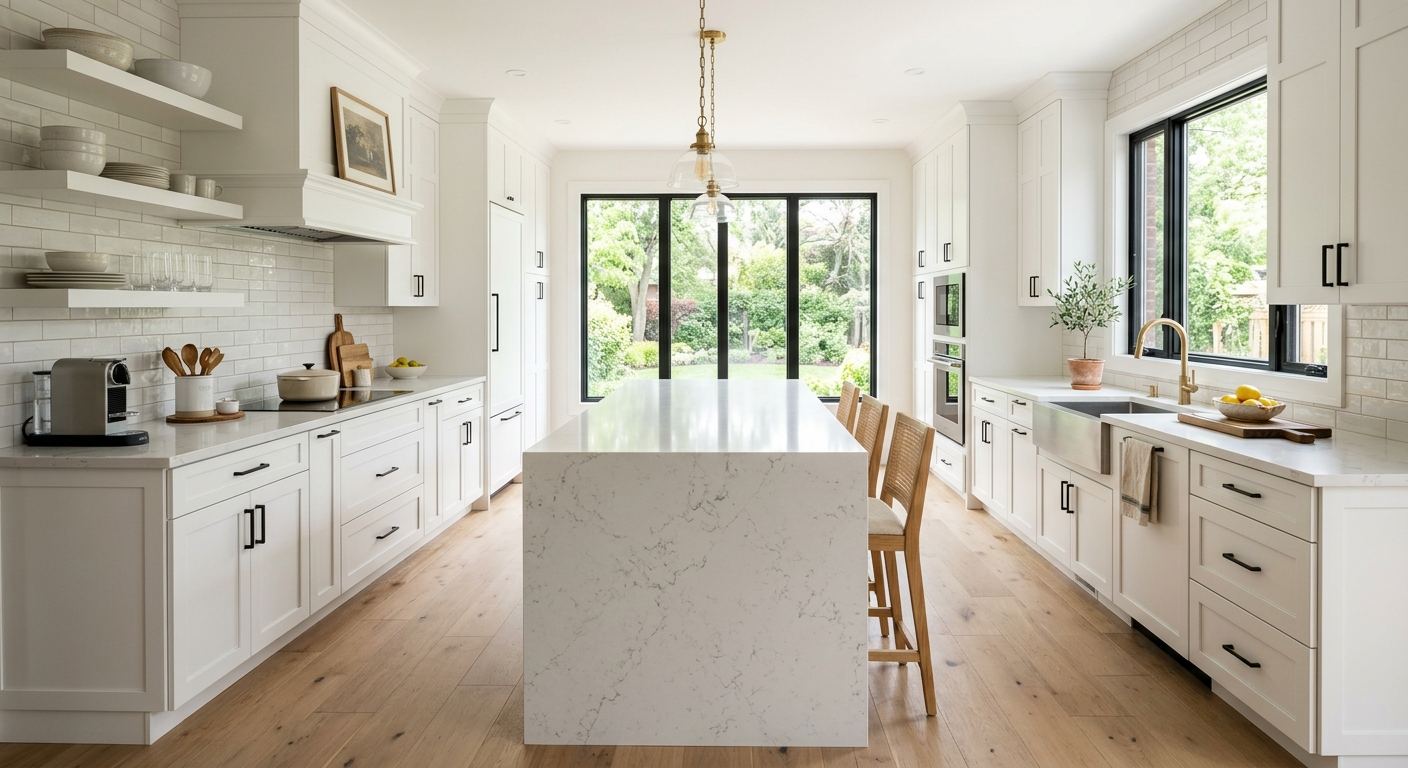
Kitchen renovation options and costs in Parkhill
Parkhill, Alberta homeowners typically choose from the same core kitchen renovation options, but the price swings based on finish tier and how much of the layout you change. In a community of about 1,770 people (Statistics Canada, 2021 Census), many renovations are “livability” upgrades that still aim to look current for future resale in the Calgary economic region. Market expectations also lean toward the mid-to-upper finish end: in the wider Calgary area, kitchen remodel budgets track local home values and household incomes, which is why homeowners often move faster to quartz or natural stone and semi-custom cabinetry rather than laminate and stock boxes. (Statistics Canada, 2021 Census)
Even though Alberta’s climate isn’t the main driver of kitchen pricing, it does affect what contractors plan for on-site: temperature swings and dry indoor air can accelerate cracking risks with some low-end finishes, so reputable crews prep surfaces carefully and allow proper cure times for adhesives, caulks and countertop setting materials. Labour availability also matters—Calgary’s active construction cycle keeps skilled trades busy, so booking early helps lock in schedule and avoid rush premiums.
In Parkhill, this trade work is especially in demand around newer in-fill and growing residential pockets where homeowners are updating kitchens for families and first-time buyers; those projects commonly start with cabinet measurements and electrical planning, then move into countertops and tile. From there, the cost ranges below will give you a realistic “apples-to-apples” benchmark before you compare quotes.
| Renovation Tier |
What's Included |
Typical Duration |
Price Range |
| Cosmetic refresh (paint, hardware, new appliances only) |
Cabinet refacing-style appearance without new cabinetry: paint/primer, new hardware, faucet swap, appliance installation only (no cabinet changes), basic caulking and touch-ups |
3–7 days |
$5,000–$15,000 |
| Mid-range full renovation (new cabinets, counters, sink, tile) |
Semi-custom or upgraded stock cabinetry, countertop install, sink + faucet, backsplash tile, minor electrical updates (GFCI/receptacles), plumbing hook-ups, disposal and site cleanup |
2–4 weeks |
$25,000–$70,000 |
| High-end full renovation (custom cabinets, stone counters, island) |
Fully custom cabinetry, quartz or natural stone counters, island build (including toe-kicks and integrated storage), upgraded lighting (often under-cabinet LEDs), appliance package tier updates, premium tile/stone backsplash |
4–8 weeks |
$70,000–$100,000 |
| Cabinet refacing only (new doors + drawer fronts, same boxes) |
Door and drawer-front replacement, new pulls/knobs, refinishing/repair of existing cabinet boxes as needed, new trim where required |
1–3 weeks |
$8,000–$35,000 |
| Countertop swap only (laminate to quartz or stone) |
Old surface removal, new countertop fabrication and install, edge profile selection, sink drop-in/granite/quartz sealing where applicable, reconnect plumbing at sink |
4–10 days |
$3,000–$12,000 |
| Backsplash tile installation only |
Demo of existing backsplash (if included), tile layout, tile setting, grouting/sealing, caulking at edges, waterproofing as required |
2–5 days |
$2,500–$8,000 |
Prices are estimates only and vary by project scope, site access and material selection.
What affects the price of kitchen renovation in Parkhill
In Parkhill, you can see two quotes for the “same” kitchen that differ by 30–50% because the scope and the risk factors aren’t identical—even when the finishes sound similar. Across the Calgary economic region, budgets move with local home values and household incomes. In higher-value pockets, homeowners more often recover costs on resale by choosing quartz or stone counters and semi-custom cabinetry. In more modest areas, laminate and stock cabinets still dominate because they deliver a strong visual upgrade without pushing into the mid-to-high five-figure ranges. Climate itself is rarely the deciding factor; instead, finish selection, lead times, and labour intensity drive pricing. Still, Alberta’s temperature swings can make scheduling and cure times more critical when installing tile, setting stone and applying finishes.
Layout changes are where costs become unpredictable regardless of finish tier. Removing a wall, adding an island, or moving plumbing/gas lines adds demolition, patching, and licensed-trade work that typically doesn’t show up in “basic” budgets. For example, swapping countertops from laminate to quartz can land in the $3,000–$12,000 band when plumbing stays put, but the same countertop upgrade with a sink move and new electrical for under-cabinet lighting can push you toward the $25,000–$70,000 mid-range full renovation band. In older Alberta homes, dated shut-offs and supply lines can also mean extra labour to access valves and verify drain slopes.
Two concrete Parkhill examples I see often: (1) adding a hood fan duct route through an exterior wall can increase costs more than upgrading cabinet hardware; (2) kitchens with older subfloors sometimes need membrane repair before tile, which raises material and labour but prevents future cracked grout. Those site realities—more than weather—tend to explain the biggest quote differences.
| Price Factor |
Why It Matters |
Cost Impact |
| Cabinet tier — stock vs. semi-custom vs. fully custom millwork |
Higher tiers cost more and take longer to fabricate; custom also affects lead times for moulding, drawers and internal layouts |
Can shift a project by roughly $10,000–$40,000 depending on scope |
| Countertop material — laminate vs. quartz vs. granite vs. stone |
Material cost, edge options, thickness, and fabrication complexity directly affect total install pricing |
Typically $3,000–$12,000 for swaps; more if sink/backsplash changes are bundled |
| Layout change — wall removal, island add, plumbing/gas move |
Demolition + structural work + re-routing lines increases trades count and uncertainty |
Often adds $5,000–$30,000+ even before finishing materials |
| Appliance package tier — builder vs. mid-range vs. pro-grade |
Upgraded appliances may require different clearances, electrical specs and ventilation |
Commonly $2,000–$15,000 within a full renovation |
| Flooring — refinish existing vs. full replacement |
Opening the kitchen floor can reveal moisture damage and require subfloor work |
May add $1,500–$10,000 depending on damage and finish type |
| Backsplash — ceramic tile vs. marble vs. full-height slab |
Stone and full-height installations increase cutting time, layout complexity and material weight |
Often $2,500–$8,000 for tile-only scopes; higher when combined |
| Electrical — new circuits for island, under-cabinet lighting |
New circuits require licensed electrician work, routing decisions and inspection |
Frequently adds $800–$6,000 to a refresh |
| Permit fees and licensed trade requirements |
Permits/inspections and the right licensing protect you and affect scheduling |
Can add $300–$3,000+ plus any delay costs |
Permits & regulations in Alberta
In Alberta, cabinet and countertop swaps usually do not require permits, assuming you’re not moving plumbing, relocating gas lines, or altering electrical beyond like-for-like receptacles. Replacing cabinets, installing new laminate/quartz/stone counters, and doing a backsplash typically fall into “renovation finishing” work that contractors can schedule without a permit. That said, kitchen renovations often cross into permit-trigger territory fast.
Work that does commonly require permits and licensed trades includes: moving plumbing supply/drain lines (including relocating the sink), relocating a gas range or changing the venting/hood system for a gas appliance, removing a load-bearing wall, or adding new electrical circuits (for an island, new outlets, or new lighting plans that aren’t like-for-like). Gas work must be done by a licensed gas fitter; electrical must be done by a licensed electrician. Both trades require inspections as part of the safe, compliant process.
For a homeowner in Parkhill, the practical way to verify compliance is to (1) ask the contractor which permits are required and who pulls them, (2) confirm the gas fitter and electrician licence numbers before work starts, and (3) request proof of coverage. You can verify licences and credentials using the relevant online licence registry pages, then request a certificate of insurance (liability). Ask whether they carry WSIB/WCB coverage (or comparable employer coverage) for workers on your site, and get those documents provided before start dates. Make sure the contract clearly states permit responsibility and inspection handling before you pay anything beyond the allowed deposit.
Cabinets, countertops and layout decisions in Parkhill
Three decisions determine most Parkhill kitchen renovation outcomes: (1) cabinet tier, (2) countertop material, and (3) layout changes. First, cabinet tier drives not just price, but how well the kitchen fits your room. Stock cabinets are the fastest and cheapest path, but limited widths and fixed drawer configurations can look “close” instead of perfect. Semi-custom cabinets are the most popular mid-range choice in the Calgary resale market because they balance lead times with better storage planning. Custom cabinets cost more, yet they’re often worth it when you need built-ins, tall pantry towers, or specific appliance spacing that stock lines can’t achieve.
Second, countertop material is where buyers notice quality. In Alberta homes, kitchens see daily temperature and humidity swings from cooking and dry heating cycles; quartz typically performs consistently with low maintenance, while granite and marble add a more premium look but require sealing and more careful upkeep. Laminate is a budget-friendly option but is more prone to wear at seams and edges if the substructure isn’t perfectly prepared.
Third, layout changes (open-concept wall removal, island addition, plumbing/gas relocation) are only justified when the space gain is tangible. If you’re moving a sink or gas line, the “hidden” cost is the trades and permit path—not the finish. A realistic example: upgrading from laminate to quartz alone often lands in the $3,000–$12,000 countertop-swap band. If you also relocate the sink and add electrical for an island, that same project can balloon into the $25,000–$70,000 mid-range band because of added demolition, re-routing, and inspection scheduling.
In the Calgary market, what sells is a cohesive, modern look with durable surfaces and sensible storage. Choose the tier that matches your resale target, then spend money where it improves daily function: storage depth, drawer organization, lighting, and a layout that prevents bottlenecks.
| Option |
Durability |
Maintenance |
Best For |
Price Range |
| Stock cabinets (big-box) |
Good for everyday use; wear shows faster at edges if quality of hardware and installation is inconsistent |
Low effort; hinges and alignment depend on installer quality |
Fast updates when keeping the layout and budget tight |
$8,000–$20,000 |
| Semi-custom cabinets (local dealer) |
Strong build with better drawer slides and more storage configurations |
Low maintenance; finish is more uniform and forgiving |
The most common Parkhill/Clean Calgary resale sweet spot |
$20,000–$45,000 |
| Custom cabinets (local millwork shop) |
Highest fit-and-finish; durable when designed for your exact appliance spacing and wall lines |
Low maintenance; occasional hardware servicing over time |
Hard-to-fit layouts, built-ins, and premium buyer expectations |
$45,000–$80,000 |
| Laminate countertop |
Moderate; can chip at corners and may telegraph wear at seams if not well supported |
Simple cleaning; avoid aggressive abrasives and protect against standing water at seams |
Budget-first renovations and shorter timelines |
$3,000–$6,000 |
| Quartz engineered countertop |
High durability and consistent surface performance |
Easy care; no sealing required in typical household use |
Most popular premium upgrade for Calgary-area buyers |
$6,000–$12,000 |
| Granite / natural stone countertop |
Very durable but varies by slab; edges and backing support matter |
Requires periodic sealing; clean with stone-safe products |
Homeowners who want unique veining and “real stone” character |
$7,000–$15,000 |
| Butcher block countertop |
Durable with proper oiling; vulnerable to burns and water exposure if neglected |
Oils and periodic maintenance; protect during heavy wet prep |
Warm, casual styles and homeowners willing to maintain |
$4,000–$10,000 |
| Marble countertop |
Premium look; softer than quartz and can etch with acidic spills |
Requires careful cleaning and sealing; best with attentive household routines |
High-end visual upgrades where maintenance expectations are understood |
$10,000–$20,000 |
How to choose a kitchen renovation contractor in Parkhill
Choosing the right contractor in Parkhill is less about the lowest price and more about controlling risk—permits, scheduling, and workmanship. Start by verifying Alberta credentials: ask for their business licence details (where applicable), then request proof of liability insurance and confirmation of WSIB/WCB coverage for their workers. You can check licences through the relevant provincial registry resources online, and for insurance, ask for a current certificate of insurance (COI) that names you properly as an additional insured where available. If subcontractors are used, ask for their COIs and licence numbers too (especially for gas and electrical).
Next, require 2–3 itemised written quotes instead of lump sums. The best estimates break out labour and materials clearly—cabinet supply, countertop fabrication and install, tile labour, electrical scope, and demolition/disposal. Read what’s excluded: dust control, permit pulling, start-to-finish protection, appliance disconnect/reconnect, and whether the quote assumes hidden conditions are “as-is.” Warranty terms matter as well: confirm workmanship warranty length, manufacturer warranty coverage on products, and whether warranties are transferable if you sell.
Payment schedule should be disciplined. In Alberta renovations, never pay more than about 10–15% upfront; keep a holdback until substantial completion, and only release final payments after you’ve reviewed the punch list. Ask for a written start date and completion estimate, and confirm the plan for material lead times—especially for cabinets and countertops that can drive schedule more than labour hours.
- Request licence/registration details and confirm insurance COIs before deposit.
- Ask for WSIB/WCB (or applicable coverage) confirmation for workers on your site.
- Get 2–3 quotes with labour + materials itemisation, not one lump figure.
- Confirm who pulls permits and which trades are licensed for gas/electrical.
- Check inclusions: disposal, protection (floor/door protection), and dust control.
- Ensure countertop templates, sink cut-outs and edge selections are listed clearly.
- Verify backsplash prep: waterproofing/underlayment responsibility if needed.
- Confirm how electrical work is handled for under-cabinet lighting and islands.
- Ask for a realistic timeline that includes material lead times and curing days.
- Clarify warranty: workmanship length, manufacturer warranties, and claim process.
- Require a written change-order process for scope adjustments.
- Use a payment plan with a holdback; avoid large upfront progress payments.
Red flags I watch for in Parkhill: (1) a quote that’s much cheaper without clear line items; (2) “no permits required” language even though plumbing/gas/electrical is being moved; (3) refusal to provide insurance/coverage proof; (4) no written schedule or vague “two months” promises without lead-time assumptions; and (5) pressure to pay most of the money upfront without a holdback.
Frequently asked questions — kitchen renovation in Parkhill
What order do kitchen renovation steps happen in?
In Parkhill (and across Alberta), the usual order is: measure and finalize layout, then rough-in stages, then install cabinetry, followed by countertops, and finally finishing touches. Practically, many crews start with demo and site prep, then complete rough electrical/plumbing moves (if you’re changing the sink, island hookups, or adding circuits). After that, framers/patching work is completed, and cabinetry goes in before countertops are templated. Countertops installation is typically followed by sink and faucet connections, then backsplash tile, paint touch-ups, and appliance set. If flooring is being replaced, it’s usually done at a strategic point—often before trim and final cabinet finishing, depending on how the new cabinets mount.
If your renovation is “mid-range full” (often in the $25,000–$70,000 band), this sequencing prevents expensive rework like re-tiling after cabinets are already set. Always confirm the plan in writing, especially around tile/counter overlap lines.
Can I live at home during a kitchen renovation in Parkhill?
Many Parkhill homeowners do stay in their homes during a renovation, but the answer depends on dust control, whether plumbing/gas lines are being moved, and how extensive the demo is. For cosmetic refreshes—like paint, hardware and appliance swaps—you can usually continue living normally with minimal interruption. For full renovations, you’ll typically have a period where the kitchen is partially or fully unusable, so plan an alternative cooking setup (microwave, hot plate, kettle) in another room.
In Alberta winters, temperature and airflow matter: contractors should maintain safe ventilation during paint, caulking and tile work, and protect areas from excessive dust. If your project includes new tile flooring or backsplash removal, expect more mess and plan a workable path to bathrooms and main living areas. A typical mid-range job (around $25,000–$70,000) often still allows “living in the home,” but not always “cooking as usual.”
Should I renovate my kitchen before selling in Parkhill?
It often helps to refresh a kitchen before listing if the upgrades bring it in line with what Calgary-area buyers expect—especially durable counters, clean finishes, and practical storage. However, the timing should match your budget and the condition of the rest of the house. If your cabinets and layout are sound, a targeted update (new counters or a backsplash) can be a smart move before resale. If the kitchen is functionally outdated—poor storage, cramped walkways, or dated plumbing—then a broader refresh can make the home feel move-in ready.
In higher-value markets within the Calgary economic region, buyers tend to notice quartz/natural stone and better cabinetry, which is why full redesign budgets commonly reach the mid five-figures and sometimes go higher when layouts change. If you’re considering a countertop swap only, you may land in the $3,000–$12,000 range, which is easier to justify quickly than a full relocation of plumbing/gas. When you do full work (often $25,000–$70,000 for mid-range), prioritize items that improve daily use and photographs well for online listings.
What's the most popular kitchen style in Parkhill right now?
In Parkhill, homeowners commonly choose clean-lined modern or transitional styles—think light-to-mid neutral cabinetry, simple shaker profiles, and warmer lighting rather than heavy, ultra-traditional looks. The Calgary resale audience responds well to quartz countertops, practical drawer storage, and a consistent palette that pairs with open living areas. While there isn’t a single “official” style that dominates every street, the most requested projects tend to prioritize brighter kitchens, better task lighting, and layouts that feel less cramped.
Material choices reflect that taste. Quartz is frequently selected because it balances appearance with low maintenance in daily use, while backsplash tile designs are kept timeless (herringbone, simple subway, or subtle patterns). If you’re aiming for a cosmetic refresh tier, you can update hardware and lighting to move the look into the current style without major structural changes. For mid-range full renovations (often $25,000–$70,000), homeowners typically move beyond paint and add new cabinetry/counters to match what buyers expect at viewings.
How do I know if I need to update my kitchen plumbing in Parkhill?
You don’t always need full plumbing replacement, but you should investigate if you’re moving the sink, dealing with leaks, or noticing slow drains. In older Alberta homes, shut-offs can be stiff, supply lines may be corroded, and drain lines can have performance issues that weren’t obvious until the kitchen is being opened. If you’re doing a countertop swap only, plumbing might be “good enough” for a reconnect—often keeping costs in the $3,000–$12,000 band. But if a contractor finds valves that won’t close properly, active weeping joints, or drain slope problems, plumbing upgrades can become part of the job.
A good contractor will include a check during demo: inspect accessible shut-offs, verify drain condition and venting logic (especially if smells occur), and confirm what needs replacement once the sink is removed. Any plan that moves supply/drain lines should be treated as permit-triggering work, and licensed trades may be required. Ask for recommendations in writing so you can see what’s “upgrade” versus “must-fix.”
What is the difference between a galley and open-concept kitchen?
A galley kitchen is laid out in two parallel runs—usually with a walkway in the middle. It’s efficient for cooking but can feel closed off, especially if you have a smaller dining/living area. An open-concept kitchen removes barriers between the kitchen and adjacent living space, making it brighter and improving sightlines, but it often requires additional electrical planning, ventilation consideration, and—if you’re removing walls—permit steps depending on whether walls are load-bearing.
In Parkhill renovations, the choice usually comes down to how you use the space. If you cook regularly and prefer efficiency, a well-designed galley with strong lighting, smart pull-out storage, and deeper drawers can work great—especially with cabinet layout tweaks rather than full structural changes. If you want entertaining flow and more spacious feel, open-concept can be worth it, but it’s often a higher-cost path because layout changes can push projects toward mid-range or higher redesign budgets (commonly $25,000–$70,000 and beyond for more complex builds). In either case, discuss plumbing and gas routing early so you don’t lose time later.