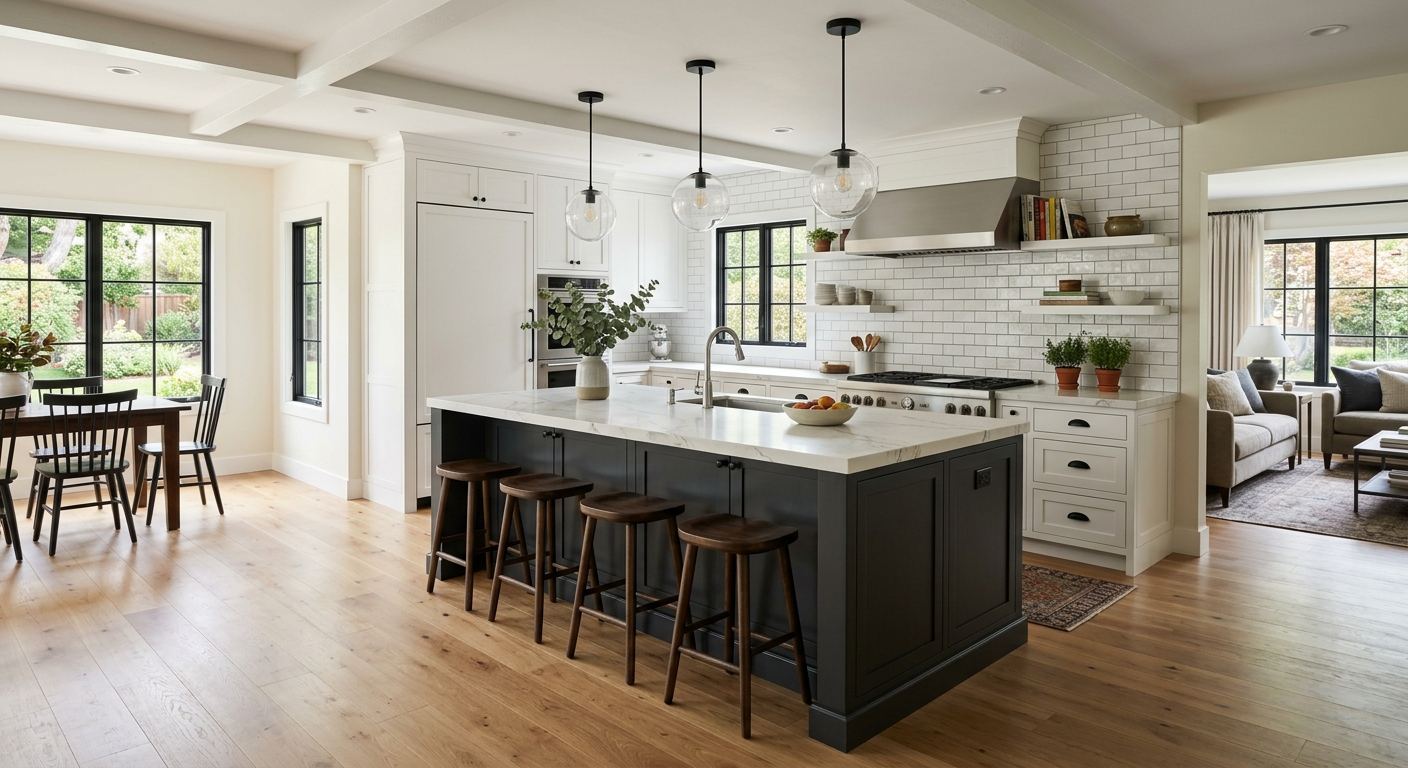
Kitchen renovation options and costs in Rocky Mountain House
Kitchen renovation in Rocky Mountain House is usually less about climate “surprises” and more about the finish expectations tied to local incomes and housing types. With a median household income of about $82,000 (Statistics Canada, 2021 Census) and a homeowner-heavy community (1,905 homeowner households, 70.7% ownership), many projects land in the mid-market lane rather than only ultra-premium builds. In practice, that means you’ll see strong demand in areas where older homes cluster and upgrades are planned room-by-room—particularly in neighbourhoods around downtown and along main residential corridors where many houses were built before 1981 (44.5% of dwellings), often with aging cabinets, older plumbing, and dated electrical.
In the Banff–Jasper–Rocky Mountain House economic region, contractor availability and material pricing can vary month-to-month, but the bigger cost driver is buyer expectation. Alberta-wide guidance typically places cosmetic or partial kitchen work around $10,000 – $40,000, while full renovations and major reconfiguration commonly move into the $40,000 – $90,000 or higher band—especially when quartz/stone counters and upgraded cabinet tiers are selected. The local market tends to price differently depending on whether you choose stock, semi-custom, or custom cabinetry and whether counters are laminate-to-quartz versus granite/stone. The result: two kitchens with the same footprint can come in 30–50% apart, even before you consider layout moves.
Below is a realistic planning table to help you compare scope before you book measurements in Rocky Mountain House.
| Renovation Tier |
What's Included |
Typical Duration |
Price Range |
| Cosmetic refresh (paint, hardware, new appliances only) |
Paint, hardware, minor caulking, new appliance installs, basic tune-ups; excludes cabinet replacement and countertop replacement |
3–7 days |
$10,000–$18,000 |
| Mid-range full renovation (new cabinets, counters, sink, tile) |
New semi-custom or stock cabinets, countertop (quartz or upgraded laminate), sink + faucet, backsplash tile, under-cabinet lighting wiring (if already planned), flooring protection/patching |
3–6 weeks |
$40,000–$65,000 |
| High-end full renovation (custom cabinets, stone counters, island) |
Custom millwork, stone counters (granite/stone), island with seating, upgraded tile feature areas, higher-end appliance package, electrical upgrades, more extensive trim/detailing |
6–10 weeks |
$70,000–$90,000+ |
| Cabinet refacing only (new doors + drawer fronts, same boxes) |
Refacing of existing cabinets, new doors/drawer fronts, hardware, re-sealing and minor adjustments; assumes boxes are sound |
1–3 weeks |
$6,000–$22,000 |
| Countertop swap only (laminate to quartz or stone) |
Removal + install of new countertop, sink cut-out as needed, edge profile update, basic backsplash refresh (not full tile feature) |
3–10 days |
$3,000–$15,000 |
| Backsplash tile installation only |
Tile supply allowance, tile install, grout/seal, surface prep, trim and outlets cover adjustments; excludes cabinet work |
3–7 days |
$1,500–$8,000 |
Prices are estimates only and vary by project scope, site access and material selection.
What affects the price of kitchen renovation in Rocky Mountain House
In Rocky Mountain House, you can receive two quotes for a similar kitchen that differ by 30–50% across the Banff–Jasper–Rocky Mountain House economic region and Alberta overall—and the reason usually isn’t climate. The biggest drivers are local household incomes (median around $82,000) and the finish tier homeowners believe they’ll recoup on resale. In stronger-value pockets of the region, buyers often default to quartz or stone counters and semi-custom cabinetry because the cost is easier to justify when the home is already positioned to command higher offers. In more modest segments, laminate and stock cabinets remain common because they offer better ROI for the same usable layout.
Layout work is the wildcard. Removing a wall for open concept, adding an island, or moving a gas line can add labour, protected framing, and inspection costs that don’t scale smoothly with finish level. For example, upgrading from laminate to quartz can fit inside a countertop-only band of about $3,000 – $15,000—but if you also relocate plumbing, the project starts behaving like a mid-range full renovation rather than a swap, pushing toward the $40,000 – $65,000 planning range.
Two local conditions commonly raise cost in Rocky Mountain House. First, older homes (44.5% built before 1981) often need more electrical and plumbing cleanup during demolition, especially around old service lines and venting paths. Second, uneven wall and floor framing is common; when cabinets are “perfectly level” only on paper, shimming and re-framing become necessary—especially if you’re adding an island where the toe-kick line must stay crisp. If you’re sticking to a like-for-like cabinet footprint and keeping existing gas/plumbing locations, you typically control budget far better.
| Price Factor |
Why It Matters |
Cost Impact |
| Cabinet tier — stock vs. semi-custom vs. fully custom millwork |
Cabinet construction quality, door styles, internal organization, and lead times vary widely |
$6,000–$35,000 swing depending on tier and kitchen size |
| Countertop material — laminate vs. quartz vs. granite vs. stone |
Materials differ in per-square-foot cost, edge options, and installation complexity |
$1,500–$15,000+ for a typical kitchen change |
| Layout change — wall removal, island add, plumbing/gas move |
More trades, more inspections, and more demo/rebuild |
$5,000–$25,000+ unpredictable variance |
| Appliance package tier — builder vs. mid-range vs. pro-grade |
Oven/microwave/hood/venting and finish integration affect electrical and cabinet detailing |
$2,000–$10,000+ variance |
| Flooring — refinish existing vs. full replacement |
Damage during demo and cabinet leveling drives replacement vs. salvage |
$1,000–$12,000 depending on current floor condition |
| Backsplash — ceramic tile vs. marble vs. full-height slab |
Surface prep and material weight/finishes change labour and installation method |
$1,500–$8,000 typical range |
| Electrical — new circuits for island, under-cabinet lighting |
Electrical scope requires licensed work and can trigger additional framing/patching |
$500–$6,000 variance |
| Permit fees and licensed trade requirements |
Permits and inspections add administrative steps; licensed trades must price in compliance time |
$300–$3,500+ plus trade schedule impact |
Permits & regulations in Alberta
In Alberta, most straightforward swaps—like replacing cabinets in the same location, or swapping countertop surfaces—typically do not require permits on their own. However, permits and licensed trades are commonly required when you change the functional systems in the kitchen. Specifically, moving plumbing supply or drain lines, relocating gas appliances (stove/range), relocating or changing a gas line, removing a load-bearing wall, or adding new electrical circuits (for example, outlets for an island or new under-cabinet lighting tied to a new circuit) usually triggers permit requirements and inspections.
In Rocky Mountain House, the practical difference is your schedule. If you’re planning an open-concept wall removal, you should expect structural assessment and inspection steps before drywall closes. For gas work, Alberta requires the work to be done by a licensed gas fitter; for electrical, a licensed electrician must complete and test the circuits, with inspections as required. Always confirm in writing who pulls permits and who pays—do not assume the homeowner will handle paperwork.
To verify your contractor’s Alberta licence and coverage, do it in this order: (1) request licence details and look for them through the appropriate online provincial registry; (2) ask for a current certificate of insurance showing general liability—plus WSIB/WCB coverage documentation where applicable—before work starts; and (3) obtain proof of clearance/coverage (or equivalent documentation) and keep it with your signed contract. If anything can’t be produced quickly, treat that as a quote-quality red flag.
Cabinets, countertops and layout decisions in Rocky Mountain House
Your three most consequential decisions in a Rocky Mountain House kitchen renovation are cabinet tier, countertop material, and whether you change the layout. Alberta winters and spring thaw create seasonal pressure on seals and finishes—so choosing materials that handle humidity shifts and frequent cleaning matters. Just as important is the Banff–Jasper–Rocky Mountain House resale mindset: buyers typically expect clean lines, durable surfaces, and modern storage, and they notice countertop material and the island/flow more than paint sheen.
1) Cabinet tier: Stock cabinets are the fastest and lowest cost, but fit and finish are more standardized. Semi-custom is the most popular mid-range choice locally because it balances price with better interior organization (more drawers, better spacing) while keeping installation timelines reasonable. Custom cabinets offer the best fit for awkward rooms common in older homes, and they support higher-end door styles—yet they cost more in both materials and shop lead time.
2) Countertops: Laminate is budget-friendly and fine for cosmetic upgrades, but it can be less forgiving for heat and heavy wear. Quartz offers a strong durability-to-maintenance ratio for daily life. Granite/stone adds premium look and natural variation, but it still needs the right install and care. In terms of planning, a countertop-only swap may land around $3,000 – $15,000, while a full renovation that pairs new cabinets and countertops frequently targets $40,000 – $65,000.
3) Layout changes: Open-concept wall removal or an island can be worth it when it improves traffic flow and creates usable seating/working space. But if your gas/plumbing has to move, you’ll feel it in the total cost regardless of whether you choose laminate or quartz. A good rule: spend on layout when you’ll use the space every day; otherwise, keep systems where they are and put your budget into cabinet function and countertop durability.
| Option |
Durability |
Maintenance |
Best For |
Price Range |
| Stock cabinets (big-box) |
Good for everyday use; performance depends on installation shimming and leveling |
Wipe clean; touch up minor chips as needed |
Fast timelines and cost-controlled renovations |
$6,000–$18,000 |
| Semi-custom cabinets (local dealer) |
Strong build quality with improved hardware choices and better internal storage |
Routine cleaning; adjust soft-close hinges as needed |
Most Rocky Mountain House renovations aiming for value + function |
$18,000–$35,000 |
| Custom cabinets (local millwork shop) |
Excellent fit and finish for non-standard walls and layouts |
Wipe clean; maintain moving hardware and seals |
High-end look and tricky room dimensions |
$35,000–$60,000+ |
| Laminate countertop |
Solid for light-to-moderate wear; edges and seams matter |
Easy daily cleaning; protect from heat and sharp impacts |
Budget-conscious refreshes or when systems/layout stay unchanged |
$3,000–$6,500 |
| Quartz engineered countertop |
High durability with excellent stain resistance for busy households |
Low maintenance; avoid severe heat exposure to the surface |
Best balance of durability, looks, and predictable maintenance |
$6,500–$12,000 |
| Granite / natural stone countertop |
Very durable with premium wear resistance and natural character |
Generally easy care; may require periodic sealing depending on product |
Premium finish and classic stone appearance |
$10,000–$18,000+ |
| Butcher block countertop |
Durable if cared for; sensitive to standing water and long wet exposure |
Regular oiling and attention to seams |
Warm, rustic style and households that like maintenance |
$5,000–$10,000 |
| Marble countertop |
High-end look; can etch or stain if not protected |
Needs careful cleaning and protection from acidic spills |
Design-forward kitchens where maintenance expectations are clear |
$12,000–$20,000+ |
How to choose a kitchen renovation contractor in Rocky Mountain House
Choosing the right contractor in Rocky Mountain House comes down to verifying qualifications, getting the right quote format, and making sure the scope is clearly written. Start with Alberta licensing: ask for the relevant licence details for the trades involved (general contractor oversight plus licensed gas fitters and electricians if your project changes those systems). For insurance, request a certificate of liability insurance and confirm WSIB/WCB coverage where applicable. You should be able to get these documents before you sign—reputable contractors can share them quickly, without “we’ll send it later.”
Next, insist on 2–3 itemised written quotes rather than a single lump sum. The best quotes break down labour and materials for cabinets, countertops, tile, electrical, plumbing/gas changes, demolition, disposal, and any subfloor or framing work needed to make cabinets sit true. Carefully read exclusions: disposal included or not, permit fees included or not, drywall patching included or not, and whether matching paint/trim work is included in the final scope. Ask where the project starts and stops—especially if you’re renovating an older home where framing might need correction.
Warranty matters. Look for a clear workmanship warranty length (and what it covers), plus product/manufacturer warranty details for cabinets, countertops, and appliances. Confirm whether warranties are transferable if you sell the home. Finally, manage payment: never pay more than 10–15% upfront, and hold back a portion until near-final completion. Get your timeline in writing with a start date and a realistic completion estimate.
- Verify licence details for the trades doing gas and electrical work (and confirm the contractor coordinates inspections).
- Request a current certificate of liability insurance and keep it on file.
- Confirm WSIB/WCB coverage documentation before demolition starts.
- Ask for an itemised quote: labour + materials, not a vague “materials and labour” lump.
- Confirm who pulls permits (if any) and whether permit fees are included or billed separately.
- Clarify disposal/recycling: demo debris removed and transported off-site.
- Ensure scope includes wall/ceiling patching and refinishing (to a defined standard).
- Ask who is responsible for cabinet leveling/trim allowances for out-of-square older walls.
- Confirm appliance install responsibility (and venting requirements for your hood).
- Get countertop templating and fabrication lead times stated in writing.
- Require a workmanship warranty and product warranty details in the contract.
- Set a payment schedule with a holdback until punch-list completion.
Concrete red flags I see in Rocky Mountain House include: contractors who won’t provide proof of insurance/licence before booking; quotes that exclude disposal but assume it “will be handled”; vague language like “electrical/plumbing as needed” with no allowance; refusal to itemise cabinet/countertop and trade scopes; and payment requests above 10–15% upfront without a signed, detailed contract.
Frequently asked questions — kitchen renovation in Rocky Mountain House
What's the most cost-effective kitchen upgrade?
If you want the biggest improvement for the least spend in Rocky Mountain House, the most cost-effective upgrade is usually a targeted refresh that improves function and visual impact without triggering major permit-heavy work. For many homeowners, that means starting with new cabinet hardware, a paint refresh, and a backsplash—then upgrading appliances if the current set is outdated. If your cabinets are in good condition, refacing can be an even better value than replacement. In rough planning terms, a cabinet refacing-only project often lands around $6,000–$22,000, while a backsplash tile install alone can fit in $1,500–$8,000. Because many houses here were built before 1981, the best ROI typically comes when you keep plumbing and gas in place and avoid layout changes unless they truly improve how you work in the kitchen.
Custom vs stock cabinets — is custom worth it?
Custom cabinets can be worth it in Rocky Mountain House when your kitchen has non-standard dimensions, difficult walls, or you’re building an island and want perfect alignment and storage. In many cases, however, semi-custom is the “sweet spot” for value because it upgrades the interior layout without the highest lead times and price of fully custom millwork. Stock cabinets (fastest and most budget-friendly) work well when your existing openings are fairly square and you’re keeping the footprint. A typical planning difference is that stock cabinetry can sit around $6,000–$18,000, while semi-custom often ranges up to $18,000–$35,000; full custom can go higher. If you’re also choosing quartz counters, the money you save on cabinets can often be redirected into countertop quality—usually the tradeoff homeowners feel most day-to-day.
How do I choose a kitchen contractor in Rocky Mountain House?
Start by verifying Alberta licensing and proof of insurance, then keep everything in writing. Ask the contractor for certificate of liability insurance and documentation for WSIB/WCB coverage before demolition. For projects involving plumbing/gas/electrical changes, confirm that licensed trades are engaged and that inspections will be coordinated. Next, request 2–3 itemised quotes so you can compare labour and materials line by line (cabinets, countertop fabrication, tile, electrical, disposal, and any drywall patching). Make sure the scope clearly states exclusions, whether permit fees are included, and who is responsible for punch-list completion. For payments, avoid large upfront draws—generally keep it to 10–15%—and hold a portion until the project is complete. In Alberta, the contractor’s ability to document compliance is often what separates smooth projects from budget blowouts.
What order do kitchen renovation steps happen in?
In Rocky Mountain House, a typical kitchen renovation sequence looks like this: (1) site measure and template (especially for countertops); (2) demolition of old cabinets and finishes; (3) rough-in work—this is where electrical, plumbing, and gas modifications happen if your layout changes; (4) framing/patching as needed to correct out-of-square conditions common in older homes (44.5% built before 1981); (5) cabinet installation and leveling; (6) countertop fabrication installation; (7) backsplash tile and sealants; (8) final trim, caulking, paint touch-ups, and appliance hookup/verification; (9) final inspection coordination (if permits were required); and (10) punch-list and warranty sign-off. If you’re doing a countertop-only upgrade, the order is shorter but still must follow templating and cut-out planning.
Can I live at home during a kitchen renovation in Rocky Mountain House?
Often yes, but it depends on how disruptive your scope is. In Rocky Mountain House, many homeowners stay in the home during mid-range renovations if the work area is contained and dust control is managed. Cosmetic upgrades or cabinet refacing are usually the easiest to manage day-to-day. For full renovations where cabinets and countertops come out, you’ll be dealing with demo dust, limited access to sink areas, and temporary kitchen “workstations.” Your contractor should provide a clear plan for protecting floors, containing dust, and when the kitchen will be “usable again.” If you’re moving plumbing or gas lines, the downtime can be longer because rough-in and inspections take time. Budgeting for a practical backup setup (microwave, kettle, small fridge) is smart—especially when your total project is trending toward $40,000–$90,000 full renovation territory.
Should I renovate my kitchen before selling in Rocky Mountain House?
Generally, renovate before selling only if you can target improvements buyers will pay attention to—without overbuilding for the local resale segment. In Rocky Mountain House, the homeowner profile (70.7% ownership; median income around $82,000) points to steady demand for clean, modern finishes and functional storage, but buyers still scan for value and maintenance. If your current cabinets are worn or counters are dated, upgrading to quartz or stone can help, especially if you’re keeping layout changes minimal. A partial refresh like $10,000–$40,000 cosmetic/partial work can refresh the listing photos and reduce buyer hesitation; a full renovation can reach $40,000–$90,000 and is best when the home’s overall condition supports the investment. Since many local homes were built before 1981, be mindful: if there are hidden electrical or plumbing issues, fixing them before listing can prevent inspection surprises.