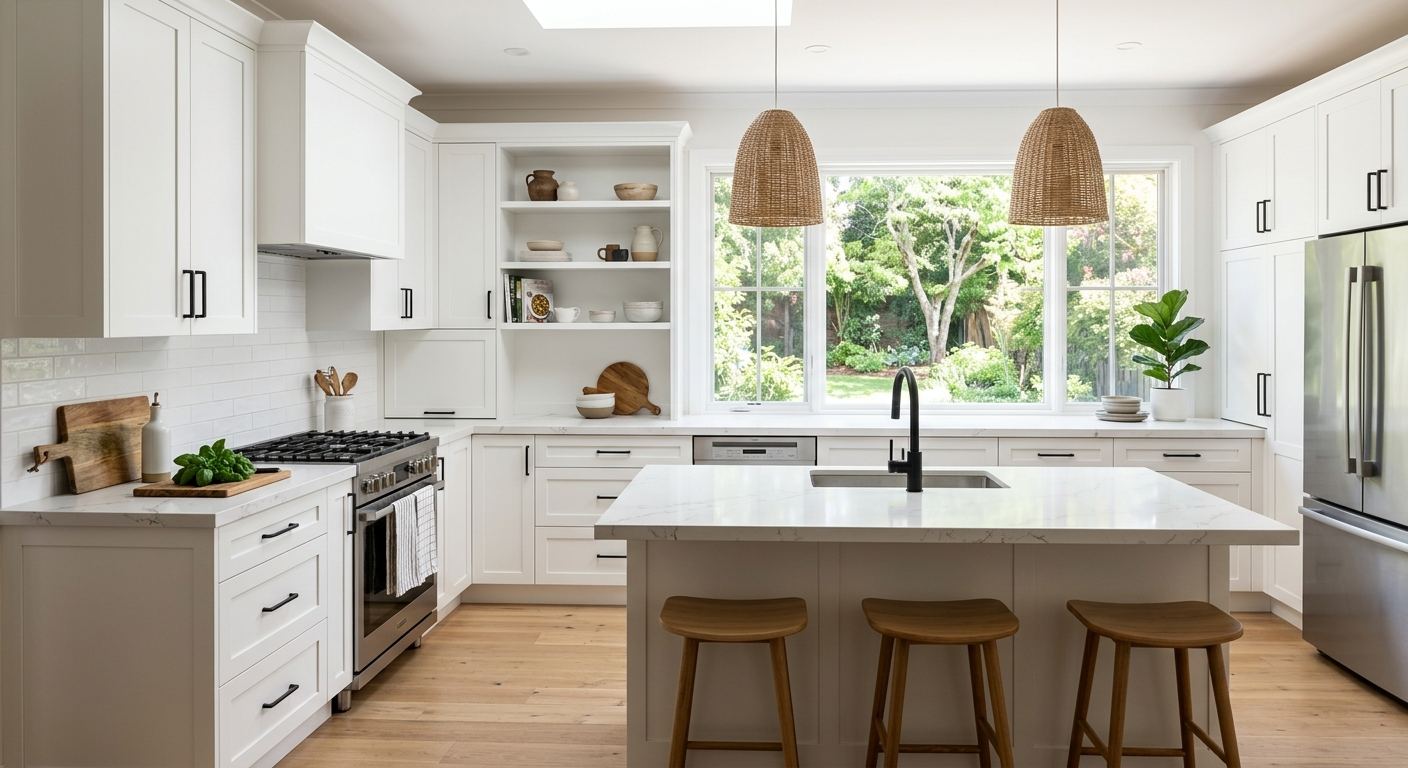
Kitchen renovation options and costs in Chaparral
In Chaparral, Alberta, kitchen renovations tend to be planned around the resale market and the level of finish you want, more than day-to-day weather. With a population of 12,500 (Statistics Canada, 2021 Census), Chaparral homeowners often choose between a quick refresh that reads “updated” at listing time, or a full redesign that modernizes the layout and upgrades the most visible materials. In the Calgary economic region, the common pattern is that higher-value homes justify higher-end counters and cabinetry because the kitchen is one of the first rooms buyers evaluate; that’s why many projects cluster toward mid five-figures and can push higher when stone, an island, and integrated lighting are part of the plan.
Calgary-area trades availability and labour rates are another driver. Skilled labour frequently runs about $90–$140 per hour in this region, so design, demolition, carpentry, and project management make up a meaningful share of the budget. Even when materials are modest, the labour intensity of cabinet installs, tile detailing, and precise countertop templating still keeps “basic” jobs from being ultra-cheap. While Alberta’s climate doesn’t directly change the price of quartz versus laminate, the realities of winter scheduling, longer curing/drying times for some finishes, and site access constraints can influence timelines and therefore costs. In Chaparral, trades demand is especially high for homes in established communities around the east/south-east Calgary commuter corridor where listings often turn quickly—meaning contractors book out faster during peak renovation seasons.
Use the tiers below to compare scope and ballpark budgeting before you request itemised quotes.
| Renovation Tier |
What's Included |
Typical Duration |
Price Range |
| Cosmetic refresh (paint, hardware, new appliances only) |
Cabinet paint or repaint, new hardware/pulls, outlet/cover plates, new appliances only (no cabinet or counter changes), basic caulking and touch-ups |
2–5 business days |
$4,500 – $15,000 |
| Mid-range full renovation (new cabinets, counters, sink, tile) |
Semi-custom or quality stock cabinets, new countertop (laminate to quartz depending on budget), sink and faucet, backsplash tile, updated trim/finishes, countertop templating and install, basic plumbing connections |
3–6 weeks |
$25,000 – $65,000 |
| High-end full renovation (custom cabinets, stone counters, island) |
Fully custom cabinetry, quartz/granite/stone counters, island build, upgraded backsplash (to ceiling or full-height look), enhanced lighting, possible layout modifications, higher-spec appliance package |
6–12 weeks |
$70,000 – $100,000 |
| Cabinet refacing only (new doors + drawer fronts, same boxes) |
New door/drawer fronts, veneer/finish system, new hardware, minor repairs to existing boxes, optional new filler panels and trim |
1–3 weeks |
$8,000 – $25,000 |
| Countertop swap only (laminate to quartz or stone) |
Template, remove existing counters, install new quartz/stone, seal where required, basic seam refinishing and fit-up |
4–10 business days |
$3,500 – $12,000 |
| Backsplash tile installation only |
Remove/prepare surface, backer/patch where needed, tile layout and install, grout and sealing, caulking at transitions |
3–7 business days |
$2,500 – $8,000 |
Prices are estimates only and vary by project scope, site access and material selection.
What affects the price of kitchen renovation in Chaparral
Two homeowners in Chaparral can receive quotes that look wildly different—often 30–50% apart—even when they both say “replace cabinets and counters.” That’s because the renovation cost in the Calgary region is driven more by home value expectations and finish tier than by climate alone. In higher-value Calgary economic-region markets, buyers tend to reward kitchens that look “new-new”: quartz or natural stone counters, semi-custom cabinetry, and cleaner detailing. In lower-budget scenarios, laminate and stock cabinetry can deliver similar visual impact while keeping the project closer to the lower end of the price bands (for example, a countertop-only swap can land in the $3,000–$12,000 range, while a full redesign commonly falls in the $25,000–$100,000 band).
Regardless of tier, layout changes are the most unpredictable line item—removing a wall, adding an island, or moving a gas line or plumbing supply/drain can add labour, licensed trades, and permitting time. In Chaparral, many homes were built on dated kitchen plumbing runs and ventilation strategies; when those routes need to be altered, costs rise quickly. Concrete examples I see often include (1) shorter backsplashes with older tile removal that reveals uneven walls, adding patching and labour; (2) kitchens with older subflooring where cabinet bases require extra shimming and repair to avoid future door misalignment; and (3) projects in active households where winter scheduling delays can extend site time, increasing supervision and overhead.
On the cost side, cabinet and countertop selections usually explain the biggest swings: moving from stock to semi-custom or custom millwork pushes budgets upward, while switching laminate to quartz can be a moderate step change compared to moving plumbing. The good news is that you can control uncertainty by locking layout decisions early and making your trade choices match your timeline.
| Price Factor |
Why It Matters |
Cost Impact |
| Cabinet tier — stock vs. semi-custom vs. fully custom millwork |
Higher tiers cost more in material and fabrication time, and they allow better fit for awkward spaces (so fewer fillers and reworks) |
$5,000–$35,000 swing depending on kitchen size |
| Countertop material — laminate vs. quartz vs. granite vs. stone |
Material price plus templating, fabrication complexity, and seam/edge requirements |
$1,500–$10,000 difference on typical kitchens |
| Layout change — wall removal, island add, plumbing/gas move |
Adds demolition, structural/engineering work, and licensed trade scope; also increases scheduling risk |
Often $8,000–$30,000+ over a no-move scenario |
| Appliance package tier — builder vs. mid-range vs. pro-grade |
Pro-grade units usually cost more and may require additional electrical/venting planning |
$1,500–$12,000+ |
| Flooring — refinish existing vs. full replacement |
If floors are removed for cabinet install, replacement is common; damaged subfloor also adds carpentry |
$2,000–$10,000+ |
| Backsplash — ceramic tile vs. marble vs. full-height slab |
Premium tile/slab increases material and labour for clean transitions and waterproofing detailing |
$500–$6,000+ |
| Electrical — new circuits for island, under-cabinet lighting |
New lighting circuits, pot lights, and under-cabinet runs involve licensed work and sometimes panel work |
$1,000–$8,000+ |
| Permit fees and licensed trade requirements |
Permits and inspection scheduling can add fees and coordination time; trade requirements control sequencing |
$200–$3,500+ plus scheduling impacts |
Permits & regulations in Alberta
In Alberta, a kitchen makeover often doesn’t require permits if you’re staying within “like-for-like” updates. Cabinet and countertop swaps typically do not require permits. That said, once you move plumbing supply or drain lines, relocate gas components (for example, moving a stove or changing a gas range setup or venting that involves gas), remove a load-bearing wall, or add new electrical circuits (such as dedicated wiring for an island or new under-cabinet lighting circuits), permits and licensed trades become part of the job.
For Chaparral homeowners, the practical approach is to treat permitting as a checklist you confirm before signing. Step one: ask your contractor which scope items trigger permits. Step two: verify the contractor’s licence and role in writing—then separately confirm that the licensed electrician and licensed gas fitter (where gas is involved) are taking responsibility for their portion. Step three: request proof of liability insurance and required coverage, plus any WCB/WSIB documentation relevant to the trade.
To verify licences and coverage, homeowners should look at the contractor’s Alberta licence information online, review certificates of insurance (including policy dates and project name where available), and keep a clearance/coverage letter on file. Make sure the contract states who pulls permits and who pays inspection-related costs. When in doubt, require a written clarification before demolition begins—retroactive fixes are where budgets get strained.
Cabinets, countertops and layout decisions in Chaparral
When you renovate in Chaparral, the three decisions that most influence both cost and resale appeal are: (1) cabinet tier, (2) countertop material, and (3) whether you change the layout (open up with a wall removal, add an island, or relocate plumbing/gas). Cabinet tier sets the tone: stock cabinets are the fastest and lowest-cost because they’re pre-made, semi-custom is the most popular mid-range choice for best value, and fully custom millwork is for tight fits and a truly tailored look.
Next, countertops. Laminate can keep budgets in check but needs careful handling at seams and around heat exposure; quartz is the balanced option many buyers expect because it’s durable and consistent in look, often landing in the same “feels premium” conversation as natural stone without the same variability. Granite/natural stone offers visual depth and can justify itself in higher-end projects, while butcher block brings warmth but requires more routine care. Marble is beautiful and high-fashion, but it typically costs more and needs sealing/maintenance habits.
Finally, layout. If you remove a wall for an open-concept feel or add an island, you’re paying for more than carpentry—you’re often funding plumbing/gas line adjustments, electrical planning, and additional framing and inspection coordination. That cost is justified when it creates usable circulation and seating that buyers will notice. A concrete example: if your goal is mostly cosmetic and you leave the plumbing where it is, you can often target the $3,000–$12,000 countertop range and spend the rest on cabinetry/finishes. If you instead move plumbing for an island sink, you can quickly exceed mid-range pricing and drift toward the $25,000–$100,000 full renovation band because the scope changes from “surface updates” to “system rework.”
In Alberta’s cold-season living patterns—where kitchens are used constantly for meal prep—durability and cleanable surfaces matter as much as style. Planning around that reality helps your renovation look right on day one and stay functional through the long winters.
| Option |
Durability |
Maintenance |
Best For |
Price Range |
| Stock cabinets (big-box) |
Good for standard layouts; performance depends on hinges and installation quality |
Low—cleaning and hardware tightening as needed |
Lower-cost refresh with limited changes |
$8,000 – $20,000 |
| Semi-custom cabinets (local dealer) |
Very good; better fit, more style options, typically stronger hardware packages |
Low to moderate; keep up with seals and wipe routine |
Most Chaparral renovations aiming for “high value” look |
$15,000 – $35,000 |
| Custom cabinets (local millwork shop) |
Excellent; made for awkward corners, appliance niches, and tailored storage |
Low—durability depends on material and finish quality |
Bespoke layouts and long-term ownership |
$25,000 – $60,000+ |
| Laminate countertop |
Moderate; can be durable but is more sensitive to heat and seam wear |
Low to moderate; avoid sustained heat and protect seams |
Budget-conscious refresh |
$3,000 – $6,500 |
| Quartz engineered countertop |
High; very good scratch and stain resistance for daily Alberta kitchen use |
Low; routine cleaner and gentle abrasion only |
Best balance of durability and resale appeal |
$5,500 – $12,000 |
| Granite / natural stone countertop |
High; strong material with natural variation and premium edges |
Moderate; sealing and periodic care |
Premium look for higher-end remodels |
$6,500 – $14,000 |
| Butcher block countertop |
Good; resilient when maintained properly |
Moderate; oiling and mindful water/heat protection |
Warm, casual kitchen style |
$4,000 – $9,000 |
| Marble countertop |
Beautiful but softer; can be more stain-prone |
Moderate to high; sealing and quick wipe-down habits |
Design-forward kitchens with lower “rough use” |
$8,000 – $18,000 |
How to choose a kitchen renovation contractor in Chaparral
Choosing the right contractor in Chaparral is less about flashy photos and more about verification and clarity. Start by confirming Alberta licensing, liability insurance, and coverage for workers. The “how to check” is straightforward: (1) ask for licence details and verify them through the appropriate Alberta online registry entry for their trade category; (2) request a certificate of insurance showing liability coverage and confirm the policy is active during your scheduled dates; and (3) ask about WCB/WSIB coverage documentation and keep it in your files. For gas or plumbing-adjacent work, ensure the right licensed trades are contracted directly (and that they provide their own proof where applicable).
Next, compare 2–3 itemised written quotes. You want labour and materials broken out separately—especially for demolition, cabinet install, countertop fabrication/templating, tile setting, electrical work, and disposal. Avoid apples-to-oranges scopes like “backsplash included” without tile height, layout, waterproofing underlayment notes, or grout type. Confirm whether permits are pulled and who pays permit fees. Disposal should be explicit: construction debris removal often affects both time and final cost.
Warranty matters too: ask for workmanship warranty length and whether it’s transferable if you sell. Also verify product/manufacturer warranties for cabinets, appliances, and countertops. Payment schedules should be conservative—never more than 10–15% upfront, with progress payments tied to milestones and a holdback until completion and punch-list sign-off. Finally, get the start date and completion estimate in writing so winter scheduling doesn’t quietly stretch your project.
- Request licence and insurance proof before the first deposit.
- Insist on itemised scope: labour, materials, and allowances listed separately.
- Confirm what’s excluded (old backsplash removal, subfloor repair, drywall patching, caulking details).
- Ask whether permits are required for your specific layout plan and who pulls them.
- Confirm disposal/haul-away is included or priced separately.
- Require countertop details: edge profile, sink cut-out, seam locations, and templating timing.
- Check electrical scope: who adds circuits and whether it’s completed before drywall close-in.
- Ask about tile prep: backer board, membrane where needed, and grout/caulk colour selection.
- Review the warranty in writing: start date, coverage, exclusions, and claim process.
- Set a payment milestone plan with a holdback until punch list completion.
- Get a demolition-to-install sequencing plan so you know when the kitchen is “out of service.”
- Verify schedule realism: materials lead times for cabinets and stone should be included.
Red flags I see in Chaparral include: quoting a lump sum with no breakdown, skipping licence/insurance questions, promising cabinet “in-stock” timing without confirming delivery lead times, not specifying who handles permits when gas or electrical changes occur, and refusing to put warranty terms in the contract.
Frequently asked questions — kitchen renovation in Chaparral
What order do kitchen renovation steps happen in?
In Chaparral, the standard order starts with confirmation of measurements and the final design package (cabinet layout, elevations, electrical plan, and countertop template schedule). After that, demolition typically comes first: remove old cabinets, disconnect appliances, and pull out damaged tile or flooring if required. Electrical and plumbing/gas work—anything that needs permits—comes next, before drywall close-in and patching. Then you install cabinets (level and anchor correctly), set tile/backsplash, and complete trim/paint details. Countertops are usually templated after cabinets are in place; installation follows cabinet and tile work so seams and edges line up cleanly. Appliance delivery and hook-up come near the end, and final inspection/punch list wraps it up. If you’re doing a countertop-only swap, the sequence is shorter and often removes less dust from the home.
Can I live at home during a kitchen renovation in Chaparral?
Often, yes—especially for a cosmetic refresh or a scoped “no layout change” job in Chaparral. Cosmetic updates and backsplash-only work are usually easiest to live through because the kitchen stays mostly functional, and the dust footprint is smaller. For mid-range full renovations where new cabinets and counters are installed, you may be able to cook using a temporary setup in another room, but expect days when the sink is disconnected during plumbing tie-ins. For higher-end redesigns with island builds or layout changes, living at home is still possible, but the disruption is more pronounced: longer timelines, more trade visits, and more dust control requirements. In Alberta’s winter season, contractors may add drying/curing time for finishes, so plan for a temporary kitchen zone longer than you’d expect in milder months. Your contractor should provide a clear “kitchen downtime” estimate before work starts.
Should I renovate my kitchen before selling in Chaparral?
Usually, renovations that improve the kitchen’s appearance and functionality before listing are worth considering in Chaparral—particularly when your home’s kitchen reads dated compared to neighbouring listings. That said, not every upgrade creates the same resale return. If cabinets are structurally fine, a refacing approach or a countertop swap can update the look without triggering major plumbing or gas changes. For example, a countertop-only upgrade commonly falls in the $3,000–$12,000 range, while a mid-range full renovation often lands closer to $25,000–$65,000 depending on cabinet tier and scope. If you’re planning to sell soon, avoid high-risk layout changes (like moving plumbing) unless the space gain is obvious in photos and showings. Also choose finishes that match buyer expectations in the Calgary economic region—clean lines, quartz or natural stone counters, and durable, easy-to-clean surfaces tend to photograph well.
What's the most popular kitchen style in Chaparral right now?
Right now in Chaparral and the broader Calgary economic region, the most popular look is typically a modern transitional style: flat-panel or simple shaker cabinet doors, brighter neutral walls, and quartz counters with clean edges. Homeowners often choose warmer whites/creams, light greys, or natural wood tones to feel current without looking too trendy. Backsplashes are frequently ceramic tile or slab-look surfaces, often kept simple to avoid distracting from the counters and hardware. Where budgets stretch, integrated lighting and an island with seating are common upgrades—because they improve both function and how the home “shows” to buyers. Materials decisions (quartz versus laminate, semi-custom versus stock cabinetry) usually reflect the price tier you’re targeting, not personal taste alone.
How do I know if I need to update my kitchen plumbing in Chaparral?
You don’t always need to replace plumbing to renovate your kitchen in Alberta, but you should evaluate it when you’re seeing symptoms or when your layout changes. Signs it’s time to update include persistent leaks under the sink, weak water pressure, discoloured water at fixtures, frequent clogging from old drain lines, or corrosion around supply connections. If you’re moving the sink, adding an island sink, or relocating appliances near a gas or plumbing run, plumbing updates become more likely because the new layout may require new supply/drain routing and proper slope. When you’re keeping the same sink location but replacing cabinets and counters, plumbing may only need minor changes—like replacing shutoff valves, adjusting trap alignment, or updating flexible connectors. Your contractor should coordinate with licensed trades where required and confirm what’s being replaced versus reused in the written scope.
What is the difference between a galley and open-concept kitchen?
A galley kitchen is a corridor-style layout where counters face each other on two parallel walls, usually with limited space for circulation. An open-concept kitchen connects the cooking area to living/dining space with fewer barriers—often achieved by removing walls or reconfiguring the space. In Chaparral renovations, open-concept designs are popular for how they photograph and how they support entertaining, but they can be more expensive because removing walls can affect structure and often requires permitting and licensed trades for electrical and, in some cases, plumbing/gas adjustments. Galley kitchens are generally simpler to renovate because you can upgrade finishes (cabinets, counters, backsplash) with less risk of system relocation. If you want the “bigger” feel, you’ll usually pay for layout changes—so decide early whether the space gain justifies the higher total budget.