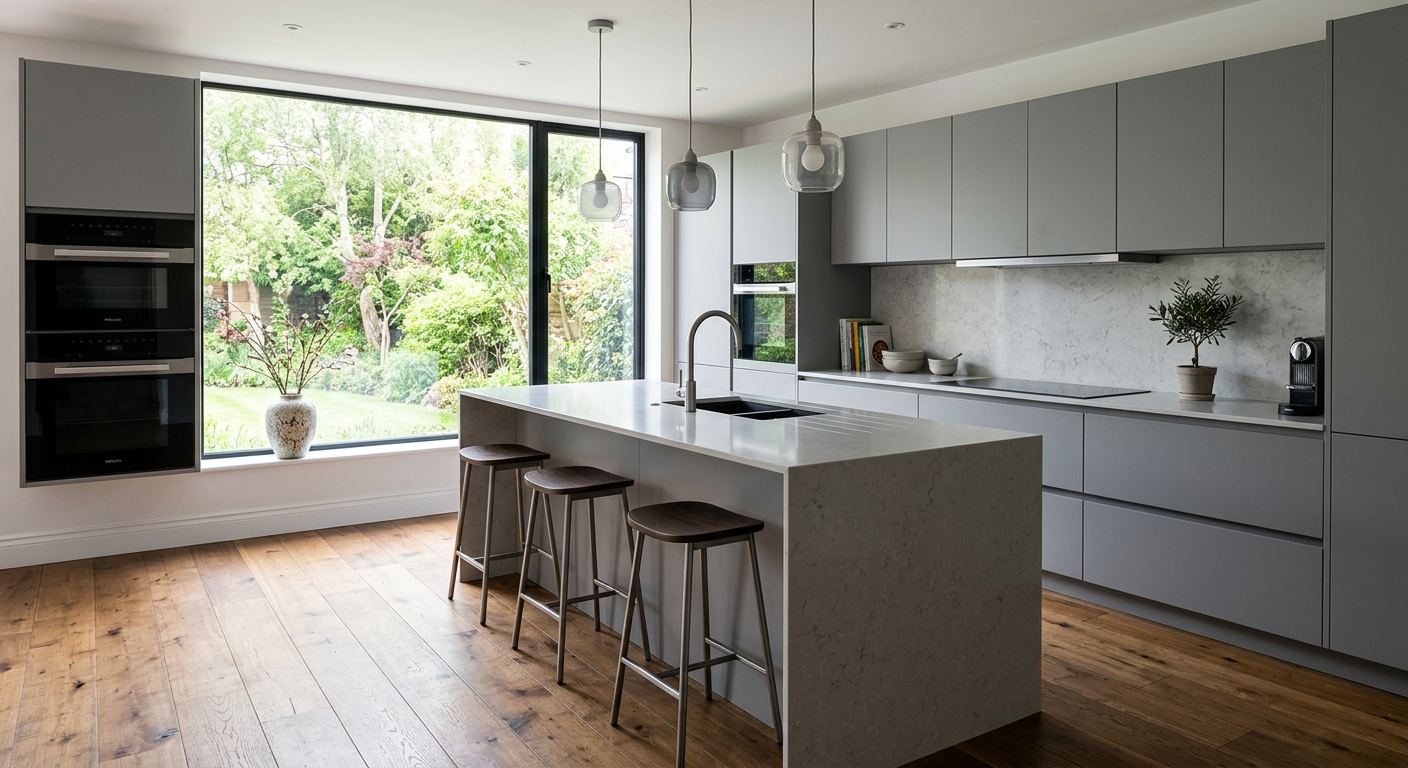
Kitchen renovation options and costs in Larkspur
Larkspur, Alberta is a popular place to refresh kitchens because many homeowners are planning to stay long enough to enjoy the upgrade, then recoup some value when the next buyer compares finishes. The Calgary economic region is also priced for upgrades: with a population of 4,988 in Larkspur (Statistics Canada, 2021 Census), most kitchen demand is driven by owner-occupiers rather than high-volume investor flips. In higher-value areas around Calgary, homeowners commonly expect a finish tier that looks “new” rather than “touched up”—which is one reason contractors see more quartz and semi-custom cabinetry as projects move from refresh to full redesign. Market logic matters: trades can charge more in strong labour markets, and buyers notice cabinetry style, stone appearance, and lighting more than they notice paint sheen.
Although Alberta winters are hard on homes, climate is not the biggest cost driver for kitchens; market expectations are. In the Calgary region, skilled labour often runs around $90–$140 per hour, so design, project management, and cabinet/counter installation time make up a large share of the budget. Also, availability swings with the construction pace—during busy seasons, scheduling can tighten and drive up labour premiums, especially for tile and custom millwork. In Larkspur, demand is especially steady for renovations across newer subdivisions near the newer growth pockets, where homeowners tend to update builder-grade kitchens quickly after move-in.
With those realities in mind, the table below shows how costs typically move from a cosmetic refresh to a full high-end renovation.
| Renovation Tier |
What's Included |
Typical Duration |
Price Range |
| Cosmetic refresh (paint, hardware, new appliances only) |
Cabinet paint or touch-ups, new pulls/knobs, appliance swap (no plumbing/gas moves), minor trim repair |
1–3 weeks |
$8,000–$18,000 |
| Mid-range full renovation (new cabinets, counters, sink, tile) |
Semi-custom or quality stock cabinetry, countertop installation, new sink/faucet, backsplash tile, basic flooring and plumbing connections |
6–10 weeks |
$25,000–$55,000 |
| High-end full renovation (custom cabinets, stone counters, island) |
Fully custom cabinetry, quartz or natural stone counters, island build, upgraded lighting, full backsplash, potential layout refinements |
10–18 weeks |
$70,000–$100,000 |
| Cabinet refacing only (new doors + drawer fronts, same boxes) |
Refacing of existing cabinet boxes, new door/drawer fronts, new hardware, coordination for trim/edge details |
2–5 weeks |
$8,000–$25,000 |
| Countertop swap only (laminate to quartz or stone) |
Remove old surface, install new quartz/stone, new undermount sink set-up as needed, sealing/finishing |
1–3 weeks |
$3,000–$12,000 |
| Backsplash tile installation only |
Tile supply and installation, surface prep, caulking/silicone at edges, grout and sealing where required |
1–2 weeks |
$2,500–$8,000 |
Prices are estimates only and vary by project scope, site access and material selection.
What affects the price of kitchen renovation in Larkspur
In Larkspur and across the Calgary economic region, two quotes for what looks like the same kitchen can differ by 30–50% because the scope details change—cabinet tier, stone choice, and whether you’re altering the layout. In this market, renovation spending is tied more to home values and household expectations than to weather performance. When homeowners are targeting a higher resale “look,” they tend to move toward quartz or natural stone counters and semi-custom cabinetry, even though laminate would last fine for years. That’s also why full redesign budgets in the region frequently land in the mid five figures and can stretch higher when walls move or an island is added. In lower-cost finish tiers, ROI is steadier because you reduce the “hard” trade time, while still improving appearance.
Layout changes are the biggest unpredictable cost regardless of finish: removing a wall, adding an island, or moving a gas line or plumbing supply can trigger extra demolition, patching, electrical adjustments, and re-connection fees. For example, swapping counters from laminate to quartz can commonly sit in the $3,000–$12,000 band, but adding new under-cabinet lighting and relocating a sink can push the project toward the $25,000–$55,000 mid-range full renovation band even if cabinets stay.
Two Larkspur-specific examples we see often: first, older kitchens in established homes sometimes have out-of-date subflooring or uneven walls, which increases tile prep labour and can add time before backsplash goes on. Second, busy seasons can reduce countertop install scheduling windows, so coordinating cabinet delivery and template timing can change the labour cost—especially for stone with longer lead times. Finally, if your home’s current electrical setup can’t support a new vent hood circuit or island lighting, electrical upgrades add cost quickly, even when the finish selections are modest.
| Price Factor |
Why It Matters |
Cost Impact |
| Cabinet tier — stock vs. semi-custom vs. fully custom millwork |
Higher tiers increase material cost, customization time, and installation complexity |
Typically adds a major share; can move a full project by tens of thousands |
| Countertop material — laminate vs. quartz vs. granite vs. stone |
Material pricing and templating/installation requirements vary widely |
Can shift countertop-only work from the low band into the upper band |
| Layout change — wall removal, island add, plumbing/gas move |
Demolition, framing/patching, and licensed trade connections increase risk and labour |
Often the largest unpredictable swing on the quote |
| Appliance package tier — builder vs. mid-range vs. pro-grade |
Pro-grade units cost more and may require different venting/clearance planning |
Can add meaningful cost even when cabinets are unchanged |
| Flooring — refinish existing vs. full replacement |
Protecting and matching existing floors affects prep time and repair risk |
Full replacement generally adds both materials and install time |
| Backsplash — ceramic tile vs. marble vs. full-height slab |
Handling, cutting, and finish quality demands change with material type |
Stone or full-height options increase labour and material waste |
| Electrical — new circuits for island, under-cabinet lighting |
New circuits require licensed electrical work and can trigger inspection steps |
May add to the mid-range band even on “finish-only” projects |
| Permit fees and licensed trade requirements |
Some work triggers permits and inspections; paperwork adds coordination time |
Can increase project overhead and scheduling |
Permits & regulations in Alberta
In Alberta, many kitchen updates don’t require permits—especially straightforward cabinet and countertop swaps. Generally, replacing cabinets, swapping laminate for quartz, and changing a backsplash (without changing plumbing/gas/electrical locations) are typically treated as finish work and usually don’t need a permit. The costs and approvals become more significant when you change services. If you’re moving plumbing supply/drain lines, relocating a gas stove or making gas-related changes (including gas connections and sometimes venting coordination with a range hood), you’ll need permits and licensed trades. Removing a load-bearing wall also requires permits and structural involvement. Adding new electrical circuits—for island outlets, new lighting, or moving major appliance circuits—requires a licensed electrician and inspection.
For homeowners in Larkspur, the best process is to verify before signing. Step 1: ask the contractor what permit(s), if any, are required and who is pulling them. Step 2: confirm licensed trade credentials—gas work by a licensed gas fitter, electrical by a licensed electrician. Step 3: request proof of liability insurance and WSIB/WCB coverage documentation (or the appropriate coverage status) before work starts. Step 4: keep copies of certificates and clearance letters in your project file. Step 5: confirm responsibilities in writing: the contract should state whether permits are included, who pays, and what the contractor warrants.
When you’re clear on these items up front, you avoid delays—because inspections can affect stone templating, cabinet install sequencing, and final countertop cutovers.
Cabinets, countertops and layout decisions in Larkspur
Your three biggest decisions in a Larkspur kitchen renovation are (1) cabinet tier, (2) countertop material, and (3) whether you change the layout. Calgary-area resale expectations influence all three. Buyers frequently expect contemporary cabinetry lines, durable surfaces, and lighting that reads “clean” and even in daily use. In Alberta winters, homes run sealed and heated for long stretches—so surface performance matters most for day-to-day wear, not freeze-thaw; the trade-time and detail quality drive costs more than climate-driven material failure.
Cabinet tier sets your budget pace. Stock cabinets are typically the fastest and cheapest because they’re standardized. Semi-custom is the most popular mid-range choice in this region: you get better dimensions, options for finishes, and practical storage improvements without fully bespoke pricing. Custom cabinets deliver the tightest fit and best use of awkward spaces, but that “best fit” requires design time, millwork lead time, and higher install labour.
For counters, laminate is a cost-stable option, while quartz is the common “best balance” purchase in Calgary because it looks upscale, is low maintenance, and withstands typical household use well. Granite/natural stone is premium and can be striking, but it still needs sealing and careful selection for pattern and edge execution. Marble is elegant yet higher-maintenance; many homeowners reserve marble for lower-traffic sections.
Layout changes are where you justify cost by space gain. An island add may be worth it if you can keep clearances comfortable and improve workflow. But if you’re only chasing appearance, you may get more value by upgrading counters and hardware first. For instance, moving from laminate to quartz can often land around $3,000–$12,000 for a countertop swap, while converting a small, closed kitchen by adding plumbing/gas relocation and an island can push the overall project toward the $25,000–$55,000 mid-range renovation band.
These choices tend to align with buyer expectations at different price points in the Calgary market: the higher you go in finish and integration, the more buyers view the kitchen as “updated,” not merely refreshed.
| Option |
Durability |
Maintenance |
Best For |
Price Range |
| Stock cabinets (big-box) |
Good for everyday use; limited sizing flexibility |
Low; wipe-clean finishes |
Fast timelines and budget-first refreshes |
$8,000–$18,000 |
| Semi-custom cabinets (local dealer) |
Very good; stronger storage planning and better fit |
Low; routine cleaning and hardware upkeep |
Most Larkspur homeowners aiming for resale-ready style |
$18,000–$35,000 |
| Custom cabinets (local millwork shop) |
Excellent; tailored to your walls and layout |
Low to moderate; depends on finish system |
Irregular spaces, premium storage, and unique layouts |
$35,000–$60,000 |
| Laminate countertop |
Decent; can be less resistant to impact than stone |
Easy; avoid heavy cutting directly |
Budget upgrades where aesthetics matter most |
$3,000–$6,000 |
| Quartz engineered countertop |
Very good; resistant to staining and everyday wear |
Low; standard cleaner and wipe-dry |
Best all-rounder for Calgary buyers |
$5,000–$10,000 |
| Granite / natural stone countertop |
Very good; natural variation adds character |
Moderate; sealing typically required |
Premium look with durable everyday performance |
$6,000–$12,000 |
| Butcher block countertop |
Good; can handle wear with proper care |
Higher; oiling and upkeep recommended |
Warm, casual style and cooks who like maintenance |
$4,000–$8,000 |
| Marble countertop |
Good but softer than many stones; can scratch |
Higher; staining etch risk needs careful use |
Low-traffic, designer look where maintenance is acceptable |
$8,000–$14,000 |
How to choose a kitchen renovation contractor in Larkspur
Choosing the right contractor in Larkspur is about verifying capability, not just reviewing a pretty photo set. In Alberta, you should confirm trade licensing, liability coverage, and WSIB/WCB status. Start with the contractor’s general liability (request a current certificate of insurance naming you if applicable) and confirm they’re registered to perform the work they’re proposing. For the trade components: gas work should be done by a licensed gas fitter, and electrical by a licensed electrician. Ask for proof of coverage and any clearance letters before demolition so you don’t get stuck with a delay if something isn’t in place. If your contractor uses subcontractors, insist that their insurance and coverage details are included in your job file.
Next, request 2–3 itemised written quotes. You want labour and materials broken out (cabinet supply vs installation, countertop templating vs install, tile prep vs tile setting, and any disposal/haul-away). A lump-sum number with no breakdown makes disputes more likely. Read the scope line-by-line: is permit pulling included? What about site protection, demolition haul-away, patching materials, and appliance setbacks? Warranty matters too: ask for the workmanship warranty length, product/manufacturer coverage terms, and whether warranties are transferable if you sell your home.
Finally, use a sensible payment schedule. Avoid paying more than 10–15% upfront. Hold back a portion until the project is complete and punch-list items are addressed. Get your start date and completion estimate in writing, and confirm how change orders are priced if you discover rot, out-of-square framing, or electrical conflicts during demo.
- Request proof of insurance (liability) before deposits are taken.
- Confirm WSIB/WCB (or appropriate coverage status) in writing.
- Verify gas licensing for any gas line changes and electrician licensing for new circuits.
- Get 2–3 itemised quotes (materials + labour, not only totals).
- Ask who pulls permits and whether permit fees are included.
- Confirm demolition and disposal/haul-away is included.
- Ask about protection (floor coverings, doorways, dust control).
- Check countertop templating timing and who bears risk for measurement errors.
- Confirm backsplash scope includes prep, grout type, caulking and edge finishing.
- Review warranty: workmanship duration, exclusions, and transferability.
- Use a payment schedule with no more than 10–15% upfront and a completion holdback.
- Get a written start date, completion target, and change-order process.
In Larkspur, the most common contractor red flags are: (1) refusal to provide itemised quotes, (2) vague scope wording about permits/disposal, (3) missing proof of insurance or coverage documentation, (4) no clear timeline for cabinets/counters templating, and (5) pressure to pay large deposits early or to sign without a detailed contract scope.
Frequently asked questions — kitchen renovation in Larkspur
Should I reface or replace my cabinets?
In Larkspur, refacing is often the smart choice when your existing cabinet boxes are solid and level, but the doors/drawers and finish feel dated. Replacement is usually better if boxes are warped, the layout is inefficient, or you want major changes like new heights, internal storage upgrades, or custom corners. A typical cabinet refacing only project can fall in the $8,000–$25,000 band, while full cabinet replacement often moves you into the broader mid-range renovation budget territory once counters, tile, and refinishing are included. Climate isn’t the usual deciding factor here; it’s more about whether the current framing and box installation are straight and serviceable after demolition. Ask your contractor to assess box condition (hinge alignment, water damage near sinks, and cabinet sides) before you choose the path.
Do I need a permit for a kitchen renovation in Alberta?
Many kitchen updates in Alberta don’t require permits, especially “finish-only” work such as swapping cabinets, installing a new countertop surface, or adding a backsplash without moving services. However, permits and licensed trades are commonly needed when you change the plumbing supply/drain locations, relocate gas equipment, remove a load-bearing wall, or add/modify electrical circuits (like new island outlets or dedicated lighting circuits). In Larkspur, the practical step is to ask your contractor exactly what permits are required and who is responsible for pulling them; that should be included in the written contract. Also request documentation: gas work by a licensed gas fitter, and electrical by a licensed electrician, with inspections completed before closing up walls. If your contractor can’t clearly explain permit responsibility, pause and get it clarified in writing.
What's the ROI on a kitchen renovation?
ROI varies with your finish tier, layout changes, and how well the renovation matches buyer expectations in the Calgary market. In higher-value parts of the Calgary region, homeowners often invest around 10–15% of the home value for a kitchen refresh and up to 20–25% for a full redesign, because quartz/stone and semi-custom cabinetry tend to support resale appeal. But ROI is strongest when you improve both appearance and function—like adding storage, updating lighting, and keeping the layout sensible—rather than overspending on ultra-premium materials for a layout that still feels awkward. If you’re trying to stay ROI-friendly, start with items that deliver big visual change with less risk: cabinets/hardware, countertops, and a clean backsplash. For example, a countertop swap alone typically sits in the $3,000–$12,000 range and can make the whole room feel updated without triggering the heavy cost of a full layout redesign.
How do I budget for a kitchen renovation?
Budgeting in Larkspur works best by choosing your tier first, then planning for the “known unknowns” tied to layout and services. Use realistic bands: a mid-range full renovation typically sits around $25,000–$55,000, while a high-end redesign with custom millwork and stone counters can reach $70,000–$100,000. Build in allowances for demolition, disposal, patching/drywall repair, electrical adjustments, and tile prep—these add up quickly even if you’re “only” changing finishes. Also consider timing: labour in the Calgary region can run roughly $90–$140 per hour, so scheduling delays can increase costs. Finally, ask for an itemised quote that breaks labour and materials line by line, so you can see what drives the difference between two contractor estimates and adjust the scope intentionally rather than after work starts.
Can I move my kitchen sink or stove?
Yes, you can move a sink or stove in Alberta, but it’s not just a labour task—it’s a services and compliance task. Moving a sink generally means altering plumbing supply and drain lines, which typically requires permits and licensed plumbing work (and coordination so countertops and cabinets fit the final rough-ins). Moving a stove or changing how it vents can involve gas connections if it’s a gas range; gas-related work must be done by a licensed gas fitter, and it often triggers permit/inspection steps. If you want the upgrade, it’s usually worth doing when it improves workflow or adds an island with proper clearances. If your goal is purely cosmetic, it’s usually cheaper to keep existing locations and spend on counters, cabinets, and lighting instead—because service relocation is where costs jump and timelines lengthen.
What's the most cost-effective kitchen upgrade?
The most cost-effective upgrade is usually the one that delivers a “new kitchen” look without changing services. In Larkspur, many homeowners get strong results from either upgrading countertops or doing a targeted backsplash and hardware refresh. If you’re aiming for maximum visual impact per dollar, a countertop swap—often $3,000–$12,000—can transform the room while avoiding the complexity of moving plumbing or gas lines. Next best is cabinet refacing when the boxes are sound, which can sit in the $8,000–$25,000 range and gives you updated doors/drawers and modern hardware. For the best ROI balance, choose a durable finish buyers like (commonly quartz) and pair it with clean lighting and a well-installed tile backsplash. In Alberta homes, the practical focus should be installation quality and proper sealing/edges so the kitchen stays easy to maintain through every season.