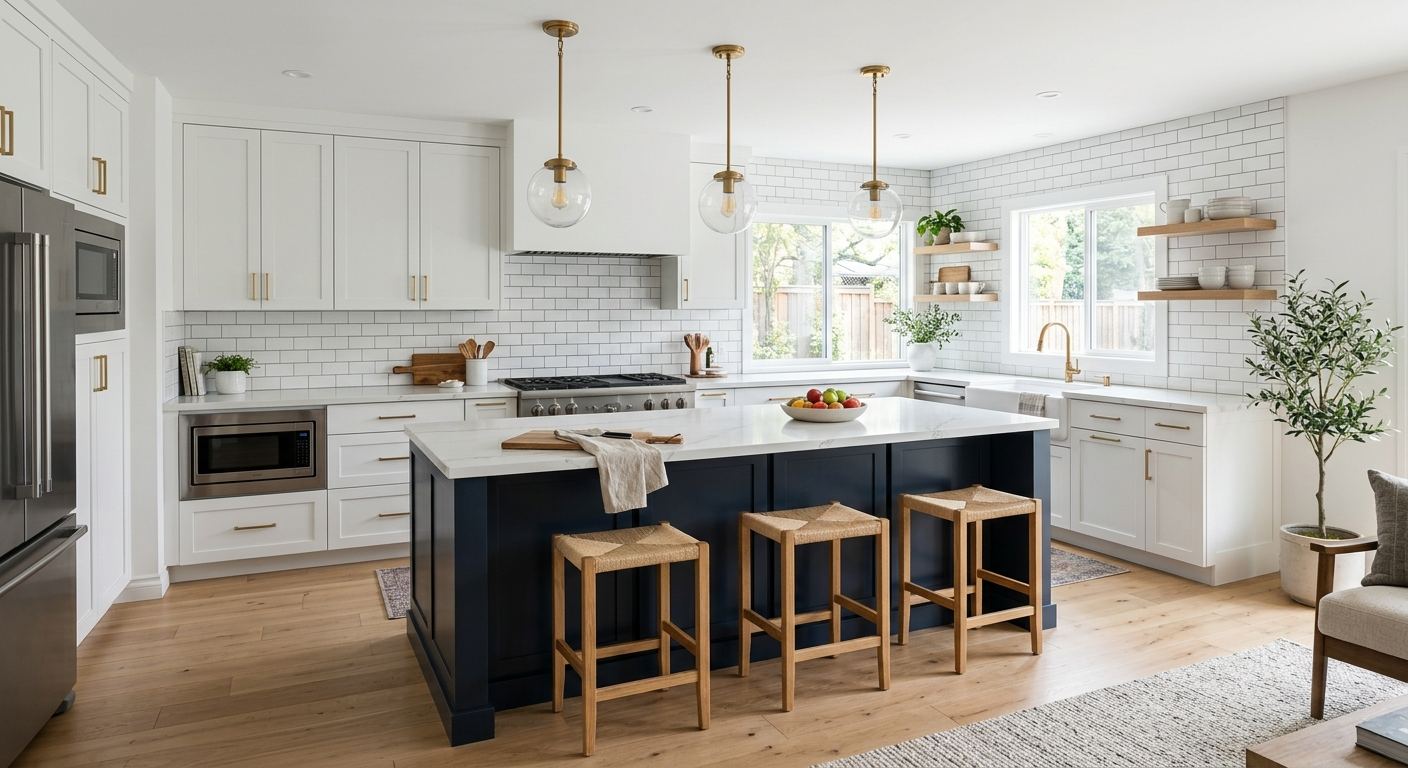
Kitchen renovation options and costs in Matt Berry
Kitchen renovations in Matt Berry typically start with a clear goal—freshen the look, improve daily function, or fully redesign the space—and the cost depends on how far you move beyond cosmetics. With a population of 4,053 in the Matt Berry area (Statistics Canada, 2021 Census), projects tend to be more neighbourhood-by-neighbour, so timing and availability of skilled trades can matter. At the same time, the Calgary economic region’s higher housing expectations push many owners toward “mid-range” finishes as a baseline, especially when the kitchen is visible from dining and living areas. In this market, higher-end materials aren’t chosen for climate performance as much as they are chosen for resale confidence—particularly quartz or natural stone counters and semi-custom cabinetry.
Alberta’s long freeze–thaw cycles and wide seasonal swings mainly show up in what contractors protect during renovation: maintaining proper ventilation, sealing around plumbing penetrations, and ensuring floors and subfloors are stable before installing heavier stone surfaces. Market conditions in Calgary also influence pricing—labour is a big driver, and skilled crews can be booked out when other trades are busy. For Matt Berry homeowners near the downtown/inner-streets corridor where access and parking are tighter, you can see higher labour and disposal coordination costs compared with quieter residential streets.
To compare realistic options, here’s a practical breakdown of renovation tiers and what they usually include before you request itemised quotes.
| Renovation Tier |
What's Included |
Typical Duration |
Price Range |
| Cosmetic refresh (paint, hardware, new appliances only) |
Paint/stain, cabinet hardware, appliance swap, minor caulking and trim touch-ups |
3–7 days |
$5,000–$15,000 |
| Mid-range full renovation (new cabinets, counters, sink, tile) |
New cabinets (semi-custom or upgraded stock), countertop install (solid surface/quartz), sink + faucet, backsplash tile, basic plumbing refresh |
3–6 weeks |
$25,000–$60,000 |
| High-end full renovation (custom cabinets, stone counters, island) |
Custom millwork, natural stone (granite/quartzite or premium engineered), island, upgraded backsplash (tile or slab), upgraded lighting and appliance package coordination |
6–12 weeks |
$70,000–$100,000 |
| Cabinet refacing only (new doors + drawer fronts, same boxes) |
New door/drawer fronts, hardware upgrade, re-finish or laminate update on cabinet exteriors, typically no cabinet box replacement |
1–3 weeks |
$8,000–$25,000 |
| Countertop swap only (laminate to quartz or stone) |
Remove old top, install new quartz/stone, edge detailing, sink/cooktop cut-outs as required, re-caulk and basic seal work |
3–10 days |
$3,000–$12,000 |
| Backsplash tile installation only |
Remove existing backsplash (as needed), prep wall, install tile and grout, caulking at edges, sealing for appropriate tile/grout |
3–7 days |
$2,500–$8,000 |
Prices are estimates only and vary by project scope, site access and material selection.
What affects the price of kitchen renovation in Matt Berry
In Matt Berry and across the Calgary economic region, you can easily see 30–50% variation in quotes for what looks like the “same” kitchen on paper. The biggest drivers aren’t weather or climate—they’re how local finish expectations line up with labour availability, the value of the home, and how much the scope changes the trades’ work. In higher-value Calgary-area markets, homeowners commonly default to quartz or natural stone counters and semi-custom cabinetry because buyers often expect that level of finish. In more modest parts of the region, laminate and stock cabinets still win on ROI. In short: the market you’re renovating for shapes the finish tier, and that tier shapes the budget far more than Alberta’s winters.
Layout changes are the cost wild card. Removing a wall, adding an island, or moving a gas line/plumbing supply typically adds labour coordination, inspection steps, and sometimes structural or ceiling work—so the price moves regardless of whether you choose laminate or quartz. For example, two kitchens can differ by as much as mid five-figures when one includes an island with new electrical and plumbing and the other keeps everything in place. Similarly, upgrading from laminate to quartz might sit in the $3,000–$12,000 counter-swap band, but if you also replace the sink, adjust countertop cut-outs, and do full-height backsplash, you quickly drift toward a broader renovation band like $25,000–$60,000.
Concrete Matt Berry cost examples: (1) older homes often have dated subflooring or uneven walls, which raises prep time before cabinets or tile can be installed; (2) constrained access near busier streets can increase labour time for material staging and debris removal; (3) if you’re swapping cabinets along an outside wall, insulation and vapour/air-sealing details can affect prep work before new cabinetry and backsplashes go in—often more than people expect.
| Price Factor |
Why It Matters |
Cost Impact |
| Cabinet tier — stock vs. semi-custom vs. fully custom millwork |
Material quality, door/drawer construction, fit/finish and lead times |
Can swing a project by roughly 2–4x versus stock |
| Countertop material — laminate vs. quartz vs. granite vs. stone |
Supply cost, fabrication complexity, and installation risk (edges, seams) |
Laminate lowest; quartz/stone can add several thousand+ |
| Layout change — wall removal, island add, plumbing/gas move |
Structural coordination, new lines, inspections, and longer schedules |
Often the largest unpredictable increase |
| Appliance package tier — builder vs. mid-range vs. pro-grade |
Pricing, electrical/gas requirements, and trim/access needs |
Ranges from “modest lift” to major premium |
| Flooring — refinish existing vs. full replacement |
Subfloor checks, transitions, and whether demo extends into adjacent rooms |
Refinish stays cheaper; replacement adds labour + materials |
| Backsplash — ceramic tile vs. marble vs. full-height slab |
Weight, wall prep, sealing, and fabrication for specialty materials |
Full-height/slab typically adds the most |
| Electrical — new circuits for island, under-cabinet lighting |
Licensed work, panel capacity checks, and code-compliant placement |
Can add several thousand depending on scope |
| Permit fees and licensed trade requirements |
Fees, scheduling inspections, and time for certified trades |
Moderate cost but can impact timeline |
Permits & regulations in Alberta
In Alberta, many straightforward surface updates do not require permits, but kitchen changes that touch building systems often do. Cabinet and countertop swaps typically do not require a permit by themselves—if you’re removing old units and installing like-for-like in the same footprint. However, if you’re moving plumbing supply or drain lines, relocating gas (including changes to stove locations), removing a load-bearing wall, or adding new electrical circuits (like for an island, upgraded lighting, or relocating outlets), you should expect permits and licensed trades.
Step one for a Matt Berry homeowner is to confirm who is responsible for permits before signing your contract. Your contractor should be clear in writing whether they pull permits, schedule inspections, and include licensed-trade documentation. Step two is to verify the contractor’s trade credentials directly: ask for proof of current liability insurance and WSIB/WCB clearance, and keep copies for your records. Step three is to verify licensed specialists where applicable—gas work must be performed by a licensed gas fitter, and any electrical work must be done by a licensed electrician with inspection sign-off.
How to check each item: look for the licence details on relevant online registries when provided, request your contractor’s certificate of insurance (showing active dates and appropriate coverage), and request clearance/coverage proof for workers (WSIB/WCB). A reputable contractor will provide these quickly and without pressure.
Cabinets, countertops and layout decisions in Matt Berry
The three most consequential decisions in a Matt Berry kitchen renovation are (1) cabinet tier, (2) countertop material, and (3) layout changes. Cabinet tier determines how fast the job goes and how “built-in” the finished look will be. Stock cabinets are the fastest and cheapest, semi-custom is the most popular mid-range option, and custom cabinets offer the tightest fit and best storage planning—but with the longest lead times. Countertop material affects both daily life and the way the kitchen photographs and feels: laminate is budget-friendly but can be less durable at seams; quartz is consistent and low-maintenance; granite and other natural stones bring character but require sealing and careful care around edges and staining; butcher block looks warm and traditional but needs ongoing maintenance and protection from moisture.
Layout decisions—open-concept wall removal, island addition, or moving plumbing/gas—are where costs jump most in the Calgary region. Buyers often like functional islands and improved traffic flow, but moving lines can erase the savings you hoped for with lower-cost finishes. A practical example: if you keep plumbing in the same location, a typical renovation might land within $25,000–$60,000. If you add an island that requires new plumbing and electrical runs, you’re more likely to move toward the upper end of that band or beyond, even if cabinets and counters stay in a mid-tier. On the other hand, upgrading counters without changing layout usually stays closer to the counter-only band of $3,000–$12,000, making it one of the easiest upgrades to justify.
Grounded in Alberta’s seasonal swings, plan around moisture control: ensure proper ventilation, seal penetrations where counters meet backsplashes, and don’t rush installation on floors that haven’t fully acclimated. In a competitive Calgary resale market, these details are part of why certain finish combinations consistently re-sell well.
| Option |
Durability |
Maintenance |
Best For |
Price Range |
| Stock cabinets (big-box) |
Good for day-to-day use; standard sizing limits customization |
Low; hardware and wipe-down maintenance |
Fast timelines and tighter budgets |
$8,000–$20,000 |
| Semi-custom cabinets (local dealer) |
Strong construction; better storage planning and door/drawer options |
Low; typical cabinet care |
Most homeowners aiming for resale-friendly finishes |
$15,000–$35,000 |
| Custom cabinets (local millwork shop) |
Best fit and feature integration; premium hinges/drawers often used |
Low, but depends on chosen finishes |
Unique layouts, custom storage, and premium look |
$30,000–$60,000 |
| Laminate countertop |
Fair; seam and edge durability varies by product quality |
Simple cleaning; protect from prolonged heat/moisture |
Budget-first projects with cosmetic priorities |
$3,000–$6,000 |
| Quartz engineered countertop |
Very durable and consistent; resists staining well |
Low—routine cleaning; avoid harsh cleaners |
High-traffic kitchens and resale-friendly durability |
$6,000–$12,000 |
| Granite / natural stone countertop |
Highly durable; natural variation and seam planning matter |
Moderate—typically requires periodic sealing |
Homeowners wanting premium natural appearance |
$8,000–$18,000 |
| Butcher block countertop |
Durable under proper care; can be dented by heavy impacts |
Higher—oil conditioning and careful moisture management |
Warm style and frequent cooking |
$4,000–$10,000 |
| Marble countertop |
Beautiful but more porous; prone to etching/staining vs quartz |
Higher—requires sealing and careful use |
Low-to-moderate daily wear and premium aesthetic |
$10,000–$25,000 |
How to choose a kitchen renovation contractor in Matt Berry
Choosing a contractor in Matt Berry (and the wider Calgary region) is mostly about proof and process. Start by verifying Alberta trade and business credentials. Ask for the contractor’s liability insurance certificate and worker coverage documentation (WSIB/WCB), then confirm the trades they’ll use are licensed for their scope—gas work handled by a licensed gas fitter, and electrical by a licensed electrician. Don’t rely on verbal reassurance; request documents and keep them with your contract.
Next, get 2–3 itemised written quotes that break labour and materials down by line item. You want clarity on demolition, rough-in, cabinetry installation, countertop fabrication/installs, tile prep, electrical scope, plumbing scope, and disposal. The best quotes clearly state what’s excluded—like moving appliances, patching drywall, subfloor repairs, or if permit pulling is included. Also confirm warranty details: a workmanship warranty (how long and what it covers), the product/manufacturer warranty, and whether coverage transfers if you sell the home.
Payment schedule matters. Never let the deposit creep beyond about 10–15% upfront. Hold back a portion until key milestones are complete, such as cabinet install verification, countertop templating/final install, and final trim/cleaning. Finally, insist on a start date and a completion estimate in writing, including lead-time assumptions for cabinets and stone.
- Request licence proof (and confirm which trades are subcontracted).
- Verify liability insurance certificate: active dates and coverage amounts.
- Ask for WSIB/WCB coverage proof for workers.
- Get 2–3 itemised quotes (no vague allowances only).
- Confirm permit pulling responsibility and inspection scheduling in writing.
- Clarify disposal/haul-away: is it included and how much debris handling is covered?
- Check scope wording: who repairs drywall, flooring transitions, and caulking?
- Ask about subfloor leveling and wall straightness requirements before cabinet install.
- Request a cabinetry lead-time estimate and what happens if it slips.
- Confirm countertop template timing and whether the install includes modifications.
- Review warranty terms: workmanship length, exclusions, and transferability.
- Confirm payment milestones (10–15% max upfront; holdback until completion).
Red flags I see with kitchen renovators in Matt Berry include: (1) unwillingness to provide insurance/coverage paperwork, (2) quotes that don’t list exclusions (especially permits, disposal, and drywall patching), (3) demanding large upfront payments (above 15%), (4) no clear timeline or reliance on “we’ll start when the materials arrive” without dates, and (5) vague warranty language or “lifetime” claims without written terms.
Frequently asked questions — kitchen renovation in Matt Berry
What's the most cost-effective kitchen upgrade?
For most homeowners in Matt Berry, the best value per dollar is usually upgrading surfaces that make the biggest visual impact—without changing layout. If your boxes and layout are sound, a countertop swap (for example, replacing laminate with quartz) often fits the $3,000–$12,000 counter-swap band, and it can refresh the whole room immediately. Pairing that with a targeted backsplash update is another high-impact, relatively predictable step. If you want to stay even tighter, a cosmetic refresh—paint, new hardware, and appliance swaps—can be done in days and aligns with the cosmetic tier pricing. The key is keeping plumbing and gas where they are; once you move lines or add an island, the renovation shifts away from “upgrade” pricing into full redesign budgets.
Custom vs stock cabinets — is custom worth it?
Custom cabinets are worth it when your kitchen has quirks: an unusual wall length, a strong need for specific storage (pantry pull-outs, appliance garages, tall end panels), or you want a seamless built-in look around vents and soffits. In a Calgary-area resale market, many buyers respond well to clean lines and better storage, but not every home needs fully custom millwork. If you’re aiming for a mid-range refresh, semi-custom cabinets often deliver the best balance of fit and cost, usually keeping you in the mid-tier renovation reality. Stock cabinets can be a smart choice for timelines and tighter budgets, especially if you’re pairing them with quartz (often within the $6,000–$12,000 countertop band). In short: custom is a “space planning” investment—only choose it if you’ll actually use what it’s built for.
How do I choose a kitchen contractor in Matt Berry?
Start with documentation: verify the contractor’s liability insurance certificate and confirm WSIB/WCB coverage for workers. Then ask which parts of the job require licensed trades—gas by a licensed gas fitter and electrical by a licensed electrician—and confirm those licences are active. Next, request 2–3 itemised quotes with labour and materials broken out so you can compare scope apples-to-apples (permits, disposal, drywall patching, electrical rough-in, and countertop install details). Avoid contractors who won’t put exclusions in writing or won’t clarify whether permit pulling and inspections are included. Lastly, check payment structure: keep upfront deposits around 10–15% and hold back until milestones are complete. In Alberta’s busy construction periods, a clear schedule and lead-time assumptions are just as important as price.
What order do kitchen renovation steps happen in?
A typical renovation flow in Matt Berry is: design finalisation and selections (cabinets, counters, backsplash, hardware), then site protection and demolition. If any permitted work is planned, rough-in trades come next—electrical and plumbing/gas changes—followed by inspections where required. After that, you’ll usually see drywall repairs and wall/floor prep for cabinet installation (straight, level surfaces). Cabinets install, then countertops templating (especially if stone is involved) followed by countertop installation. Backsplash tile and trim happen after cabinets/counters are set, then final electrical connections and appliance installation. Finally, you finish with caulking, grout, touch-ups, and a thorough clean-up. Proper sequencing matters in Alberta’s temperature swings so surfaces cure correctly and seams around counters stay sealed.
Can I live at home during a kitchen renovation in Matt Berry?
Often yes, but it depends on the scope and timing. Cosmetic refreshes and countertop-only projects usually allow continued living with minimal disruption—think a few days to a couple of weeks. For a mid-range full renovation (commonly landing in the $25,000–$60,000 range), you can typically plan a functional “temporary kitchen” using a microwave, kettle, and fridge elsewhere, but you’ll want to protect paths and keep dust contained. High-end redesigns can involve longer demo, tile work, and multiple trades, which makes it harder to live normally for the whole period. The contractor should outline dust control measures, appliance storage, and when water access is temporarily interrupted for plumbing work. In Alberta, plan for heating/cooling and ventilation—especially when using primers, paints, or sealants that need proper airflow.
Should I renovate my kitchen before selling in Matt Berry?
In many Calgary-area situations, kitchens sell homes—so a renovation can help—but only if you choose changes aligned with buyer expectations and the finish tier of the neighbourhood. If your kitchen is functional but dated, a countertop upgrade (often in the $3,000–$12,000 band) and a fresh backsplash can give strong “move-in ready” appeal without overbuilding. If you’re considering a full redesign, budgets typically land in the mid five-figures or higher (for example, $25,000–$100,000 depending on layout changes and cabinet/stone choices). The big risk is spending at the high end when the surrounding homes are refreshed rather than redesigned. A good contractor will help you choose the right level of upgrade so you don’t pay premium costs (like new plumbing/gas or custom millwork) unless the added space and function are likely to matter to local buyers.