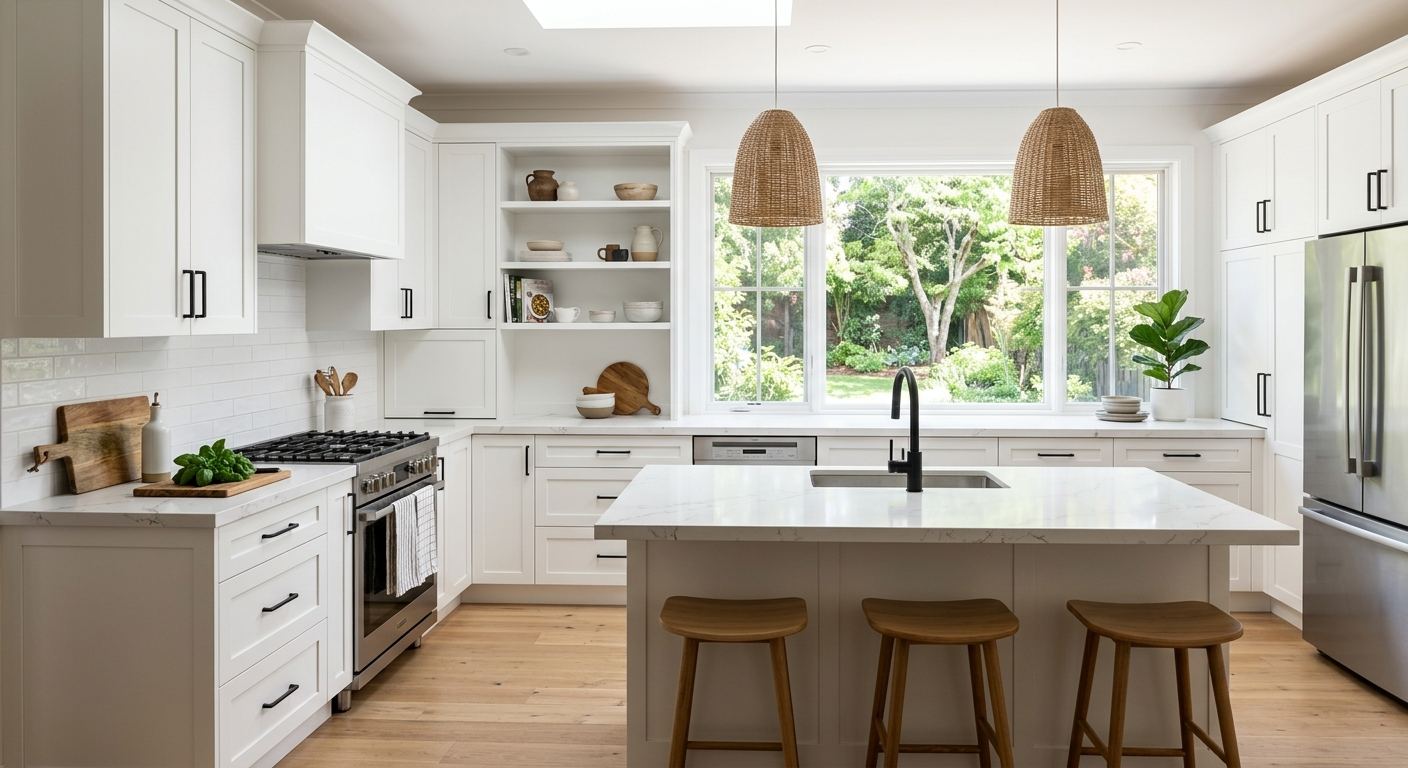
Kitchen renovation options and costs in Spruce Cliff
Spruce Cliff, Alberta is a neighbourhood where kitchen renovations tend to track the broader Calgary market: the higher the home value expectations, the more homeowners plan around durability and resale-ready finishes. With a small community population (4,195 people, Statistics Canada, 2021 Census), trades availability is strong because Calgary’s overall demand pulls specialists into the area, especially when projects involve stone, cabinetry, and electrical updates.
In Calgary’s economic region, budgets are usually driven more by what buyers will pay later than by weather exposure. Even though Alberta’s winters can be hard on HVAC and home systems, kitchen materials themselves (like quartz, tile, and quality cabinet finishes) are selected for indoor moisture stability, so climate is rarely the deciding cost driver. Instead, local price expectations push many remodels toward quartz or natural stone counters and semi-custom cabinetry; that’s why full-kitchen renovations commonly fall in the mid five-figures and often reach the upper band when layouts change or walls move. In a higher-value market within the region, homeowners frequently target a kitchen refresh in the 10%–15% range of home value, while more involved redesigns can run closer to 20%–25% depending on the property.
Contractors also price in Calgary’s fast-paced construction schedule. Skilled labour around 90–140 per hour means design time, demolition coordination, and project management are a significant share of the total. In Spruce Cliff, the trade is especially busy where older bungalow and townhome stock is being updated for modern open layouts and improved lighting—so it’s smart to lock in dates early. Use the table below to compare renovation tiers and what typically fits your scope.
| Renovation Tier |
What's Included |
Typical Duration |
Price Range |
| Cosmetic refresh (paint, hardware, new appliances only) |
Cabinet paint or touch-up, new hardware, appliance swap (no plumbing/gas moves), minor caulking and trim |
1–3 weeks |
$7,500–$18,000 |
| Mid-range full renovation (new cabinets, counters, sink, tile) |
Semi-custom or quality stock cabinets, countertop installation, sink swap, backsplash tile, base trades coordination |
3–7 weeks |
$25,000–$60,000 |
| High-end full renovation (custom cabinets, stone counters, island) |
Custom millwork, premium stone counters, island with integrated lighting, upgraded tile/backsplash, coordinated electrical & plumbing as needed |
6–12 weeks |
$65,000–$100,000 |
| Cabinet refacing only (new doors + drawer fronts, same boxes) |
New door/drawer fronts, new hardware, optional cabinet finishing, typically limited countertop involvement |
2–4 weeks |
$12,000–$35,000 |
| Countertop swap only (laminate to quartz or stone) |
Remove existing surface, install new countertop, basic sink cut-in and resealing (no layout/plumbing moves) |
3–10 days |
$3,500–$12,000 |
| Backsplash tile installation only |
Tile supply and install, prep and waterproofing as required behind tile, grout and caulking details |
5–10 days |
$2,500–$8,000 |
Prices are estimates only and vary by project scope, site access and material selection.
What affects the price of kitchen renovation in Spruce Cliff
In Spruce Cliff and across the Calgary economic region, two quotes for the “same” kitchen can differ by 30%–50% because contractors price risk, schedule, and complexity—not just materials. Local home values and household purchasing power steer homeowners toward different finish tiers. In higher-value areas of Calgary and nearby communities, homeowners often default to quartz or natural stone counters and semi-custom cabinetry because the investment is easier to justify on resale. In more modest pockets of the region, laminate and stock cabinetry remain popular because they deliver a bigger cost-to-impact ratio. Climate plays a smaller role than most people expect: your kitchen sits indoors year-round, and modern cabinet coatings and stone products handle Calgary’s seasonal swings well when the home’s humidity control is adequate—so the big cost drivers are usually layout, trade scope, and finish choices.
Here are the biggest real-world examples that move costs up or down in Spruce Cliff:
- An island addition changes electrical and sometimes plumbing. If you need a new circuit plus under-cabinet lighting, labour time rises quickly—often shifting a job from the $25,000–$60,000 mid-range band into the higher portion of that band or beyond.
- Upgrading countertops from laminate (budget-friendly) to quartz (durable, modern) typically adds cost but reduces long-term maintenance worries—this is a common “best bang for the buck” change.
- If you’re swapping just counters (no plumbing moves), the project can stay closer to the $3,500–$12,000 countertop-swap band; the moment you move the sink location, the quote can jump fast due to drain supply work and resealing.
Finally, housing age matters. Older Spruce Cliff homes can have wiring or plumbing routes that don’t align with a new layout, and any hidden damage found during demo (water staining behind base cabinets, old shutoffs, or undersized electrical) can add thousands regardless of finish level.
| Price Factor |
Why It Matters |
Cost Impact |
| Cabinet tier — stock vs. semi-custom vs. fully custom millwork |
Custom sizes, higher build quality, better hardware, and finish options increase labour and production time |
$5,000–$40,000+ |
| Countertop material — laminate vs. quartz vs. granite vs. stone |
Material cost and installation complexity (templating, weight, seams, polishing) |
$1,000–$10,000+ |
| Layout change — wall removal, island add, plumbing/gas move |
Most unpredictable costs: structural coordination, trades scheduling, and permit-driven work |
$3,000–$25,000+ |
| Appliance package tier — builder vs. mid-range vs. pro-grade |
Electrical requirements, ventilation needs, and premium installation specs |
$1,500–$15,000+ |
| Flooring — refinish existing vs. full replacement |
Subfloor condition, demolition scope, and matching transitions after cabinet installation |
$1,000–$12,000 |
| Backsplash — ceramic tile vs. marble vs. full-height slab |
Higher-end stone adds material cost and increased cutting/setting labour |
$800–$7,000+ |
| Electrical — new circuits for island, under-cabinet lighting |
Licensed work, inspections, and longer scheduling windows |
$1,000–$8,000 |
| Permit fees and licensed trade requirements |
Structural changes, gas work, and electrical add administrative and compliance costs |
$300–$5,000+ |
Permits & regulations in Alberta
In Alberta, many straightforward kitchen updates do not require a permit—especially if you are keeping plumbing and gas where they are. A cabinet swap, cabinet refacing, and countertop replacement typically do not require a permit as long as there are no moves to supply/drain lines or gas connections. Likewise, replacing finishes like tile or backsplash is usually permit-free.
However, permits and licensed trades are required when you change the building services. In practical terms for Spruce Cliff homeowners, you should expect a permit (and an electrician or gas fitter) for work such as: moving plumbing supply or drain lines, relocating a gas stove or making changes to a gas range hookup, removing a load-bearing wall or other structural framing, and adding new electrical circuits (for example, a new circuit for an island, or dedicated under-cabinet lighting that requires new wiring). Gas work must be completed by a licensed gas fitter, and electrical by a licensed electrician—both typically require inspections as part of the compliance process.
Step-by-step, here’s how to verify a contractor before signing: (1) ask for their licence details and check the relevant online registry, (2) request a current certificate of insurance showing general liability (and any trade-specific coverage where applicable), and (3) confirm workers’ compensation coverage (WSIB/WCB) so you’re not assuming liability for injuries. Always confirm, in writing, who is pulling permits and paying the fees—responsibility belongs in the contract scope, not in verbal promises.
Cabinets, countertops and layout decisions in Spruce Cliff
For most Spruce Cliff kitchens, the biggest decisions come down to three levers: cabinet tier, countertop material, and whether the layout changes. Cabinet tier sets the tone and cost. Stock cabinets are the fastest and typically the cheapest; semi-custom is the most common choice in Calgary because it balances price with better sizing and higher-end finishes; custom cabinets give the best fit around older framing irregularities, but they push project timelines and budgets.
Countertops do even more for resale perception. Laminate can be a budget win, but it needs careful sealing around edges and tends to show wear sooner. Quartz is a popular mid-to-high option because it handles daily kitchen use well and offers a consistent, modern look. Granite and other natural stones deliver unique patterning and a premium feel, while marble is stunning but requires more disciplined maintenance. For the local market, these choices line up with buyer expectations at different price points: mid-range remodels often land in the $25,000–$60,000 range with quartz and upgraded tile, while high-end redesigns commonly push into the $65,000–$100,000 band when an island and premium stone are part of the plan.
Layout changes are where costs become hardest to predict, regardless of finish level. An open-concept wall removal or an island addition can require new electrical and sometimes plumbing/gas relocation. The cost is justified when you’re gaining functional space (better traffic flow, improved workspace, and more storage), not just chasing a trend.
Example: If you upgrade from laminate to quartz without moving the sink, you may stay close to the countertop-swap band (often $3,500–$12,000). If the same project includes relocating the sink, labour and permit-driven trade work can push total costs into a mid-range full renovation budget because of drain/supply changes and resealing work.
| Option |
Durability |
Maintenance |
Best For |
Price Range |
| Stock cabinets (big-box) |
Good durability with standard finishes; less flexibility for odd spaces |
Low maintenance; handle wear depends on finish quality |
Fast timelines and cost-focused refreshes |
$8,000–$20,000 |
| Semi-custom cabinets (local dealer) |
Very solid builds with better options for storage and sizing |
Low to moderate; standard cleaning and gentle hardware care |
Most Spruce Cliff remodels aiming for resale-ready results |
$20,000–$45,000 |
| Custom cabinets (local millwork shop) |
Highest durability potential with tailored joinery and fit |
Low maintenance; best long-term performance when built and finished well |
Challenging layouts, custom sizing, and premium kitchens |
$35,000–$75,000+ |
| Laminate countertop |
Moderate durability; seams and edges are more vulnerable |
Easy daily care; avoid standing water at seams |
Budget-forward renovations and appliance-only updates |
$1,800–$4,000 |
| Quartz engineered countertop |
High durability; resists staining and daily wear well |
Low maintenance; wipe clean and use non-abrasive cleaners |
Most mid-range and premium kitchens |
$4,500–$9,000 |
| Granite / natural stone countertop |
High durability; heat and scratch resistance varies by stone |
Requires periodic sealing depending on the stone and finish |
Premium looks with rugged everyday performance |
$6,000–$12,000 |
| Butcher block countertop |
Good durability but can dent; sensitive to prolonged moisture |
Regular oiling and careful drying after spills |
Warm, casual kitchen styles and family-friendly use |
$3,500–$7,500 |
| Marble countertop |
Beautiful but softer; can be prone to etching and staining |
Higher maintenance; quick cleanup and careful product use |
Showpiece kitchens where aesthetics outweigh low-maintenance needs |
$8,000–$15,000+ |
How to choose a kitchen renovation contractor in Spruce Cliff
Choosing the right contractor in Spruce Cliff is mostly about verification and clarity. Start by confirming Alberta licensing: ask for licence details for any trade that will be doing gas work (needs a licensed gas fitter) and electrical work (needs a licensed electrician). Then verify insurance and workers’ compensation. Request a certificate of insurance showing general liability and make sure it’s current for the project dates. For WSIB/WCB, ask for proof of coverage so you’re not exposed if a worker is injured on-site.
Next, get 2–3 itemised written quotes. You want labour and materials separated—especially cabinets, countertops, tile, demolition/disposal, electrical, plumbing, and any permit-related line items. A lump-sum number is not enough for comparing contractors. Read the scope line-by-line for what’s excluded: disposal, protection of floors, patching/drywall finishing level, appliance install responsibility, and whether permit pulls are included. If you’re moving services, ensure the quote identifies the licensed trade scope and inspection responsibility.
Warranty matters locally. Ask for workmanship warranty length, product/manufacturer warranty terms, and whether coverage is transferable if you sell your home. For payment, keep deposits reasonable: never pay more than 10%–15% upfront, and hold a completion payment until punch-list work and final clean-up are done. Lock in timeline commitments: get the start date and a completion estimate in writing, with allowances for countertop and cabinet lead times.
- Verify gas fitter and electrician licences for any relocated gas/electrical work
- Request current insurance certificate and confirm project-specific coverage
- Confirm WSIB/WCB coverage in writing
- Get 2–3 itemised quotes with line-by-line labour and materials
- Check whether demolition and disposal are included (not just “demo”)
- Confirm permit responsibility and whether fees are included
- Review countertop templating and seam planning details in the quote
- Ask who handles appliance installation and any needed venting/connection updates
- Confirm flooring protection plan during cabinet and countertop install
- Clarify drywall/patching and paint responsibilities after trades work
- Require a written timeline including cabinet/counter lead times
- Set a holdback and punch-list completion standard in the contract
Concrete red flags I see in Spruce Cliff: (1) quotes that hide permit/licensed trade work behind “allowance” numbers without details, (2) no written scope for disposal and patch/paint, (3) asking for a large upfront payment (beyond 10%–15%), (4) vague warranty terms or no workmanship warranty, and (5) contractors who won’t provide insurance/coverage documentation when asked.
Frequently asked questions — kitchen renovation in Spruce Cliff
Can I move my kitchen sink or stove?
Yes, you can move a sink or stove in Spruce Cliff, but it changes the scope—and the compliance requirements. Moving a sink typically means rerouting supply and drain lines, which usually requires permits and licensed plumbing work. If your stove uses gas, relocating it involves gas connection changes and must be performed by a licensed gas fitter; inspections may apply depending on the work. From a cost perspective, it’s the layout/service moves—not the finishes—that most often push a project upward. For example, staying in a countertop-only band (often around $3,500–$12,000) is realistic only when you’re not changing plumbing. Once you move plumbing or gas, many kitchens move into the mid-range full renovation budget territory (commonly $25,000–$60,000), because demolition, patching, and trade scheduling add time and labour.
What's the most cost-effective kitchen upgrade?
For many homeowners in Spruce Cliff, the most cost-effective upgrade is upgrading the look without moving walls—most commonly a countertop swap to quartz plus a coordinated backsplash. That approach can deliver a major visual change while keeping plumbing and gas work minimal. If you’re not relocating the sink, countertop-only projects often land in the $3,500–$12,000 range, and you can usually bundle the backsplash tile installation (commonly $2,500–$8,000) to complete the “new kitchen” look. This also matches Calgary buyers’ expectations for modern, low-maintenance surfaces. Compared with a layout change (where the unpredictable part is trades and permits), a finish-forward upgrade protects your budget and reduces schedule risk, especially in Alberta where skilled trades are in high demand.
Custom vs stock cabinets — is custom worth it?
Custom cabinets can be worth it in Spruce Cliff when your kitchen has limitations that stock can’t solve—like tight clearances, unusual corners, or a desire for built-in storage that fits your exact lifestyle. If your layout is standard and your measurements are straightforward, semi-custom is often the best balance. Stock cabinets are typically the fastest and cheapest, while semi-custom tends to deliver the most practical upgrades for resale-ready kitchens. Custom is usually the highest cost tier (often pushing well into the higher bands within full renovations), and the payback depends on whether the fit, storage, and finishing quality matter to your buyer pool. For a clear budget reality: moving from stock to semi-custom commonly shifts total project cost meaningfully, while upgrading counters from laminate to quartz can often deliver a bigger “wow” per dollar when you keep the cabinet box arrangement stable.
How do I choose a kitchen contractor in Spruce Cliff?
Choose a contractor by verifying credentials and demanding itemised transparency. In Alberta, ensure the relevant trades are licensed: electrical for any new circuits and gas work for any stove/range changes. Confirm insurance and WSIB/WCB coverage before the job starts—ask for documents, not promises. Then get 2–3 written quotes that break out labour and materials (cabinets, countertops, tile, demolition/disposal, and any electrical/plumbing allowances). Read exclusions carefully: disposal, patching, permit pulls, and appliance install responsibilities should be explicit. For reliability, confirm a realistic timeline and that cabinet/counter lead times are accounted for. Finally, review the workmanship warranty terms and product warranty coverage, including whether warranty transfers if you sell your home. If the quote is vague, payments are front-loaded beyond 10%–15%, or they won’t share documentation, move on.
What order do kitchen renovation steps happen in?
In a typical Spruce Cliff kitchen renovation, the order is designed to keep trades efficient and protect your finishes. First comes measurement/design confirmation and ordering cabinets and countertops. Next is demolition and rough-in checks: electrical/plumbing/gas scope is confirmed, and any service relocations (if included) are completed by the licensed trades. After that, rough inspections happen where required, then drywall patching and prep follows. Cabinets are installed next, followed by countertop templating and fabrication. Once countertops arrive, they’re installed and sealed; backsplash tiling typically comes after countertops are in so the alignment is clean. Flooring finishing often happens in the middle depending on whether you’re reinstalling or replacing flooring—many contractors do floors before cabinets so base cabinets sit properly. Appliances and final trim/caulking come at the end, then walkthrough and punch-list close-out. This sequencing reduces schedule downtime and helps avoid rework costs.
Can I live at home during a kitchen renovation in Spruce Cliff?
Sometimes yes, but it depends on the scope, your kitchen setup, and how disruptive the demolition and trades work will be. If you’re doing a cosmetic refresh or countertop/backsplash-only changes, many homeowners stay in place with a workable temporary setup (microwave/coffee station and a safe access path). For mid-range full renovations, living on-site is possible but usually means you’ll rely on a temporary cooking area and manage noise and dust control daily—especially during cabinet installation and tile work. If your project includes layout changes, moving plumbing or gas, or opening walls, expect longer disruption and more uncertainty, even in Alberta where planning and inspections are routine. As a practical guide, if you’re staying closer to a smaller band like a countertop swap (often $3,500–$12,000), the disruption is usually more manageable. If your plan is closer to a full redesign (commonly $25,000–$100,000 depending on scope), most families arrange partial or full relocation for the noisiest weeks.