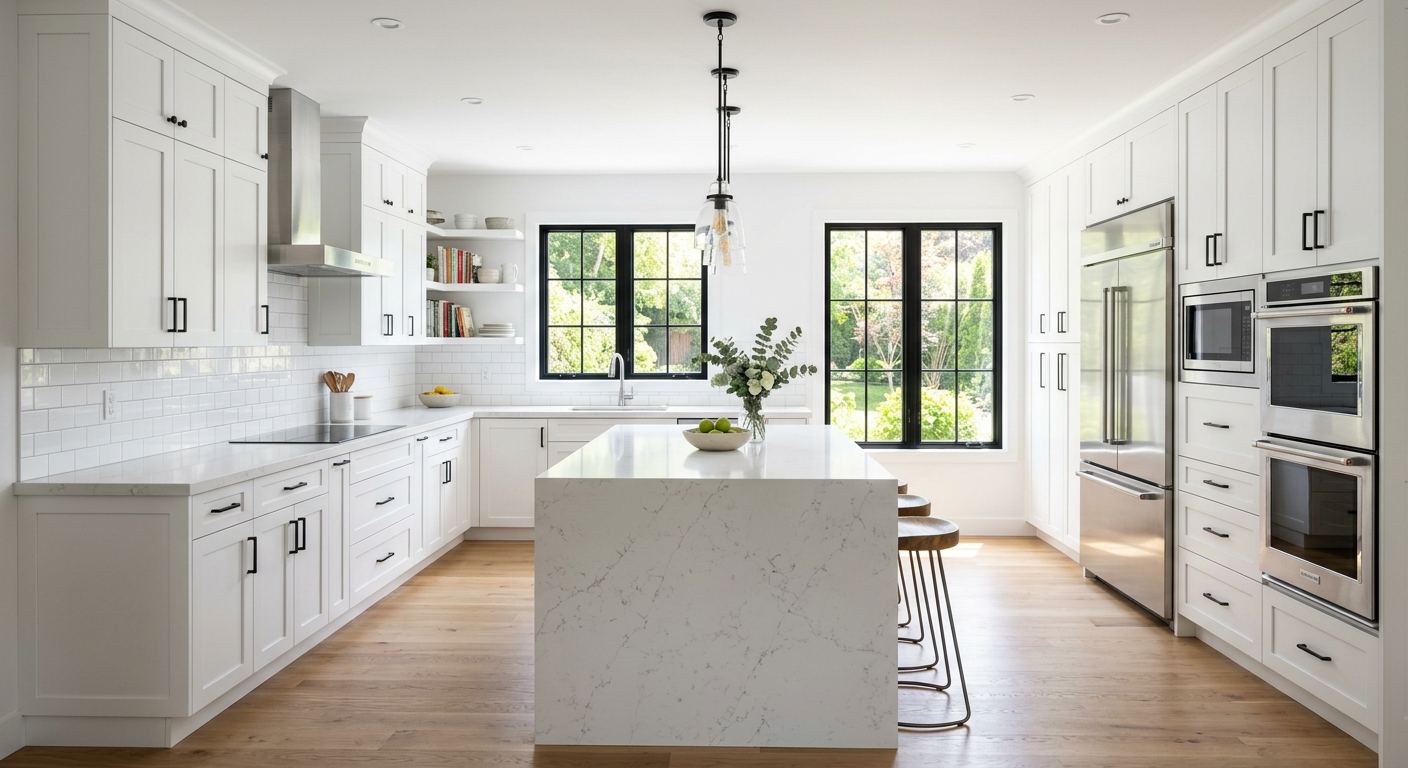
Kitchen renovation options and costs in Pineridge
Pineridge is a smaller, steady market within the Calgary economic region, so kitchen quotes tend to track buyer expectations and resale value rather than weather alone. With a population of 9,850 (Statistics Canada, 2021 Census), most upgrades are driven by what’s selling in nearby Calgary communities—typically updated finishes, durable counters, and cabinets that look “built-in.” In practice, Calgary-area home values often support renovations that “hold value,” which is why many homeowners budget for quartz or natural stone counters and semi-custom cabinetry even on mid-range refreshes.
In Alberta, the strong construction cycle keeps trade availability competitive, and labour is a large share of the budget—skilled work in Calgary commonly runs about $90–$140 per hour. That labour reality is why “basic” projects still include quality cabinetry and solid-surface counters more often than they do in slower regions. Climate plays a secondary role: the bigger cost driver is indoor moisture management during winter and freeze–thaw season, especially if older homes have plumbing runs or exterior-side walls near the kitchen.
In Pineridge, you’ll often see the most consistent demand from long-established pockets of older housing stock along established corridors where homeowners tackle kitchens during bathroom/finishing updates. If you’re comparing your options, start by matching the scope to the budget range in the table below.
| Renovation Tier |
What's Included |
Typical Duration |
Price Range |
| Cosmetic refresh (paint, hardware, new appliances only) |
Cabinet paint or stain (no box work), new pulls/knobs, backsplash patchwork (if needed), appliance swaps (no plumbing/gas moves) |
3–7 working days |
$5,000–$15,000 |
| Mid-range full renovation (new cabinets, counters, sink, tile) |
Semi-custom or upgraded stock cabinets, new countertop and sink, backsplash tile, new or updated flooring, basic electrical allowances |
3–6 weeks |
$25,000–$60,000 |
| High-end full renovation (custom cabinets, stone counters, island) |
Fully custom cabinetry, quartz or natural stone (often with waterfall/island), island build, integrated lighting, premium appliance package, more detailed tile and flooring work |
6–10 weeks |
$60,000–$100,000 |
| Cabinet refacing only (new doors + drawer fronts, same boxes) |
Refacing panels, new hardware, new end panels as needed, optional countertop/backsplash not included unless added |
1–3 weeks |
$8,000–$35,000 |
| Countertop swap only (laminate to quartz or stone) |
Remove existing counters, templating, install new countertop and edge profile; sink cut-outs as applicable |
3–10 working days |
$3,000–$12,000 |
| Backsplash tile installation only |
Surface prep, tile supply and install, grouting and sealing where required; caulking and trim to match cabinetry |
2–5 working days |
$2,500–$8,000 |
Prices are estimates only and vary by project scope, site access and material selection.
What affects the price of kitchen renovation in Pineridge
Even when two homeowners in Pineridge ask for “the same kitchen,” Calgary-area quotes can diverge by 30–50% because the drivers aren’t cosmetic—they’re structural, logistical, and labour-linked. In the Calgary economic region, home value and household spending capacity often steer finish choices. When the market supports a higher resale expectation, many projects move into the mid-range and high-end bands (for example, $25,000–$60,000 for a mid-range full renovation and up to $60,000–$100,000 for major redesign work). In those situations, homeowners typically choose quartz or natural stone counters and semi-custom/custom cabinetry because the cost is easier to justify at resale, rather than because of climate performance.
In Pineridge and across Alberta, the unpredictability usually comes from layout changes. Removing a wall, adding an island, or moving a gas line or plumbing run introduces trades, permitting steps, and extra framing/flooring patchwork. That labour-and-schedule effect can outweigh any savings from picking a simpler cabinet door style.
Here are a few concrete examples that swing cost in the Pineridge area: (1) Older homes sometimes have non-standard cabinet depths or off-square walls—plan on extra carpentry hours if the base framing isn’t level. (2) Kitchens near exterior walls can require moisture-conscious adjustments—if we discover cold-side condensation issues behind existing backsplash or under the sink, remediation can add scope. (3) If you want a wide island with seating, you may need a bigger electrical allowance for under-cabinet or island lighting and power outlets.
| Price Factor |
Why It Matters |
Cost Impact |
| Cabinet tier — stock vs. semi-custom vs. fully custom millwork |
Custom dimensions, materials, and hardware options change labour hours and material cost. |
Typically shifts projects by several thousand dollars; often the biggest controllable factor after layout. |
| Countertop material — laminate vs. quartz vs. granite vs. stone |
Material cost and install complexity (seams, edges, thickness, weight) affect timelines and crew cost. |
Can add $2,000–$10,000+ depending on stone choice and island/seam requirements. |
| Layout change — wall removal, island add, plumbing/gas move |
Triggers additional trades, structural considerations, and patching (drywall, flooring, insulation). |
Frequently the largest swing; can push you from mid-range into high-end pricing. |
| Appliance package tier — builder vs. mid-range vs. pro-grade |
Pro-grade units may require more electrical/venting coordination and higher install tolerances. |
Often $1,000–$8,000+ difference depending on brands and ventilation upgrades. |
| Flooring — refinish existing vs. full replacement |
Flooring removal/repair depends on subfloor condition and how far cabinets are re-set. |
Full replacement commonly adds material + labour; partial may still add patching costs. |
| Backsplash — ceramic tile vs. marble vs. full-height slab |
Higher-end materials increase prep, cuts, and sealing requirements. |
Can range from “quick install” pricing to premium slab installs with higher labour. |
| Electrical — new circuits for island, under-cabinet lighting |
New circuits require licensed work and inspection; lighting adds fixtures, wiring, and testing. |
Small upgrades may be a few hundred to low-thousands; full island electrical can escalate. |
| Permit fees and licensed trade requirements |
Some scope requires permits; trade scheduling affects lead times and total duration. |
Can add several hundred to more, but the bigger cost is often scheduling and coordination. |
Permits & regulations in Alberta
In Alberta, many “finish-only” kitchen updates don’t require permits—cabinet door replacements/refacing and countertop swaps typically fall under non-structural work. However, once you change services or the structure, permits and licensed trades become part of the job. For example, moving plumbing supply or drain lines, relocating a gas stove or range hood where gas is involved, removing a load-bearing wall, or adding new electrical circuits (common for islands and under-cabinet lighting) generally require permits and licensed trade involvement.
For Pineridge homeowners, a practical way to protect yourself is to verify responsibility before you sign. Step one: ask the contractor to list every permit-triggering activity in writing—“what we pull permits for” and “what you pull permits for” if anything changes. Step two: confirm the licensed trades. For electrical, ask for the electrician’s licence details and proof of insurance, and confirm that an inspection will be scheduled after rough-in and before final handover. For gas-related changes, the gas fitter must be licensed, and you should expect inspections.
Step three: request proof of liability insurance and Workers’ Compensation (WSIB/WCB) coverage. Then you can verify it by checking the contractor and trade credentials online (for licences) and by reviewing certificate of insurance documents—your contractor should provide them on request. A clearance letter for WCB/WSIB is typically part of standard documentation provided to clients.
Cabinets, countertops and layout decisions in Pineridge
When you renovate in Pineridge, your best decision-making starts with three choices that drive both cost and resale appeal in the Calgary market: (1) cabinet tier, (2) countertop material, and (3) layout changes. Cabinet tier sets the “look” and the fit. Stock cabinets are the fastest and cheapest option, but they’re less forgiving if your existing walls aren’t perfectly square. Semi-custom cabinets are usually the sweet spot in the $25,000–$60,000 mid-range band—local dealers can adjust heights and widths while keeping production timelines predictable. Custom cabinets cost more, yet they shine when you need exact dimensions around ceilings, vents, or odd corners.
Countertops then lock in durability and maintenance expectations. Laminate is budget-friendly, but quartz is the common Calgary choice because it resists staining and requires minimal day-to-day care. Granite/natural stone offers a premium look and unique veining, while butcher block brings warmth but needs regular sealing and more careful cleaning to prevent moisture damage—especially relevant in Alberta kitchens where wet hands and winter condensation can be part of daily life.
Layout changes justify cost only when they create real function. If you add an island, you may pay more for electrical and sometimes plumbing/gas coordination; that’s usually worth it when it improves traffic flow and creates seating or prep space. If you’re merely replacing faces, avoid layout moves to stay closer to countertop-swap pricing like $3,000–$12,000, rather than a full redesign.
As a dollar example: upgrading from laminate to quartz on a medium-sized kitchen can be “worth it” when it supports a semi-custom cabinet package—often the combined spend better fits buyers expecting solid-surface counters. But if you’re already near the top of the mid-range budget, moving plumbing or relocating gas typically costs more than the aesthetic upgrade itself.
| Option |
Durability |
Maintenance |
Best For |
Price Range |
| Stock cabinets (big-box) |
Good for standard measurements; can struggle with out-of-square walls |
Low; hardware and surface care as directed |
Fast projects, tight budgets, straightforward layouts |
$8,000–$18,000 |
| Semi-custom cabinets (local dealer) |
Very good; better tolerance around site conditions |
Low to moderate; regular cleaning and careful moisture control |
Most Alberta homeowners wanting a “built-in” look |
$18,000–$35,000 |
| Custom cabinets (local millwork shop) |
Excellent; tailored dimensions and higher-quality detailing |
Low to moderate; finish-specific care |
Complex spaces, premium finishing, major layout changes |
$35,000–$60,000+ |
| Laminate countertop |
Moderate; seams and edge wear are more common over time |
Low; avoid cutting directly on the surface |
Budget refreshes without changing the whole kitchen |
$3,000–$6,000 |
| Quartz engineered countertop |
High; resists staining and daily wear well |
Low; wipe clean, no sealing typically required |
Busy households and Calgary resale expectations |
$5,000–$10,000 |
| Granite / natural stone countertop |
High; durable but varies by stone |
Moderate; may require periodic sealing depending on the slab |
Premium look where budget supports natural variation |
$7,000–$12,000 |
| Butcher block countertop |
Moderate to high; sensitive to prolonged moisture |
Higher; needs regular oiling/sealing and careful drying |
Warm aesthetic, lighter-use kitchens, or planned maintenance |
$4,000–$8,000 |
| Marble countertop |
Moderate; can etch or stain more easily than quartz |
Higher; careful cleaning and protection required |
Showpiece premium kitchens with lower-chemical cooking routines |
$8,000–$15,000 |
How to choose a kitchen renovation contractor in Pineridge
Choosing the right contractor in Pineridge is less about flashy photos and more about proof. First, verify Alberta licensing and coverage. Ask for the contractor’s liability insurance certificate (and confirm it names the insured party correctly), and request evidence of WSIB/WCB coverage for workers. For any scope involving gas or electrical, confirm the relevant licensed trade credentials directly (electricians for electrical work; gas fitters for gas-related changes). You should also receive licence information or verification guidance so you can cross-check it through the applicable online licence registries.
Second, get 2–3 itemised quotes. Insist on a breakdown that separates labour and materials (cabinet supply vs install, countertop fabrication vs install, tile labour, electrical allowances). A lump sum often hides major differences in what’s included, especially for disposal, demolition prep, and subfloor repair.
Third, read the scope like a contract reviewer: what’s excluded (old cabinet removal, drywall patching, subfloor leveling), is permit pulling included, and is waste disposal included? For warranties, ask for the workmanship warranty length, the product/manufacturer warranties, and whether they transfer if you sell the home. Payment schedules matter too: never pay more than about 10–15% upfront, and hold back a portion until completion and punch-list items are done. Finally, request a written timeline with start date, realistic lead times for cabinets/counters, and a completion estimate.
- Confirm contractor liability insurance and the coverage term matches the project dates.
- Request WSIB/WCB clearance or coverage documentation before work starts.
- For gas/electrical scope, verify the correct licensed trades are assigned.
- Get an itemised quote: demolition, framing, cabinets, counters, tile, electrical, plumbing allowances.
- Ensure permit responsibilities are stated in writing (who pulls, who pays, who coordinates inspections).
- Check disposal/included waste haul-away—kitchens generate more debris than most rooms.
- Confirm what happens if materials are delayed (counter templating timing, cabinet lead times).
- Ask who protects your home during demolition (dust control, floor protection, plastic barriers).
- Require a written start date and completion target with milestone dates.
- Confirm warranty: workmanship length and manufacturer warranty documentation.
- Use a staged payment plan—10–15% max upfront and holdback until punch-list is complete.
- Ask for sample cabinet/stone/paint selections in writing so you don’t pay change-order premiums later.
Red flags we commonly see with kitchen contractors in Pineridge include: vague or non-itemised pricing, refusing to confirm which permits are required, inadequate proof of insurance/WSIB/WCB, pressured “full payment upfront” requests, and schedules that ignore cabinet/counter lead times—leading to frequent stop-work delays.
Frequently asked questions — kitchen renovation in Pineridge
How do I budget for a kitchen renovation?
Budgeting in Pineridge usually starts with choosing a scope tier, then adding a realistic contingency. For many homeowners, a mid-range full renovation (new cabinets and counters, plus tile and a sink) lands around $25,000–$60,000, while a higher-end redesign with an island and upgraded stone can reach $60,000–$100,000. Local quotes often feel higher than expected because labour and project management are significant in the Calgary economic region (trades are busy), and because kitchen layouts trigger extra coordination. Climate mainly affects scheduling and moisture-protection details—more of a “how we build it” cost than a “buy different materials” cost. To tighten your number, pick your cabinet tier and countertop first, then decide whether any layout moves (plumbing/gas) are truly necessary. Always add a contingency for hidden issues behind older drywall and under aging flooring.
Can I move my kitchen sink or stove?
Yes, but in Alberta the cost and compliance steps change quickly. Moving a kitchen sink typically requires adjustments to drain and supply plumbing runs—this often triggers permits and licensed plumbing work, depending on the changes to lines and locations. Moving a stove is even more sensitive: if your cooking is gas and you’re relocating the stove or range hood connection, gas work must be done by a licensed gas fitter, with inspections. In a practical budgeting sense, a simple countertop swap alone might be $3,000–$12,000, but once you’re moving plumbing or gas, you’re no longer in “swap-only” pricing territory; you’ll likely need a full renovation approach in the mid-range band or above. Before signing, ask your contractor to list the exact services to be moved, who pulls permits, and how long the licensed trades lead times add to your start/finish dates.
What's the most cost-effective kitchen upgrade?
In many Pineridge kitchens, the most cost-effective upgrade is improving the visible “front-of-house” surfaces without changing services. That often means either a cabinet refacing or a countertop swap paired with a new backsplash. Cabinet refacing can be a strong value because you keep the existing boxes but modernize doors, drawer fronts, and hardware—typical pricing sits around $8,000–$35,000. A countertop swap only is sometimes even more efficient for tight budgets, commonly $3,000–$12,000, especially if your cabinet layout is staying put. The key is to avoid scope creep: if you plan to move plumbing, add an island, or relocate appliances, those moves become the main cost drivers and can erase the savings. If your cabinets are structurally sound and your layout works, refacing + a better counter + a tidy backsplash is usually the best ROI path in the Calgary-area resale mindset.
Custom vs stock cabinets — is custom worth it?
Custom cabinets can be worth it in Pineridge when your kitchen has challenges that stock can’t solve cleanly: out-of-square walls, unusual corner angles, ceiling-height constraints, or a layout where you want everything to align perfectly for a premium look. If your goal is speed and budget control, stock cabinets are typically the quickest route, and they’re often best for straightforward layouts. In Calgary-area resale expectations, semi-custom is the most common “bridge” option, balancing cost and fit. Pricing reflects this: stock is often the lower tier (commonly $8,000–$18,000), semi-custom sits mid-range (often $18,000–$35,000), and fully custom can climb to $35,000–$60,000+. If your budget is capped, you can still get a high-end look by choosing a good door style, modern hardware, and solid countertop/backsplash finishes—without paying for custom millwork everywhere.
How do I choose a kitchen contractor in Pineridge?
Start by verifying Alberta coverage and credentials. Ask for the contractor’s liability insurance certificate, proof of WSIB/WCB coverage, and—when needed—confirm the licensed electrician/gas fitter is assigned for electrical or gas work. Then request 2–3 itemised written quotes with clear labour and materials breakdowns (demolition, cabinet install, countertop fabrication vs install, tile labour, electrical allowances). Make sure the quote states what permits are required and who pulls them, and whether waste disposal is included. Review warranties: confirm workmanship warranty length and whether product warranties are documented and transferable if you sell. Payment structure should be conservative—typically no more than 10–15% upfront, and hold back funds until the punch list is complete. Finally, insist on a written timeline that accounts for cabinet and countertop lead times so you don’t get “schedule surprises” during winter when trades are in demand.
What order do kitchen renovation steps happen in?
The usual order for a kitchen renovation in Pineridge is designed to manage trades efficiently and prevent rework. First comes demolition and rough site prep (including dust control and protecting floors). Next is rough-in work: any plumbing, gas, and electrical changes must be completed before walls close and before cabinet install lines are set. After rough-in, you’ll typically see drywall/patching and then flooring prep/installation to create a level base. Cabinets are installed next, because countertops and backsplash measurements depend on their final positions. Then countertops are templated and installed (with sink cut-outs confirmed), and backsplash tile goes in after counters are set to ensure accurate edges and caulking lines. Finally, appliances are installed, caulking and trim are finished, and the job concludes with inspection/clean-up and warranty handover. If you’re only doing a countertop swap or backsplash, the sequence is shorter—but a contractor should still follow the same logic: rough-in first, then measure, then install.