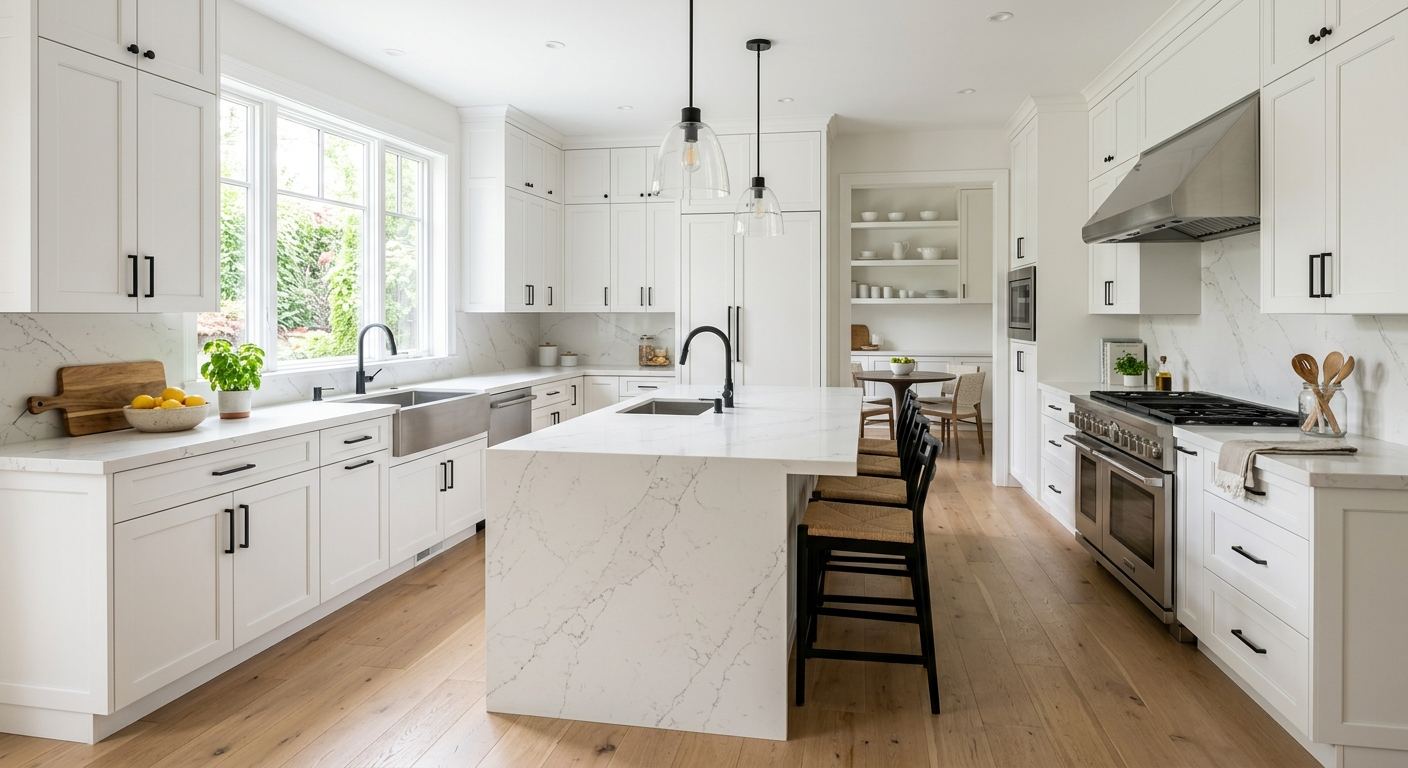
Kitchen renovation options and costs in Temple
In Temple, Alberta, kitchen renovations are usually planned around the realities of a growing Calgary-area housing market and what buyers expect when they tour. With Temple’s population at 10,525 (Statistics Canada, 2021 Census), there’s a steady need for tradespeople, but pricing still reflects the wider Calgary economic region. Renovation budgets here track more closely to home values and household buying power than to weather alone—so homeowners in higher-value pockets commonly opt for quartz or natural stone counters and semi-custom cabinetry. That finish direction is consistent with how the Calgary region performs, where many full-kitchen projects land in the mid five-figures and can rise into six figures when layouts change or walls get moved.
Alberta’s strong construction market also matters. When contractors are busy, lead times for cabinetry, stone templates, and appliance delivery can push schedules, and labour rates in the Calgary area often run around 90–140 per hour, making project management and trade coordination a meaningful part of the total. Local demand is especially high in the newer, actively-renovated pockets near North Temple, where owners tend to refresh finishes to match modern buyer expectations.
To help you compare options at a glance, here are the typical tiers homeowners use when planning a Temple kitchen project—ranging from a quick refresh to a full redesign with upgraded materials.
| Renovation Tier |
What's Included |
Typical Duration |
Price Range |
| Cosmetic refresh (paint, hardware, new appliances only) |
Cabinet paint or repaint, new hardware, backsplash touch-up or minor tile work, replacement appliances (no plumbing/gas changes) |
3–7 days |
$8,000–$18,000 |
| Mid-range full renovation (new cabinets, counters, sink, tile) |
New semi-custom or mid-range cabinets, new countertop and sink, backsplash tile, flooring minor repairs/replacement as needed, basic plumbing refresh (no major relocations) |
2–4 weeks |
$25,000–$55,000 |
| High-end full renovation (custom cabinets, stone counters, island) |
Custom cabinetry, quartz or natural stone (often with waterfall ends), island with upgraded electrical, integrated lighting, higher-end tile/stone backsplash, appliance package with installation |
5–10 weeks |
$70,000–$105,000 |
| Cabinet refacing only (new doors + drawer fronts, same boxes) |
Door/drawer replacement, new hardware, re-seal/adjust existing boxes, paint where needed, countertop left as-is unless you choose to swap |
1–3 weeks |
$8,000–$35,000 |
| Countertop swap only (laminate to quartz or stone) |
Remove existing top, template, fabricate and install new countertop and edges, new sink cut-out if required, caulking and finishing |
3–10 days |
$3,000–$12,000 |
| Backsplash tile installation only |
Tile supply and labour (ceramic or similar), surface prep, waterproofing where applicable, grouting and finishing |
2–5 days |
$2,500–$8,000 |
Prices are estimates only and vary by project scope, site access and material selection.
What affects the price of kitchen renovation in Temple
In the Calgary economic region, it’s common to see quotes for the “same” kitchen differ by 30–50%. The biggest driver isn’t weather—it’s the finish tier homeowners choose based on local home values and household buying capacity. In higher-value Calgary-area markets, buyers expect quartz or stone counters and semi-custom cabinetry, so quotes reflect that reality even before you touch layout. In more modest markets, laminate and stock cabinets still dominate because they deliver better ROI per dollar when reselling. In both cases, labour and coordination matter: skilled trades in Calgary often run roughly 90–140 per hour, so a schedule-friendly crew and a tight scope can reduce costs substantially.
Layout changes create the most unpredictable portion of the budget, regardless of finish level. Removing a wall, adding an island, or moving a gas line typically adds new framing, new finishes, and extra trade hours. Even if your cabinet and countertop selection stays mid-range, plumbing and electrical work can push a project toward the upper end of the $25,000–$55,000 band for mid-range work.
In Temple, you’ll also feel three local conditions in the pricing: first, older housing stock often has dated electrical layouts, so adding under-cabinet lighting or island receptacles can require additional circuits. Second, countertop edges and cut-outs (especially around older sink plumbing rough-ins) sometimes increase fabrication complexity. Third, the strong construction market means lead times for custom doors or stone templates can influence total labour days and site overhead—timing becomes a cost factor.
| Price Factor |
Why It Matters |
Cost Impact |
| Cabinet tier — stock vs. semi-custom vs. fully custom millwork |
Quality of box construction, door options, internal hardware, and fit to your exact layout |
Large swing; can move a mid-range job toward the high-end band |
| Countertop material — laminate vs. quartz vs. granite vs. stone |
Material price plus edge profiles, thickness, seams, and fabrication difficulty |
Laminate keeps budgets lower; quartz/stone commonly adds thousands |
| Layout change — wall removal, island add, plumbing/gas move |
New framing, new venting/utility runs, additional inspections, and longer timelines |
Often the biggest unknown; frequently drives the jump to the top of the band |
| Appliance package tier — builder vs. mid-range vs. pro-grade |
Installation complexity, ventilation requirements, and matching trim/finishes |
Can add meaningful cost even when cabinets stay mid-range |
| Flooring — refinish existing vs. full replacement |
Protection vs. replacement, subfloor condition, and moisture/leveling needs |
Replacement is typically more expensive once removal reveals issues |
| Backsplash — ceramic tile vs. marble vs. full-height slab |
Material weight, fastening systems, and finish complexity |
Premium backsplashes can raise costs beyond cosmetic scope |
| Electrical — new circuits for island, under-cabinet lighting |
Licensed circuit work, wiring runs, and additional labour/inspection steps |
Can add thousands; increases with complexity and number of fixtures |
| Permit fees and licensed trade requirements |
Work requiring permits/inspections changes scheduling and documentation |
Not always huge in direct fees, but it affects overall labour and coordination |
Permits & regulations in Alberta
In Alberta, a countertop swap or a cabinet installation/refacing typically doesn’t require a permit. However, once you start changing the kitchen’s utilities or structural elements, permits and licensed trades usually come into play. In practical terms for homeowners in Temple, these are the types of work that typically do require permits: moving plumbing supply or drain lines, relocating a gas stove/range or making changes involving gas, removing a load-bearing wall, and adding new electrical circuits (for example, island receptacles or new under-cabinet lighting that requires circuit work). Gas work must be done by a licensed gas fitter, and electrical work by a licensed electrician, with inspections required.
How to verify before you sign: Step one is to ask the contractor for (1) their Alberta business details, (2) proof of liability insurance, and (3) proof of WSIB/WCB coverage for workers. Step two is to confirm the trades that will do gas and electrical work—request their licence documentation and insurance certificates. Step three is to look for a clearance letter or equivalent proof of coverage (depending on how the contractor provides documentation), then confirm the certificate is current. Step four is to ensure the contract clearly states who is pulling permits (it should be stated in writing), who pays permit fees, and who schedules inspections.
If a contractor won’t provide licence/insurance documentation or leaves permit responsibility vague, that’s a warning sign—especially in Alberta where kitchen work often triggers multiple licensed scopes.
Cabinets, countertops and layout decisions in Temple
The three biggest decisions in a Temple kitchen renovation are cabinet tier, countertop material, and whether you change the layout. First, choose your cabinet tier: stock cabinets are typically the fastest and lowest cost, semi-custom is usually the most popular mid-range option for fit and style, and custom cabinets cost more but can tailor storage, pantry configurations, and exact measurements. Second, countertop material affects both day-to-day life and resale appeal. Laminate can look very good at a lower price, but it’s less durable for heavy heat and abrasion. Quartz is a common Alberta choice because it resists stains and holds up well to everyday use. Natural stone (granite or other stones) brings premium aesthetics, but you still pay for fabrication and, depending on the stone, periodic maintenance. Third, layout changes—like removing a wall for open-concept flow, adding an island, or relocating plumbing/gas—are often justified only when the space gain improves how you use the kitchen.
In the Calgary resale market, buyers typically respond well to functional storage and a clean, modern surface package. That’s why upgrading counters and cabinetry often makes more sense than spending heavily on niche decorative items. For example, if you’re currently in a mid-range budget around $25,000–$55,000, upgrading from laminate to quartz can be a practical “buyer-friendly” lift. But if your quote increases enough to push you into the higher-end band (where full redesigns with islands and stone commonly reach $70,000–$105,000), make sure you’re also getting the layout improvements that justify the added cost—otherwise, the ROI can weaken.
Construction sequencing also matters in Alberta climates: keep moisture control tight, protect floors during demo, and plan for stone templating and long-lead cabinetry so the job doesn’t drag out longer than necessary.
| Option |
Durability |
Maintenance |
Best For |
Price Range |
| Stock cabinets (big-box) |
Good for light-to-moderate daily use; limited custom sizing |
Simple care; hinges/hardware depend on brand |
Fast renovations and budget-conscious owners |
$8,000–$20,000 |
| Semi-custom cabinets (local dealer) |
Better fit and hardware options; strong everyday durability |
Low to moderate; adjust as needed over time |
Most Temple renovations aiming for strong resale appeal |
$18,000–$35,000 |
| Custom cabinets (local millwork shop) |
Highest precision fit; tailored storage systems |
Low day-to-day upkeep; depends on finish type |
Unique layouts, full-height pantry walls, and premium upgrades |
$30,000–$60,000 |
| Laminate countertop |
Moderate; can chip or scorch with heat misuse |
Easy clean; watch edges and seams |
Value-focused upgrades |
$3,000–$6,500 |
| Quartz engineered countertop |
High; resilient to staining and everyday wear |
Low; generally no sealing required |
Homes targeting modern buyer expectations |
$6,000–$10,500 |
| Granite / natural stone countertop |
High; durable surface with unique variation |
Varies by stone; may need periodic sealing |
Premium look and statement styling |
$7,000–$12,000 |
| Butcher block countertop |
Good with care; sensitive to standing water and heat |
Oiling and conditioning are part of ownership |
Warm, casual kitchens and those who enjoy maintenance |
$4,500–$9,000 |
| Marble countertop |
Beautiful but softer than quartz; can etch |
Higher upkeep; sealing and careful cleaning |
Design-forward renovations with lower “impact” cooking style |
$9,000–$14,000 |
How to choose a kitchen renovation contractor in Temple
Choosing the right contractor in Temple is mostly about verification and clarity. Start by confirming Alberta licensing, liability insurance, and WSIB/WCB coverage. For licensing, ask for the contractor’s business registration details and then confirm the specific trades they’ll use for gas and electrical work. For insurance, request a current certificate of insurance showing liability coverage appropriate for renovation work. For WSIB/WCB, ask for proof that covers their workers—then check the document’s validity period. If the contractor is hesitant or can’t provide these items promptly, that’s a major red flag.
Next, get 2–3 itemised written quotes. You want labour and materials broken out (cabinet supply vs. install, countertop supply vs. fabrication, electrical and plumbing labour, demolition, disposal, and any millwork adjustments). Avoid lump sums that don’t explain what you’re paying for. Read the scope carefully: are permits included? Is disposal included? Is drywall repair included after plumbing/electrical rough-ins? Also confirm warranty terms—workmanship warranty length, manufacturer warranty coverage, and whether warranties are transferable if you sell your home.
For payment, use a sensible schedule: never pay more than 10–15% upfront, and hold back a portion until the project is substantially complete (with keys handover and punch-list items finished). Ask for a start date and a completion estimate in writing so you can plan around lead times for cabinetry and stone.
- Request proof of insurance and WSIB/WCB coverage before work begins.
- Confirm who pulls permits and who pays permit fees in the contract.
- Ask for licence details for gas fitting and electrical contractors.
- Use itemised quotes (labour + materials) instead of one lump number.
- Clarify what “demo” includes and whether flooring protection is priced.
- Confirm disposal and dump fees are included or separately quoted.
- Ensure countertop templates are scheduled before final measurements change.
- Verify cabinet adjustments and re-install details are included.
- Ask how electrical/island lighting will be integrated with the cabinet plan.
- Check warranty: workmanship duration and product/manufacturer coverage.
- Put the payment schedule in writing with maximum upfront percentages.
- Get a written timeline with dependencies (stone templating, delivery dates).
Red flags to watch for in Temple: they won’t provide itemised labour/material breakdowns; they won’t specify who’s responsible for permits and licensed trades; they ask for high upfront payments beyond 10–15%; their written scope is vague about disposal and drywall repairs; or their warranty terms are limited to “materials only” with no workmanship coverage.
Frequently asked questions — kitchen renovation in Temple
Can I move my kitchen sink or stove?
Yes, you can move a sink or stove in Temple, Alberta—but whether it’s simple depends on what utilities you’re changing. Moving a sink usually means relocating plumbing supply and drain lines, which typically triggers permits and requires licensed plumbing work. Moving a stove, especially a gas range, can also require permits and must be done by a licensed gas fitter. From a budget perspective, this is often what turns a project from a mid-range full renovation into a higher cost bracket, because layout changes add framing, patching, and inspection steps on top of new cabinetry and counters. Even if your finish tier is steady (for example, staying within the mid-range planning around $25,000–$55,000), utility relocations are commonly the unpredictable part of the quote.
What's the most cost-effective kitchen upgrade?
In most Temple homes, the most cost-effective upgrade is upgrading the “visible surfaces” without changing the core layout. That usually means either a countertop swap or a cabinet refresh. A countertop swap only can often land in the $3,000–$12,000 range, which gives a big visual impact and brings your kitchen closer to what buyers expect in the Calgary-area resale market—without the risk and cost of plumbing or gas changes. If your cabinet boxes are still sound, refacing can also be a strong option, commonly in the $8,000–$35,000 range depending on door styles and hardware. If you want the biggest return per disruption, keep plumbing and electrical where possible and spend your budget on quality counters and a clean backsplash.
Custom vs stock cabinets — is custom worth it?
Custom cabinets can be worth it in Temple when your layout is challenging, you want specific storage solutions, or you’re aiming for a premium look that aligns with higher-end buyer expectations in the Calgary economic region. Stock cabinets are typically faster and cheaper, and they’re a good match for straightforward layouts. Semi-custom is often the practical “middle”: more sizing options than stock, but usually less expensive and less time-consuming than fully custom millwork. The key is matching the cabinet tier to the rest of your budget. If your total project is targeting the mid-range full renovation band (often $25,000–$55,000), going all-in on custom cabinets can push you toward higher-end costs without necessarily improving functionality. If you’re planning a full redesign with an island and premium stone, then custom cabinets are more likely to justify the added spend.
How do I choose a kitchen contractor in Temple?
Start with verification, not marketing. In Alberta, a reputable contractor should provide documentation for licensing where applicable, liability insurance, and WSIB/WCB coverage for their workers. Ask who will do the gas work and who will do the electrical—gas fitting must be by a licensed gas fitter, and electrical by a licensed electrician, with inspections. Next, get 2–3 itemised written quotes showing labour and materials separately (cabinets, countertops, demo, disposal, plumbing/electrical labour, tile installation, and any permit-related coordination). Read the scope for inclusions and exclusions: disposal, drywall patching, paint finish, and whether permit pull is included. Finally, confirm the warranty in writing and use a payment schedule that never exceeds about 10–15% upfront. These steps protect you from cost creep and schedule delays common in a busy Calgary-area market.
What order do kitchen renovation steps happen in?
A typical Temple kitchen renovation sequence starts with measurement and approvals, then demolition. First, the contractor confirms the layout, verifies what utilities can stay, and schedules rough-in trades (plumbing and electrical) based on your approved cabinet plan. Next, demo happens: removal of countertops, cabinets, and any flooring or backsplash that needs replacement. After that comes rough-in for plumbing/gas/electrical where changes are required, followed by inspections when permits apply. Then you’ll see drywall repairs and surface prep, flooring installation or refinishing, and finally countertop templating and fabrication. Cabinet installation comes before countertops, and under-cabinet electrical/lighting gets integrated during install. The backsplash is installed after countertops are set to ensure correct fit and clean edges. Close-out includes appliance hookups, caulking, and a punch-list.
Can I live at home during a kitchen renovation in Temple?
Often yes, many homeowners in Temple renovate while living in the home, especially for cosmetic refreshes or countertop-only work. For a mid-range full renovation (frequently $25,000–$55,000), living in the house is possible but you’ll likely need a temporary food setup and a protected path for dust control. For higher-end redesigns—especially those involving wall removal or relocating plumbing/gas—staying comfortable becomes harder because the kitchen may be partially unusable for several weeks and construction traffic increases. In Alberta winters, ventilation and dust management matter more because windows may stay closed; plan for air purification and frequent cleanup. Your contractor should outline how you’ll access bathrooms/laundry, how they protect floors, and how they stage materials and appliances so life continues safely during the build.