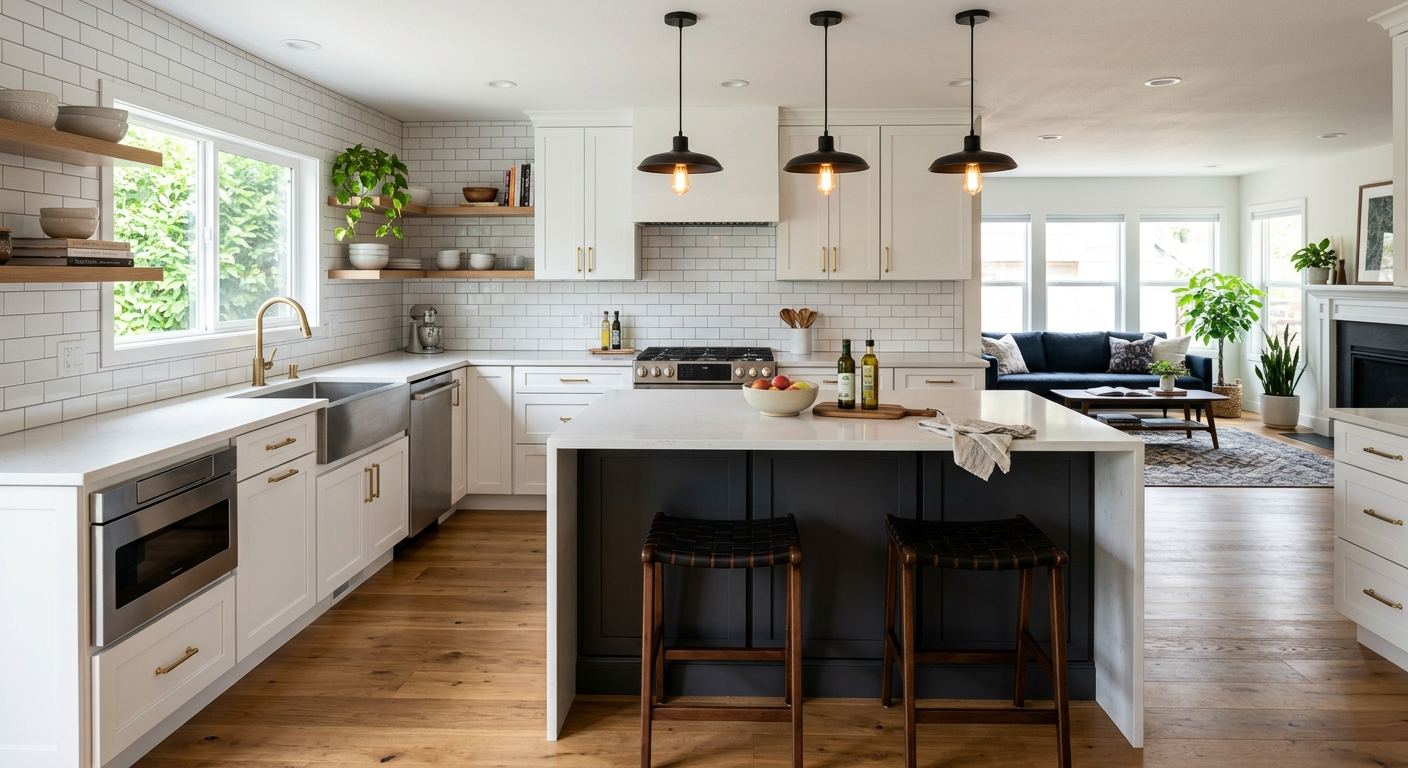
Kitchen renovation options and costs in Carstairs
Carstairs homeowners typically have three clear paths when planning a kitchen renovation: a cosmetic refresh, a mid-range full renovation, or a high-end redesign. With a median household income of $99,000 (Statistics Canada, 2021 Census), many families budget to improve day-to-day function without pushing into the most premium millwork tiers. And because Carstairs has a strong base of owner households—86.4% own (Statistics Canada, 2021 Census)—there’s often a focus on finish quality that holds value over time. Renovation costs in the Calgary economic region don’t rise mainly from weather exposure; instead, they track local home value expectations and the finish tier buyers anticipate at resale. That’s why you’ll see more quartz or natural stone counters in higher-value pockets and more semi-custom cabinetry as the “sweet spot” for most projects. Skilled-trade availability also shapes timing: Calgary’s active construction market supports faster scheduling for common scopes, but once you add plumbing/gas moves and electrical revisions, lead times widen. In Carstairs, demand is especially consistent around the Hwy 24 and 597 corridor where homeowners often target practical layout improvements and updated lighting before moving to the next stage of renovations. Use the comparison below to align your scope with a realistic budget, then we can dial it in with measurements, product selections, and site access details.
| Renovation Tier |
What's Included |
Typical Duration |
Price Range |
| Cosmetic refresh (paint, hardware, new appliances only) |
Cabinet paint or stain touch-ups (where applicable), new pulls/knobs, updated faucet, appliance swap (no changes to plumbing/gas/electrical), optional minor trim/backsplash caulk work |
3–7 days |
$5,000–$15,000 |
| Mid-range full renovation (new cabinets, counters, sink, tile) |
New semi-custom or quality-stock cabinets, new countertops (quartz typical), sink + faucet swap, backsplash tile, new under-cabinet lighting (often included), disposal and basic plumbing changes |
3–5 weeks |
$30,000–$65,000 |
| High-end full renovation (custom cabinets, stone counters, island) |
Custom cabinets/millwork, premium stone counters (granite/stone slab or higher-tier quartz), island build with upgraded lighting, integrated appliance package, full-height or upgraded backsplash (tile or statement feature), revised layout with plumbing/gas/electrical coordination |
6–12 weeks |
$75,000–$120,000 |
| Cabinet refacing only (new doors + drawer fronts, same boxes) |
Refacing material/doors and drawer fronts, hardware refresh, new soffit/trim details (where needed), backsplash integration depending on scope |
1–3 weeks |
$10,000–$35,000 |
| Countertop swap only (laminate to quartz or stone) |
Removal and disposal of existing counters, new quartz or stone install, new sink cutout (if staying same footprint), countertop sealing/edge treatment, basic backsplash tie-in if required |
3–7 days |
$4,500–$12,000 |
| Backsplash tile installation only |
Tile selection + install (ceramic tile typical), prep/leveling, grout/seal where needed, caulk and finishing trims |
2–5 days |
$2,500–$8,000 |
Prices are estimates only and vary by project scope, site access and material selection.
What affects the price of kitchen renovation in Carstairs
In Carstairs and across the Calgary economic region, you can see the same “size kitchen” priced 30–50% apart because quotes respond to how homeowners choose materials and how complicated the trades plan the work. Local home value and median income tend to set the finish expectations far more than weather does: in higher-value Calgary-area markets, homeowners often default to quartz or natural stone and semi-custom cabinetry because those costs are easier to recover on resale. In more modest build expectations, laminate and stock cabinets dominate because they deliver a strong refresh at a lower total outlay. Regardless of finish tier, layout changes are where the budget becomes unpredictable—removing a wall, adding an island, or moving a gas line and associated venting all add labour, coordination, and inspection time. For a practical example, a countertop swap is commonly a $3,000–$12,000 item when the plumbing is staying put, while a mid-range full renovation is more often $25,000–$65,000 once you’re changing cabinets, counters, and tile. Carstairs housing stock also matters: homes built before 1981 make up 25.8% of dwellings (Statistics Canada, 2021 Census), and older kitchens can hide knob-and-tube remnants, out-of-level floors, or outdated electrical runs that increase prep and electrical costs. Lastly, Alberta’s freeze-thaw cycles don’t usually inflate the renovation labour directly, but they can tighten site scheduling and make dust control and ventilation planning more critical when trades are working around exterior exposure and winter heating demands—especially if drywall and flooring work expand the timeline.
| Price Factor |
Why It Matters |
Cost Impact |
| Cabinet tier — stock vs. semi-custom vs. fully custom millwork |
Material quality, door styles, internal storage features, and build-to-measure complexity drive the cabinet portion of the budget |
Often +$8,000–$25,000 from stock to semi-custom; +$25,000+ for full custom in full redesigns |
| Countertop material — laminate vs. quartz vs. granite vs. stone |
Premium surfaces cost more per square foot and require heavier handling; installation detailing can change with thickness and edges |
Typical countertop installs range from about $3,000–$12,000; premium stone can push the upper end |
| Layout change — wall removal, island add, plumbing/gas move |
Triggers engineering/structural coordination, new venting considerations, and multiple trades scheduling and inspections |
Commonly +$10,000–$30,000 depending on how many systems are moved |
| Appliance package tier — builder vs. mid-range vs. pro-grade |
Higher tiers add cost and may require electrical upgrades or different venting clearances |
Typically +$2,500–$15,000 across full kitchen appliance sets |
| Flooring — refinish existing vs. full replacement |
Kitchen traffic and subfloor condition affect whether you can keep existing flooring or must replace for a clean edge |
Often +$3,000–$10,000 for full replacement, less if refinishing is feasible |
| Backsplash — ceramic tile vs. marble vs. full-height slab |
Material weight, cut complexity, and whether you go full-height change labour and waste |
Can move the scope from about $2,500–$8,000 for tile-only into higher remodel budgets |
| Electrical — new circuits for island, under-cabinet lighting |
More outlets, lighting runs, and potential panel work add licensed electrician time and materials |
Often +$1,500–$6,000; more if panel upgrades are required |
| Permit fees and licensed trade requirements |
Permits, inspections, and required licensed trades for gas/plumbing/electrical add direct costs and schedule risk |
Budget for several hundred to a few thousand dollars plus time for scheduling inspections |
Permits & regulations in Alberta
In Alberta, a simple cabinet and countertop swap usually doesn’t require a building permit because you’re not changing the underlying systems. That typically includes replacing cabinets with new ones in the same footprint, swapping laminate for quartz, and setting a new backsplash—no movement of plumbing supply/drain, no gas relocation, and no new electrical circuits. Where permits and licensed trades do come in is when you alter the systems: moving plumbing supply lines or drain lines, relocating a gas stove or changing a gas-powered range hood setup, removing or modifying load-bearing walls, or adding electrical circuits for an island, new dedicated outlets, or under-cabinet lighting that requires fresh wiring. Gas work must be completed by a licensed gas fitter, and electrical work by a licensed electrician; both require inspection after rough-in/installation depending on the scope.
To verify a contractor in Carstairs, ask for three things before you sign: (1) licence details for the required trades (confirm they’re active and relevant to your scope), (2) liability insurance certificate showing adequate coverage for construction work, and (3) proof of WSIB/WCB coverage (or a valid exemption where applicable). Where to look: request the licence numbers and confirm them using the relevant provincial licence registry entry, review the certificate of insurance for policy dates and jobsite coverage, and confirm WSIB/WCB status with documentation they provide.
Cabinets, countertops and layout decisions in Carstairs
The three most consequential decisions in a Carstairs kitchen renovation are: (1) cabinet tier, (2) countertop material, and (3) whether you change the layout. Cabinet tier affects how quickly you can get installed, how well the kitchen fits awkward angles, and how storage is planned for everyday use. Stock cabinets are the fastest and cheapest, semi-custom is usually the most popular mid-range choice for a clean look with better storage, and custom cabinets deliver the best fit for older wall lines and off-square rooms. Countertop material is the durability and maintenance anchor: laminate is cost-effective but less resilient to deep staining and heat, while quartz is a strong “set it and forget it” option in daily family use. Granite and natural stone can look premium and last for years, but require more care, sealing schedules, and realistic expectations around etching from acidic foods. Layout choices—open-concept wall removal, island addition, or plumbing/gas relocation—are where the cost is justified only if the space gain improves workflow and resale buyer appeal. In the Calgary market, many buyers expect a functional island or updated lighting even if the house isn’t newly built, and homes built before 1981 often benefit from re-planning that fixes inefficient triangle flow.
Here’s a practical dollar example: if you keep the footprint and swap to quartz, a countertop install typically lands in the $3,000–$12,000 band. If you instead add an island and move plumbing/gas to support it, the project usually moves into the mid five-figure range and can approach or exceed the full renovation band because the work includes cabinetry changes, electrical work, and trade scheduling, not just surfaces. Alberta’s winter conditions don’t dictate countertop choice, but they do mean you’ll want a contractor who controls dust and finishes properly so the kitchen stays livable during drywall and flooring phases.
| Option |
Durability |
Maintenance |
Best For |
Price Range |
| Stock cabinets (big-box) |
Good for everyday use; tolerances are standard so corners may be less custom |
Low to moderate—standard cleaning and occasional hardware adjustment |
Budget-first refresh and fastest timeline |
$8,000–$20,000 |
| Semi-custom cabinets (local dealer) |
Very durable with better storage options and more door/finish choices |
Low—wipe clean; keep hinges aligned as house settles |
Most Carstairs homeowners optimizing resale value |
$18,000–$35,000 |
| Custom cabinets (local millwork shop) |
Highest fit and finish; ideal for unusual walls and upgraded storage |
Low—requires careful cleaning but is built for long-term wear |
When you want a tailored layout and premium look |
$35,000–$60,000 |
| Laminate countertop |
Moderate; can be sensitive to heat and sharp impacts at seams |
Easy cleaning; avoid hot pans directly and protect against moisture at cut edges |
Cosmetic updates and tighter budgets |
$3,000–$6,000 |
| Quartz engineered countertop |
High durability for daily cooking; resists staining better than many naturals |
Low—wipe with mild cleaner; avoid abrasive pads |
Family kitchens that need reliable performance |
$6,000–$12,000 |
| Granite / natural stone countertop |
Very durable and heat resistant; durability varies by stone type and finish |
Moderate—periodic sealing and quick cleanup for acidic spills |
Premium appearance with traditional stone appeal |
$8,000–$14,000 |
| Butcher block countertop |
Durable if maintained; can dent but can be sanded in many cases |
Higher—regular oiling and immediate drying after wet tasks |
Casual warmth and active cooking styles |
$5,000–$10,000 |
| Marble countertop |
Beautiful but softer than granite; can show etching and surface wear |
Higher—needs careful cleaning and sealing discipline |
Low-to-moderate kitchen wear and “statement” designs |
$10,000–$18,000 |
How to choose a kitchen renovation contractor in Carstairs
Choosing the right contractor in Carstairs is less about fancy photos and more about verification, clarity, and process. Start with licensing and coverage: when your scope includes gas line changes, confirm the contractor works with a licensed gas fitter for that portion; for electrical work, confirm a licensed electrician is involved. Request their liability insurance certificate (make sure it covers general construction activities and includes jobsite relevance) and confirm WSIB/WCB coverage status. To check each item, use the licence registry information they provide, verify policy dates and coverage limits on their insurance certificate, and ask for WSIB/WCB proof documents they can stand behind. You should also confirm that their project team has a clear chain of responsibility for permits and inspections where required in Alberta.
Next, get 2–3 itemised written quotes with a proper breakdown of labour and materials (cabinets, counters, tile, plumbing/electrical allowances, disposal, and any permit/inspection costs). Read what’s excluded: demolition and disposal, cabinet delivery/handling, subfloor repairs, appliance install (and whether it includes hookup), and whether permits are included or “to be billed separately.” Warranty matters too—ask for workmanship warranty length and what it covers if something fails after installation; also confirm product manufacturer warranties and whether they’re transferable to you as the homeowner. For payments, keep it conservative: never pay more than 10–15% upfront, and hold back a portion until the job is substantially complete and cleaned up. Finally, ensure your timeline is written: start date, lead times (especially for cabinets and stone), and a completion estimate.
- Ask for licence numbers and confirm active status relevant to your scope (gas/electrical where applicable)
- Require liability insurance proof before work starts; verify coverage limits and policy effective dates
- Confirm WSIB/WCB clearance status in writing (no exceptions made verbally)
- Get a fully itemised quote with labour vs materials lines, not a single lump sum
- Clarify who pulls permits and who pays permit/inspection fees if required in Alberta
- Confirm disposal is included (dump fees, haul-away) and what materials are handled
- Ask how they protect floors and keep dust contained during demolition and tile work
- Verify cabinet lead times and what happens if products arrive late
- Check warranty: workmanship coverage period, exclusions, and response timeline
- Set a payment schedule in the contract with a holdback until punch list completion
- Confirm whether appliance install includes plumbing/electrical hook-up and where the responsibility ends
- Ensure schedule milestones are in writing: demolition, rough-in, cabinets, counters, final trim
Red flags I see in Carstairs include: (1) quotes that don’t list labour/material breakdown (especially for cabinets and countertops), (2) promises to “handle permits” without stating who pulls them and what triggers permits in Alberta, (3) vague warranty language like “lifetime on materials” with no workmanship coverage timeline, (4) overly large upfront deposits beyond 10–15%, and (5) refusal to provide insurance or WSIB/WCB proof until the day work begins.
Frequently asked questions — kitchen renovation in Carstairs
Custom vs stock cabinets — is custom worth it?
In Carstairs, custom cabinets are worth it when your kitchen has off-square walls, awkward angles, or you want built-in storage features (corner systems, appliance garages, or pantry layouts) that stock units can’t match cleanly. If you’re keeping the footprint and aiming for a realistic mid-range upgrade, semi-custom is often the best value and still looks “designer” in photos and resale showings. Stock cabinets can make sense for tighter budgets and faster timelines, especially for cosmetic refreshes where you’re also keeping countertops and layout. As a planning benchmark, many mid-range full renos in the Calgary region land around $30,000–$65,000, and the cabinet tier you choose usually determines whether you sit nearer the lower or upper end. If your contractor proposes custom but you’re not changing layout or storage needs, you may be paying for fit you won’t feel day-to-day.
How do I choose a kitchen contractor in Carstairs?
Start with verification and details. In Alberta, confirm the contractor’s responsibility matches your scope: gas work must be by a licensed gas fitter, and electrical by a licensed electrician—don’t accept “we’ll figure it out later.” Ask for their liability insurance certificate and proof of WSIB/WCB coverage, then check licence status using the numbers they provide. Next, demand 2–3 itemised written quotes with labour and materials broken out, including what’s excluded (disposal, subfloor repairs, permit pull, appliance hook-up). A solid contractor will also list timeline milestones and lead-time risks for cabinets and stone. For reference, if a quote is wildly below the typical full kitchen band (for example, below $25,000) yet includes layout changes and premium materials, it’s often missing critical scope lines. In Carstairs, clarity beats persuasion—especially because older homes may require extra prep before cabinets go in.
What order do kitchen renovation steps happen in?
Most kitchen renovations in Carstairs follow a predictable sequence that protects finishes. First is design and measurement, then ordering cabinets/counters and confirming any permits (when plumbing, gas, structural, or new electrical circuits are involved). Demo comes next, followed by rough-in work: framing adjustments, electrical (new circuits/outlets/lighting), and plumbing/gas rough lines if anything is moved. After inspections where required, you move to drywall/patching and surface prep. Then flooring or subfloor repairs are completed, cabinets go in, and countertops are templated/installed. Tile backsplashes and trim follow, then final electrical fixtures, caulking, hardware, and appliance installation. Finally, there’s cleanup and a punch-list walkthrough. If someone proposes installing countertops before rough-ins are finalized, that’s a scheduling and leak-risk red flag—especially when older 1970s-era or pre-1981 kitchens have hidden inconsistencies (25.8% of homes built before 1981).
Can I live at home during a kitchen renovation in Carstairs?
Often, yes—especially for cosmetic refreshes or countertop/backplash-only work where the kitchen remains usable. For mid-range full renovations (commonly $30,000–$65,000 when you’re changing cabinets/counters and tile), many families temporarily use a basement or small portion of the main floor for coffee and basic meals while trades focus on demolition and rough-in. For high-end redesigns that include island builds and layout changes, dust and disruption are more significant, and a short stay elsewhere can be practical depending on how extensive the plumbing/gas and electrical revisions are. Carstairs winter conditions also mean contractors need good ventilation and dust control when drywall and flooring are being adjusted. The key is a staged plan: protect adjacent rooms, establish a “safe work zone,” and confirm when you’ll have access to a functioning sink. A good contractor will outline daily access rules and when your kitchen can reasonably be used again.
Should I renovate my kitchen before selling in Carstairs?
Usually, kitchen renovations that refresh surfaces and improve layout function before listing help the most in Carstairs and the Calgary economic region. Because homebuyers look for modern cabinetry, clean countertops, and updated lighting, a mid-range refresh can differentiate your home on the showing circuit. That said, you don’t need the most expensive materials for a strong return—quartz paired with semi-custom cabinetry is the common “buyer-expected” combination in this region. If your scope is purely cosmetic and keeps costs controlled, it may be worth doing as long as cabinets and counters look current. As a ballpark, cabinet refacing alone can run roughly $10,000–$35,000 and can be a smart pre-sale step if the existing boxes are sound. But if your layout is inefficient or your electrical/plumbing is outdated, it’s often better to address those issues before selling because buyers notice function problems. Consider your timeline and whether your contractor can meet lead times for cabinets and stone; rushing selections can delay the listing date.
What's the most popular kitchen style in Carstairs right now?
Right now, the most common direction I see in Carstairs is a clean, modern transitional look: shaker-style fronts, warm neutrals, and practical lighting—often paired with quartz counters for a consistent, low-maintenance finish. Many homeowners aim for a semi-custom cabinet plan that improves storage (pantries, pull-outs, better corner use) without taking on the full custom price. Darker accent colours are showing up more, especially around islands, but they’re typically balanced with lighter floors or backsplash tones to keep the space bright. In terms of budgeting, this style usually sits in the mid-range full renovation band (often $30,000–$65,000 when cabinets, counters, sink, and backsplash tile are included). Homes built before 1981 can have layout and electrical limitations, so a contractor who can plan the upgrade sequence matters. Whether you go modern or classic, buyers generally expect durable surfaces and crisp workmanship—those details show up in photos and in person.