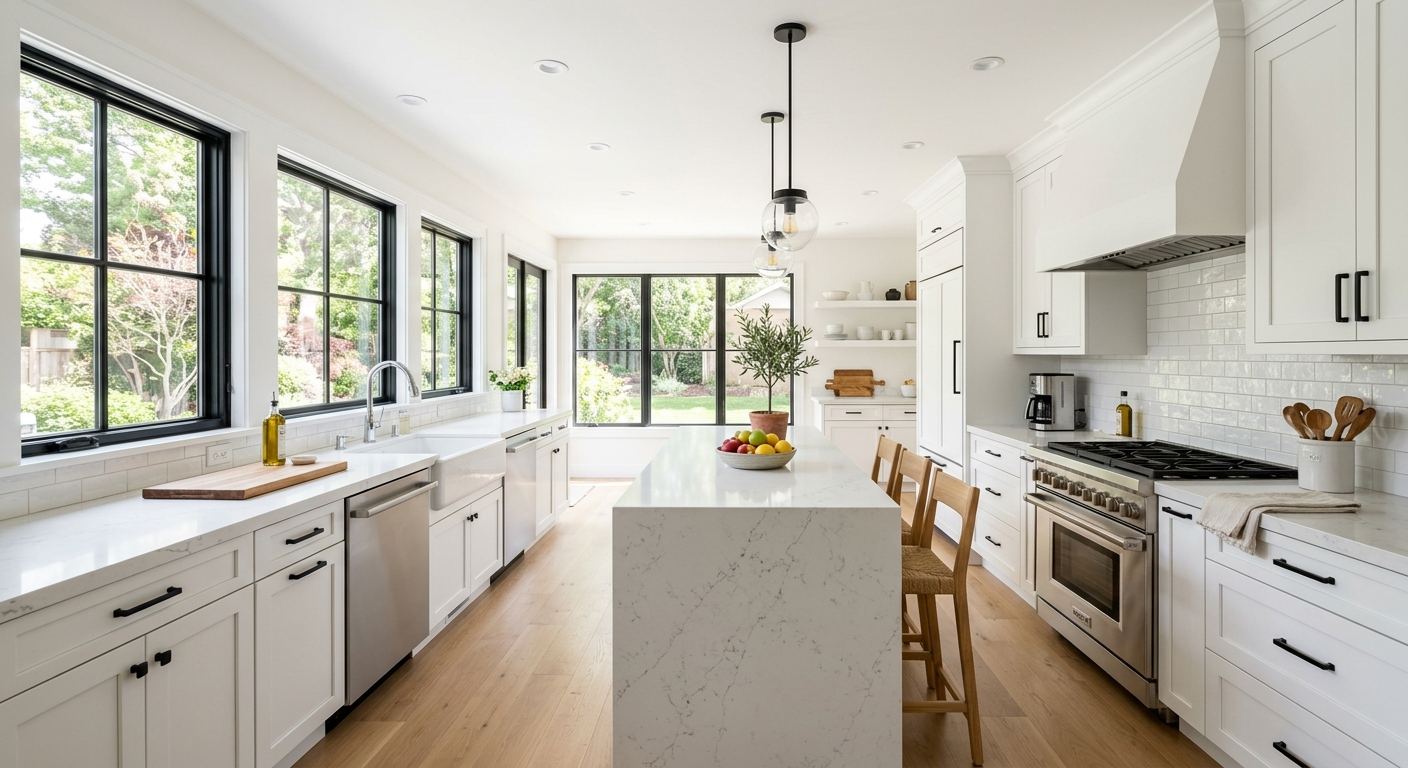
Kitchen renovation options and costs in Downtown West End
In Downtown West End, Alberta, kitchen renovations tend to fall into three cost paths: a quick cosmetic refresh, a mid-range full upgrade, or a high-end redesign with upgraded finishes. Calgary’s broader economic pull matters here—Statistics Canada reported a population of 2,825 for Downtown West End in 2021 (Statistics Canada, 2021 Census)—and that smaller local profile typically means contractors concentrate work into the most active corridors, so pricing can tighten when demand is high. At the same time, homeowners often set expectations based on local buying power; in higher-value pockets of Calgary, it’s common to see more “sell-ready” kitchens, which pushes choices toward semi-custom cabinetry and quartz or natural stone counters. Market-wide, kitchens are commonly budgeted around 10–15% of home value for a refresh and up to 20–25% for a full redesign in upscale properties in this region, so many projects land in the mid five-figures to start.
Calgary’s costs aren’t driven by climate as much as Alberta’s trade availability and material pricing cycles. Labour in the Calgary economic region often runs about 90–140 per hour, and that makes design, project management, and labour-intensive steps (cabinet install, flooring transitions, electrical upgrades) a major share of the budget. Work is especially in demand around the beltline/17 Avenue SW style multi-unit and infill cluster within Downtown West End, where access, scheduling, and elevator or parking constraints can add complexity.
Below is a practical comparison of renovation tiers so you can match scope to budget before you call for estimates.
| Renovation Tier |
What's Included |
Typical Duration |
Price Range |
| Cosmetic refresh (paint, hardware, new appliances only) |
Prep/paint, new hardware/pulls, install of 1–3 appliances, basic caulking and reseal where needed |
1–3 weeks |
$8,000–$18,000 |
| Mid-range full renovation (new cabinets, counters, sink, tile) |
Semi-custom cabinets, countertop install, new sink/faucet, backsplash tile, updated plumbing connections, flooring patching |
3–7 weeks |
$25,000–$65,000 |
| High-end full renovation (custom cabinets, stone counters, island) |
Fully custom millwork, quartz or natural stone (island-focused), larger-format tile, upgraded lighting, potential layout change |
6–12 weeks |
$70,000–$120,000 |
| Cabinet refacing only (new doors + drawer fronts, same boxes) |
Door/drawer replacement, new trim, minor hardware updates, surface prep/paint or veneer refresh |
2–5 weeks |
$8,000–$35,000 |
| Countertop swap only (laminate to quartz or stone) |
Remove and dispose old counters, template/fabricate new tops, set and seal, backsplash caulk refinishing |
1–2 weeks (plus fabrication time) |
$3,000–$12,000 |
| Backsplash tile installation only |
Tile supply install, waterproofing where required, grout/seal, edge finishing and caulking |
4–10 days |
$2,500–$8,000 |
Prices are estimates only and vary by project scope, site access and material selection.
What affects the price of kitchen renovation in Downtown West End
For the same kitchen job, quotes in Downtown West End can vary by 30–50% because contractors price risk differently—access, sequencing, demolition conditions, and how much labour is folded into “includes.” In Alberta, the biggest drivers are usually local finish expectations tied to home values and household incomes, not climate. In higher-value markets around the Calgary economic region, homeowners default to quartz or stone counters and semi-custom cabinetry because the cost is easier to recover on resale. In more modest tiers, laminate and stock cabinets dominate because they deliver a visible upgrade at lower install labour and material cost. In practice, you’ll often see budgets cluster around the region’s $25,000–$100,000 full-reno band, with many homeowners starting near the mid-point and moving up once layout, stone, and electrical decisions are made.
Layout changes are where unpredictability spikes regardless of finish tier. Removing a wall, adding an island, or moving a gas line/plumbing line can add structural work, licensed trade time, and rework for flooring and electrical. For example, if you move a sink and run new drain lines, costs can jump more than swapping laminate for quartz—because plumbing coordination and inspections stack on top of material selection. Conversely, if your cabinets are sound and you only change counters, a countertop swap can land in the $3,000–$12,000 range, often with minimal demolition and less labour disruption.
Two Downtown West End realities that commonly push cost up are tight staging/access (parking and unloading constraints) and older infill homes where subflooring, plumbing stub-outs, or wiring routes aren’t as straightforward. Alberta’s freeze-thaw doesn’t usually drive kitchen renovation cost directly, but it does influence how many contractors plan for air sealing, subfloor transitions, and moisture management around exterior-facing kitchen walls—small issues can become extra labour when you open up the space.
| Price Factor |
Why It Matters |
Cost Impact |
| Cabinet tier — stock vs. semi-custom vs. fully custom millwork |
Higher tiers cost more to fabricate and install (and often require more precise fit) |
Can swing the project by roughly 15–40% depending on scope |
| Countertop material — laminate vs. quartz vs. granite vs. stone |
Material cost and fabrication complexity change labour hours and waste |
Often adds $3,000–$12,000 on countertops alone across selections |
| Layout change — wall removal, island add, plumbing/gas move |
Requires trades coordination and often additional structural/electrical work |
Frequently the largest variable; can add 10–30%+ |
| Appliance package tier — builder vs. mid-range vs. pro-grade |
Premium appliances increase price and sometimes require new rough-in or ventilation |
Can change totals by several thousand dollars quickly |
| Flooring — refinish existing vs. full replacement |
Refinishing limits demolition; replacement adds underlayment, transitions and labour |
May add $2,000–$8,000 depending on subfloor and finish |
| Backsplash — ceramic tile vs. marble vs. full-height slab |
Higher-end materials require more careful layout and waterproofing details |
Commonly shifts $2,500–$8,000 for backsplash-only scope |
| Electrical — new circuits for island, under-cabinet lighting |
Adding circuits increases licensed electrician time and inspection steps |
Can add $1,500–$6,000+ depending on run distance and fixtures |
| Permit fees and licensed trade requirements |
Required permits and inspections change scheduling and documentation |
Small fees, but can add days to timeline and cost for coordination |
Permits & regulations in Alberta
In Alberta, many “swap-in-place” kitchen upgrades do not require a permit, but anything that changes the building systems can. A cabinet or countertop swap typically does not require a permit. However, moving plumbing supply or drain lines, relocating gas connections (for example, moving a stove or changing the routing for a range hood that vents with gas), removing a load-bearing wall, or adding electrical circuits are typically permit-triggering changes and must be done by the appropriate licensed trades.
For homeowners in Downtown West End, the safest way to verify responsibility is to make sure your contractor clarifies, in writing, exactly which items they will permit and which items you will permit (it should be clearly allocated). Step-by-step, you can verify Alberta licensing and coverage before work starts:
- Ask for the licensed trade licence details (gas fitter and electrician where applicable) and confirm they match the trades doing the work.
- Request a current Certificate of Insurance and look for general liability coverage and any specific endorsements relevant to your job.
- Confirm WSIB/WCB coverage (or the applicable clearance documentation) before work begins.
- Ensure the contractor provides permit numbers/confirmations when required, and schedules inspections.
- Keep signed scopes and change orders so permit responsibility can’t shift mid-job.
When in doubt—especially for gas and electrical—pause signing until the written scope confirms who pulls permits and who covers licensed trade work in Alberta.
Cabinets, countertops and layout decisions in Downtown West End
When you’re renovating a kitchen in Downtown West End, three decisions usually determine about 80% of your outcome: (1) cabinet tier (stock, semi-custom, or custom), (2) countertop material, and (3) layout change (open-concept wall removal, island addition, or plumbing/gas relocation). Calgary buyers generally expect a clean, modern finish, so at entry levels many homeowners choose stock cabinets with quality hardware, while mid-range projects gravitate toward semi-custom cabinetry for better sizing and smoother drawer/door alignment. Higher-end homes often justify custom millwork—especially when you’re working around unusual window lines, older chase walls, or a non-standard fridge wall—because the fit reduces gaps that can otherwise show up immediately at inspection or resale photos.
Countertops follow a similar logic. Laminate can look sharp, but it’s less resilient to heavy impact and standing heat than quartz and natural stone. Quartz is usually the “best balance” for busy households because it resists staining better and doesn’t need sealing. Granite and other natural stones offer distinct character, but maintenance expectations and material handling can raise overall cost and scheduling. For layout, open-concept changes and island additions are most justified when they create meaningful daily value—more prep space, better circulation, or better sightlines—because plumbing/gas relocation can push labour, coordination, and inspection steps up fast.
Here’s a concrete example of where the money can make sense: if you’re already budgeting a mid-range renovation in the $25,000–$65,000 range, upgrading from laminate to quartz might add only a portion of the total, yet it often improves buyer perception immediately. But if you’re moving a sink and relocating plumbing, that can outweigh the savings from choosing laminate, because labour and licensed trade time generally rise more than countertop-only upgrades. On the other hand, if your layout is staying put and your boxes are solid, a countertop swap into the $3,000–$12,000 band can be a high-ROI move without opening walls.
| Option |
Durability |
Maintenance |
Best For |
Price Range |
| Stock cabinets (big-box) |
Good for standard layouts; longevity depends on installation quality |
Low upkeep; touch-ups for chips/edge wear as needed |
Fast refreshes and budget-conscious remodels |
$8,000–$25,000 |
| Semi-custom cabinets (local dealer) |
Better fit and stronger options; performs well over years of use |
Low upkeep; hinges/draw slides maintained through normal cleaning |
Most Downtown West End renovations aiming at strong resale value |
$25,000–$55,000 |
| Custom cabinets (local millwork shop) |
Highest fit and build quality for irregular spaces |
Low upkeep; often includes premium hardware and finishes |
Challenging layouts, premium designs, and long-term “forever home” plans |
$55,000–$95,000 |
| Laminate countertop |
Moderate; can scratch and chip more easily |
Wipe clean; avoid heat directly on surface |
Budget upgrades where you want a new look without major risk |
$3,000–$6,500 |
| Quartz engineered countertop |
High durability; resistant to staining and daily wear |
Simple wipe-down; generally no sealing required |
Busy households and buyers seeking “low fuss” countertops |
$6,500–$12,000 |
| Granite / natural stone countertop |
Very durable but varies by slab; supports heavy use |
Often benefits from periodic sealing and careful stain management |
Premium looks with unique veining |
$8,000–$16,000 |
| Butcher block countertop |
Durable, but can be sensitive to water sitting and sharp impacts |
Oiling/conditioning required; wipe spills promptly |
Families who like a warm, functional surface |
$5,000–$10,500 |
| Marble countertop |
Beautiful but softer; can etch and scratch |
Higher maintenance; requires careful cleaning and sealing |
Statement kitchens with controlled mess and lifestyle fit |
$10,000–$20,000 |
How to choose a kitchen renovation contractor in Downtown West End
Choosing the right kitchen contractor in Downtown West End, Alberta is mostly about verification and clarity. Start by confirming Alberta licensing and coverage: ask for proof that gas work (if any) is done by a licensed gas fitter, and electrical work by a licensed electrician. Request current liability insurance documents and confirm WSIB/WCB coverage—before the first day of work—so you’re protected if something goes wrong on site.
Next, get 2–3 itemised written quotes. You want labour and materials broken down (cabinet install labour, countertop fabrication/installation, plumbing/electrical line items, demolition, disposal, flooring transitions). Avoid offers that only state a single lump sum without showing what’s included. Read the scope for exclusions: disposal, patching/drywall finishing, permit pulling, protection of cabinets during counter templating, and whether under-cabinet lighting wiring is included or treated as an add-on.
Warranty matters too. Ask for (1) workmanship warranty length and what it covers, (2) product/manufacturer warranty details for cabinets, countertops, and appliances, and (3) whether warranties are transferable if you sell. Payment scheduling is a major risk reducer: never pay more than 10–15% upfront, and use a holdback until the job is complete and punch list items are resolved. Finally, insist on a written start date and completion estimate, including a realistic fabrication lead time for quartz or custom cabinetry.
- Licence and proof of insurance provided before contract signing
- WSIB/WCB clearance or documentation confirmed for the correct contractor/entity
- Itemised quote (labour vs materials) with named brands and models
- Permit responsibility explicitly stated in the contract
- Demolition and disposal included (or separately priced) and defined
- Who handles utility shutoffs for plumbing/gas during rough-in
- Template and fabrication lead times included for countertops
- Electrical scope includes circuit counts and lighting accessories
- Flooring scope includes transitions, underlayment, and patching strategy
- Warranty terms for workmanship and products documented in writing
- Payment schedule capped at 10–15% upfront; progress milestones documented
- Clear change-order process (written approval required before work proceeds)
Concrete red flags in Downtown West End: (1) refusal to provide insurance/WSIB details, (2) “permit included” statements without specifying what triggers it, (3) quotes that don’t list disposal, patching, or electrical scope, (4) asking for large upfront payments beyond 15%, and (5) vague timelines that ignore cabinet/counter fabrication lead times.
Frequently asked questions — kitchen renovation in Downtown West End
How much does a kitchen renovation cost in Downtown West End?
In Downtown West End, Alberta, full kitchen renovation budgets commonly land in the mid five-figures, aligning with the Calgary economic region’s typical full-reno band of $25,000–$100,000. If you’re planning a mid-range renovation—new semi-custom cabinets, counters, a sink, and backsplash tile—many projects start around $25,000–$65,000. High-end redesigns with custom cabinets, stone counters, an island, and upgraded lighting can climb toward $70,000–$120,000. The biggest cost swings usually come from layout changes (wall removal, island addition, moving plumbing/gas lines), plus the cabinet tier and countertop material. If you’re staying in the same footprint and keeping “good boxes,” you can often reduce costs significantly by choosing selective upgrades like countertops or backsplash.
How long does a kitchen renovation take in Downtown West End?
Timelines in Downtown West End are typically driven by fabrication and inspection sequencing rather than demolition alone. Cosmetic refreshes can be completed in about 1–3 weeks when only paint, hardware, and appliance installs are involved. Mid-range full renovations often take 3–7 weeks, assuming cabinet lead times are reasonable and plumbing/electrical work can be scheduled promptly. High-end projects with custom millwork plus stone and layout changes can run 6–12 weeks. If you change plumbing/gas routing or add electrical circuits, expect extra coordination and inspection steps. Also, condo and infill access constraints around the Downtown West End corridor can affect staging and work windows, which contractors should spell out in your written schedule.
Quartz vs granite countertops — which is better?
For most homeowners in Downtown West End, quartz is the “low-fuss” choice. Quartz countertops are engineered, typically consistent in appearance, and generally resist staining well with straightforward daily cleaning—making them a strong fit for busy kitchens. Granite is naturally beautiful and can deliver a one-of-a-kind look, but it may require periodic sealing depending on the specific slab and finish. In terms of budget, both can sit in the countertop portion of the broader renovation range (often within the $3,000–$12,000 band for countertop-only swaps, depending on size and edge profiles). If you want the most predictable maintenance and performance, quartz usually edges out. If you want natural variation and are comfortable with the maintenance expectations, granite can be a great premium option.
Should I reface or replace my cabinets?
Refacing is usually the right move when the existing cabinet boxes are solid, square, and well-installed—especially if you like the layout and don’t want the dust and disruption of full removal. In that scenario, cabinet refacing commonly fits within the $8,000–$35,000 range and can refresh the look quickly. Replacing makes more sense when boxes are damaged by moisture, sagging is visible, or the hardware alignment is off enough that you’ll fight doors/drawers every day. Replacing also gives you flexibility to change cabinet heights, add organizers, and correct structural issues uncovered during demolition. In Downtown West End, where many homes have older rough-ins, I often recommend inspecting box condition before deciding—sometimes a “reface” quote misses hidden water damage behind toe kicks or around plumbing runs.
Do I need a permit for a kitchen renovation in Alberta?
In Alberta, you typically don’t need a permit for cabinet and countertop swaps because you’re not altering the building systems. However, permits are usually required when you move plumbing supply or drain lines, relocate gas for the stove/range hood setup, remove a load-bearing wall, or add new electrical circuits. Gas work must be completed by a licensed gas fitter, and electrical work by a licensed electrician, with inspections as required. For a Downtown West End homeowner, the key is clarity: confirm in writing which items require permits and who is pulling them. Don’t sign if the scope is vague—permit responsibility should be reflected in your contract so it doesn’t become a dispute later.
What's the ROI on a kitchen renovation?
Kitchen ROI depends heavily on what you change and what your local buyers expect—especially in the Calgary area where many homeowners prioritize modern finishes and practical upgrades. In higher-value pockets, buyers often respond well to quartz or stone counters, a well-fitted cabinet layout, and updated lighting because those features are easy to see in photos and walkthroughs. That’s why many projects target a budget aligned with the region’s typical refresh level (commonly around 10–15% of home value for a refresh) and go higher—up to 20–25%—when the home supports a full redesign. That said, the ROI drops if you overspend on changes the neighbourhood won’t value (or if layout changes add cost without improving flow). The best ROI usually comes from “sell-ready” finishes and smart layout improvements rather than luxury materials in a kitchen that won’t benefit from the added labour.