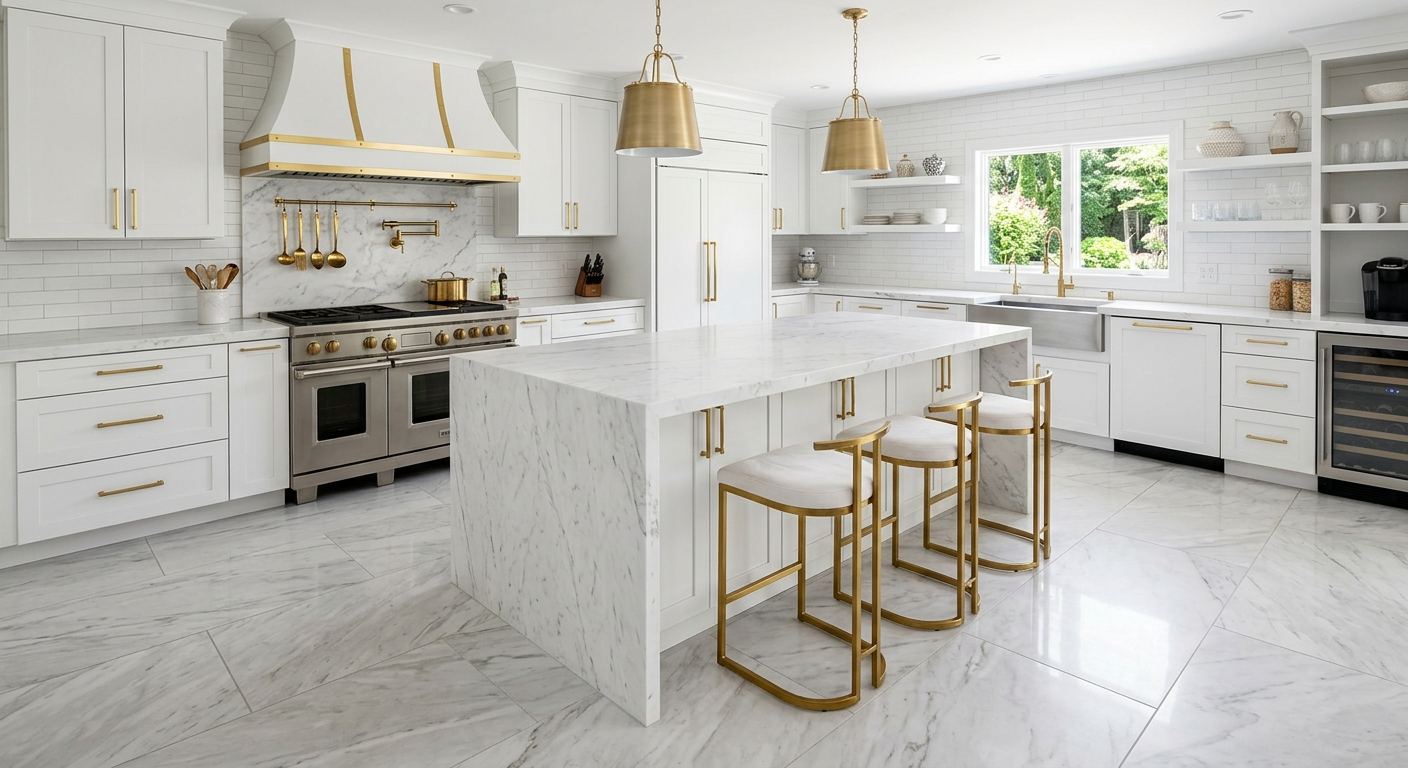
Kitchen renovation options and costs in West Jasper Place
In West Jasper Place, Alberta, kitchen renovations typically start with what you want to change (finish-only versus layout), and then contractors match that scope to local pricing. With a small local population of 2,966 residents (Statistics Canada, 2021 Census), the premium you pay is less about local scarcity and more about Calgary-area demand for skilled crews and materials. In practice, higher household spending power across the region tends to lift finish expectations: many homeowners move beyond “paint-and-appliances” toward new cabinets, quartz counters, and upgraded lighting, especially in homes where the kitchen has become the main daily hub. West Jasper Place also sits within Calgary’s broader renovation market, where budgets track home value and household income rather than weather performance.
Calgary’s climate still matters, but mostly indirectly: winter freeze-thaw cycles and heavy temperature swings can expose poor install details (like under-sink waterproofing, caulking, and ventilation), so contractors budget time for prep and finishing that protects against moisture. At the same time, Alberta’s active construction season and consistently strong trade demand mean labour and project management are a substantial part of your total—so two quotes for the same kitchen can differ by 30–50% when one contractor includes more planning, better cabinetry, or additional electrical/plumbing allowances. In demand areas near West Jasper Place often include older infill and mature neighbourhood pockets where homeowners refresh dated cabinetry and add modern countertops and backsplash tile.
Below is a practical way to compare options before you request your itemised quote.
| Renovation Tier |
What's Included |
Typical Duration |
Price Range |
| Cosmetic refresh (paint, hardware, new appliances only) |
Cabinet paint or touch-ups, new pulls/knobs, appliance swap, minor trim and caulking, basic cleanup |
3–7 days |
$8,000–$20,000 |
| Mid-range full renovation (new cabinets, counters, sink, tile) |
Semi-custom cabinets, new countertops (solid surface/quartz), sink and faucet, backsplash tile, flooring refresh or patching, basic electrical allowance |
3–6 weeks |
$25,000–$65,000 |
| High-end full renovation (custom cabinets, stone counters, island) |
Custom millwork, natural stone (granite/stone), island with integrated lighting, upgraded backsplash (often full-height), expanded electrical, appliance package, layout changes |
6–12 weeks |
$65,000–$100,000 |
| Cabinet refacing only (new doors + drawer fronts, same boxes) |
New door/drawer fronts, veneer/finishing system, upgraded hardware, alignment adjustments, matching trim pieces |
1–3 weeks |
$8,000–$30,000 |
| Countertop swap only (laminate to quartz or stone) |
Removal and install of new counters, sink cut-out adjustments (if needed), new caulk and basic edge sealing |
2–5 days |
$3,000–$12,000 |
| Backsplash tile installation only |
Tile supply and install, surface prep, waterproofing as required, grout/caulk, cleanup |
3–7 days |
$2,500–$8,000 |
Prices are estimates only and vary by project scope, site access and material selection.
What affects the price of kitchen renovation in West Jasper Place
Even when homeowners in West Jasper Place ask for the “same kitchen,” quotes can swing by 30–50% across Calgary and the rest of Alberta because the biggest cost drivers aren’t the counters—they’re the finish tier, the layout risk, and how much coordination is included. In higher-value Calgary-region homes, many owners justify spending more because the improvement is easier to recoup at resale; that’s where quartz or natural stone and semi-custom cabinets become the default. In more budget-focused scenarios, laminate and stock cabinets dominate because they deliver a noticeable refresh without pushing the project toward the mid five-figures. The result is that the same footprint can fall anywhere from the $25,000–$65,000 “mid-range” band to the $65,000–$100,000 high-end band depending on choices and whether you move anything.
Layout changes are the least predictable part of the budget. Removing a wall, adding an island, or relocating plumbing/gas introduces additional labour, inspections, and waiting time for rough-in trades. For example, moving a sink to an island can add cost quickly because it often means more drain slope planning, new shutoffs, and additional cabinet and countertop allowances. Similarly, changing the stove location may require gas coordination and an electrical plan for ventilation controls.
Local condition examples that raise cost in West Jasper Place include older cabinetry foundations that aren’t perfectly square (requiring more shimming and re-lining), flooring transitions that don’t match the new cabinet run, and ventilation/trim work where previous owners didn’t leave an ideal access path for re-routing. Calgary’s strong construction market also means scheduling can affect your total: if you compress timelines to avoid seasonal workload, labour rates and procurement may shift. These realities show up even when your finish target is still within the broad kitchen renovation bands.
| Price Factor |
Why It Matters |
Cost Impact |
| Cabinet tier — stock vs. semi-custom vs. fully custom millwork |
Better materials and closer fit reduce rework; custom adds design time and manufacturing |
Often the biggest swing within a “full renovation” quote |
| Countertop material — laminate vs. quartz vs. granite vs. stone |
Material cost plus fabrication complexity (edges, cut-outs, seams) drives labour |
Can move a project by several thousand to tens of thousands |
| Layout change — wall removal, island add, plumbing/gas move |
Triggers coordination, rough-in work, and inspection planning |
Highest uncertainty; often the main reason quotes differ 30–50% |
| Appliance package tier — builder vs. mid-range vs. pro-grade |
Electrical/gas requirements, ventilation specs, and install complexity change |
Can add or subtract several thousand quickly |
| Flooring — refinish existing vs. full replacement |
Old subfloors may require prep; matching adjacent flooring affects labour |
Small refresh stays cheaper; full replace raises total significantly |
| Backsplash — ceramic tile vs. marble vs. full-height slab |
Premium materials need better substrate prep and often more detailed finishes |
Upscale backsplashes can push the project into higher bands |
| Electrical — new circuits for island, under-cabinet lighting |
New circuits and lighting add licensed labour and inspection steps |
Unexpected electrical scope is a common budget creep |
| Permit fees and licensed trade requirements |
Work requiring permits adds administration, time, and trade scheduling |
Typically noticeable for layout/plumbing/gas/electrical changes |
Permits & regulations in Alberta
In Alberta, cabinet and countertop swaps usually do not require permits because you’re replacing finishes without changing plumbing, gas, structural elements, or electrical systems. However, a “simple” kitchen can become permit-required when you move services or make structural changes. In West Jasper Place, for instance, permits are commonly needed if you move plumbing supply/drain lines (sink relocation, adding a dishwasher line run), relocate gas appliances (stove/range location or any gas-related changes tied to the stove and venting), remove a load-bearing wall, or add new electrical circuits (often for island outlets, under-cabinet lighting, or added ventilation controls).
Gas work must be done by a licensed gas fitter, and electrical work must be done by a licensed electrician. Both typically require inspections once rough-in is complete and again after installation, depending on the scope. Before signing anything, confirm permit responsibility in writing—your contractor should spell out who pulls permits, who covers inspection scheduling, and what happens if items change mid-project.
Step-by-step homeowner checks:
- Ask for the contractor’s licence details where applicable and verify eligibility through online provincial resources or the contractor’s stated registration information.
- Request certificates of insurance: liability coverage and confirm that trade workers are covered under their own insurance.
- For employers/contractors, confirm coverage for workplace safety obligations (WSIB/WCB) and request documentation.
- Request a clearance letter or coverage verification for the specific dates of work.
- Verify that the licensed gas fitter and electrician name and licence numbers are included on your project documentation, not just “subcontractor details.”
Cabinets, countertops and layout decisions in West Jasper Place
When homeowners renovate in West Jasper Place, the three biggest decisions that control both the look and the long-term value are cabinet tier, countertop material, and whether you change the layout. First, choose your cabinet tier: stock (fastest and cheapest, limited custom fit), semi-custom (the most common mid-range option because you get better sizing without custom lead times), or custom (best fit for irregular walls/ceilings, and the most expensive). Second, pick the countertop material. Laminate is budget-friendly but can be less forgiving with impact and heat; quartz is a practical upgrade for durability and daily maintenance; granite/stone add natural character and heat resistance; butcher block can feel warm but requires more care; marble looks high-end but demands careful sealing and cleaning.
Third, consider layout changes. Opening an area with wall removal or adding an island can be justified when you’re gaining real function—extra seating, better circulation, or improved prep space. If you change plumbing/gas routing, the cost risk rises regardless of finish tier, because you’re paying for rough-in work and potential adjustments for cabinet runs and countertop overhangs.
Calgary resale expectations matter. At the “mid-range” level (often in the $25,000–$65,000 range), buyers expect clean lines, durable surfaces like quartz, and updated hardware/lighting. At the “high-end” level (often $65,000–$100,000), custom millwork, natural stone, and integrated island features become the norm.
Concrete dollar example: If you keep the footprint and upgrade from laminate to quartz only, you may stay within a smaller scope like a countertop-focused project (often within the $3,000–$12,000 band for install), while still getting a major visual upgrade. By contrast, trying to “save money” by swapping counters but moving the sink and stove can push you into a full renovation budget because the plumbing/gas/electrical coordination becomes the main driver.
| Option |
Durability |
Maintenance |
Best For |
Price Range |
| Stock cabinets (big-box) |
Good for everyday use; limited customization may need compromises |
Low—clean and tighten hardware as needed |
Fast turnarounds and budget-focused upgrades |
$8,000–$20,000 |
| Semi-custom cabinets (local dealer) |
Very durable with better sizing and materials |
Low; wipe clean and check soft-close hardware |
Most homeowners seeking the best balance of fit and cost |
$20,000–$45,000 |
| Custom cabinets (local millwork shop) |
Top-tier fit and finishes; designed for your exact space |
Low, but higher expectations for hardware and finish care |
Complex layouts, ceiling/alcove accuracy, premium resale finishes |
$45,000–$75,000 |
| Laminate countertop |
Decent but can chip or scratch; seams/edge durability varies |
Easy daily care; avoid prolonged heat exposure |
Cost control and short-term refresh |
$3,000–$6,000 |
| Quartz engineered countertop |
Highly durable against stains and normal wear |
Low—routine cleaning; generally no sealing |
Busy households that want a “premium” look without heavy upkeep |
$6,000–$10,000 |
| Granite / natural stone countertop |
Excellent durability; unique character with strong heat resistance |
Moderate—often needs periodic sealing depending on stone |
Owners prioritizing natural variation and upscale presence |
$8,000–$12,000 |
| Butcher block countertop |
Durable but can show wear; sensitive to water at seams |
Higher—oil and re-finish as needed |
Warm, casual kitchens and prep-focused users |
$5,000–$9,000 |
| Marble countertop |
Beautiful but more prone to etching/staining than quartz |
Higher—requires careful cleaning and sealing |
Decorative luxury where maintenance habits are realistic |
$10,000–$16,000 |
How to choose a kitchen renovation contractor in West Jasper Place
Choosing the right contractor in West Jasper Place is mostly about verification and clarity, not marketing. Start by confirming Alberta requirements through documentation. Ask for proof of liability insurance (so you’re protected if damage occurs on site), and request verification of workplace safety coverage (WSIB/WCB) if the contractor employs workers. If work involves licensed trades, insist that the electrician and gas fitter carry their own insurance and are named/linked to the project. Where to look: (1) insurance certificates provided before work begins, (2) coverage verification letters for the contractor, and (3) licence details for relevant trades through provincial online registries or official documentation the contractor provides.
Next, get 2–3 itemised written quotes. You want labour and materials separated (cabinet supply, install labour, countertop fabrication, tile labour, plumbing/electrical allowances) rather than a single lump-sum. Read the scope line-by-line: confirm what’s excluded (old countertop disposal, underlayment or subfloor repairs, paint touch-ups, appliance install hookups, permit pulling, or drywall patches). Ask whether demolition, debris hauling, and surface prep are included or billed as extras.
Warranty should be in writing. Look for the workmanship warranty duration, whether product warranties apply (and who the claimant is), and whether warranties are transferable if you sell the home. For payments, never pay more than 10–15% upfront; hold back a portion until completion and sign-off. Finally, make sure your timeline includes a written start date and completion estimate tied to the order lead times for cabinets and stone.
- Request proof of liability insurance (certificate of insurance) before deposit.
- Verify WSIB/WCB coverage documentation or clearance letter for contractor/employees.
- Insist on named licensed trades for any electrical or gas scope.
- Compare quotes using the same inclusions list (appliances, disposal, caulking, patching).
- Confirm permit pulling responsibility in the contract if plumbing/gas/electrical changes are included.
- Ask for cabinet specs: tier, warranty, and whether installation uses shims/level bases correctly.
- Confirm countertop scope: template, fabrication, seams, edge profiles, and sink cut-out allowances.
- Check tile scope: waterproofing method, layout plan, and grout/caulk details at transitions.
- Ask who supplies and installs under-cabinet lighting and whether it includes drivers/transformers.
- Get demolition and disposal included (and clarified in writing).
- Require a detailed schedule with milestones: demolition, rough-in, cabinets install, countertop install, trim/paint.
- Use a holdback schedule (do not release final payment until punch list is completed).
Red flags I commonly see with kitchen renovation contractors in West Jasper Place include: overly vague scope with “allowances” that aren’t itemised, no written warranty terms, requiring large upfront deposits beyond 15%, avoiding proof of insurance/coverage when asked, and quoting without a demolition/disposal or permitting plan (which usually turns into change orders mid-job).
Frequently asked questions — kitchen renovation in West Jasper Place
Do I need a permit for a kitchen renovation in Alberta?
In Alberta, a straightforward refresh—like swapping cabinets for similar ones, replacing countertops, or updating finishes—often does not require a permit. But permits are typically required when you change services or structural elements in West Jasper Place, such as relocating plumbing supply/drain lines, moving a gas stove or making related gas changes, removing a load-bearing wall, or adding new electrical circuits (for island outlets or under-cabinet lighting). Because scope determines the answer, the best step is to review your project plan with the contractor and confirm in writing who will pull permits. If your quote is targeting a “mid-range” renovation around $25,000–$65,000, ask specifically whether your allowance includes permit fees and licensed trade sign-offs where needed.
What's the ROI on a kitchen renovation?
Kitchen ROI in Calgary-area markets generally depends on what you upgrade and how closely it matches buyer expectations. In higher-value parts of the region, homeowners often spend about 10–15% of their home value for a refresh and up to 20–25% for full redesigns, and those investments are easier to recover when finishes (like quartz counters and quality cabinetry) are aligned with typical buyer demand. For West Jasper Place, kitchens that stay functional—good lighting, durable surfaces, modern storage—tend to perform better than renovations that chase trends but ignore layout and service upgrades. If your budget lands in the mid five-figures (for example within the $25,000–$65,000 band), the ROI is usually strongest when the layout doesn’t create expensive plumbing/gas surprises. If you’re moving walls or services (often pushing toward $65,000–$100,000), ROI rises when the space gain is obvious and the finish tier is consistent with the neighbourhood’s resale expectations.
How do I budget for a kitchen renovation?
Budgeting starts with choosing your renovation tier, then setting realistic allowances for the “hidden” parts of scope. In West Jasper Place, the big swing factors are cabinet tier, countertop material, and whether you’re changing plumbing/gas/electrical routes. A common approach is to plan your project around the bands: a cosmetic refresh may be $8,000–$20,000, while a mid-range full renovation often falls in the $25,000–$65,000 range and high-end redesigns can reach $65,000–$100,000. Next, build a contingency for surprises—older kitchens can have out-of-square framing, flooring transitions, or outdated shutoffs that require extra prep. Also request an itemised quote so you can see separate costs for demolition/disposal, tile, electrical, and countertop fabrication. That way, when a contractor proposes “extras,” you can evaluate whether they’re true necessities or optional upgrades.
Can I move my kitchen sink or stove?
Yes, you can move a sink or stove in Alberta, but the feasibility and cost depend on distance, existing plumbing/gas access, and how much of the layout you’re changing. Moving a sink usually means rerouting drain lines with proper slope and adding supply lines, while relocating a gas stove requires coordination with a licensed gas fitter. If you’re doing any gas or significant electrical changes in West Jasper Place, expect permits and inspections to be part of the plan. The most common reason budgets rise is not the location choice—it’s the additional rough-in work, cabinet modifications, and countertop allowances for the new openings and supports. If your plan is to keep costs closer to a countertop-only or cosmetic approach, don’t assume sink/stove relocation fits there. For a full redesign approach (often in the $65,000–$100,000 band), relocating services can be justified when the payoff is a clearly better work triangle and seating flow.
What's the most cost-effective kitchen upgrade?
The most cost-effective upgrade is usually the one that delivers the biggest visual impact with the least service disruption. In West Jasper Place, many homeowners get strong bang-for-buck from either a countertop swap (especially moving from laminate to quartz) or a backsplash upgrade—because both change the look dramatically without the same level of plumbing/electrical risk as a layout change. A countertop swap typically sits around $3,000–$12,000 depending on material and sink/cut-out complexity. If you want another high-impact option, backsplash tile installation—often $2,500–$8,000—can modernize dated kitchens quickly. Pairing these with refreshed hardware and paint can keep you out of full redesign territory. The “best” choice also depends on whether your cabinet boxes and framing are sound; if the cabinet situation is failing, refacing or replacing may become the smarter foundation upgrade before you spend on counters and tile.
Custom vs stock cabinets — is custom worth it?
Custom cabinets can be worth it when your space is challenging—odd wall lengths, ceiling constraints, or you want a very specific storage layout that standard sizes can’t match. In West Jasper Place, where many homes have older dimensions or less-than-perfect surfaces, custom fit can reduce visible gaps and improve how doors align. That said, stock cabinets are often the best financial choice for straightforward layouts and faster timelines, especially for homeowners aiming for a cosmetic or limited-scope upgrade. Semi-custom is frequently the “sweet spot” because it offers better sizing than stock without the full design-and-fabrication cost of custom millwork. If you’re trying to stay closer to the mid-range renovation band (commonly $25,000–$65,000), semi-custom with quartz countertops and a well-planned backsplash usually delivers the strongest balance of cost and buyer appeal. If you’re targeting higher-end finishes (often $65,000–$100,000), custom becomes more justifiable alongside natural stone and an island because the overall package reads premium and cohesive.