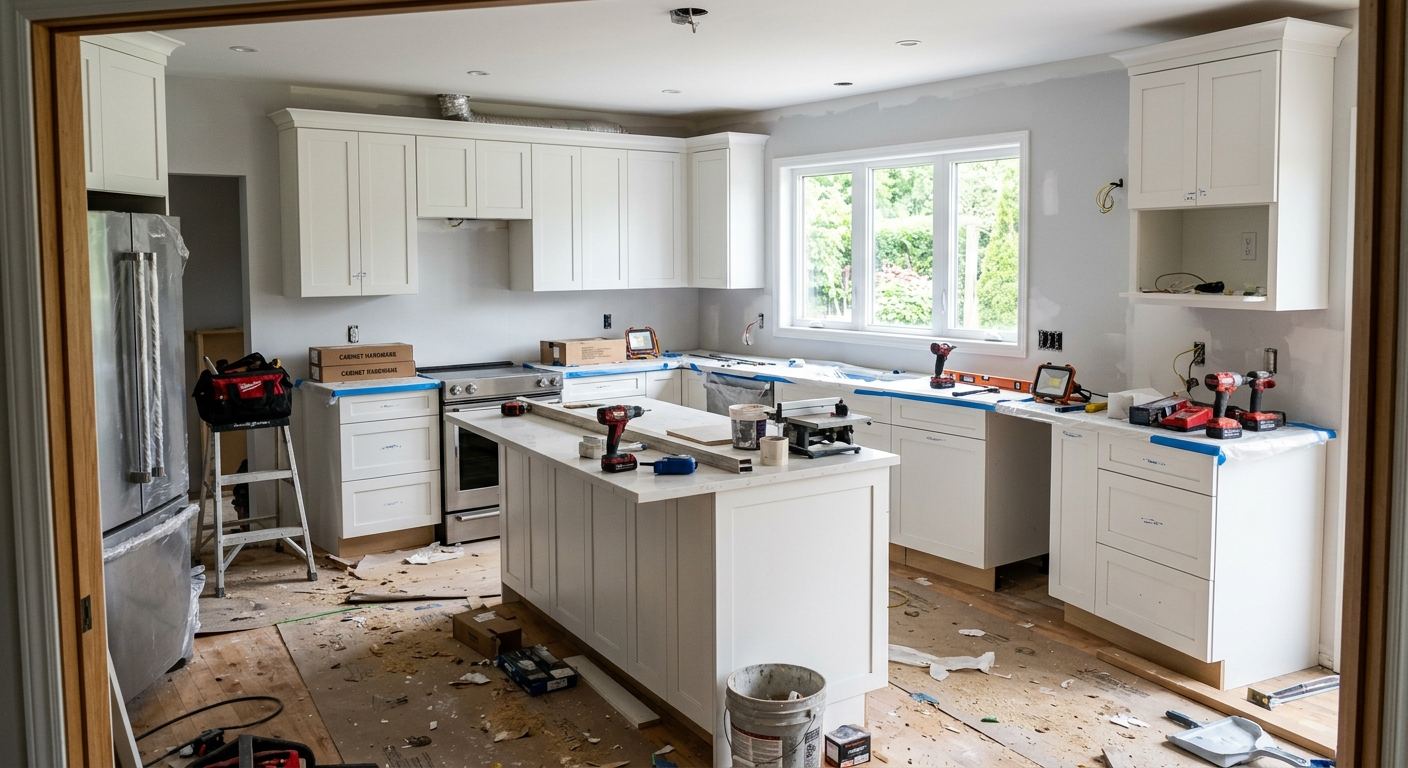
Kitchen renovation options and costs in Downtown Commercial Core
In Downtown Commercial Core, Alberta, kitchen renovation choices usually start with your finish level and how “showroom” you want the space to look—then the budget follows. In a market where the broader region’s housing demand is strong (Statistics Canada, 2021 Census) and the population footprint is tight (8,225 people reported in the local profile), many homeowners expect a cleaner, more custom look than you’d see in lower-turnover communities. That matters because Calgary economic region buyers often reward modern surfaces and well-fitted cabinetry at resale, so homeowners lean toward quartz or stone counters and semi-custom cabinetry rather than staying with laminate and stock boxes.
Calgary’s climate doesn’t drive the renovation cost as much as you might think—most cost swings come from labour availability and the materials tier. However, Alberta temperature swings and frequent freeze–thaw cycles can affect how quickly crews can complete tile and sealant work, and it can expose installation shortcomings around plumbing penetrations and exterior-adjacent walls. The Downtown Commercial Core trade demand is especially high around the Beltline and adjacent inner-city corridors, where older condo and infill homes are commonly renovated to keep up with buyer expectations.
To help you budget realistically, here are common renovation tiers you’ll see in Calgary quotes, followed by what typically drives the differences.
| Renovation Tier |
What's Included |
Typical Duration |
Price Range |
| Cosmetic refresh (paint, hardware, new appliances only) |
Cabinet hardware swap, paint/trim touch-ups, new sink/faucet if existing plumbing is retained, appliance replacement only |
2–4 days |
$6,000–$18,000 |
| Mid-range full renovation (new cabinets, counters, sink, tile) |
Semi-custom or upgraded stock cabinets, new countertop, new sink and faucet, backsplash tile, minor electrical for task lighting, flooring repairs/partial replacement |
2–5 weeks |
$25,000–$55,000 |
| High-end full renovation (custom cabinets, stone counters, island) |
Fully custom cabinetry, premium stone counters (e.g., granite/engineered stone), island build, integrated lighting, new backsplash (often expanded), upgraded appliance package |
4–10 weeks |
$70,000–$100,000 |
| Cabinet refacing only (new doors + drawer fronts, same boxes) |
Door/drawer front replacement, new hardware, optional new crown/trim details, limited surface prep; counters typically retained or swapped separately |
1–3 weeks |
$8,000–$35,000 |
| Countertop swap only (laminate to quartz or stone) |
Remove old counters, template/measure, install new countertop and edges, integrate sink cut-out (if compatible), seal/caulk and re-finish transition areas |
3–7 days |
$3,000–$12,000 |
| Backsplash tile installation only |
Surface prep, tile supply install, grout/seal, cut-outs for outlets and returns |
3–10 days |
$2,500–$8,000 |
Prices are estimates only and vary by project scope, site access and material selection.
What affects the price of kitchen renovation in Downtown Commercial Core
In Downtown Commercial Core, Alberta, it’s common to see quotes for the “same” kitchen jump by 30–50% across Calgary and the broader Alberta market—even when layouts look similar. The biggest drivers are local home-value expectations and household purchasing behaviour, not climate. In higher-value Calgary-area pockets, homeowners typically justify a full redesign by selecting quartz or natural stone counters and semi-custom cabinetry because these materials help the kitchen feel “move-in ready” for buyers. In more modest renovation plans, laminate and stock cabinetry still deliver strong day-to-day upgrades at a lower cost, which is why budgets often land closer to the lower end of the full-renovation band (for example, $25,000–$55,000) instead of going straight to high-end builds ($70,000–$100,000).
Two local condition examples that routinely change costs in Downtown Commercial Core: first, older inner-city homes and some infill layouts often have less accessible plumbing runs in soffits and behind base cabinets, so a “simple” sink swap can turn into labour for re-routing. Second, tight working clearances—common in condo conversions and townhouse rows—can increase install time for countertops and tile, because crews move equipment in smaller stages.
Layout changes add the most unpredictable spend regardless of finish level. Removing a wall, adding an island, or moving a gas line (or even changing venting for an upgraded hood) can expand the scope into permitted trade work and demolition/rebuild. That’s why I tell homeowners to treat layout changes as the main budget risk; finishes are easier to choose, but field conditions decide the final cost.
| Price Factor |
Why It Matters |
Cost Impact |
| Cabinet tier — stock vs. semi-custom vs. fully custom millwork |
Quality of fit/finish, internal construction, and how the cabinet line handles irregular walls |
Can shift a project by roughly $10,000–$40,000 depending on total run and custom features |
| Countertop material — laminate vs. quartz vs. granite vs. stone |
Material cost, fabrication complexity, and edge/detail options |
Typical countertop budget moves by about $2,000–$10,000 across tiers |
| Layout change — wall removal, island add, plumbing/gas move |
Demolition, engineering/permit requirements, and rework risk |
Often the largest swing; can add $8,000–$30,000 or more |
| Appliance package tier — builder vs. mid-range vs. pro-grade |
Brand pricing plus electrical/gas readiness and installation complexity |
Usually $2,000–$15,000 depending on lineup and integration |
| Flooring — refinish existing vs. full replacement |
Subfloor conditions and matching to adjacent rooms |
Commonly $1,500–$8,000 difference |
| Backsplash — ceramic tile vs. marble vs. full-height slab |
Material weight, pattern matching, and labour intensity |
Can add $1,500–$5,000 beyond a standard tile job |
| Electrical — new circuits for island, under-cabinet lighting |
Licensed work and time for boxes/conduit and inspection |
Typical add-on range $1,000–$6,000 |
| Permit fees and licensed trade requirements |
Changes to plumbing, gas, or wiring often trigger permitting and inspections |
Often $500–$3,500+ depending on scope |
Permits & regulations in Alberta
For Alberta kitchen work near Downtown Commercial Core, cabinet and countertop swaps usually do not require permits. If you’re staying with the existing plumbing locations and not altering load conditions, you can often proceed with cabinet installation and countertop template/install as a “finish work” scope. In contrast, permits and licensed trades commonly apply when you move infrastructure. That includes relocating water supply or drain lines, moving or adding gas lines and gas-rated components (for stoves and properly vented range hoods), removing a load-bearing wall, or adding new electrical circuits (like power for an island or dedicated lines for high-draw appliances).
Before signing, confirm who pulls the permit in writing—many homeowners assume the contractor handles everything, but responsibility should be explicit in the contract. Step-by-step, here’s how a homeowner in Downtown Commercial Core can verify readiness: (1) ask the contractor for proof of Alberta licensing—gas work must be performed by a licensed gas fitter, and electrical must be performed by a licensed electrician; (2) request a certificate of insurance showing liability coverage and, where applicable, WSIB/WCB coverage; (3) check their licence status using the appropriate online registry for the trade they’re claiming (and ensure it matches the name/company on the insurance certificate); (4) ask for an inspection/clearance plan—especially for gas and electrical—so you know what will be inspected and when.
If the scope touches gas, electrical, or structure, it’s worth slowing down and verifying paperwork early. It protects your budget and prevents delays that can otherwise push completion timelines out by weeks.
Cabinets, countertops and layout decisions in Downtown Commercial Core
The three most consequential decisions in a Downtown Commercial Core kitchen renovation are cabinet tier, countertop material, and whether you change the layout. First, cabinet tier: stock cabinets are fastest and cheapest, semi-custom is usually the sweet spot for inner-city homes, and fully custom millwork costs the most but can fix awkward wall conditions and deliver a cleaner built-in look. Second, countertop material: laminate is budget-friendly but less impact- and heat-tolerant; quartz offers a strong balance; granite/natural stone feels premium but can require different care; butcher block gives warmth but needs maintenance; marble is beautiful yet more sensitive to etching and staining.
Third, layout changes drive both comfort and resale appeal. An open-concept adjustment (removing a wall) or island addition can be justified when it creates usable circulation and adds seating. But plumbing/gas relocation is where costs can jump—especially if the work requires permitted trade involvement. In Calgary’s resale market, buyers often look for kitchens that feel bright and intentional, so many mid-range renovations target the $25,000–$55,000 band with semi-custom cabinets and quartz counters, while fully reimagined kitchens with island plumbing, stone, and premium details push toward $70,000–$100,000.
A concrete example: if your cabinet run is staying put, swapping laminate to quartz can realistically sit around the countertop swap range ($3,000–$12,000) while keeping demolition minimal. However, if you add an island and require moving a water supply and electrical for under-cabinet and island lighting, the project can move from a “surface upgrade” to a full renovation scope where the total budget is dominated by labour, trade coordination, and patch repairs—regardless of whether you choose quartz or granite.
| Option |
Durability |
Maintenance |
Best For |
Price Range |
| Stock cabinets (big-box) |
Good for straightforward walls; hinges/finishes vary by line |
Low routine care; touch-ups if finish chips |
Budget-first refreshes, quick turnarounds |
$8,000–$20,000 |
| Semi-custom cabinets (local dealer) |
Better sizing and options for interior layouts and trims |
Low to moderate; depends on finish type |
Most Downtown Commercial Core renovations aiming for resale value |
$18,000–$45,000 |
| Custom cabinets (local millwork shop) |
Highest fit; handles irregularities and design specifics |
Low routine care; repair is tailored |
Design-forward kitchens, awkward spaces, premium finishes |
$35,000–$75,000+ |
| Laminate countertop |
Moderate; susceptible to seam wear and impact marks |
Easy daily cleaning; protect from heat and sharp impacts |
Cost-sensitive upgrades |
$3,000–$6,500 |
| Quartz engineered countertop |
High; resistant to staining and everyday wear |
Low; wipe-clean and avoid abrasive pads |
Busy kitchens where looks and durability both matter |
$6,000–$12,000 |
| Granite / natural stone countertop |
Very high; durable and heat-tolerant |
Periodic sealing may be needed; clean spills promptly |
Premium look with robust day-to-day performance |
$7,500–$14,500 |
| Butcher block countertop |
Medium to high; can be very durable with care |
Needs regular oiling and sanding of nicks |
Warm, casual design styles |
$4,500–$10,000 |
| Marble countertop |
Medium; softer surface can scratch and etch |
Higher care; stone-safe cleaners and protection from acids |
Visual luxury where the kitchen is less abuse-prone |
$10,000–$18,000+ |
How to choose a kitchen renovation contractor in Downtown Commercial Core
Choosing the right contractor matters more in Downtown Commercial Core than most places because timelines are tight and site access can be tricky in older infill and multi-unit buildings. Start with verification of Alberta licensing, liability insurance, and WSIB/WCB coverage. Ask for (a) the contractor’s own business registration details and trade licences for the scopes they’re performing, (b) certificates of insurance showing liability coverage, and (c) WSIB/WCB clearance information that matches the contractor’s obligations. Then confirm each item: insurance should name the correct legal entity, licences should align with the type of work (gas work for gas fitters, electrical for electricians), and the clearance letter should reflect current coverage status.
Next, get 2–3 itemised written quotes instead of lump sums. A good quote breaks labour and materials line-by-line (cabinet supply, countertops fabrication/installs, tile labour, demolition, disposal, electrical/plumbing labour, and any permit-related items). Read exclusions carefully—what’s not included can be a major cost driver if it’s discovered mid-job. Ask whether permits are pulled by the contractor or by a subcontractor and whether disposal is included.
Warranty should be in writing: workmanship warranty length, product/manufacturer warranty coverage, and whether the warranty is transferable if you sell your home. For payment schedule, never pay more than 10–15% upfront; use a holdback until completion and final walkthrough. Finally, require a written start date and completion estimate that aligns with material lead times—cabinet and stone fabrication schedules can affect your timeline more than the demolition itself.
- Request insurance certificates and ensure the legal name matches the contract.
- Confirm gas work and electrical work are performed by licensed trades for the permit-inspection scope.
- Ask whether disposal and dumpster fees are included, or if they’re a separate line item.
- Verify countertop templating and fabrication lead times in writing before you sign.
- Require an itemised labour/material quote (no “all-in” totals only).
- Confirm who pulls permits and who covers inspection-related rework costs.
- Check warranty details: workmanship duration, what triggers it, and exclusions.
- Clarify payment milestones and insist on a 10–15% maximum deposit.
- Ask for a planned schedule of sub-trades (carpentry, tile, electrical, gas) and sequencing.
- Confirm how they handle damaged drywall, uneven floors, or out-of-square cabinet runs.
- Look for a written change-order process with pricing guidelines.
- Ensure they protect floors and keep jobsite cleaning consistent during demolition and install.
Red flags I see in Downtown Commercial Core include: vague scopes that omit disposal or permits; quotes that don’t separate labour vs materials; contractors who won’t provide insurance/WSIB/WCB clearance; unrealistic timelines that ignore stone/cabinet lead times; and payment requests for large deposits without a detailed contract and schedule.
Frequently asked questions — kitchen renovation in Downtown Commercial Core
What's the best countertop material for a busy Downtown Commercial Core kitchen?
For a busy kitchen in Downtown Commercial Core, quartz is usually the most practical “best overall” choice. It’s engineered for everyday durability, it resists staining well compared with many softer options, and it typically needs less daily care than natural stone that may require periodic sealing. If your budget is aligned with a countertop-only plan, you can often keep within the countertop installation band of about $3,000–$12,000, depending on size, edges, and cut-outs. Granite is also very durable and heat-tolerant, but it can involve sealing considerations and more care in the first months after install. Laminate works for tight budgets, but in high-traffic households it’s more likely to show wear at seams and from impacts.
How do I add an island to my Downtown Commercial Core kitchen?
In Alberta, adding an island starts with the hard part: layout and infrastructure. If the island is just seating with no plumbing, electrical work may be limited to dedicated outlets or under-cabinet lighting—still often requiring a licensed electrician. If you want a sink, dishwasher, or gas cooktop, expect the scope to expand into permitted work with licensed trades, because you may be moving water supply/drain lines or relocating gas. In practical terms, your contractor should confirm routing paths, floor/subfloor conditions, and whether any wall removal affects structure. Budget-wise, island additions often push full projects into the mid-to-high bands; a typical full renovation lands in the $25,000–$55,000 range for a straightforward build, while more complex islands commonly trend toward $70,000–$100,000 when plumbing/gas and premium finishes are involved.
How much does a kitchen renovation cost in Downtown Commercial Core?
Kitchen renovation costs in Downtown Commercial Core typically cluster in the mid five-figures to six figures, depending mostly on cabinetry tier, countertop choice, and whether you change the layout. A mid-range full renovation (new cabinets, counters, sink, and tile) is commonly budgeted around $25,000–$55,000, while a high-end redesign (custom cabinets, stone counters, island, and more integrated features) often reaches $70,000–$100,000. Cosmetic-only refreshes can be much lower if you’re not moving plumbing or wiring. The key is that labour and trade coordination in Calgary’s active market can represent a large share of the budget—so even “similar kitchens” can differ by 30–50% when field conditions require extra demo, patching, or permit-related work.
How long does a kitchen renovation take in Downtown Commercial Core?
Timelines depend on scope and material lead times, not just the visible demolition and install days. A cosmetic refresh can be completed in about 2–4 days because it avoids cabinetry tear-out and most trade permitting. Mid-range full renovations often take around 2–5 weeks, while high-end projects with custom millwork, stone fabrication, and an island can run 4–10 weeks. In Calgary, the biggest schedule variable is when cabinets and countertops are ordered and templated, especially if your home has tight access and multiple trades need to sequence around each other. Ask your contractor for a written start date, a completion estimate, and an order/templating plan. Don’t sign off until you know lead times for cabinets and stone.
Quartz vs granite countertops — which is better?
“Better” depends on your lifestyle. Quartz is often the better choice for busy Downtown Commercial Core households because it’s generally low-fuss: it resists stains and is easier to maintain day-to-day. Granite is also durable and heat-tolerant, but because it’s natural stone, it may require sealing and more attention to how spills are cleaned over time. From a budgeting standpoint, both options commonly fall within the broader countertop installation band of $3,000–$12,000, but granite can trend higher when fabrication complexity or premium slabs are involved. If you want a balance of durability and easy care, quartz is usually the practical winner; if you want a distinctive natural look and you’re comfortable with routine stone care, granite is excellent.
Should I reface or replace my cabinets?
Refacing is usually worth it when your cabinet boxes are sound, straight, and well-installed—especially if the renovation goal is to refresh the look without major demolition. It’s also typically faster than full replacement because it can stay within the cabinet refacing band of about $8,000–$35,000. Replacing cabinets is the better move when boxes are out of square, poorly built, water-damaged, or when you’re planning deeper layout changes like moving doors/drawers to accommodate new organization. In Downtown Commercial Core kitchens, I commonly recommend semi-custom or full replacement when homeowners want a new island plan or updated functionality that can’t be achieved with fronts alone. If you’re only upgrading finishes and keeping plumbing/wiring where it is, reface plus a countertop swap is often the most cost-effective upgrade path.